When explaining becomes a sin

As the cacophony of politicians and commentators replaces that of the police sirens, look out for the particularly shrill voice of those who condemn as evil anyone with an alternative explanation for the looting than theirs. For an example, take the Daily Mail headline for Tuesday, which reads “To blame the cuts is immoral and cynical. This is criminality pure and simple”

If I’ve got them right, this means that when considering what factors contributed to the looting, identifying government spending cuts is not just incorrect, but actively harmful. For the Mail, the issue of explanations for the looting is of such urgency that they are comfortable condemning anyone who seeks an explanation beyond that of the looting being “criminality pure and simple”. What could be motivating this?

Research into moral psychology provides a lead. One of my favourite papers is “Thinking the unthinkable: sacred values and taboo cognitions” by Philip Tetlock (2003). In this paper he talks about how our notion of the sacred affect our thinking. The argument he makes is that in all cultures some values are sacred and we are motivated to not just to punish people who offend against these values, but also to punish people who even think about offending these values. The key experiment, from Tetlock et al, 2000, concerns a vignette about a sick child and hospital manager, who must decided if the hospital budget can afford an expensive treatment for the sick child. After reading about the manager’s decision, participants in the experiment are given the option to say how they felt about the manager, and to answer questions about such things as whether they think he should be removed from his job, and whether, if he were a friend of theirs, they would end their friendship with him. Unsurprisingly, if the vignette concludes by revealing that the manager decided the treatment was too expensive, participants are more keen to punish the manager than if he decided that the hospital could afford to treat the child. The explanation in terms of sacred values is straightforward: life, especially the life of a child, is a sacred value; money is not and so should not be weighed against the sacred value of life. But the most interesting contrast in the experiment is between participants who read vignettes in which the manager took a long time to make his decision and those in which he didn’t. Regardless of whether he decided for or against paying for the treatment, reading that the manager thought for a long time before making a decision provoked participants to want to punish the manager more. Tetlock argues that we are motivated to punish not just those who offend against sacred values, but also those who appear to be thinking about offending against sacred values – by weighing them against non-sacred values. In an added twist, Tetlock and colleagues also offered participants the opportunity to engage in ‘moral cleansing’ by subscribing to an organ donation scheme. Those participants who read about the manager who chose to save the money over saving the child, and those who read about the manager who took a long time to make his decision, regardless of what it was, were most motivated to donate their organs. This shows, Tetlock argues, that it is merely enough for the idea of breaking a taboo to flicker across your consciousness to provoke feelings of disgust at ourselves (which provoke the need for moral cleansing).

Tetlock’s papers are a full and nuanced treatment of how sacred values and taboo cognitions affect our thinking. I have only presented a snapshot here, and can but recommend that you read the full papers yourself, but I’d like to break from the science to draw some fairly obviously conclusions.

The Daily Mail editors feel they are in a moral community in which society is threatened by the looters and by those who give them succour, ‘the handwringing apologists on the Left’ who ‘blame the violence on poverty, social deprivation and a disaffected…youth’ (to quote from the rest of Tuesday’s editorial). For some, the looting is an immoral act of such a threatening nature that to think about it too hard, to react with anything other than a vociferous condemnation, is itself worthy of condemnation.

The sad thing about adopting this stance is that it prevents media commentators from thinking about how they themselves might have contributed to the looting. The footage on TV and in newspapers such as the Daily Mail has been vivid and hysterical. Television has shown the most dramatic footage of the looting, while headlines have screamed about the police losing control and anarchy on the streets. You don’t have to be a scholar of psychology to realise that this kind of media environment might play a role in encouraging the copycat looting sprees that sprung up outside of London (although if you were, you would be aware of the literature on how newspaper headlines and TV footage, can provoke immitation in the wider population).

Some, like the Daily Mail, see any attempt at explaining the looting as excusing the looting. The looting, like so much for them, is a moral issue of such virulence that they see people who understand society differently as part of the same threat to society as the looters. Research in moral psychology provides some clues about their style of thinking. It doesn’t, as far as I know, provide much of a clue about how to alter it.

REFS

Tetlock, P. E. (2003). Thinking the unthinkable: Sacred values and taboo cognitions. Trends in Cognitive Sciences, 7(7), 320–324.

Tetlock, P.E. et al. (2000) The psychology of the unthinkable: taboo trade-offs, forbidden base rates, and heretical counterfactuals. J. Pers. Soc. Psychol. 78, 853– 870

See also Vaughan’s Riot Psychology

Inner visions of seven dimensional space

I’ve just found an amazing 2002 article [pdf] from the American Mathematical Society about blind mathematicians.

I was surprised to learn that the majority work in geometry, supposedly the most ‘visual’ discipline, and fascinated to learn that they generally believe the experience of sight puts people at a disadvantage because it locks us into a perception-led view of space.

This can be a problem in geometry because it regularly works in problems that involve more than three dimensions or requires an understanding of objects from all ‘angles’ simultaneously.

Alexei Sossinski points out that it is not so suprising that many blind mathematicians work in geometry. The spatial ability of a sighted person is based on the brain analyzing a two-dimensional image, projected onto the retina, of the three-dimensional world, while the spatial ability of a blind person is based on the brain analyzing information obtained through the senses of touch and hearing. In both cases, the brain creates flexible methods of spatial representation based on information from the senses. Sossinski points out that studies of blind people who have regained their sight show that the ability to perceive certain fundamental topological structures, like how many holes something has, are probably inborn…

Sossinski also noted that sighted people sometimes have misconceptions about three-dimensional space because of the inadequate and misleading twodimensional projection of space onto the retina. “The blind person (via his other senses) has an undeformed, directly 3-dimensional intuition of space,” he said.

There is not any maths in the article but it is written for mathematicians so it contains lots of mysterious sentences like “Morin first exhibited a homotopy that carries out an eversion of the sphere in 1967”.

However, the article is also a fantastic history of blind mathematicians and has lots of quotes from current leaders in the field who explain who their supposed disability lets them better understand the maths of three and more dimensions.

Even for those without a maths background it’s an amazing insight into some remarkable people.
 

pdf of ‘The World of Blind Mathematicians’ (via @tiempoasm).

Slogans trigger resistance while logos slip through

Language Log covers a fascinating study that found that commercial logos unconsciously encourage brand-compliant behaviour but slogans do the reverse and seem to trigger automatic resistance.

It seems that while slogans are read as being deliberately persuasive, logos slip under our advertising radar and trigger a series of brain-friendly associations built up by the company.

…brand names and logos, argue Laran and colleagues, are different from other commercial messages in that they’re not necessarily perceived as inherently persuasive—despite the fact that they’re often designed with great care, we may normally take them to be primarily referential, much as any proper name might be. Slogans (or, as they say in the industry, taglines) are transparently persuasive according to the authors. Perhaps people react to these latter messages in knee-jerk reverse-psychology manner by blocking and even countering the typical brand associations.

Laran et al. found that when they had people look at cost-conscious brand names like Walmart in an alleged memory study and then later take part in an imaginary shopping task, they were able to replicate the implicit priming effect: people were willing to spend quite a bit less than if they’d seen luxury-brand logos. But when subjects saw slogans (e.g. Save money. Live better.) instead of the brand names, there was a reverse priming effect: now, the luxury-brand slogans triggered more penny-pinching behavior than the economy-brand slogans.

You can read the full study online as a pdf but Language Log has some fantastic coverage on the unconscious psychology of advertising.
 

Link to LanguageLog ‘Not so gullible after all’.

Subtle word change affects election participation

A subtle word change to refer to the self on a pre-election survey seems to significantly boost the number of voters in national elections.

A new study led by psychologist Christopher Bryan and published in the Proceedings of the National Academy of Sciences investigated how the sense of self motivates the public act of voting.

The authors point out that in terms of individual self-interest, voting is irrational. Just the probability of being killed in a car accident on the way to the polls far outweighs the likelihood that the average American’s vote will influence the outcome of most elections.

But from a public point of view, voting is essential for a functioning democracy, so the study tested the hypothesis that doing something positive for the community might motivate people by giving a potential boost to our self-image.

To do this, the researchers ran three experiments where they asked potential voters to complete an internet survey asking about the upcoming elections.

Importantly, half the people got a survey that referred to the act of voting while the other half got an identical survey but where the questions were worded to refer to them as a voter, directly implicating their self-identity.

For example, one version of a question would use a verb to refer to voting as an act (“How important is it to you to vote in the upcoming election?”) while another would use a noun to directly implicate the respondent (“How important is it to you to be a voter in the upcoming election?”)

Directly after the survey, respondents in the self-implicating condition said they were much interested in voting in the upcoming election than those who completed the ‘voting as act’ survey, suggesting that the self-focused wording boosted enthusiasm.

Crucially, the effect also transferred into actions as another study looked at public voting records and found that those who had completed the self-focused survey were actually more likely to vote than those who had completed the action-focused survey.

Finally, the researchers ran the same study using a survey company to randomly select a nationally representative sample of people. These respondents were also more likely to vote if they completed the self-focused ‘election survey’.

Studies that attempt to influence behaviour often find effects that are ‘small but reliable’.

In contrast, the authors note that the effects of the simple word change “are among the largest experimental effects ever observed on objectively measured voter turnout” – increasing actual turnout by more than 10%.

The researchers suggest that the effect is not solely about make the questions more self-relevant, but more strongly linking the self to a concept generally regarded as positive – voting.

This means the perception of the concept itself is also key and the effect might be reversed if the wording change referred to something generally regarded as negative – for example, a criminal act.
 

Link to open-access study in PNAS.

A dose of female intelligence

Harvard Business Review interviews a research team who have found that increasing the number of women in a team raises group intelligence.

Of course, the findings could also be as accurately described as showing that men make groups more stupid, although the researchers are far too tactful to mention this particular interpretation.

Woolley: We’ve replicated the findings twice now. Many of the factors you might think would be predictive of group performance were not. Things like group satisfaction, group cohesion, group motivation—none were correlated with collective intelligence. And, of course, individual intelligence wasn’t highly correlated, either.

Malone: Before we did the research, we were afraid that collective intelligence would be just the average of all the individual IQs in a group. So we were surprised but intrigued to find that group intelligence had relatively little to do with individual intelligence.

HBR: But gender does play a role?

Malone: It’s a preliminary finding—and not a conventional one. The standard argument is that diversity is good and you should have both men and women in a group. But so far, the data show, the more women, the better.

As a male clinical psychologist, I am now completely accustomed to being intellectually out-gunned by my female colleagues, but it’s important to realise that there’s more to group work than intelligence.

Do we really want a world of better decisions but with fewer dick jokes? Just the thought of it keeps me up at night.

(See?)
 

Link to article in Harvard Business Review (and don’t miss the podcast).

The psychology of expert predictions

This week’s edition of BBC Radio 4 All in the Mind has a fantastic section on the psychology of knowledgeable predictions that bursts lots of bubbles about the power of experts but also discusses how to make more accurate predictions.

You can listen to the whole programme online but it seems the crucial section has accidentally found it’s way onto YouTube which you can catch here.

The discussion is with author Dan Gardner and by psychologist Dylan Evans who tackle the links between risk, prediction and knowledge.

It has lots of fascinating insights, including the fact that the fame of experts is inversely related to their accuracy, that US weather forecasters are better than UK forecasters (and not because UK weather is more difficult), and that more confident predictions are more likely to be wrong.

If you want to catch the whole of All in the Mind the section of grief myths is also wonderful.
 

Link to All in the Mind.
Link to section on expert predictions.

The psychology of the end of the world

I’ve written an article for Slate on tomorrow’s predicted doomsday and how believers cope with the non-arrival of the apocalypse.

Although many people are familiar with When Prophecy Fails, a book by psychologist Leon Festinger that charted how a flying saucer cult dealt with the non-arrival of the Armageddon, it’s less widely know that it is only one among many studies that investigated how believers coped with failed prophecies.

When Prophecy Fails has become a landmark in the history of psychology, but few realize that many other studies have looked at the same question: What happens to a small but dedicated group of people who wait in vain for the end of the world? Ironically, Festinger’s own prediction—that a failed apocalypse leads to a redoubling of recruitment efforts—turned out to be false: Not one of these follow-ups found evidence to support his claim. The real story turns out to be far more complex.

Psychologists and sociologists have eagerly accompanied those waiting for the second coming of Christ, alien visitation and nuclear apocalypse to see how the followers would react.

While none of the apocalyptic groups reacted as Festinger predicted, they have given us a fascinating insight into how we make sense of stark contradictions and have helped us understand why our beliefs are more resilient that many would assume.
 

Link to Slate article on the psychology of failed prophecy.

Three Christs return and are waiting to be won

The New York Review of Books has just reprinted the classic book ‘The Three Christs of Ypsilanti’ documenting psychologist Milton Rokeach’s offbeat experiment where he brought three delusional Christs together in the same psychiatric hospital.

I wrote about the astounding but somewhat ethically dubious study in a recent article for Slate if you want some background and I’m pleased to see a new edition being printed, as even the out-of-print second edition was being sold for hundred of dollars.

The publishers have kindly offered a copy of the book as a prize, sent anywhere in the world, so we thought we’d run a quick competition (please note, although I’m quoted on the publishers’ page for the book, I’m not financially involved in any way).

Anyway, the competition is this:

You’re working in a psychiatric hospital and suddenly everyone thinks you’re a patient. How would you convince them you’re really a psychiatrist?

Leave an answer in the comments, I’ll pick the best one by the end of the week and the prize will be sent to you, anywhere in the world.

COMPETITION CLOSED: Thanks for all your wonderful entries. The winner has been announced although you’re welcome to continue to add your own fantastic ideas below if you’d like to join the fun.


Link to publishers page for The Three Christs of Ypsilanti.

How to jail the innocent

The Innocence Project has used DNA technology to overturn hundreds of wrongful convictions. Slate has an excellent two part series on the two main reasons why these people were falsely jailed: eyewitness misidentifications and false confessions.

The series is by law professor Brandon Garrett who has analysed the first overturned 250 cases to examine the psychology behind distorted justice.

This is from the piece onthe biases that in line-ups that have sent people down for long-stretches after being falsely identified:

Where did this false certainty come from? The trial records I looked at suggest that unsound and suggestive police identification procedures played a large and troubling role. Police used unnecessary show-ups, where they presented the eyewitness with just the defendant. Or stacked lineups to make the defendant stand out.

Or offered suggestive remarks, telling the eyewitness whom to identify or to expect a suspect in a lineup. Or confirmed the witness’s choice as the right one. Even well-intended, encouraging remarks, like “good job, you picked the guy,” can have a dramatic effect on eyewitness memory, as psychologists have shown.

Indeed, more than one-third of the cases I looked at involved multiple eyewitnesses, as many as three or four or five eyewitnesses who all somehow misidentified the same innocent person. Further, almost half of the eyewitness identifications were cross-racial. Psychologists have long shown how eyewitnesses have greater difficulty identifying persons of another race.

Both pieces tackles how biases have warped specific high profile cases, sometimes leading to decades of false imprisonment.
 

Link to Slate piece on eyewitness misidentifications (via @psyDoctor8)
Link to Slate piece on false confessions.

Hungry judges less likely to grant parole

Not Exactly Rocket Science covers a study that is in equal parts delightful and terrifying: it found that judges are much less likely to grant parole when they’re hungry.

It’s the work of Shai Denzeger from Ben Gurion University of the Negev, and summarises the results of 1,112 parole board hearings in Israeli prisons, over a ten month period…

It shows that the odds that prisoners will be successfully paroled start off fairly high at around 65% and quickly plummet to nothing over a few hours… After the judges have returned from their breaks, the odds abruptly climb back up to 65%, before resuming their downward slide. A prisoner’s fate could hinge upon the point in the day when their case is heard.

Twinkie your honour?
 

Link to Not Exactly Rocket Science with the full story.

The Oscar for best neuroscience research goes to…

Both of this year’s lead Oscar winners have published scientific papers on neuroscience. We’ve covered Natalie Portman’s work on frontal lobe development in children before, but it turns out Colin Firth has also just co-authored a study on structural brain differences in people with differing political views.

An excellent post on The Neurocritic tells the intriguing story of how the study came about.

It turns out Firth was a guest editor on the daily BBC Radio 4 news programme Today and commissioned neuroscientist Geraint Rees to scan the brains of two prominent UK politicians – one staunchly liberal and the other a confirmed conservative – to look for differences.

The piece was clearly a piece of news fluff – as you can tell very little from scanning just two people – but it was motivated by a genuine interest in whether political opinions correlate with brain differences.

Rees decided to develop the idea into a more comprehensive study, using scans from 90 people, to see whether the density of the brain’s grey matter differed in line with differences in political views.

The study didn’t look at differences across the whole brain, just the anterior cingulate, a part of the frontal lobes, and the deep brain structure the amygdala.

The areas were chosen because previous studies have found that conservatives are more sensitive to fear-inducing prompts – a response linked to the amygdala, whereas liberals show more brain activity in the anterior cingulate when they have to hold back an automatic response.

It must be said that the link between these functions and brain areas is still quite preliminary, so the study is more of an exploration than a cast-iron test of a well-defined idea.

This new study, published in Current Biology and co-authored by Colin Firth, Geraint Rees along with neuroscientist Ryota Kanai and the producer of the Radio 4 programme, found distinct differences in these areas.

We found that greater liberalism was associated with increased gray matter volume in the anterior cingulate cortex, whereas greater conservatism was associated with increased volume of the right amygdala

This doesn’t tell us anything about whether conservatives or liberals are “born or made”. Despite the fact that the whole question is daft and over-simplified, a simple association between beliefs and brain areas doesn’t help us understand anything about cause and effect.

It could be that the brain areas differ because conservatives and liberals differ in how much they ‘practice’ alternative ways of thinking about the world, rather than brain structure ‘determining’ political orientation.

I really recommend the Neurocritic piece for more background, but the fact that the 2011 winners of the best actor and actress Oscar both have their name on neuroscience studies shows how fashionable the science has become.

And if, by chance, a certain Grammy award winning She Wolf would like to join the trend I would be more than willing to help out with the statistical analysis.

Yes, I realise my chat-up lines could do with a bit of work.
 

Link to The Neurocritic on Colin Firth’s neuroscience study.

Psychosis keeps up with the times

Delusions in conditions like schizophrenia and bipolar disorder have tracked social concerns over the 20th century, according to a wonderful study just published in the International Journal of Social Psychiatry.

Psychologists Brooke Cannon and Lorraine Kramer reviewed the patient records of a state psychiatric hospital in the US looking at each decade of the 20th Century in turn.

They recorded the content of the delusions for every patient with psychosis and while they didn’t find that the level of delusions changed, they did find that they tended to relate to the social concerns of the time.

…more patients after 1950 believe they are being spied upon is consistent with the development of related technology and the advent of the Cold War.

Delusional content tended to reflect the culture at the time, with focus on syphilis in the early 1900s, on Germans during World War II, on Communists during the Cold War, and on technology in recent years.

Indeed, delusions now are being reported relating to computers, the internet and computer games.

An earlier study that looked at hospital records from Slovenia found a similar pattern – with madness also reflecting developing social themes.

The researchers of this study noted that “After the spread of radio in the 1920s and television in the 1950s in Slovenia, there was an obvious increase in delusions of outside influence and control as well as delusions with technical themes.”
 

Link to PubMed entry for study on delusions in 20th Century US.
Link to PubMed entry for study on delusion in in 20th Century Slovenia.

To catch a thief and fool a scientist

If you only listen to one radio programme this month, make it this one. The BBC Radio 4 programme Fingerprints on Trial explores how identifying people at crime scenes by their prints is subject to serious psychological biases and is not the exact science that we, and ironically, the forensic fingerprint community, like to believe.

It covers some spectacular high-profile cases, the science behind how prior knowledge can bias the supposedly objective identification of prints, and the baffling fingers-in-the-ears lalalala response of some fingerprint experts who just completely deny it’s a problem.

The programme riffs on the work of psychologist Itel Dror who has shown that changing the ‘backstory’ to a case can alter what fingerprint matches experts find.

So here’s how these biases could work in practice. Fingerprint examiners in this country [the UK] generally know the type of crime their working on. Any murder is high profile, so the chances are they’d know quite a bit about the case. They might see crime scene photographs and might even have heard snippets from detectives working on the case. And then when they start to check the fingerprints from the murder scene, evidence from cognitive psychology shows that what they know, or think they know, can influence what they then see in the prints.

Combines gripping sad-but-true whodunits, cutting edge cognitive science and a pressing issues for forensic science.

Excellent stuff.
 

Link to BBC streamed version and programme info.
mp3 of podcast from BBC.

A victim of metaphor

A gripping piece from Not Exactly Rocket Science describes how simply changing the metaphors used to describe crime can alter what we think is the best way of tackling it.

The article covers a new study on the power of metaphors and how they can influence our beliefs and understanding of what’s being discussed.

In a series of five experiments, Paul Thibodeau and Lera Boroditsky from Stanford University have shown how influential metaphors can be. They can change the way we try to solve big problems like crime. They can shift the sources that we turn to for information. They can polarise our opinions to a far greater extent than, say, our political leanings. And most of all, they do it under our noses. Writers know how powerful metaphors can be, but it seems that most of us fail to realise their influence in our everyday lives.

First, Thibodeau and Boroditsky asked 1,482 students to read one of two reports about crime in the City of Addison. Later, they had to suggest solutions for the problem. In the first report, crime was described as a “wild beast preying on the city” and “lurking in neighbourhoods”. After reading these words, 75% of the students put forward solutions that involved enforcement or punishment, such as calling in the National Guard or building more jails. Only 25% suggested social reforms such as fixing the economy, improving education or providing better health care.

The second report was exactly the same, except it described crime as a “virus infecting the city” and “plaguing” neighbourhoods. After reading this version, only 56% opted for more enforcement, while 44% suggested social reforms. The metaphors affected how the students saw the problem, and how they proposed to fix it.

The study is interesting because it touches on a central claim of the linguist George Lakoff who has argued that metaphors are central to how we reason and make sense of the world.

Lakoff’s arguments have had a massive influence in linguistics, where they have started more than one scientific skirmish, and were adopted by the US Democratic party in an attempt to reframe the debates over key issues.

Despite the fact that Lakoff was one of the pioneers of the idea that metaphor is central to reasoning, his political associations have made him somewhat unfashionable and it’s interesting that this new study makes only passing reference to his work.
 

Link to Not Exactly Rocket Science on new metaphor study.
Link to full text of scientific study.

Sniffing out the unconscious

The illusion that a horse could do maths may be behind sniffer dogs falsely ‘detecting’ illicit substances according to an intriguing study covered by The Economist.
The horse in question was called Clever Hans and he was rumoured to be able to do complicated maths, work out the date, spell German words – all from questions called out by the audience.

The trainer would run his hand across possible responses on, for example, a piece of paper, and Hans would tap with his hoof to signal when the correct answer was being pointed to.

Psychologist Oskar Pfungst became suspicious and eventually worked out than the horse was doing no more than waiting until his trainer changed his body posture when he hit on the right answer.

His trainer was completely unaware that his expectancies were shaping the horse’s behaviour but this form of unintentional behavioural influence over animal behaviour has become known as the ‘Clever Hans effect‘.

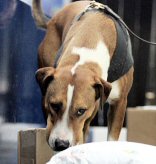
The Economist reports on a new study of sniffer dogs that seems to show a similar effect in action.

Sniffer dogs and their handlers were told to search an area that that might have up to three target scents and that on two occasions the scents would be clearly marked with bits of red paper.

In reality, there were no target scents, so anything the dogs detected was a false alert.

When handlers could see a red piece of paper, allegedly marking a location of interest, they were much more likely to say that their dogs signalled an alert. Indeed, in the two rooms where red paper was present and sausages were not, 32 of a possible 36 alerts were raised. In the two where both red paper and sausages were present that figure was 30–not significantly different. In contrast, in search areas where a sausage was hidden but no red piece of paper was there for handlers to see, it was only 17.

The dogs, in other words, were distracted only about half the time by the stimulus aimed at them. The human handlers were not only distracted on almost every occasion by the stimulus aimed at them, but also transmitted that distraction to their animals–who responded accordingly. To mix metaphors, the dogs were crying “wolf” at the unconscious behest of their handlers.

In other words, when the human handlers become suspicious the dogs are more likely to seem to detect suspicious scents, making the process a lot more subjective than the search teams like to believe.
 

Link to The Economist article ‘Clever hounds’.

A place downtown where the freaks all come around

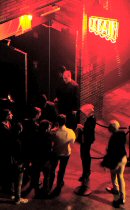
Kellogg Insight has a fantastic article on how nightclub bouncers make instant status judgements to decide whether to let people into exclusive clubs.

It’s a curious insight into perception of social status that both relies on some social stereotypes and turns others completely on their head.

The article is based on the work of sociologist Lauren Rivera who got a job as a “coat-check girl” in a high class club to observe the selection process in action before revealing her true intentions and interviewing the doormen to work out how they made status judgements of hopeful clubbers.

Through conversations and observations, she found that bouncers ran through a hierarchical list of qualities to determine in seconds who would enhance the image of the club and encourage high spending. Social networks mattered more than social class, or anything else for that matter. Celebrities and other recognized elites slipped through the door. And people related to or befriended by this “in crowd” often made the cut, too.

Wealth is considered to be one of the strongest indicators of status, yet bouncers frowned upon bribes even though bribes are obvious displays of money. “New Faces,” as the bouncers called unrecognized club-goers, were selected on the basis of gender, dress, race, and nationality. Sometimes the final call boiled down to details as minor as the type of watch that adorned a man’s wrist.

As we’ve discussed before, Rivera is not the first sociologist to immerse herself in the swing of urban night life for her work.

Sociologist Simon Winlow actually got a job as a bouncer to get, er, hands on experience of the role of violence in the night time economy.
 

Link to Kellog Insight on status judgements in night clubs.
Link to previous Mind Hacks post on work of Simon Winlow.