Don’t fret the technique

My new favourite typo: if you’re fed up with the sound of electric rock n’ roll perhaps you’d prefer some autistic guitar.

This gentleman has an autistic guitar for sale, thankfully with an instruction book and tuner for novices.

For those of you who are a bit more advanced, this page tells you how to tune your autistic guitar using a Korg bass/guitar tuner.

If you want to see some pros in action, this guy plays “eclectic and autistic guitar”, while young Eliot has “an electric guitar and a autistic guitar and hoping to get an ovation autistic electric guitar”.

Rock on!

Fraudian slip

Today’s BPS Research Digest has a wonderfully ironic and recursive Freudian slip in a post about the misdiagnosis of women with mental illness in Victorian Britain.

It highlights how misdiagnosis could get the doctor in hot water, and makes a link with Freud’s later ideas about hysteria – symptoms that appear to be neurological, such as paralysis, but aren’t accounted for by damage to the nervous system.

I hope Christian won’t mind me pointing out that the misspelling of Freud is brilliantly paradoxical:

Remember this is some decades before Fraud started applying the diagnosis of conversion disorder or hysteria to so many women, many of whom probably had organic illnesses.

Freud argued that the ‘Freudian slip‘, or parapraxis, is an example of the unconscious mind slipping past our conscious editing of speech and action, potentially revealing the true beliefs of desires of the person in question.

I wonder whether he’d feel vindicated over the sentence above, or would just despair that such talented psychologists think he was talking bunk on this occasion.

With regards to the question over the reliability of diagnosing hysteria, now reclassified as ‘conversion disorder‘, Slater completed a famous 1965 study where he followed up patients who had been diagnosed with hysteria to see if they later showed definite signs of neurological illness.

He found that over 60% later showed signs of genuine neurological illness and dryly stated that “The only thing that ‚Äòhysterical‚Äô patients have in common is that they are all patients”.

Although influential at the time, it has subsequently been discredited as lacking rigorous methods (taking family doctor notes as follow-up data, for example).

The most comprehensive study was published in 2005 and looked at patients diagnosed with hysteria over many decades and found that misdiagnosis rates were one third in the 1950s, but have been at 4% since the 1970s – probably due to the emergence of reliable brain imaging technologies.

Incidentally, the image on the left is a slightly edited panel from a six page comic called The New Adventures of Sigmund Freud where an Uzi toting Sigmund takes on Osama Bin Laden in his secret lair.

Link to BPSRD on ‘The Suspicions of Mr Whicher’.
Link to 2005 hysteria follow-up study with full text link.
Link to The New Adventures of Sigmund Freud.

Monty Python’s fluent aphasia

Thripshaw’s Disease was a fictional medical condition shown in a sketch from the classic comedy series Monty Python’s Flying Circus that bears a remarkably similarity to fluent aphasia, a speech impairment that can occur after brain injury.

Mind Hacks reader Patricio sent in this fascinating observation, and we can see from the sketch that the man can understand what is said to him (intact comprehension), but produces fluent but jumbled sentences.

Speech problems after (usually left-sided) brain injury are called aphasia and the concept reflects the various ways speech can be impaired.

Sometimes aphasia affects speech production, so people can hardly seem to get a word out, while other people can produce fluent speech although it can be full of misplaced words, odd word order or nonwords. Often in fluent aphasia, people can also have difficulties in understanding what is said, but it’s not always the case.

Of course, there can be a mix of all sorts of problems, but the type of speech disorder depicted in the Monty Python sketch is called paragrammaticism and was tackled by a classic study by Butterworth and Howard.

Most interestingly, the researchers found that these errors are identical to the grammatical errors people without brain injury tend to make on a day-to-day basis, but just happen much more frequently.

Here’s one of the examples from the study:

My father, he is the biggest envelope ever worked in Ipswich. He strikes every competition and constitution that’s going. He’s got everybody situated and they’ve got to talk to him.

And there’s also a lovely example from this book:

I’ll tell you, not like before, I must say that once the beginning happened in the beginning, as I arrived and naturally it was, of course, quite decisive.

The gentleman in Monty Python sketch also shows paraphasias (saying the wrong word where you intended to say another) and neologisms (creating instant nonsense words).

Interestingly, the interviewer on the TV chat show slightly later in the sketch shows a classic transcortical motor aphasia – a slow halting speech with inappropriate word stress – typically caused by damage to areas of the mid part of the left frontal lobe.

This character is played by Graham Chapman who studied medicine and qualified as a doctor although apparently never practiced owing to the success of Monty Python.

I wonder if he was inspired by some of the usual speech patterns of aphasia, or whether this was just an interesting coincidence.

Link to video of Monty Python sketch (thanks Patricio!).
Link to Butterworth and Howard study.
Link to PubMed entry for study.

Computers cause abnormal brain growth – proof!

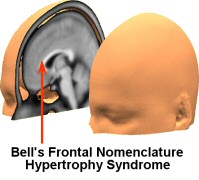
I have discovered shocking evidence that computers are affecting the brain. After extensive research, I have discovered the problem is remarkably specific and I have isolated it to an individual brain area affected by one particular application. Microsoft Word is causing abnormal growth in the frontal lobes.

The cingulate cortex is a part of the frontal lobe that is known to be involved with conflict monitoring, pain and emotion, while Microsoft Word is a clumsy but ubiquitous word processing package that has an annoying habit of auto-correcting things you don’t want to be auto-corrected.

For example, try typing the words ‘cingulate cortex’ into Word and see what happens. It changes it to ‘cingulated cortex’, adding an annoying ‘d’ onto the end of the first word.

Whenever I’m writing a neuropsychology article, I now have the habit of doing a search and replace before I finish to sweep up any of these auto-errors. So I was wondering whether anyone else had suffered the same problem and searched the scientific literature.

Now, it could be that people have just been making standard typos throughout history, as adding a rogue ‘d’ is not uncommon, even when we’re writing with a pen, but this doesn’t seem to be the case.

While the use of the term ‘cingulate cortex’ stretches back to at least the beginning of the 20th century, the term ‘cingulated cortex’ barely appears, until Microsoft Word’s autocorrection tool arrives on the scene.

There are 15 uses of the phrase “cingulated cortex” from 1900 to 2000. There are 1,740 uses from 2000 to now.

Microsoft Word, it seems, is slowly changing the brain.

Without further ado, I have named the disorder Bell’s Frontal Nomenclature Hypertrophy Syndrome and demand that it be included in the diagnostic manuals.

Thousands of disturbed people will not get the help they need without this essential recognition, although in the mean time I will be offering private treatment at special rates.

Of course, I strongly encourage further research and welcome offers of interviews from the press, radio or television.

I am also available for weddings, funerals and Bar Mitzvahs.

Digital drugs emergency – paging Dr. Beat

USA Today has an unintentionally hilarious article on the dangers of ‘digital drugs’ that can supposedly mimic the effects of alcohol, marijuana, LSD, crack, heroin, sex, heaven and hell.

Woohoo! I hear you shout, before realising the article is actually a woefully misinformed piece about binaural beats, a fascinating but harmless phenomenon when two pure tones of close but differing frequencies are played, one in each ear.

This can produce a perception of a pulse or a ‘beat’ which isn’t actually present in the sound but is a result of our brain making sense of the tones.

You need headphones to get the effect properly and there’s a couple of examples on the Wikipedia page (ignore the ‘hypothetical effects on brain function’ section though, it’s currently full of drivel and miscited experiments).

The fact that it causes a ‘pulsing’ in the brain has led to lots of websites suggesting it can ‘synchronise your brain waves’ – and whenever ‘synchronising brain waves’ is mentioned you can be sure they’ll be lots of nonsense about ascending to higher states of consciousness, super mind power and legal LSD being mentioned.

Actually, there are a minority of people who can have their state of consciousness altered by flashes of light at certain frequencies.

In fact, it may trigger full blown seizures in some (photosensitive epilepsy) but also causes minor and subtle seizure activity in others and in some can stimulate memories or images, or perhaps just cause an ‘odd’ feeling.

This was the basis of the original ‘dream machine‘ and subsequent electronic versions which flash lights in your eyes. The history and neuroscience of this discovery was retold in the excellent book Chapel of Extreme Experience if you’re interested.

Some preliminary research has shown that binaural beat audio can decrease anxiety or boost mood, but the studies are small and inconclusive and some are published in what we might tactfully refer to as ‘non-mainstream’ journals.

In the vast majority of people though, flashing lights or auditory pulses of whatever type do bugger all on their own, despite what various New Age websites and YouTube videos try and convince you (infinite bliss anyone?).

The USA Today piece manages to swallow this hook, line and sinker to fantastic comic effect:

Different types of digital drugs

Some sites provide binaural beats that have innocuous effects. For example, some claim to help you develop extrasensory powers like telepathy and psychokinesis.

Other sites offer therapeutic binaural beats. They help you relax or meditate. Some allegedly help you overcome addiction or anxiety. Others purport to help you lose weight or eliminate gray hair.

However, most sites are more sinister. They sell audio files (“doses”) that supposedly mimic the effects of alcohol and marijuana.

But it doesn’t end there. You’ll find doses that purportedly mimic the effects of LSD, crack, heroin and other hard drugs. There are also doses of a sexual nature. I even found ones that supposedly simulate heaven and hell.

There’s plenty more great entertainment in the article. Life imitates Chris Morris, again.

Hey, I’m having a comedown from my infinite bliss.

I want my money back.

Link to ‘Web delivers new worry for parents: Digital drugs’ (via MeFi).

A party game that goes down like a red balloon

I just found this clever advert for The Economist which has an immediate impact but kinda becomes a bit awkward if you think about it for too long.

Presumably, it’s meant to convey the idea that the magazine is ‘mind expanding’. But as we mentioned in an earlier post, we tend to ascribe different sorts of properties to the mind and brain.

One key difference is that we don’t ascribe physical properties to the mind, which is a bit of a pain when you’re trying to create a visual advert. So the designers went for a brain.

But ‘brain expanding’ is just kind of awkward. It makes me think of hydrocephalus – a condition where faulty fluid drainage causes internal pressure which literally balloons the brain.

In young children with soft skulls this causes skull deformation, in adults it just tends to squash the brain against the side of the skull. Either way, it usually needs surgical intervention to insert a shunt valve to treat the drainage problem, else brain damage and death follow in a high proportion of cases.

Nevertheless, if you can get your hands on any of these balloons you’ve instantly got yourself a neurosurgery party game for kids. The first kid to fashion a shunt out of a drinking straw gets a special John Holter prize.

Yes, I know I should get out more.

Link to Economist advert.

Psychopharmaparenting

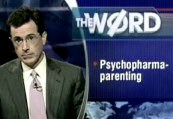
Neuroanthropology has found a highly amusing video clip from the satirical US comedy show The Colbert Report on the increasing use of psychiatric drugs in children, something he dubs ‘psychopharmaparenting’.

Colbert riffs on 2006 article from The New York Times that reported a five-fold increase in children being prescribed antipsychotics.

These drugs are typically not prescribed because a child is experiencing psychosis (for reasons that no-one is entirely sure of, children only rarely become psychotic) but because of behavioural problems.

One antipsychotic drug (risperidone) has been approved in some countries for children with autism who are aggressive, self-injure or have severe tantrums, but the concern is that these sorts of drugs are being used more widely to simply pacify difficult to manage children.

Methylphenidate (Ritalin) is another drug which has caused similar concerns as parents and teachers pressure doctors to prescribe the drug even for what used to be considered relatively mild problems of inattention and hyperactivity.

The official line is that these drugs are the last resort, because behavioural interventions – specific programmes that teach parents to manage children’s behaviour in a more effective way – are remarkably effective with a large evidence base to back them up.

Unfortunately, despite not meddling with the brain’s dopamine system to who-knows what long-term effect, they’re not as well-known, not always available and require effort and learning.

Any decision to give medication involves weighing up and advantages and disadvantages, but there is always an interplay between the influence of the scientific evidence, and what has become socially acceptable.

The fact Colbert is able joke about psychopharmaparenting is a sign of how widespread the practice has become.

Link to psychopharmaparenting clip.

Cogito ergo t-shirt

Indie t-shirt designers 410BC are channelling Descartes in their spring collection, with a brain emblazoned t-shirt that declares ‘I think therefore I am’.

Not a bad shirt for $15 dollars I think you’ll agree, especially if you’re hip to 17th century French philosophers.

The phrase “I think therefore I am” originated because Descartes wanted to know about what sort of things existed in the world, but realised he couldn’t trust his senses because they could be fooled.

He imagined the most extreme example he could think of, where an evil demon was keeping him in a Matrix-style universe in which everything he perceived was an illusion. He asked the question, if he couldn’t trust his senses, what could he truly know.

Descartes came to the conclusion that he could doubt everything except the fact he was doubting and therefore concluded that his ability to doubt, and consequently his thought, was proof of his existence – summed up in has famous phrase “I think therefore I am”.

In part, this also led him to believe that thought was not part of the physical universe, and that thought and matter were separate entities. In fact, he believed thoughts were part of the soul but interacted with the body through the pineal gland – a small structure which occupies a central position in the brain.

Descartes’ proposal that thought and matter (or mind and brain) are separate entities is known as as Cartesian dualism and is now much derided.

One difficulty is that while few people deny that both mind and brain exist in the physical world, it’s difficult, and some would say impossible, to talk about them in the same way.

For example, it’s easy to answer the question ‘what colour are your neurons?’ but impossible to answer the question ‘what colour are your thoughts?’

This causes all sorts of merry hell for cognitive scientists and leads to the rather bizarre tendency for people to think that every explanation that includes the mind needs to be reduced to brain function for it to be valid.

Philosophers, who tend to be much more able to think about these things without panicking, tend to favour what’s called property dualism, which says that while we accept everything happens in the physical world, we can’t always match every aspect of one level of description to another, even if both are both completely coherent on their own level.

I’m hoping that the 410BC autumn collection will have a similar t-shirt that says “I think, but that doesn’t mean I believe that properties that I ascribe to my thoughts on level of mental description will necessarily be reducible to the theories of neurobiology, although I agree that the scientific endeavour to discover which properties have reliable neural correlates will be an important part of any complete theory of the human mind, bearing in mind that reduction is not an answer in itself and will have to be complemented by theories that span all levels of explanation”.

However, I also think they might need a few more attractive blonde models to boost sales on that one.

Link to 410BC ‘Cogito ergo sum’ t-shirt (via Hide Your Arms).

Neuroscience recordings

If the words Neuroscience Recordings make you think of depth electrodes, you may be surprised to hear its also the name of a record label specialising in techno and trance.

I am rather taken by this track, although even if techno isn’t your thing, they do have this rather catching range of t-shirts.

Now if only someone would name their record label ‘cognitive neuropsychology’ I’d have a great excuse for wearing a geeky cognitive science t-shirt without having to admit that I’m wearing a geeky cognitive science t-shirt.

No ladies, it’s not an anorak, it’s a light-weight sports jacket.

Link to Neuroscience Recordings.

Facebook ate my psychiatrist

Sometimes I just despair. I almost understand it when the media gets its knickers in a twist about ‘internet addiction’ and similar nonsense, because most outlets never been great at separating the wheat from the chaff. But it beggars beliefs why otherwise respectable professionals can spout similar drivel when they’re supposed to be trained to deal with the evidence.

Case in point. At the recent Annual Meeting of the Royal College of Psychiatrists Dr Himanshu Tyagi gave a widely reported talk where he said social networking sites like Facebook and MySpace could damage young people’s relationships and make them more susceptible to suicide, despite the evidence suggesting exactly the opposite.

On this occasion, the icing on the cake was provided by the Royal College, who for some reason decided to press release this scandalous scaremongering.

I shall reproduce the critical paragraph below, because it pushes so many media panic buttons you’d think it was from one of the UK tabloids:

‚ÄùThis is the age group involved with the Bridgend suicides and what many of these young people had in common was their use of Internet to communicate. It’s a world where everything moves fast and changes all the time, where relationships are quickly disposed at the click of a mouse, where you can delete your profile if you don’t like it and swap an unacceptable identity in the blink of an eye for one that is more acceptable,‚Äù said Dr Tyagi. ‚ÄúPeople used to the quick pace of online social networking may soon find the real world boring and unstimulating, potentially leading to more extreme behaviour to get that sense.

”It may be possible that young people who have no experience of a world without online societies put less value on their real world identities and can therefore be at risk in their real lives, perhaps more vulnerable to impulsive behaviour or even suicide. This is definitely a line of reasoning that warrants more investigation and research.”

So what evidence is there that Facebook damages social relationships? None. In fact, less than none because the little amount of existing research suggests it actually encourages social cohesion.

One recent study published in the Journal of Computer-Mediated Communication found exactly this and noted that “students reporting low satisfaction and low self-esteem appeared to gain in bridging social capital if they used Facebook more intensely”.

Another study found that students use Facebook to enhance relationships they already formed in real life. One study did find that using such sites could lower self-esteem, but only when (wait for it) users got negative feedback from others, it boosted self-esteem when they got positive feedback.

Furthermore, the fact that Tyagi and the Royal College are allowing a link to be made with a spate of suicides in Bridgend is in really bad taste.

Bridgend is a county in South Wales that has suffered a number of suicides of young people during the last year, and the UK tabloids initially ran scare stories about ‘internet suicide cults’ because almost all of them used social networking sites.

I’m sure you’ve already picked up on the flawed logic here, and, indeed, this theory was quickly dismissed by the authorities (presumably alongside the ‘eats crisps’ and ‘wears jeans’ suicide cult theories).

So goodness knows why the Royal College are promoting this tasteless insinuation alongside a load of evidence-free and frankly sensationalist drivel.

Oh, did I mention that Tyagi is a partner in a large online medical education website for doctors?

Link to Facebook study.

Cat psychology (no, really)

I just found this curious empirical study, published last year in the academic journal Psychological Reports, on the personality structure of domestic cats.

The study analysed owner ratings and found four underlying components of cat personality.

Personality in domestic cats.

Psychol Rep. 2007 Feb;100(1):27-9.

Lee CM, Ryan JJ, Kreiner DS.

Personality ratings of 196 cats were made by their owners using a 5-point Likert scale anchored by 1: not at all and 5: a great deal with 12 items: timid, friendly, curious, sociable, obedient, clever, protective, active, independent, aggressive, bad-tempered, and emotional. A principal components analysis with varimax rotation identified three intepretable components. Component I had high loadings by active, clever, curious, and sociable. Component II had high loadings by emotional, friendly, and protective, Component III by aggressive and bad-tempered, and Component IV by timid. Sex was not associated with any component, but age showed a weak negative correlation with Component I. Older animals were rated less social and curious than younger animals.

How long before we start having ‘personality disorder‘ for domestic cats I wonder. Cat psychiatrists, start your engines.

Link to PubMed entry for paper.

Our time is up

Writer director Rob Pearlstein created a completely endearing 15 minute short film called Our Time is Up about a therapist who discovers he has six weeks to live. It’s wonderfully produced and even got nominated for an Oscar in 2006.

To be fair, it’s initially a bit reliant on some rather tired clich√©s about patients and therapists, but despite itself, it’s disarmingly warm and funny.

The writing is excellent, wrapping up what could have been a series of short sketches into a gently poignant and thought-provoking story.

Link to ‘Our Time is Up’ on YouTube.
Link to the film’s website.

Clutter press

For those wanting an update on the ‘phone network causes suicide’ nonsense that inexplicably made it onto the front page on a national newspaper, Ben Goldacre over at Bad Science contacted the person behind the story who apparently claims to have ‘lost’ the data behind the nonsensical claims.

I contacted Dr Coghill, since his work is now a matter of great public concern, and it is vital his evidence can be properly assessed. He was unable to give me the data. No paper has been published. He himself would not describe the work as a “study”. There are no statistics presented on it, and I cannot see the raw figures. In fact Dr Coghill tells me he has lost the figures. Despite its potentially massive public health importance, Dr Coghill is sadly unable to make his material assessable.

The claims didn’t even make sense as they were reported, and the fact this sort of rubbish managed to get on the front page of a paper is quite shocking.

Bad Science does a great job of picking up on all the bizarre angles of this ‘funny if it wasn’t so influential’ piece of headline scaremongering.

Link to Bad Science on Coghill nonsense.

Trip At The Brain

It’s an age old story. Boy meets girl. Boys loses girl. Boy thinks it might be because he was hypnotised by a crazed scientist who was swinging a brain on a chain. Boy thinks this might explain why the girl was originally a nun but changed into hallucinatory sex vampire.

Yes, it’s the video for mostly nonsensical ‘Trip At The Brain’, produced in 1988 by the skate metal pioneers Suicidal Tendencies.

I suspect it’s what might happen if you were the lead singer of a metal band who hallucinated evil neuroscientists while on a bad trip, or if you were a neuroscientist who hallucinated a metal band while on a bad trip.

Nevertheless, it remains one the finest examples of 20th century neuroscience, heavy metal and hallucinatory sex vampire art.

Link to video of Suicidal Tendencies’ ‘Trip at the Brain’

A strange rite of nudity

“In a way, young Dr Highsmith had plenty of warning. He should have known all was not well that day he came home and discovered his wife performing a strange rite of nudity.

But Highsmith was too wrapped up in the psychiatric problems of a lovely model named Barbara to be aware what was happening to his marriage. Though sex was his business, he found it difficult to keep it strictly business – especially with Barbara giving him an increasing role in her haywire love life…”

The description of Henry Lewis Nixon’s 1954 pulp novel Confessions of a Psychiatrist, billed as “a titillating treatise on the love therapy racket, told with daring sophistication and unblushing frankness”.

It looks like it was also published as a double bill with another book, which, unfortunately, was not about psychiatrists and their daring sophistication / unblushing frankness.

Sadly, there are few details about the book on the net, so if you’re dying to find out what the “strange rite of nudity was”, you’re going to have to track down a copy for yourself.

Link to a few more details.