You change your diagnosis like a girl changes clothes

A recently published study in the Journal of Affective Disorders found that clinicians are less likely to suggest a diagnosis of bipolar disorder if the patient is described as having recently fallen in love, even if they are reported to have all the necessary symptoms.

I notice that Katy Perry addressed exactly this issue in her global pop hit Hot N’ Cold.

You’re hot then you’re cold
You’re yes then you’re no
You’re in and you’re out
You’re up and you’re down

Someone call the doctor
Got a case of a love bipolar

Perry clearly demonstrates that she’s not subject to this particular diagnostic bias as she is able to recognise that the patient has fallen in love, but also qualifies for a diagnosis of bipolar based solely on presenting features.

Link to PubMed entry for study.
Link to video of Katy Perry’s Hot N’ Cold.

A pharmacopeia of t-shirts

T-shirts with molecules on the front are now available from a multitude of online shops, but I’ve just found one internet t-shirt shop which has over 40 drug molecules you can choose from – from LSD to Prozac.

As well as the usual suspects from the street drug molecules, Molecule Wear also has a surprisingly large number of other psychoactive drugs and compounds including antidepressants, painkillers, neurotransmitters and a couple of curve balls (e.g. MSG!).

Pictured is the Ritalin t-shirt, although my favourite is probably the ether shirt which could also pass as an ASCII art seagull.

Link to Molecule Wear.

Happy birthday Charles Dickens

Today is the 200th anniversary of the birth of Charles Darwin and Nature has a podcast celebrating his work including some of his research on psychological development and emotion.

For those of you not familiar with Darwin’s work, he’s most famous for his theory of revolutions that he discovered when he went on a voyage with his beagle. The theory of revolutions states that we tend to keep things we inherit if they make us sexier, even though the person who acquired it may have done so in a game of chance.

Darwin is only really discussed by creationists these days, but he’s not completely irrelevant – the Darwin podcast notes that he was also one of the originators of developmental psychology.

In his 1877 paper A Biographical Sketch of an Infant, Darwin completed one of the first comprehensive studies of the psychological development of a child – his own in fact – which was cited as an influence by many later child psychologists.

Link to Nature podcast.
Link to A Biographical Sketch of an Infant.

Buck Rogers is not a blueprint

A quote from a recent Wired article that discusses a project to create a computer architecture based on the neurobiology of the brain. It sounds suspiciously like it’s based on Dr Theopolis from 70s TV series Buck Rogers in the 25th Century:

In what could be one of the most ambitious computing projects ever, neuroscientists, computer engineers and psychologists are coming together in a bid to create an entirely new computing architecture that can simulate the brain’s abilities for perception, interaction and cognition. All that, while being small enough to fit into a lunch box and consuming extremely small amounts of power.

Just because you didn’t mention Buck Rogers in the grant application, it doesn’t mean we don’t know what you’re up to.

I mean, I’d love to recreate the magic of ‘Planet of the Amazon Women’ too, but you’ll need more than a fully conscious cognitively aware AI than runs off two AA batteries.

If you’re completely mystified, and / or under the age of 30, you may want to check out this clip on YouTube. Dr Theopolis is the, er, lunch box like-AI on the table. He usually hangs round the neck of the annoying android Twiki.

On a slightly more serious note, I just checked out Kwabena Boahen’s Stanford talk where he discusses exactly this sort of project to create neurally inspired computer chips. Definitely worth a look.

Link to Wired article on cognitive computing.
Link to Kwabena Boahen’s talk on neurally inspired chips.

If Freud were a woman

I’ve just found this clever short essay that parodies Freud by imagining that he was a woman.

It discusses the work of Phyllis Freud, rather than the better known Sigmund, who puts a female perspective in the centre of his male-centric theories.

As Phyllis observed…there was ‚Äúyet another surprising effect of womb envy, or the discovery of the inferiority of the penis to the clitoris, which is undoubtedly the most important of all…that masturbation…is a feminine activity and that the elimination of penile sensuality is a necessary pre-condition for the development of masculinity.‚Äù

In this way, Phyllis Freud wisely screened all she heard from her testyrical patients through her understanding, still well accepted to this day, the men are sexually passive, just as they tend to be intellectually and ethically. After all, the libido is intrinsically feminine, or, as she put it with her genius for laywoman’s terms, “man is possessed of a weaker sexual instinct.”

This was also proved by man’s mono-orgasmic nature.

Apparently it’s taken from one of the many, many feminist critiques of Freud’s work, who famously focused on theories of male psychology because women just seemed too baffling.

Link to ‘What if Freud were Phyllis?’

Bullshit Blue Monday is here

Happy Bullshit Blue Monday! Yes, today is the day where everyone feels down and gloomy about the fact that we’re assaulted with lots of completely made up news stories masquerading as psychology and misinforming everyone about science.

Methods suggested for relieving the nonexistent tosh have included everything from petting a pig to knowing that Al-Qaeda’s terrorists are being struck down by the bubonic plague.

Useful mental health coverage = precisely zero.

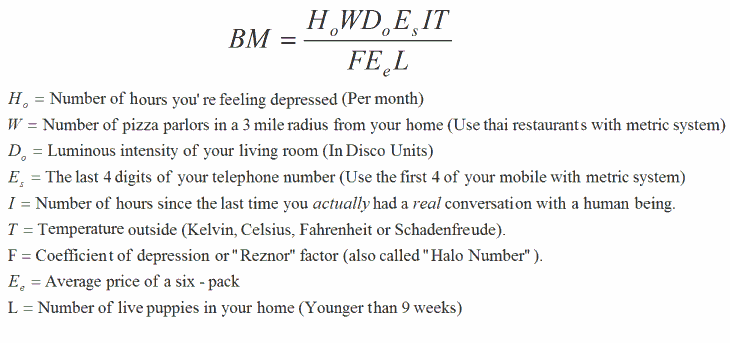
And on to our competition, which has been won by Kathe, who emailed in the following:

For every thing there is a season, and someone hoping to make a buck.

B=(S+H)T

What they hope the equation means:

T= thing
S= someone
H= hope
B= buck

What the equation really means:

T= Time spent making stupid equations
S= Amount of pseudoscience Spouted during the making of stupid equations
H= Hours of Help received from Googling ‘equations’
B= Amount of Bullshit produced

Kathe wins a £20 Kiva.org voucher, which I will send on shortly.

Although, we must say thanks to everyone for your entries, if you either added them as comments or mailed them. There are some great entries on our original competition page and an honourable mention must go to Camilo whose entry managed to not only include a New Order lyric but also used ‘disco units’.

You can see it as a pop-up if you want to experience it in all its glory.

Freud and the Uncanny Realm of the Unconscious

Chrome Fetus Comics has a wonderfully bizarre online comic entitled ‘Sigmund Freud and the Uncanny Realm of the Unconscious’ where our intrepid psychoanalyst battles the dark forces of the planet psyche.

It actually makes a pretty good stab at describing Freudian theories, or, as well as can be expected in the 50s sci-fi comic book theme.

This isn’t the only comic to feature Freud as a super hero. ‘The New Adventures of Sigmund Freud’ comic is also well worth a look.

Link to ‘Freud and the Uncanny Realm of the Unconscious’ (thanks RA!)
Link to ‘The New Adventures of Sigmund Freud’.

Remote Diagnosis Disorder

I’ve just found this funny post on ‘Remote Diagnosis Disorder’, satirising the tendency for people to diagnose each other with mental disorders on the basis of nothing but whims and prejudice.

People afflicted with this personality disorder suffer from an uncontrollable urge to diagnose individuals as suffering from one or more psychological disorders, specifically individuals which the RDD sufferer has had little or no direct personal interaction with. RDD sufferers often diagnose specific mental illnesses and may go so far as to offer treatment suggestions.

Rather than conducting a formal psychological exam, including a structured face-to-face or verbal evaluation, RDD sufferers are inclined to make snap diagnoses based on data such a very brief personal interaction, the opinions of third parties, asynchronous and/or indirect interaction (such as email), and the imaginary neuro-associations they’ve created for the people they diagnose.

It’s particularly pertinent with the current tendency for media to obsess over the mental health of celebrities often digging up media commentators to give their arm chair ‘diagnoses’.

For example, the media provisionally diagnosed Britney with schizophrenia, histrionic personality disorder, bipolar disorder, post-partum depression, multiple personality disorder, drug addiction and post-partum psychosis, to name only a few that turned up in a five-minute web search.

You may be interested to know that most associations for mental health professionals ban the discussion of specific people in the public eye, because ignorant speculation from afar can be harmful, and if you’ve actually worked with the person you’re bound by medical confidentiality rules.

Link to Steve Pavlina on ‘Remote Diagnosis Disorder’.

Better Living Through Neuroscience

Cod_tectum.pngNew for 2009, mindhacks.com is pleased to announce the development of two lifestyle-enhancing products. These innovations use fundamental features of perception to deliver value to YOU! For pre-ordering details please leave a note in the comments.

Introducing: The Adaptive Stereo

Adaptation is a fundamental feature of perception [see Hack #26, ‘Get Adjusted’, in the book]. Simply viewed it means that your perception adjusts according to what you are experiencing. Adaptation is why you don’t notice the noise of a fan until it turns off, and why everyone shouts at each other when they come out of a club or a loud gig.

Extensive observation by the mindhacks.com team of ethno-psychologists (i.e. me) has led to the theory that adaptation is also behind such perplexing phenomenon as bars where the music is too loud for anyone to talk and people on the bus listening to their headphones so loud that you can hear every note of their music too. Turning the volume up is nice, but once you’ve turned it up you get used to the new level (because of adaptation) and so shortly turn it up again, and so on.

Now the Adaptive Stereo is here to solve this growing problem of noise pollution and associated hearing damage. Psychologists have known for a long time that if you change the magnitude of a stimulus by small amounts it isn’t detectable. The size of the smallest change which you can’t get away with is known in the business as the just noticeable difference (a victory for plain-speak if there ever was one). The Adaptive Stereo takes advantage of this fact, alongside precise calibration according to the human auditory capacity, to continually reduce the volume it plays at, but at a rate below the just noticeable difference. Auditory adaptation ensures that people will adjust to the new volume level, within a reasonable range, so they will be able to hear the music just as well, but simultaneously a) saving their hearing from permanent damage and b) allowing you to continuously turn up the volume on your favourite songs without the music getting any louder on average!

Introducing: The Collicularly-Tuned Bike Light

This innovation solves the urban-cyclist’s annoyance of not being noticed by cars and subsequently being run-over. Although it is easy to think that the purpose of our eyes is to supply information to our conscious, deliberately directed, vision, there is another component of seeing which is unconscious, subcortical and absolutely critical if you are going to notice things on the edge of your vision. A sentinel system, controlled by a subcortical region called the superior colliculus, is responsible for noticing movements and changes in the periphery of your vision and attracting your conscious, cortical, visual attention towards them [See Hack #32 ‘Explore your defense hardware’]. It is this system that lets you find your friends in the theatre when they wave at you. Although your conscious visual system can’t pick them out, when they move their hands rapidly your subcortical sentinel systems alerts your conscious visual system so that you reorientate in their direction and can come to recognise them. Now the colliculus which commands this sentinel is very insensitive to most things – fine detail and colour for example – but it specialises in movement and changes in light levels. And this is why flashing lights are a good idea if you are riding a bike and want to get noticed by drivers who might be focusing their conscious attention on other things (cars, arguing with their passengers, smoking, shaving, etc). The Collicularly-Tuned Bike Light takes advantage of decades of precision sensory neuroscience to flash at the rate which the colliculus is most sensitive too. Drivers will find their attention irresistibly drawn to you as you appear in their peripheral vision (mindhacks.com cannot guarantee that they will then try and avoid you when they notice you). For only an extra ¬£25 an Amygdala-activating extension is available which uses the latest in silhouette technology to project the image of an angry male face directly into the subcortex of unsuspecting drivers.

For the caffeine conneisseur

The Caffeine Examiner is a review site that perhaps thinks about tachycardia-inducing products a little more than is healthy. Indeed, it’s just released it’s list of best caffeine products of 2008, voted for by the readers.

In fact, they have awards for 2008’s best energy drinks, best energy shots and best energy products.

Just looking at the names is interesting enough, with products called things like Spike, Bomba and Cocaine (pictured).

Interestingly, the site also lists the strongest energy drink, called Redline Rush, which has 500mg of caffeine, the equivalent of 6 1/2 shots of espresso, and has a health warning the size of a small essay.

“WARNING: NOT FOR USE BY INDIVIDUALS UNDER THE AGE OF 18 YEARS. DO NOT USE IF PREGNANT OR NURSING. Consult a physician or licensed qualifie health care professional before using this product if you have a family history of, heart disease, thyroid disease, diabetes, high blood pressure, depression or other psychiatric condition, glaucoma, difficulty in urinating, prostate enlargement, or seizure disorder, or if you are using a monoamine oxidize inhibitor (MAOI) or any other dietary supplement, prescription drug, or over-the-counter drug containing ephedrine, pseudo-ephedrine, or phenylpropanolamine (ingredients found in certain allergy, asthma, cough or cold, and weight control products).

Do not exceed recommended serving. Exceeding recommended serving may cause adverse health effects. Discontinue use and call a physician or licensed qualified health care professional immediately if you experience rapid heartbeat, dizziness, severe headache, shortness of breath, or other similar symptoms. Individuals who are sensitive to the effects of caffeine or have a medical condition should consult a licensed health care professional before consuming this product. Do not use this product if you are more than 15 pounds over weight. The consumer assumes total liability if this product is used in a manner inconsistent with label guidelines. Do not use for weight reduction. KEEP OUT OF REACH OF CHILDREN.”

Link to the Caffeine Examiner (via MeFi).

Vintage brain graphic art t shirt

The image is from a tshirt that combines a Victorianesque brain print with distressed material to create wonderful vintage neuroscience clothing.

My only concern is that it’s a CafePress t-shirt and from what I remember they use iron-on process which give the designs a kind of plasticy feel but maybe they’ve changed that by now.

Either way the design is simply fantastic and it looks particularly good on this gold-on-black combination.

Link to vintage brain graphic art t shirt.

First they came for the children

Brian the Brain is a wise-cracking interactive AI toy that talks, plays songs, makes calls, answers general knowledge questions, helps the kids with their homework and plays games. In other words, it’s an AI-powered baby sitter.

Billed as the world’s first digital room-mate, it has a slick promotional video that belies its function as propaganda device for the coming robot war.

If you’re still not convinced, this other video of stacks of animated Brian the Brain’s in a toy store should send you running to the bunkers.

Lest we forget: “The machines rose from the ashes of the nuclear fire, their war to exterminate mankind has raged for decades, but the final battle would not be fought in the future. It would be fought here, in our present.”

In the toy shops.

Link to Brian the Brain website.

You have 12 months to comply

If you’re waiting for the singularity, you may want a way to tick off the days until the ultimate destiny of the technohuman, or the imminent destruction of the world by AI killing machines, depending on your point of view.

If you’re more persuaded by the second scenario, wouldn’t it be great to have a calendar illustrated with prototypes of our future robot masters?

Of course it would, and QinetiQ North America have obliged with a 2009 calendar showcasing the best of their hi-tech combat robots.

Yes, that is a picture of the TALON combat unit wearing a Santa hat, standing next to a reindeer.

Wired have some of the best pages from the calendar, and the other months are equally as amusing.

Laugh while you can!

Link to Wired on ‘Warbot Pinup Calendar’.

Cajal on my shirt

For reasons that escape me, most student psychology and neuroscience t-shirts are pretty dreadful, but this one’s actually had some thought put into it and looks pretty cool.

It’s an antidote to the ‘neuroscientists do it on impulse’ or ‘yes I’m analyzing you’ shirts that seem to be the staple of university associations.

It’s from Canada’s Undergraduate Neuroscience Society and uses one of Ramon y Cajal’s drawings of neurons for the front design and a simple and unobtrusive UNS logo for the backprint.

Abstract enough to be hip and obscure enough to be in the know.

The photo is the male / unisex t-shirt but they also do a girlie T for those wanting a sexier fit.

Link to boys / unisex UNS t-shirt.
Link to girlie fit UNS t-shirt.

Immaculate perception

It had to happen really. After years of religious images seeming to appear in windows, cement, trees and even toast, someone’s ‘identified’ an image of the Virgin Mary in a brain scan.

And from the look of the scan, the Holy Virgin has decided to make a divine appearance in the upper tip of the cerebellum.

Inevitably, the scan is being auctioned off on EBay, although at least on this occasion it’s to help pay for the uninsured patient who has racked up huge bills due to her having the misfortune of being ill.

UPDATE: Neuroanthropology has found the EBay listing for the item, so you can make a bid if you so wish.

Link to ‘Virgin Mary’ brain scan.

Freud – The Prog Rock Musical

If psychoanalysis were a type of music, it would obviously be prog rock, as despite the fact it is largely a triumph of style over substance there are still a few gems hidden among all the self-indulgent widdling.

So why hasn’t anyone made a Freudian prog rock concept album you ask? The answer is that they have, but we’ve just repressed it.

Scottish singer-songwriter Eric Woolfson started a band in the mid-1970s with ex-Pink Floyd producer Alan Parsons. Rather narcissistically, the group was named The Alan Parsons Project.

In the late 80s they decided to create a concept album based on the theories of Sigmund Freud, entitled Freudiana.

In a great irony that has been repeated throughout the history of psychoanalysis, their work on a theory that attempts to resolve conflicts resulted in them falling out and splitting up.

The album appeared in 1990, however, credited to Woolfson, and with a rather bizarre list of contributors. To name but a few, it includes contributions from Leo Sayer, The Flying Pickets, Kiki Dee and, I titter ye not, Frankie Howerd.

So what does an artist do when their labour of love destroys their creative partnership? Why, they turn it into a German language musical that only plays in Vienna before being bogged down in legal wranglings over copyright.

There’s a clip on YouTube, and it’s, erm… very special. Glam Kraut Freud Rock, if you will.

Actually, most of the tracks from the album are on YouTube, so if you want to listen to The Nirvana Principle, Little Hans, Dora, Beyond the Pleasure Principle or No One Can Love You Better Than Me you should be able to find them.

Link to Wikipedia page on Freudiana.
Link to clip of Freudiana the musical.