Legal highs making the drug war obsolete

If you want any evidence that drugs have won the drug war, you just need to read the scientific studies on legal highs.

If you’re not keeping track of the ‘legal high’ scene it’s important to remember that the first examples, synthetic cannabinoids sold as ‘Spice’ and ‘K2’ incense, were only detected in 2009.

Shortly after amphetamine-a-like stimulant drugs, largely based on variations on pipradrol and the cathinones appeared, and now ketamine-like drugs such as methoxetamine have become widespread.

Since 1997, 150 new psychoactive substances were reported. Almost a third of those appeared in 2010.

Last year, the US government banned several of these drugs although the effect has been minimal as the legal high laboratories have over-run the trenches of the drug warriors.

A new study just published in the Journal of Analytical Toxicology tracked the chemical composition of legal highs as the bans were introduced.

A key question was whether the legal high firms would just try and use the same banned chemicals and sell them under a different name.

The research team found that since the ban only 4.9% of the products contained any trace of the recently banned drugs. The remaining 95.1% of products contained drugs not covered by the law.

The chemicals in legal highs have fundamentally changed since the 2011 ban and the labs have outrun the authorities in less than a year.

Another new study has looked at legal highs derived from pipradrol – a drug developed in 1940s for treating obesity, depression, ADHD and narcolepsy.

It was made illegal in many countries during the 70s due to its potential for abuse because it gives an amphetamine-like high.

The study found that legal high labs have just been running through variations of the banned drug using simple modifications of the original molecule to make new unregulated versions.

The following paragraph is from this study and even if you’re not a chemist, you can get an impression of how the drug is been tweaked in the most minor ways to create new legal versions.

Modifications include: addition of halogen, alkyl or alkoxy groups on one or both of the phenyl rings or addition of alkyl, alkenyl, haloalkyl and hydroxyalkyl groups on the nitrogen atom. Other modifications that have been reported include the substitution of a piperidine ring with an azepane ring (7-membered ring), a morpholine ring or a pyridine ring or the fusion of a piperidine ring with a benzene ring. These molecules, producing amphetamine-like effects, increase the choice of new stimulants to be used as legal highs in the coming years.

New, unknown and poorly understood psychoactive chemicals are appearing faster than they can be regulated.

The market is being driven by a demand for drugs that have the same effects as existing legal highs but won’t get you thrown in prison.

The drug war isn’t only being lost, it’s being made obsolete.

The return of All in the Minds

The two best psychology and neuroscience radio shows, both confusing called All in the Mind, have just started new series in the last couple of weeks.

BBC Radio 4’s programme, which takes more of a magazine format featuring several topics each week, has just kicked off with a programme about stress, humour and discussing personal mental health issues.

On the other side of the wires, ABC Radio National’s programme has begun with an edition on the genetics of mental illness and one on self-harm. I really recommend the genetics programme, by the way, as it takes a fresh look at the whole concept.

Both come highly recommended so do tune in your wireless. Or click your mouse. Whichever is easiest.
 

Link to BBC Radio 4’s All in the Mind
Link to ABC Radio National’s All in the Mind

A new symbol for epilepsy in Chinese

The Chinese character for epilepsy has been changed to avoid the inaccuracies and stigma associated with the previous label which suggested links to madness and, more unusually, animals.

The new name, which looks like this just makes reference to the brain although the story of how the original name got its meaning is quite fascinating in itself.
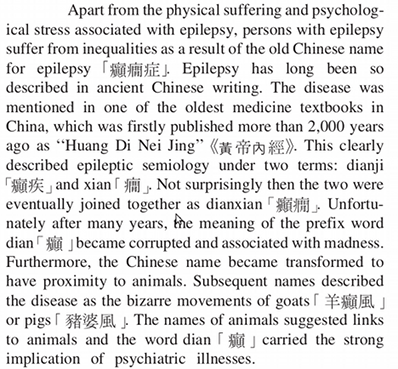

The following text is from an article in the medical journal Epilepsia which announced the change:

If you’re wondering where the bit about the ‘bizarre movements of goats’ came I suspect it’s from a type of fainting goat that looks like it has seizures and falls over. You can see them ‘in action’ in this YouTube video.

However, the link is mistaken as the goats do not have seizures. The effect is caused by their muscles locking up, independently of their brain, by a condition called myotonia congenita.
 

Link to ‘Announcement of a new Chinese name for epilepsy’ (via @cmaer)

I predict a riot (based on a single study)

A group of black bloc researchers fed up with the lack of interest in replicating psychology studies has set up a strike force called the The Reproducibility Project that will recreate all 2008 studies from three major cognitive science journals.
That sound you can hear. That’s shit hitting the fan.

The Chronicle of Higher Education covers the project that’ll check-out the replicability of well-known studies.

So why not check? Well, for a lot of reasons. It’s time-consuming and doesn’t do much for your career to replicate other researchers’ findings. Journal editors aren’t exactly jazzed about publishing replications. And potentially undermining someone else’s research is not a good way to make friends.

Brian Nosek knows all that and he’s doing it anyway. Nosek, a professor of psychology at the University of Virginia, is one of the coordinators of the project. He’s careful not to make it sound as if he’s attacking his own field. “The project does not aim to single out anybody,” he says. He notes that being unable to replicate a finding is not the same as discovering that the finding is false. It’s not always possible to match research methods precisely, and researchers performing replications can make mistakes, too.

But still. If it turns out that a sizable percentage (a quarter? half?) of the results published in these three top psychology journals can’t be replicated, it’s not going to reflect well on the field or on the researchers whose papers didn’t pass the test. In the long run, coming to grips with the scope of the problem is almost certainly beneficial for everyone. In the short run, it might get ugly.

Unfortunately, psychology and science in general still see a non-replication as a failure (in fact, we even use the term ‘failed replication’).

This is clearly nonsense and checking the original finding is equally as valuable if the new data agree with, or disagree with, the original study.

Sadly, we’ll have to change the attitude of several generations of scientists to reset this rusty conceptual switch.

The Reproducibility Project have just got frustrated with the entrenched attitudes and have manned the barricades. And who cam blame them?
 

Link to Chronicle article on The Reproducibility Project.

The future of fMRI

Nature has an article looking at the future of fMRI brain scanning in light of its long-lasting hype and recently discovered problems.

Brain scanning has become massively popular both in the scientific community and in the media, in great part because the pictures it produces seem quite intuitive: images of the brain with colours on it which apparently represent neural activity when we’re doing something.

However, the current situation with fMRI is nicely but inadvertantly captured in the article:

It has turned psychology “into a biological science”, says Richard Frackowiak…

[two sentences later]

Perhaps the biggest conundrum in fMRI is what, exactly, the technique is measuring.

fMRI has indeed turned much of psychology into a biological science but it hasn’t really given us a fundamentally deeper understanding of neuropsychology largely due to the measurement problem.

Recent revelations that fMRI studies are not as reliable as we thought and that some common ways of analysing data may be flawed have made many people question the utility of the technique – or at least, many of the past studies that may not have been well controlled.

The Nature article looks at where the science will go next, although I can’t help thinking that if it became less expensive the gloss would rub off – and then at least we could assess it a little more reasonably.

Sadly, scientists are no less attracted to bling.
 

Link to Nature article ‘Brain imaging: fMRI 2.0’

Inside The Ailing Brain

The Ailing Brain is a fantastic documentary series on the brain and its disorders that’s freely available online. It has been produced in Spanish but the first part is now on YouTube with English subtitles.

The series is among the best neuroscience documentary series I have even seen (along with Susan Greenfield’s Brain Story – made before she lost the plot) with the first part tackling the science and effects of neural implants.

If you see nothing else, go to 6:10 to watch what happens when a patient with an implanted deep brain stimulation device to treat Parkinson’s Disease switches off the machine. It’s an amazing sight.

But if you’ve got 20 minutes, you’d be very well advised to take some time to watch the whole episode as it’s both wonderfully produced and utterly compelling.

There are three programmes so far although the second and third haven’t been subtitled yet. But if you understandeas español, you can check out the whole series here. The second part is on memory disorders and the third is on mental illness.

I’ll post more on Mind Hacks when the other parts with English subtitles appear. Wonderful stuff.
 

Link to ‘Refurbished Brains’ episode with English subtitles.
Link to whole series in Spanish.

Goodbye Colombia, for now

A few days ago I moved back to the UK after spending three years working in beautiful Colombia.

I had the pleasure of learning from some fantastic colleagues and managed to find myself working across the country from the Amazon to the Andes.

As a small and inevitably inadequate token of my appreciation I’d like to thank my colleagues in Médecins Sans Frontières from across Colombia, colleagues from the Hospital Universitario San Vicente de Paúl and the Universidad de Antioquia in Medellín, as well as the many other fantastic mental health professionals who helped me along the way and tolerated my enthusiastic but ‘freestyle’ Spanish.

I arrived in Bogotá to find Alonso, a particle physicist, had organised ‘neurobeers’ which were both enormously good fun and full of fantastic folks. Much appreciated.

And finally, thank you to Shakira (who can now contact me at my British address).

A mental space filled with flowers

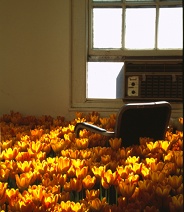
An entire psychiatric hospital has been filled with flowers before demolition as part of a beautiful art installation to remember a place “rich with a history of both hope and sadness.”

Art website Colossal has amazing pictures of the sublime artwork.

In 2003 a building housing the Massachusetts Mental Health Center (MMHC) was slated for demolition to make way for updated facilities. The closure was a time for reflection and remembrance as the MMHC had been in operation for over 9 decades and had touched countless thousands of patients and employees alike, and the pending demolition presented a unique problem. How does one memorialize a building impossibly rich with a history of both hope and sadness, and do it in a way that reflects not only the past but also the future? And could this memorial be open to the public, not as a speech, or series of informational plaques, but as an experience worthy of they building’s unique story?

To answer that question artist Anna Schuleit was commissioned to do the impossible. After an initial tour of the facility she was struck not with what she saw but with what she didn’t see: the presence of life and color. While historically a place of healing, the drab interior, worn hallways, and dull paint needed a respectful infusion of hope. With a limited budget and only three months of planning Schuleit and an enormous team of volunteers executed a massive public art installation called Bloom. The concept was simple but absolutely immense in scale. Nearly 28,000 potted flowers would fill almost every square foot of the MMHC including corridors, stairwells, offices and even a swimming pool, all of it brought to life with a sea of blooms.

A beautiful and touching piece.
 

Link to photos from Colossal (via @sarcastic_f)
Link to artist’s pages on the project.

Reminder: revelatory experiences conference

A final reminder about the revelatory experience conference where the psychology, neuroscience and anthropology of visionary experiences will be discussed in London on March 23rd.

Rather than debating whether such experiences are ‘true’ or not, it’s more aimed at discussing how well our current tools of science, medicine and interpretation help us make sense of the wide variety of revelatory experiences in the world.
 

Link to conference details.

Catching the krokodil

Over the last few months somewhat sensational media reports have appeared discussing a cheap Russian heroin-like drug nicknamed ‘krokodil’ due to it causing scaly lesions at the site of injection.

It has been variously headlined as a ‘designer drug’ or ‘the drug that eats junkies’ but until now it has not been discussed in the scientific literature.

For the first time, however, a short article has appeared with more details, and has just been published in Clinical Toxicology by three Russian resesarchers.

The main part of the article is reproduced below edited to remove the references.

“Crocodile” is a street name of drug containing mainly desomorphine (Dihydrodesoxymorphine-D), produced in home conditions by simple synthesis from codeine, most often on the basis of codeine-containing medicines, in Russia available over-the-counter so far. Desomorphine presents sedative and analgesic effects; it is 8–15 times more potent than morphine, and has weaker toxic, convulsant, emetic and respiratory depression action.

The drug is administered intravenously or intramuscularly. It has very fast onset of action (2–3 min) and a short duration of action (2 h). First symptoms of addiction usually appear after 5–10 days. From intake of the first dose, death comes maximally after 2–3 years, but even single dose may be lethal for predisposed person. High toxicity is caused by the presence of impurities. Skin in the places of injections becomes grey and green, scabrous, flakes off, so it resembles the skin of crocodile. Postproduction impurities (residues of acids and alkalis, petroleum derivatives, industrial oils, organic solvents, red phosphorus, iodine, heavy metals) act irritant on vessels which become damaged and afterwards obliterated.

It causes peripheral limb ischemia with following necrosis, often secondarily infected, which require surgical intervention and even limb amputations. So this drug “bites” the limbs, as a real crocodile. Addicted people may be recognized by the smell of iodine, used during drug production. “Crocodile” generally is similar to so-called “Polish heroin” (“compote”)— drug produced also in home conditions from poppy straw, popular in Poland till the late 1990s.

The “crocodile” is cheap (costs less than one can of bear), so it is very popular and is used mainly by poor opiate drug addicts in Russia. Its production developed at the time of restriction of heroin trafficking from Afghanistan. According to current estimates, in Russia there are 100—250 thousands of people addicted to “crocodile.” About 30 thousands of people die per year.

The presence of this drug was confirmed in Germany (among immigrants from Russia), Czech Republic, Ukraine, France, Belgium, Sweden and Norway. Unofficially, one fatal poisoning of 23-year-old man from Warsaw in Poland, in December 2011, is suspected, but we don’t know details yet, because of lasting investigation. With people migration, we should expect single cases of “crocodile” use in countries, where it is not present at this moment.

Oddly the article has translated the Russian ‘krokodil’ into ‘crocodile’ for the article, despite the fact it is more widely known by its original spelling.

Interestingly though, it seems that the drug is another in the line of nasty highs that can be synthesised by anyone with household ingredients and a single container (the other being the single bottle methamphetamine synthesis).
 

Link to locked short Clinical Toxicology article.
Link to Wikipedia on krokodil and desomorphine.

Did drug money keep the banks high and dry?

A little known but striking comment from the then executive director of the United Nations Office on Drugs and Crime on how illegal drug money was the only thing that kept the banks afloat during the 2008 crash.

Vienna-based UNODC [United Nations Office on Drugs and Crime] Executive Director Antonio Maria Costa said in an interview released by Austrian weekly Profil that drug money often became the only available capital when the crisis spiralled out of control last year.

“In many instances, drug money is currently the only liquid investment capital,” Costa was quoted as saying by Profil. “In the second half of 2008, liquidity was the banking system’s main problem and hence liquid capital became an important factor.”

The United Nations Office on Drugs and Crime had found evidence that “interbank loans were funded by money that originated from drug trade and other illegal activities,” Costa was quoted as saying. There were “signs that some banks were rescued in that way.”


Link to Reuters reporting of interview.

Christmas brain lectures available worldwide

This year’s Royal Institution Christmas Lectures were a fantastic trip through neuroscience and the brain – and you can now watch them online from anywhere in the world.
The Christmas Lectures are a traditional event where a leading scientist is chosen to present the latest developments in a fun and engaging way to a lecture theatre full of slightly posh kids.

They’re televised in the UK but they’ve now been made available online and you can watch all three streamed over the net.

And I really recommend you do as they’re fantastic.

They’re presented by psychologist Bruce Hood and they’re packed with excellent demonstrations that use everything from cutting edge neuroscience technology to stuff you could find in your house.

Enormously enjoyable whether your a fan or a profesional (or both).
 

Link to excellent online Christmas lectures.

The manual that must not be named

The American Psychiatric Association have used legal threats to force a critical blog to change its title because they didn’t like it being called ‘DSM Watch’.

The ‘DSM Watch’ website, now called ‘Dx Revision Watch‘, is one of the better websites keeping track and critiquing the upcoming changes to psychiatry’s diagnostic manual, the DSM-5.

On January 3rd the website owner reported receiving two cease and desist letters from the APA ordering the removal of all reference to the ‘DSM5 trademark’ from the site’s domain dsm5watch.wordpress.com

You might be wandering why the APA registered DSM-5 as trademark – which is a legal device to protect against other people making profit from your good name – and why they are using it to bully critics.

Firstly, DSM Watch was a non-commercial site and so was in no danger of profiting from referencing DSM-5 in its domain name, and secondly no-one for a moment would look at the site and think it was an official APA site – in part, because despite the great content, it does not have, shall we say, the most corporate of looks.

If the APA still didn’t think the distinction was clear enough a simple request to add a message saying ‘not an official DSM5 website’ (or maybe they’d prefer ‘product’, who knows?) would suffice.

Apparently though, we can now distinguish between official and non-official DSM websites because the non-official ones are those engaged in healthy and appropriate criticism of the manual that must not be named.

However, I do hope they’re going to clamp down on the punk band DSM-5 so no-one mistakenly buys a copy of the diagnostic manual when they actually wanted a ticket to a sweaty hardcore gig.

Imagine the disappointment.
 

Link to post on APA legal threats.

Clinical test copyright bullying legally dubious

James Grimmelmann, Associate Professor at New York Law School, has written on the takedown of an open-access cognitive screening test by the copyright holders of the Mini Mental State test.

He says “any copyright claim here is legally weak and morally indefensible”.

His piece is worth reading in full not only because he sets out clearly why the legal challenge to the open-access Sweet 16 test is highly dubious but why, at least in the US jurisdiction, copyrighting any test form is simply not possible.

What about the forms? You might object that PAR isn’t trying to stop doctors from using the MMSE, only to stop others from selling the forms that go with it. Well, it turns out the Supreme Court rejected that argument, too. In Baker v. Selden, the defendant was selling a book of blank forms to be used with the plaintiff’s accounting system. The Court held that this, too, was permissible. Yes, the Court said, the plaintiff could copyright his book explaining the system of accounting, but that copyright would not extend to the forms themselves…

The same goes for blank MMSE forms. Those are “necessary incidents” to administering the MMSE, at least if you want to write down the answers in a standardized way. Indeed, to the extent that the forms are designed to total up a patient’s score, a Copyright Office regulation says flatly that they’re uncopyrightable…

In other words, not only is the copyright bullying of other tests likely to be way out of bounds, but this also extends to any copyright claim on the original test form itself.
 

Link to Grimmelmann on MMSE copyright bullying (via @deevybee)

Diagnostic test takedown by copyright bullies

The New England Journal of Medicine report on how the authors of key screening test, the Mini–mental state examination, have initiated a take-down of an open, validated and freely-available equivalent due to it also asking test-takers to recall three words, a string of numbers and some basic questions about the date and location.

The Mini–mental state examination, commonly known as the MMSE, is most widely used to screen for cognitive impairment and requires little specialist knowledge in neuropsychology, so it has become the evaluation of choice for most general doctors.

As most people with dementia are managed by general practitioners, the majority of people with dementia are likely to rely on the MMSE for their diagnosis.

The copyright is genuinely owned by the creators but after more than 30 years of it being freely copied without complaint the authors have initiated a copyright clampdown, now charging $1.23 per copy through a company called PAR Inc.

Disappointed by the cash-in, Harvard neurologist Tamara Fong created and validated an open-access 16-item test to do the same job which she named the Sweet 16 (word to the wise: don’t name your test something which could get you in trouble for Googling).

Among other things, the Sweet 16 contains a part where you are asked to remember three words, a part where you are asked to remember a string of numbers and a part where you are asked to say the time, date and location.

As with many cognitive tests, these short tasks are also part of the MMSE.

The Sweet 16 is now no longer available online due to a presumed copyright action by the MMSE authors and publishing company.

The New England Journal of Medicine notes:

For clinicians, the risk of infringement is real. Photocopying or downloading the MMSE probably constitutes infringement; those who publish the MMSE on a Web site or pocket card could incur more severe penalties for distribution.

Even more chilling is the “takedown” of the Sweet 16, apparently under threat of legal action from PAR (although PAR has not commented publicly). Are the creators of any new cognitive test that includes orientation questions or requires a patient to recall three items subject to action by PAR? However disputable the legal niceties, few physicians or institutions would want to have to argue their case in court.

Cashing-in on a simple and now, clinically essential, bedside test that you’ve ignored for three decades makes you seem, at best, greedy.

Taking down open-access equivalents because they also ask people the location and date and to remember a handful of words and numbers makes you a seem like a cock and a danger to clinical progress.

The NEJM again:

…there is a clear clinical benefit to using well-tested, well-validated, continually improved clinical tools in complex patient care — as demonstrated by the MMSE’s use before 2000.

In a sense, copyleft is how academic medicine has always been assumed to work. Restrictive licensing of such basic tools wastes resources, prevents standardization, and detracts from efforts to improve patient care.

This is really disgraceful behaviour and the MMSE authors and PAR Inc. should reconsider their attempts at stopping independently developed diagnostic evaluations because they include simple memory tests, but hopefully the event will lead to wider understanding for the need to have open tests for clinical assessment.
 

Link to NEJM on takedown of essential clinical tests (via @deevybee)

Mixing up a decade of All in the Mind

The amazing ABC Radio National programme All in the Mind is ten years old and is celebrating by mixing up some specially themed editions from its extensive archives.

First up is the psychology and neuroscience of sex that tackles everything from gender myths to the neuroscience of female orgasm.

The following edition, to hit the wires next week, is a special on consciousness and there’s plenty more gold on its way.

All in the Mind is one of the few programmes that is as interesting to professionals as it is to enthusiasts and if you’ve never had a listen, now’s a good chance to check out some of the audio.
 

Link to All in the Mind site.
Link to 10th Anniversary Special 1: Getting Sexy.