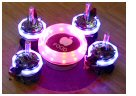
Commercial brain computer interface on sale

Neurophilosopher reports on a commercial brain-computer interface system called g.MOBIlab that has just become available.

The system comes in various versions that can be hooked up to PCs and PDAs using various interfaces including wireless and across the internet.

To quote from the company’s website:

g.MOBIlab – g.tec’s portable biosignal acquisition and analysis system – is the perfect tool for recording multimodal biosignal data on a standard Pocket PC, PC or notebook. This allows to investigate brain-, heart-, muscle-activity, eye movement, respiration, galvanic skin response, pulse and other body signals.

Reading electrical signals from the brain and other parts of the body is relatively simple.

The thing that will determine whether the system is of reasonable standard will be the post recording electronics such as the signal amplifiers, filters and digital signal processing software, to make sense of noisy data that is generated when the brain is at work.

Neurophilosopher has also linked to a video where someone is navigating through a virtual world using the system.

Link to Neurophilosopher on the g.MOBIlab system.

Mind and brain podcast guide

The BPS Research Digest has just published a comprehensive list of psychology and neuroscience podcasts available for your listening pleasure.

It’s been put together by the BPSRD editor (our very own Dr Christian Jarrett) and is a fantastic guide to the best in mind and brain audio.

It includes podcasts from universities, scientific journals and professionals in the field and includes everything from serious analysis to lighthearted discussion.

Link to BPSRD article ‘Psychology podcasts: a clickable list’.

All in the Mind on the Zyprexa saga

ABC Radio’s All in the Mind has broadcast a special on the legal case and previously secret Eli Lilly documents that just came to light on antipsychotic drug Zyprexa, also known as olanzapine, one of the most profitable drugs in the world.

We’ve been keeping track of the story here at Mind Hacks, as it was first picked up by The New York Times and disseminated across the world.

A lot of the digging on the story has been done by investigative journalist Philip Dawdy who has been publishing his revelations on mental health blog Furious Seasons.

He also published copies of the previously secret Eli Lilly documents that seem to suggest that the drug company tried to promote olanzapine inappropriately and obscure information about the drugs negative health effects.

As well as covering the accusations and revelation, All in the Mind also gets Eli Lilly’s response, who have categorically denied any wrong-doing and give a spirited defence on the programme.

Link to AITM on ‘The Zyprexa story’.

Wired on independent neuroscientist Jeff Hawkins

The latest edition of Wired magazine has an article on technology pioneer turned neuroscientist Jeff Hawkins, who is attempting to develop and research a novel way of understanding how the brain learns.

Hawkins is best known for inventing the Palm Pilot and Treo hand held computers, but has now focused his efforts on a long-time interest, neuroscience.

He has founded the Redwood Neuroscience Institute that develops computational models of neurobiology and has recently launched an artificial intelligence company Numenta.

Hawkins’ big break into the world of cognitive science came with his book On Intelligence (ISBN 0805078533) where he set out his original and somewhat grand theory of brain function, the ‘memory prediction framework’.

As an independent researcher in the field, he’s gone for quite a different approach from mainstream neuroscience, not least by attempting to develop a theory that aims to explain a major function of the brain in one go.

I must admit, I’ve got a great admiration for independent cognitive science researchers. Steve Grand is another self-taught original thinker (and well worth hearing speak if you get the chance).

The Wired article look both at Hawkins’ theories, and his journey from Silicon Valley engineer to independent mind and brain researcher.

UPDATE: The webpage of Numenta has just been updated with details of the application based on Hawkin’s research on the brain – Thanks Marcos!

Link to Wired article on Jeff Hawkins.

Equus on Front Row

A new version of Peter Shaffer’s Equus has just opened in London and there was an interesting discussion about the role of psychiatry and mental illness in the play on BBC Radio 4’s Front Row, which you can hear as a realaudio stream.

Equus is both a coming-of-age play about a mentally disturbed young man, and a detective story, as the psychiatrist tries to work out what led the young man to blind several horses.

It’s incredibly powerful, both in its content and staging, and was written after Shaffer heard of a case where a boy seemed to senseless attack a number of horses and wondered how someone might get to that point in their life.

The realaudio archive of Front Row only stays online for a week, so will only be available for five days or so more days. Catch it while you can!

The discussion is in the first 10 minutes of the programme.

realaudio of Front Row.
Link to Wikipedia page on Equus.
Link to website of London production of Equus.

MoD ‘remote viewing’ documents online

As a follow up to our recent post reporting that the UK’s Ministry of Defence conducted ‘remote viewing’ experiments, the documents from these experiments are now available on the MoD’s own website.

The documents were requested by someone under the Freedom of Information Act.

There’s lots of blanked out areas, but the observational logs make for intriguing, if not somewhat bizarre, reading.

The subject [blanked] recorded only two ‘images’. The first being the head of a bear or a baboon and the second the word RATS in the style of street graffiti in white…

Though the subject recorded detailed images it was clear from analysis of the target in terms of the descriptions given by the subject that the target was no accessed.

A curious case of government parapsychology research.

Link to MoD’s Remote Viewing documents (via Further).

Artificially evolving social robots

Carl Zimmer has written a fascinating piece on a study that simulated the evolution of communication in artificially intelligent robots.

The robots were small and mobile, were controlled by artificial neural networks, and could send and receive signals via infrared.

A group of robots was put into an arena with a light-emitting ‘food source’ and a ‘poison source’. The robots could only tell the difference when they got close enough to see coloured paper that the ‘sources’ were resting on.

Robots gained a point when they found the ‘food’ and lost a point when they stumbled across the ‘poison’.

Crucially, the researchers could electronically ‘breed’ the robots to improve their neural networks, so they could compare how the offspring of different combinations of best and worst performing robots would behave.

Zimmer notes some of the interesting results:

Here, however, is where the experiment got really intriguing. Each robot wears a kind of belt that can glow, casting a blue light. The scientists now plugged the blue light into the robot circuitry. Its neural network could switch the light on and off, and it could detect blue light from other robots and change course accordingly. The scientists started the experiments all over again, with randomly wired robots that were either related or unrelated, and experienced selection as individuals or as colonies.

At first the robots just flashed their lights at random. But over time things changed. In the trials with relatives undergoing colony selection, twelve out of the twenty lines began to turn on the blue light when they reached the food. The light attracted the other robots, bringing them quickly to the food. The other eight lines evolved the opposite strategy. They turned blue when they hit the poison, and the other robots responded to the light by heading away.

Two separate communication systems had evolved, each benefiting the entire colony.

The researchers have made some Quicktime video available if you want to see this in action and the scientific paper is available as a pdf file.

The research was led by Prof Laurent Keller, a biologist who specialises in understanding the evolution of communication networks.

There’s much more about this fascinating experiment and the other surprising types of behaviour that emerged from it over in Zimmer’s article.

Link to article Carl Zimmer’s article ‘Evolving Robotspeak’.
pdf of scientific paper.

Famous for amnesia and the history of memory

NPR Radio has a fantastic programme that charts the story of famous amnesic patient HM and how research into his impairments have revolutionised the way we understand human memory.

HM became densely amnesic after an operation removed the hippocampus on each side of the brain to treat his otherwise untreatable epilepsy.

Epilepsy can often be triggered by disturbances in the hippocampus, and removing the site of this disturbance is one way of treating life-threatening seizures.

We know now, largely because of HM, that removing one hippocampus has relatively small impact on memory, while removing both causes a profound antereograde amnesia.

This means HM cannot remember new information, meaning that he has relatively normal memory for the time before his operation, but can remember virtually nothing since.

This was one of the first and only times the operation to remove both hippocampi was conducted because of the effects that were discovered.

However, because the removal of the brain areas was done surgically, it allowed a very precise understanding of how the removed areas might contribute to normal memory processes.

A discipline called cognitive neuropsychology studies damage to the brain to work out normal function, by matching up which areas are damaged by what patients can no longer do.

Using these methods, HM has provided a huge insight into the neuropsychology of memory.

The first study on HM was published way back in 1957 [pdf] by brain surgeon William Scoville and neuropsychologist Brenda Milner.

He has been anonymous and kept from the public eye, but his family has now agreed to release audio tapes of him made in the 1990s.

The NPR programme is their first broadcast.

HM is still alive and has been the focus of studies on the neuropsychology of memory until the last paper [pdf] in 2002 although now has reportedly ‘retired’ from research.

Link to ‘H.M.’s Brain and the History of Memory’ with audio.
pdf of first paper on HM by Scoville and Milner.
pdf of 2002 review on HM’s contribution to memory research.

Subliminal messages on slot machines

CBC News is reporting that Ontario’s gambling regulator has removed almost 90 slot machines from use because they appear to show subliminal jackpot displays every time the game is played.

Information displayed very quickly, or within a sequence of other images (known as ‘masking’ in psychology), can be found to have a detectable effect on the brain and measurable mental processes, despite the fact that people may be unaware of seeing them.

For example, one study found that images of fearful faces displayed at a rapid rate changed activity in a brain area called the amygdala, despite the participants having no conscious experience of seeing the fearful expressions.

It is not clear how much this sort of thing actually changes anyone’s behaviour, although the practice is outlawed in many countries as being dishonest.

Link to CBC News story on subliminal slot machines with video segment (via BB).

Real life earthquake simulator to treat disaster trauma

As an intriguing follow-up to our recent story on using virtual reality to treat battle-related PTSD, BBC News is reporting on a relatively low-tech solution for earthquake-related PTSD – a house on a shaking platform.

The research, led by Dr Metin Basoglu, has just been published in the journal Psychological Medicine and reports that the simulator was used to effectively treat earthquake survivors in Turkey.

One component of psychology treatments for anxiety disorders, including PTSD, involves safely introducing the person to the anxiety-inducing situation in a gradual and controlled manner so they can habituate to the stress.

This is obviously easier for trauma caused by dogs or cars than it is for earthquakes or war, and so researchers are starting to develop novel ways of simulating these conditions.

This is an excerpt from the research paper on how the simulator was used:

The earthquake simulator consisted of a small furnished house based on a shake table that could simulate earthquake tremors on nine intensity levels. The participants controlled the tremors (using a mobile control switch), stopping or starting it whenever they wanted to, and increasing the intensity whenever they felt ready for it. If the participant’s anxiety related more to the tremors, they were asked to focus on this sensation and the sight and sound of the moving objects. If their distress related more to re-experiencing trauma events, they were encouraged to talk about these events to facilitate imaginal exposure. The session was terminated when the survivors felt in complete control of their distress or fear.

What’s great about Basoglu’s method is that it could be easily and cheaply used in areas hit by earthquakes, even if the affected doesn’t have access to high technology.

It is even conceivable that hand operated version of the ‘earthquake’ simulator could be built.

Link to BBC News story “Simulator ‘conquers quake stress'”.
Link to summary of research paper on PubMed.

Virtual reality to treat combat trauma

BBC News is reporting on a AAAS presentation on how virtual reality is being used to treat soldiers who have suffered post-traumatic stress disorder (PTSD) after combat.

Symptoms of PTSD include intrusive memories, pathological avoidance of things related or loosely-related to the trauma, and persistent arousal.

Cognitive behaviour therapy or CBT is one of the most effective treatments for PTSD.

Among its key methods is to slowly reintroduce the person to things associated with the trauma, while dealing with the negative thoughts that are triggered by the situation.

This is relatively straightforward if the person was traumatised by a car crash, as cars, roads and traffic are readily available.

If the person was traumatised by war, however, it is not always feasible to expose the person to ‘low level’ combat conditions as it may be too dangerous, or the person may have been taken out of the combat zone already.

Virtual reality is a possible way of doing this without putting the soldier at risk, while being realistic enough to treat the condition.

This research is part of a project led by Dr Albert Rizzo, which was the subject of a 2005 NPR radio programme which explored the treatment and its benefits.

While the project has been running for a while, the AAAS presentation contained the latest results, which reportedly suggest a promising outcome for soldiers treated with this method.

Link to BBC News story ‘Virtual treatment for US troops’.
Link to NPR programme ‘Virtual Reality Therapy for Combat Stress’ (with audio and video).

Greetings cards for mental illness

Greetings card manufacturer Hallmark have released a new line of cards especially for the person in your life experiencing mental illness, such as depression or an eating disorder, or other traumatic and difficult times.

ABC News has a report on the cards which are designed with colours to reflect the mood of the situation and pithy messages to match:

For eating disorders: “All I want is for you to be healthy and happy with yourself. Please take it one day at a time until you are.”

For depression: “When the world gets heavy, remember, I’m here to help carry it with you.”

There’s no word on cards for psychosis or paranoia (maybe “Like you, I never trusted those neighbours and their infernal thought stealing machines”) or people detained under the mental health act (“Kafkaesque doesn’t begin to describe the situation. Have a successful tribunal”).

Perhaps I’ve found a gap in the market?

Link to Journeys cards on Hallmark website.
Link to ABC News story (via Trouble with Spikol).

Top ten psychology studies

Jeremy Dean of PsyBlog is currently doing a run down of his top ten psychology studies and will conclude the series by asking for a vote for the reader’s favourite.

He’s writing up each one as a separate article, so you get a flavour of what the study involved and how it changed our knowledge of psychology.

So far, five out of the ten have been covered and include influential studies such as the one that laid the foundations for cognitive behavioural therapy and another where euphoria was induced by experimental trickery.

The full list will be released and written-up over the coming weeks, and a vote will decide the winner!

Link to PsyBlog’s “Top Ten Psychology Studies”.

SciAm Mind Matters

Scientific American have launched a new weekly blog seminar on the mind and brain where they target a particular study and get leading psychologists and neuroscientists give their take on it.

The editors give a quick run down of the study itself, while the invited commentators pull out the crucial issues or points of controversy.

So far they’ve looked at PTSD, navigation, environmental enrichment and the science of decision making, and there’s a new focus every week.

Link to SciAm Mind Matters.