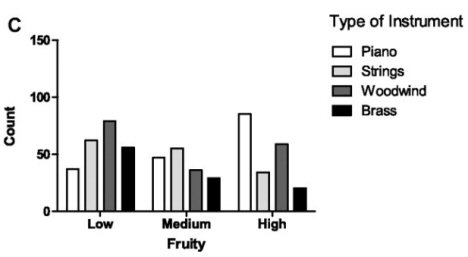
Strong piano at high fruitiness

A wonderful graph which shows how strongly the sounds of the piano, strings, woodwind and brass instruments are associated with fruity smells, across smells of low, medium and high fruitiness.

From a recent study entitled ‘A Fruity Note: Crossmodal associations between odors and musical notes’.

The study also tests how strongly these instruments are associated with acrid, floral and spicy scents, in case you needed to know.
 

Link to abstract / DOI entry of study.

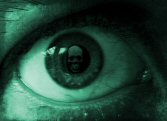
Witch on a hallucinogenic flying broomstick

I’ve just found this fascinating discussion on the psychopharmacology of ‘witches ointments’, that supposedly allowed 16th century witches to ‘fly’.

It’s from a fantastic 1998 Anesthesiology article about atropine containing plants, like belladona, deadly nightshade and hemlock, and their effects.

De Laguna was not the sole commentator about the relationship of mind‐altering drugs and witchcraft in the 16th century. In De Praestigiis Daemonum, which Freud called one of the 10 most significant books of all time, Johann Weyer (1515–1588 CE) concluded henbane was a principal ingredient of witches’ brew, along with deadly nightshade and mandrake.

According to Weyer, there were other ointments, but the essential ingredients remained the same in all. The preparations, when applied to the upper thighs or genitals, were said to induce the sensation of rising into the air of flying.

Witches were thought to anoint a chair or broomstick with the devil’s ointment, and after self‐application, would fly through the air to meet for devil worship at the sabbat. Francis Bacon (1561–1626 CE) observed that “… the witches themselves are imaginative, and believe oftentimes they do that, which they do not … transforming themselves into other bodies … not by incantations or ceremonies, but by ointments, and annointing themselves all over.”

In an extensive review of psychotropic plant ointments of the Renaissance, Piomelli and Pollio examined transcripts of witchcraft trials, writings on demonology, and the botanical composition of ointments that alleged witches used on themselves during the 15th and 16th centuries.

Despite the difficulty with accurate identification of the plants, the documents reported consistent pharmacologic effects. Further, the biochemical logic of applying these plants in a fat‐based unguent was sound, as it would promote passage of the alkaloids through the intact skin and mucosa.

The use of soot (slightly alkaline) likely would enhance the passage of organic bases because a weakly alkaline environment would be sufficient to neutralize the positive ionic charge. That this is an effective ethnobotanical technique may be seen with Peruvian coca chewers, who mix in their mouths the cocaine‐containing leaves with alkaline cinders to enhance uptake.

There is even experimental evidence for believing that a fatty base was used in these ointments; an ointment from the 13th or 14th century, found accidentally, was subjected to chemical analysis and had an animal fat content of 40%.

The full article is well worth checking out as it tackles how the plants have been used in potions and preparations through history and were a early form of anaesthesia in ancient and medieval surgery.
 

Link to Anesthesiology article.

Inner visions of seven dimensional space

I’ve just found an amazing 2002 article [pdf] from the American Mathematical Society about blind mathematicians.

I was surprised to learn that the majority work in geometry, supposedly the most ‘visual’ discipline, and fascinated to learn that they generally believe the experience of sight puts people at a disadvantage because it locks us into a perception-led view of space.

This can be a problem in geometry because it regularly works in problems that involve more than three dimensions or requires an understanding of objects from all ‘angles’ simultaneously.

Alexei Sossinski points out that it is not so suprising that many blind mathematicians work in geometry. The spatial ability of a sighted person is based on the brain analyzing a two-dimensional image, projected onto the retina, of the three-dimensional world, while the spatial ability of a blind person is based on the brain analyzing information obtained through the senses of touch and hearing. In both cases, the brain creates flexible methods of spatial representation based on information from the senses. Sossinski points out that studies of blind people who have regained their sight show that the ability to perceive certain fundamental topological structures, like how many holes something has, are probably inborn…

Sossinski also noted that sighted people sometimes have misconceptions about three-dimensional space because of the inadequate and misleading twodimensional projection of space onto the retina. “The blind person (via his other senses) has an undeformed, directly 3-dimensional intuition of space,” he said.

There is not any maths in the article but it is written for mathematicians so it contains lots of mysterious sentences like “Morin first exhibited a homotopy that carries out an eversion of the sphere in 1967”.

However, the article is also a fantastic history of blind mathematicians and has lots of quotes from current leaders in the field who explain who their supposed disability lets them better understand the maths of three and more dimensions.

Even for those without a maths background it’s an amazing insight into some remarkable people.
 

pdf of ‘The World of Blind Mathematicians’ (via @tiempoasm).

The scent of the past

The Boston Globe has a fascinating piece on the growing movement to incorporate smells into the historical record and the technology that is allowing us to ‘record’ scents.

To put smells in a historical context is to add a whole dimension to how we understand the world. Boston’s Back Bay, for instance, has at different times been filled with the smells of a saltwater marsh, a cesspool, horses, and car exhaust. Some smells vanish, new ones arise, and some shift in a way that tells a cultural story.

The jasmine and leather notes of a Chanel perfume from 1927 help us understand the boldly androgynous women of the flapper era, just as the candied sweetness of the latest Victoria’s Secret fragrance tells us something about femininity today. What we smell in our cities, homes, and natural spaces is just as much a part of our lives as the what we see, hear, and touch.

It’s a fantastic article that touches on everything from the neuroscience of smell, to the cultural meaning of certain scents, to the science of storing and recreating odours from the past.
 

Link to fantastic article ‘A Whiff of History’.

The psychology of expert predictions

This week’s edition of BBC Radio 4 All in the Mind has a fantastic section on the psychology of knowledgeable predictions that bursts lots of bubbles about the power of experts but also discusses how to make more accurate predictions.

You can listen to the whole programme online but it seems the crucial section has accidentally found it’s way onto YouTube which you can catch here.

The discussion is with author Dan Gardner and by psychologist Dylan Evans who tackle the links between risk, prediction and knowledge.

It has lots of fascinating insights, including the fact that the fame of experts is inversely related to their accuracy, that US weather forecasters are better than UK forecasters (and not because UK weather is more difficult), and that more confident predictions are more likely to be wrong.

If you want to catch the whole of All in the Mind the section of grief myths is also wonderful.
 

Link to All in the Mind.
Link to section on expert predictions.

Psychometric schooling snark

A sarcastic comment on the horrors of school, unexpectedly hidden away in the 1986 book A handbook of test construction: introduction to psychometric design by Paul Kline.

A test is said to be face valid if it appears to measure what it purports to measure, especially to subjects. Face validity bears no relation to true validity and is important only in so far as adults will generally not co-operate on tests that lack face validity, regarding them as silly and insulting. Children, used to school, are not quite so fussy.

 
Link to psychometric snark.

Alice through the crooked glass

Not Exactly Rocket Science covers a fascinating study where participants felt they were the size of a doll or had expanded to giant proportions simply by using a headset, a camera and a bit of foot stroking.

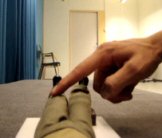
In a typical experiment, a volunteer is being stroked while wearing a virtual reality headset. She’s lyng down and looking at her feet, but she doesn’t see them. Instead, the headset shows her the legs of a mannequin lying next to her.

As she watches, Bjorn van der Hoort, one of Ehrsson’s former interns, uses two rods to stroke her leg, and the leg of the mannequin, at the same time. This simple trick creates an overwhelming feeling that the mannequin’s legs are her own. If the legs belong to a Barbie, she feels like she’s the size of a doll. If the legs are huge, she feels like a 13-foot giant.

Van der Hoort performed this illusion on almost 200 people. Questionnaires revealed that they did indeed think of the mannequins as their own body parts. Familiar objects didn’t break the spell. When van der Hoort threatened the mannequins’ legs with a knife, the volunteers’ skin broke into a worried sweat, as if their real bodies were in danger. If he touched the doll’s legs with a pencil or his finger, the recruits thought they were being prodded by giant objects. Rather than feeling like dolls in a normal world, they felt like normal people in a giant world.

The researchers Not Exactly Rocket Science dub this the ‘Alice illusion’ after the changes in size experienced by the heroine in Alice in Wonderland.

These experiences can also be experienced as part of ‘Alice in Wonderland Syndrome’ which is usually associated with migraines or epilepsy (although they can occur without any brain disorder) likely due to them affecting the brain’s system for understanding the body’s relation to the surrounding space.

Temporary body-warping experiences are being created in the lab, however, in healthy normal folks and with surprisingly simple tricks.

The Not Exactly Rocket Science piece covers the latest delightful example.
 

Link to NERS on the ‘Alice illusion’.
Link to full text of scientific study.

Human nature is a moving target

I just caught up with a fascinating discussion on ABC Radio’s Future Tense on what artificial intelligence showdowns like the Turing Test tell us about the evolution of human nature.

It sounds like a bit of clichéd subject but the interview with author Brian Christian is full of novel, thoughtful insights into how human nature is evolving in response to technological innovations.

This is one of many fascinating bits, about the effect of mobile phone technology on the dynamics of conversation.

One of the comments that we’ve heard several times on our program in the past is that people are now starting to interact with each other like computers. That computers aren’t just learning from us, we’re learning from computers…

…I would also say that the shift in telephone technology from landlines to cellphones has had a kind of unforeseen trade-off, which is that we’re now much more accessible geographically, but the cost is that the lag on the connection is six times greater. So it’s about half of a second instead of a little bit less than a tenth of a second.

And it may not seem like much, but in fact it is enough to disrupt a lot of the subtle dynamics of timing and pauses, and yielding to other people, and it’s turning communication much more into a kind of peer data exchange, you know, pure content.


Link to ABC Future Tense on technology and human nature.

Is free will spent by a knock-out drug?

I’ve got a brief article in Wired UK about whether the knock-out drug burundanga could help us understand the neuroscience of free will.

The drug is actually an extract of plants from the brugmansia family with the active ingredient being scopolamine.

The urban legend goes that when you’ve been spiked with the drug you do whatever you’re told and can’t remember anything afterwards. The truth is probably less spectacular but surprisingly, its effect on conformity has never been tested.

You may remember I made a radio programme on the same topic with the lovely people from ABC All in the Mind and although the article has just come out, it was actually the inspiration for the documentary.
 

Link to Wired UK article on knock-out drugs and free will.
Link to ABC All in the Mind documentary on burundanga.

Diamond in the rough

We’ve covered a few cases of people swallowing unusual things before, although this is probably one of the strangest cases we’ve yet come across in the medical literature.

A diamond thief was caught by a security guard during a burglary and needed a free hand to fight him off, so he swallowed the precious stone.

He was detained and taken to hospital but the diamond failed to pass naturally, so the police obtained a court order allowing the doctors to remove the diamond through the, er… tradesman’s entrance.

Often, the presence of unusual foreign objects inside the body are the result of mental illness or accident but this is the first case I know that has occurred due to quick thinking.

A 36-year-old man involved in the burglary of a precious diamond was surprisingly found at the crime scene by a security agent while he was just holding in his hand the precious stone. To keep the stone in a safe place during the battle with the security agent, the thief put the stone in his mouth and swallowed it.

Once the thief was arrested by the police, he was kept under surveillance and the stools were screened to retrieve the stone. Unfortunately, the bowel movements of the suspect were rare and the stone was not evacuated in a timely fashion. The patient was then referred to our hospital for an abdominal X-rays recommended by current medical and forensic guidelines.

The abdominal X-ray showed the stone in the cecal area. Because of court order, we shortened the waiting time until natural expulsion. Therefore, the patient underwent a total colonoscopy in the presence of police officers that easily allowed uncommon stone retrieval using a basket catheter.

The picture above, by the way, is what a diamond looks like through an endoscope, after is has got stuck up the nether regions of a burglar.
 

Link to case study.
pdf of full text.

Total information war

Perhaps one of the most important articles yet published on military infowar, propaganda, media influence and PSYOPs has appeared online.

Called ‘Military Social Influence in the Global Information Environment: A Civilian Primer’ – the piece is written by psychologist Sarah King who outlines the theory and practice of US information warfare as it stands today.

Although the piece gives a fascinating and sometimes jaw dropping account of US information operations (replete with examples) it serves as an essential general introduction to how military thinking has moved on from assuming wars are fought with troops on the ground to conceptualising conflict as inseparable from its social impact.

A more prominent view among information warriors is that changes in information, technology, and social influence capabilities have actually transformed the terms of war. War between standing armies of nation-states is seen as increasingly unlikely, both because the United States is an unmatched military superpower and because damage that would result from use of modern physical weapon systems is deemed intolerable.

Our military’s enemies, experts predict, are most likely to be small, rogue groups who attempt to prevail by winning popular support and undermining U.S. political will for war. The argument here is that in most modern war, physical battles, if they exist, will be for the purpose of defining psychological battlespace.

What’s striking is the effort to dominate all aspects of the ‘information sphere’ – from public opinion, to news coverage, to acceptance on the ground, to shaping the general cultural concept of the country’s military.

The many examples given of how this has been attempted during the recent and ongoing conflict are completely fascinating.

If you only ever read one article on ‘information ops’ make it this one. It’s online and open-access with expert commentary due to appear during the year.
 

Link to excellent InfoWar article (thanks Stephan!).

The death of the mind

Business Week has an important article on how internet companies are using the massive data sets collected from the minutia of users’ behaviour to influence customer choices.

The article is a useful insight into how tech companies are basing their entire profit model on the ability to model and manipulate human behaviour but the implication for psychology is, perhaps, more profound.

Psychological theories and ideas about how the mind work seem to play a small, if not absent role in these models which are almost entirely based on deriving mathematical models from massive data sets.

Sometimes the objective is simply to turn people on. Zynga, the maker of popular Facebook games such as CityVille and FarmVille, collects 60 billion data points per day—how long people play games, when they play them, what they’re buying, and so forth. The Wants (Zynga’s term is “data ninjas”) troll this information to figure out which people like to visit their friends’ farms and cities, the most popular items people buy, and how often people send notes to their friends.

Discovery: People enjoy the games more if they receive gifts from their friends, such as the virtual wood and nails needed to build a digital barn. As for the poor folks without many friends who aren’t having as much fun, the Wants came up with a solution. “We made it easier for those players to find the parts elsewhere in the game, so they relied less on receiving the items as gifts,” says Ken Rudin, Zynga’s vice-president for analytics.

Although the example given might seem trivial, it is a massive generator of profit and can be applied to any sort of online behaviour.

What’s striking is that the relationships between the context, motivations, evaluation and behaviour of the users is not being described in terms of how the mind or brain understand and respond the situation but purely as a statistical relationship.

It is psychology devoid of psychology. Rather than the wisdom of crowds approach, it’s the behaviour of zombies model. Unsurprisingly, none of the entrepreneurs mentioned are cognitive scientists. They’re all mathematicians.

I am reminded of the Wired article ‘The End of Theory’ which warned that big data crunching computers could solve scientific problems in the same way. The generated mathematical model ‘works’ but the model is uninterpretable and does not help us understand anything about what’s being studied.

Similarly, while the experimental psychologist’s dream for more than a century has been to work with large data sets to have confidence in our conclusions about the mind, the reality, currently being realised, may actually make the mind redundant in the majority of the commercial world.
 

Link to Business Week article (via @ivanoransky).
Time flies when you’re having fun

The New Yorker has a fantastic profile of neuroscientist David Eagleman that captures both his playful approach to science and his intriguing work on how we perceive time.

Eagleman is one of the most engaging thinkers in neuroscience – equally at home tackling fascinating areas of cognitive science and writing playful books about the afterlife.

The New Yorker article manages to both his wide ranging enthusiasm and the science behind his work into offbeat but essential brain functions.

Time isn’t like the other senses, Eagleman says. Sight, smell, touch, taste, and hearing are relatively easy to isolate in the brain. They have discrete functions that rarely overlap: it’s hard to describe the taste of a sound, the color of a smell, or the scent of a feeling. (Unless, of course, you have synesthesia—another of Eagleman’s obsessions.) But a sense of time is threaded through everything we perceive. It’s there in the length of a song, the persistence of a scent, the flash of a light bulb. “There’s always an impulse toward phrenology in neuroscience—toward saying, ‘Here is the spot where it’s happening,’ ” Eagleman told me. “But the interesting thing about time is that there is no spot. It’s a distributed property. It’s metasensory; it rides on top of all the others.”

An entertaining article that tackles everything from time stretch during life threatening incidents to a study on drummers with Brian Eno. Great fun and throught-provoking.
 

Link to New Yorker profile of David Eagleman.

Arresting suicide by cop

Suicide by cop‘ is a fairly recent concept that has come to light after cases of people who seemingly provoked police shootings in an attempt to end their own lives.

Miller-McCune magazine has an excellent article on how the police are increasingly recognising this as a problem and are working towards diverting these situations to avoid a lethal outcome.

Although some cases are clear-cut, exact figures are hard to come by, not least because it often involves inferring the intentions of someone who has just been killed.

While some say the problem is vastly under-recognised, others are concerned that it could be used as an excuse for questionable shootings by saying the subject was suicidal.

However, the Miller-McCune article takes a comprehensive look at what we know about ‘suicide by cop’ and how innovative new programmes are being put-in-place to try and pick up cases and divert them to mental health services.

Most people who have studied the phenomenon will tell you that, typically, suicide-by-cop scenarios fall into two categories: the “fleeing felon” who tries to escape police and, once cornered, decides he’s going to go out in a blaze of glory; and the “emotionally disturbed person,” who, like Seth, is looking for a way out of the pain of either mental illness or some kind of life failure.

The police encounter “emotionally disturbed persons” so regularly that, in cop lingo, they are called “EDPs.” Whether it’s a domestic call (a man with a history of depression has become violent because his ex won’t take him back), a workplace incident (an employee locks herself in a bathroom with a letter opener after being let go), or a schizophrenic homeless man screaming obscenities at shoppers at the local Dollar Store, police are often the first responders to problems involving our nation’s mentally ill. Situations involving the emotionally disturbed are volatile and can quickly spiral out of control, but most American police officers receive little specialized training on dealing with them.

The author of the piece, crime journalist Julia Dahl, and the mother of a man who tried to kill himself by provoking the police were interviewed recently on NPR Radio’s Here and Now.

Unfortunately, I’m on a low-bandwidth 1990s-style internet connection so can’t listen to it very easily, although it looks like a good complement to the article.
 

Link to Miller-McCune article ‘How to Stop Suicide by Cop’.
Link to ‘suicide by cop’ interview on NPR radio.

How to jail the innocent

The Innocence Project has used DNA technology to overturn hundreds of wrongful convictions. Slate has an excellent two part series on the two main reasons why these people were falsely jailed: eyewitness misidentifications and false confessions.

The series is by law professor Brandon Garrett who has analysed the first overturned 250 cases to examine the psychology behind distorted justice.

This is from the piece onthe biases that in line-ups that have sent people down for long-stretches after being falsely identified:

Where did this false certainty come from? The trial records I looked at suggest that unsound and suggestive police identification procedures played a large and troubling role. Police used unnecessary show-ups, where they presented the eyewitness with just the defendant. Or stacked lineups to make the defendant stand out.

Or offered suggestive remarks, telling the eyewitness whom to identify or to expect a suspect in a lineup. Or confirmed the witness’s choice as the right one. Even well-intended, encouraging remarks, like “good job, you picked the guy,” can have a dramatic effect on eyewitness memory, as psychologists have shown.

Indeed, more than one-third of the cases I looked at involved multiple eyewitnesses, as many as three or four or five eyewitnesses who all somehow misidentified the same innocent person. Further, almost half of the eyewitness identifications were cross-racial. Psychologists have long shown how eyewitnesses have greater difficulty identifying persons of another race.

Both pieces tackles how biases have warped specific high profile cases, sometimes leading to decades of false imprisonment.
 

Link to Slate piece on eyewitness misidentifications (via @psyDoctor8)
Link to Slate piece on false confessions.

Hearing the voices of colours

A spectacular case of psychosis, rather oddly described as ‘Methamphetamine Induced Synesthesia’, in a case report just published in The American Journal on Addictions.

The report concerns a 30-year-old gentleman from the Iranian city of Shiraz with a long-standing history of drug use who recently started smoking crystal:

Six months PTA [prior to admission] (October 2009), he started smoking methamphetamine once a day, and gradually increased the frequency to three times a day.

Two months PTA (January 2010), he developed symptoms of auditory and visual hallucinations (seeing fairies around him that talked to him and forced him to conduct aggressive behavior), self-injury, and suicidal attempts.

He developed odd behaviors such as boiling animal statues. He was hearing the voices of colors, which were in the carpet. Colors moved around and talked to each other about the patient. He also saw the heads of different kinds of animals gathering on a board, and they talked to him.

Finally, his mother brought him to the emergency room of Ebnecina Psychiatric Hospital in Shiraz.

The authors are using the term ‘synaesthesia‘ very liberally as it usually refers to an experience in one sense automatically triggering sensations in another – such as numbers having specific colours or tastes.

I’m not sure that ‘hearing the voices of colours’ necessarily qualifies as this could as much a delusion (a distorted belief) or a hallucination (that isn’t specifically tied to seeing the colours) rather than a genuine synaesthetic experience.

As the authors didn’t investigate any further and only have the gentleman’s word for his experiences, it’s a little hard to say.

However, it’s also worth noting that our concept of synaesthesia is no longer tied to ‘crossing of the senses’ as synaesthesia for increasingly meaningful things is being discovered.

Only recently, two confirmed and tested cases of ‘swimming-style synesthesia’ were reported in the journal Cortex where different colours were reliably triggered by the sight of people doing different swimming strokes.
 

Link to locked case report of ‘meth-induced synaesthesia’.