In defense of Big Pharma

pills_on_counter.jpgCommentary Magazine has an articulate article arguing in support of large drug companies and the necessity of current drug developing and marketing practices.

Most of the articles you see these days are quite critical of ‘Big Pharma’ so it’s refreshing to see a spirited defense.

Over the last decade, extraordinary advances in bioengineering have transformed pharmacology. Sooner or later, the industry and its pilot fish will surely find drugs that can halt colon, breast, and lung cancers, that can curb obesity and thus heart disease, and that will not merely suppress the HIV virus but purge it from the body completely. A new pharmacology of the brain may cure depression and stop the onset of Alzheimer’s. These and other once inscrutable scourges are now—essentially—becoming problems in diligent engineering.

The article tackles the economics, politics and medicine of producing potentially useful drugs on an international scale and argues that only large corporate entities have the resources and the motivation to do so.

Link to article ‘In Defense of Big Pharma’.

Is homophobia associated with homosexual arousal?

The classic 1996 paper by psychologist Henry Adams and colleagues that reported that homophobic males were more likely to be turned on by gay pornography that non-homophobic males is available online as a pdf file.

This study has been cited (not without controversy) as evidence for Freud’s concept of latent homosexuality.

It is no less controversial now and there have been many criticisms and commentaries since it was first published.

pdf of full-text paper.
Link to summary on PubMed.

Applied sleep science

nuria_sleep.jpgScience has an engaging article on how to apply the science of sleep in the service of improving your own night’s sleep, with plenty of clear advice and links to the research.

A bit bizarrely, it’s in their ‘Career Development’ section, presumably based on the idea that getting a good night’s sleep is good for your career.

Despite the slightly awkward spin, it’s useful look at how sleep research can be directly applied to optimising your downtime.

Link to ‘Forty Winks: Science and Sleep’.

Nature vs nurture via neuroscience

brain_environment_interaction.jpg

For those of who you particularly enjoyed the Prospect article on the interaction between environment and genetics in promoting certain mental states and behaviours, Nature Reviews Neuroscience has an in-depth review article on how neuroscience is helping understand this complex process.

If you haven’t got time to get down and dirty with a full-on review article though, Brain Ethics has a fantastic summary that captures the main points.

Link to full text of Nature Reviews Neuroscience article.
Link to Brain Ethics article.

The intelligent environment

school_student.jpgContinuing our IQ theme, the New York Times has a fascinating article on the contributions of genetics and environment to IQ and argues that the effect of the environment becomes much more crucial for those from low-income backgrounds.

[Psychologist Eric Turkheimer] has a reputation as a methodologist’s methodologist. In combing through the research, he noticed that the twins being studied had middle-class backgrounds. The explanation was simple – poor people don’t volunteer for research projects – but he wondered whether this omission mattered.

Together with several colleagues, Turkheimer searched for data on twins from a wider range of families. He found what he needed in a sample from the 1970’s of more than 50,000 American infants, many from poor families, who had taken I.Q. tests at age 7. In a widely-discussed 2003 article [pdf], he found that, as anticipated, virtually all the variation in I.Q. scores for twins in the sample with wealthy parents can be attributed to genetics. The big surprise is among the poorest families. Contrary to what you might expect, for those children, the I.Q.’s of identical twins vary just as much as the I.Q.’s of fraternal twins. The impact of growing up impoverished overwhelms these children’s genetic capacities. In other words, home life is the critical factor for youngsters at the bottom of the economic barrel. “If you have a chaotic environment, kids’ genetic potential doesn’t have a chance to be expressed,” Turkheimer explains. “Well-off families can provide the mental stimulation needed for genes to build the brain circuitry for intelligence.”

This interaction between economic background and mental functioning has now been replicated in a number of studies looking at everything from mental illness to criminal behaviour (e.g. see Christian’s previous post).

It seems that the simple summing of genetic and environmental effects is no longer a valid way of understanding how we develop, as the duration, quality and frequency of different life experiences seem to have unique influences on the expression of our inherited traits.

Link to New York Times article ‘After the Bell Curve.
pdf of Turkheimer’s paper.

Happiness is an impossible dream

adam_phillips_guardian_pic.jpgPsychoanalyst Adam Phillips is interviewed in The Guardian about the paradox of chasing happiness and the negative effects of emotional idealism.

Phillips argues that trying to eliminate all sources of stress in your life is a pointless exercise and we should become better at tolerating difficult situations if we are to be become fully content.

I tell Phillips that at my workstation books with the word happiness in the title arrive unbidden by the hour. They include: Daniel Gilbert’s Stumbling on Happiness, Richard Schoch’s The Secrets of Happiness, Darrin McMahon’s The Pursuit of Happiness, Richard Layard’s Happiness: Lessons from a New Science and Jonathan Haidt’s The Happiness Hypothesis. Do you read these books? “I’ve looked at them. They seem to me to be the problem rather than the solution.”

Phillips also gives his take on the current focus on CBT as the psychological therapy of choice and the use of psychoanalysis as a long-term therapy for people with socially turbulent modern lives.

Link to article ‘Happiness is always a delusion’.

The Flynn effect is reversing

rubix_cube_solved.jpgAmerican Scientist discusses the trend for changes in how well people score on intelligence tests and notes that the Flynn effect, whereby the population has been scoring increasingly well on intelligence tests over time, seems to be slowing down or reversing in some places.

It is well-known is psychology that performance on cognitive tests changes over time and across populations, which is why the most widely used tests (particularly the Wechsler series) have different versions for different countries, and are re-released every few years with new comparison data.

An IQ score is always relative to the average performance of the rest of the population, so an IQ of 100 always means you score the same as the average of the population on a current test.

As new tests are released, this average may shift, so it is difficult to directly compare IQ results from previous versions of a test.

On old tests, however, it was noticed by Flynn that people were scoring better by about 3 points per decade. The American Scientist article notes that this effect is starting to slow down or reverse in some places though.

Does this mean we’re becoming less intelligent? Probably not. It likely reflects the fact that the skill set of population is changing and that we become practiced at different tasks at different rates as modern life develops.

As an aside, IQ tests considered trustworthy by psychologists rarely go above 160, so anyone quoting a 160+ IQ is likely to be talking nonsense.

Link to article ‘Smart as We Can Get?’.
Link to Wikipedia article on the Flynn effect.

Directing dreams with sky orchestras

sky_orchestra.jpgArtist Luke Jerram is working with sleep scientists to create a device that could direct the content of dreams.

Jerram is working with psychologists Drs Chris Alford and Jennie Parker to create and test a machine that uses sound in an effort to shape the individual dreamer’s experience.

It was inspired by Sky Orchestra, another project of Jerram’s that sent an orchestra of hot-air balloons into the sky to play sounds to a sleeping population to affect their dreams on a city-wide scale.

There is a video (wmv) of the ‘orchestra’ in action and it seems a truly beautiful way to be bathed in sound during the twilight of consciousness.

There’s more music from the sky orchestra at this site, so you can try out the effects for yourself.

Link to Dream Director web page.
Link to Sky Orchestra web page.

Brain-Computer Interfaces

braincomputer.JPG
The June edition of IEEE Transactions in Neural Systems and Rehabilitation Engineering has some articles of interest including such titles as “Could cortical signals control intraspinal stimulators?” from the Mushahwar lab, “Cortically coupled computer vision for rapid image search” from the Sajda lab, “An oral tactile interface for blind navigation” from Tang and Beebe, “The Neurochip BCI: towards a neural prosthesis for upper limb function” from the Fetz lab, as well as recent reports from scientists at BCI2000. Also check out the articles by Leuthhardt et al, and Moran et al.

For a recent review of the field of neuroprosthetics, you can download presentations from the website of the Telemedicine and Advanced Technology Research Center of the United States’ Army.

Also check out the Neurotech Network “dedicated to the use of neurotechnology, the application of medical electronics to improve or restore function of the human nervous system,” directed by Jennifer French. Ms. French is an advocate for people with neurologic impairment and is a person I greatly admire.

Dear Shakespeare, an update on sleep…

midsummer's_sleep.jpgShiban Ganju writes a letter to Shakespeare in 3 Quarks Daily, updating the Bard on the scientific advances in understanding sleep.

Shakespeare was obviously fascinated by sleep as many of his plays and poems contain references to sleep and dreaming, perhaps the most famous being A Midsummer Night’s Dream.

Ganju also notes that Macbeth and Lady MacBeth had troubled stage 4 sleep and that King Richard had significant sleep pathologies.

Link to Shiban Ganju’s “Sleep and Insomnia, A Letter to Shakespeare”.

Science of Happiness on the air

happy_shadow.jpgThe Canadian science radio show Quirks and Quarks had a recent special on the Science of Happiness – an area that has seen an upsurge of interest in recent years.
The show interviews some of the leading psychologists in the field and discusses the sometimes counter-intuitive findings about how our happiness is affected by our experience of the world.

We mentioned work by Professor Daniel Gilbert, one of the show’s contributors, previously on Mind Hacks.

Link to show webpage.
mp3 or ogg of programme audio.

From Freud to cognitive therapy

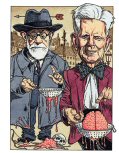
Linklater_essay_image.jpgProspect Magazine has an in-depth article about the development of cognitive behaviour therapy (CBT) – one of the most researched and effective forms of modern psychotherapy.

The article tracks how Aaron Beck discovered the principles of CBT after initially starting off as a Freudian therapist himself.

The therapy is now one of the most widely recommended non-drug treatments for mental disorder, as well as a number of other situations where psychological function can be altered to increase quality of life, such as in chronic pain.

The article is one of the best descriptions of CBT I’ve yet seen in a mainstream publication and does a great job of outlining the history of the practice.

Link to article ‘After Freud’.

Implanting magnets for a sixth sense

quinn_surgery.jpgWired magazine has an article about reporter Quinn Norton’s experience of implanting a magnet in her fingertip to add a magnetic touch sense to her sensory repertoire.

Matt reported on this practice previously on Mind Hacks, where those with the implants say they can detect magnetic fields from electrical devices.

Because of the sensitivity of the finger, different types of electrical current can supposedly be felt as different textures in the air.

The operation is not available from qualified practictioners, so involves risk of infection or the magnet breaking up – both of which Norton experienced after her implant.

Link to Wired article ‘A Sixth Sense for a Wired World’ (via BB).
Link to previous report on Mind Hacks.

Destructive impact

sciencenews_20060527.jpgThis week’s Science News has a cover article on the psychology, neuroscience and genetics of how violence and anti-social behaviour develops in young people.

The article examines how human biology and the influence of family and social life interact to increase the chances of violence and bullying in some, while leaving others able to control their actions despite being subject to hostile experiences.

Henry’s story highlights a theme that is attracting increasing scientific attention: Like all children, chronic troublemakers and hell-raisers respond to a shifting mix of social and biological influences as they grow. Some developmental roads arc relentlessly toward brutality and tragedy. Others, like Henry’s, plunge into a dark place before heading into the light of adjustment.

Developmentally minded researchers are now beginning to map out violence-prone paths in hopes of creating better family and school interventions. New evidence indicates that a gene variant inherited by some people influences brain development in ways that foster impulsive violence, but only in combination with environmental hardships. Other studies explore how family and peer interactions build on a child’s makeup to promote delinquency. Separate work examines ways to counteract the malign effects of bullying rituals and other types of coercion in schools.

“Violence is such a complicated issue,” Twemlow says. “There’s always a set of preconditions to violent behavior and never just one cause.”

Science News have kindly made the full article freely available online.

Link to ‘Destructive Impact’ from Science News.

Illusions of taste

A curious comment just added to the discussion page of Wikipedia’s illusion entry has really got me thinking:

the beginning of the article claims that all human senses can be fooled. I’ve yet to expirence an illusion of taste/smell. i.e. something salty tasting sweet. it may follow that consumption is the ‘truest’ of human expirences… [sic] Andrew

The only example that I could find on PubMed suggests that we experience taste in areas of the mouth without taste receptors, because we are fooled by the touch sensations of the food in our mouths. I could find no similar ‘smell illusions’.

If anyone knows of any examples of taste or smell illusions I’d be very interested to hear about them.

UPDATE: There’s some great answers on the comments page. Keep ’em coming. Thanks!