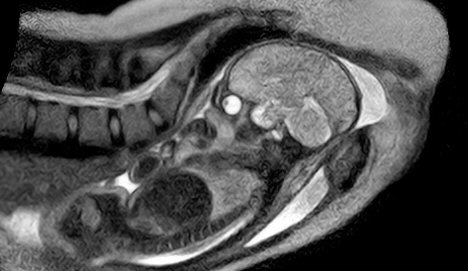
Brain scan of baby during birth

Local.de reports on the first MRI scan of a baby being born, apparently completed by Berlin’s Charité Hospital. The image shows a clear saggital section of the baby’s brain as it is being delivered.


The article reports:

A team comprised of obstetricians, radiologists and engineers have built an “open” MRI scanner that allows a mother-to-be to fit fully into the machine and give birth there, the hospital announced on Tuesday.

The MRI (magnetic resonance imaging) scanner has already taken unique images of the body of a mother and the movement of her baby through the birth canal to the point where its head emerges into the world. The birth that took place in the scanner went smoothly and both mother and baby were in good health, a hospital spokeswoman said.

All I can say is – wow!
 

Link to Local.de story ‘MRI scans live birth’ (via @BoraZ).

Clapham Junction and the frustrations of dementia

I’ve just found an amazing Terry Pratchett article published in the Journal of Mental Health earlier this year entitled ‘Diagnosing Clapham Junction syndrome’ where he discusses his experience with dementia.

Pratchett was diagnosed with posterior cortical atrophy, usually considered to be an atypical form of Alzheimer’s disease that is focused on the back of the brain and tends to cause particular disruption to visual abilities.

You can’t battle it, you can’t be a plucky “survivor”. It just steals you from yourself. And I’m 60; that’s supposed to be the new 40. The baby boomers are getting older, and will stay older for longer. And they will run right into the dementia firing range. How will a society cope? Especially a society that can’t so readily rely on those stable family relationships that traditionally provided the backbone of care?

What is needed is will and determination. The first step is to talk openly about dementia because it’s a fact, well enshrined in folklore, that if we are to kill the demon then first we have to say its name. Once we have recognized the demon, without secrecy or shame, we can find its weaknesses. Regrettably one of the best swords for killing demons like this is made of gold – lots of gold. These days we call it funding. I believe the D-day battle on Alzheimer’s will be engaged shortly and a lot of things I’ve heard from experts, not always formally, strengthen that belief. It’s a physical disease, not some mystic curse; therefore it will fall to a physical cure. There’s time to kill the demon before it grows.

I have to say, in one section, Pratchett is probably a little hard on clinicians in terms of how long it takes to diagnose dementia, which is not an easy task.

Dementia is usually defined as a decline in mental abilities that happens faster than would be expected from normal ageing and is associated with degeneration of the brain.

There are many types of dementia, and diagnosis is often broken down into ‘possible’, ‘probable’ and ‘confirmed’ versions.

Rather frustratingly, for those wanting a precise and confident diagnosis of, let’s say, Alzheimer’s disease, a ‘confirmed’ diagnosis can only be officially made on the basis of close examination of the brain tissue after the symptoms are known.

In practice this means that dementia can only be ‘confirmed’ after death. The result is that most people get a diagnosis of ‘possible’ or ‘probable’ dementia.

The former is made when the person has known cognitive problems and estimates that they were much better before, and the latter only when testing has shown that there has been a definite decline over at least six months.

For a diagnosis of Alzheimer’s, this needs to affect at least two areas of mental functioning, so a tried and tested decline in just memory over six months would still leave some doubt. This means a wait of a year can be pretty standard for a ‘probable’ diagnosis.

After finally getting his diagnosis after experiencing difficulties for some time, Pratchett says “you could have used my anger to weld steel”. It’s worth saying that the frustration is shared.

By the way, Pratchett’s article was published in a special open-access edition of the Journal of Mental Health focussing on classification where several people discuss their experience of hearing their diagnosis.

There’s a particularly good piece by Mark Vonnegut, son of science fiction author Kurt Vonnegut who was previously diagnosed with schizophrenia and is now a qualified doctor, working as a primary care pediatrician.
 

Link to Terry Pratchett on ‘Diagnosing Clapham Junction syndrome’.
Link to table of content for open-access edition.
‘Tummy time’ for baby’s brain development

Slate has an amazing article on how the brain development of young babies is linked to the amount of playtime they spend on their tummies.

This in itself is quite a startling fact, but it turns out that the campaign to cut cot death – which involved persuading parents to put babies to sleep on their back – has led to a unintentional but general decline in waking ‘tummy time’ and a slowing in movement and nerve development for some babies.

It turns out that this can have surprisingly long-term effects:

How do we know that the babies who miss out on tummy time are at a lasting as opposed to temporary disadvantage? Looking at data from thousands of people born in 1966 in Northern Finland, a research group led by Charlotte Ridgway at the Institute of Metabolic Sciences, Cambridge, has shown that a one-month delay in infant motor development had the same detrimental effect on how a 14-year-old performs in physical education class as a one-unit increase in the same child’s body-mass index. Using the same Northern Finland cohort, Ridgway and her co-authors also mapped a one-to-one link between the age at which infants stand unaided in their first year—another critical prewalking milestone—and their muscle strength and endurance, as well as cardiovascular fitness, at age 31.

It’s a very well researched piece with all the relevant evidence carefully linked in the article, discussing a surprising but important link between brain development and early movement possibilities.
 

UPDATE: Time has a cautious response to to this article, noting that although the idea is plausible, the data is largely correlational making it difficult to be confident about a lack of tummy time causing developmental delay. Recommended.


Link to ‘Tummy Time: Why babies need more of it than they’re getting’.

Photographing the brain, 1894

Legendary Polish neurologist Edward Flatau created one of the first photographic brain atlases way back in 1894. This photo shows how he carefully took 20-minute exposure photos of freshly sliced brains.

The photo is from a recent article published in European Neurology that discusses how Flatau created the atlas and the review it got from a young Sigmund Freud, then early in his career as a neurologist.

To be fair, Freud’s review was 200 words of benign praise and hardly worthy of note, but the article is worth checking out for the discussion and images from the pioneering atlas.

Lucky for us, the article has been made open-access so enjoy it while you can.

Flatau used whole and dissected human brains, unfixed and only rinsed in water. He applied small diaphragms to effect a better depth of field, and took longexposure photographs, with exposure times of 20–30 min for uneven surfaces (ventral, dorsal, lateral and medial facies, plates I, II, V and VII), and up to 10 min for flat sections (horizontal, coronal and sagittal, plates III/ IV, VI and VIII) A schematic color chromolithograph depicted central brain pathways and connections.


Link to article directly.
Link to DOI entry for article in European Neurology.

An infection of mental fog

The Guardian has an excellent article on how tropical diseases are a major and largely unrecognised risk to the mental agility of young children as parasites directly or indirectly affect the brain.

Frustratingly, the diseases are widespread and, in many cases, easily treatable, if only the resources were available.

Unfortunately, the same problems that make treatment scarce also mean that the conditions are under-researched and it’s still not clear in many cases how the diseases end up causing mental deterioration.

We are still a long way from understanding the mechanisms by which a given disease may affect cognitive function. For instance, a parasitic worm infection may have its main effect on educational progress by causing diarrhoea and malaise, leading the child to miss school or to be listless and unmotivated in the classroom. But there may be more direct effects on brain development caused by malabsorption of nutrients or iron-deficiency anaemia. It has also been suggested that the toxins generated by some parasites may affect brain function.

Such effects may be temporary, the child catching up with his or her peers once the infection has been cured, or long-lasting, if brain development is disrupted during a critical phase. Research in this area is difficult, but is urgently needed if we are to develop effective preventive strategies.


Link to Guardian piece ‘Out of sight, out of mind’.

The cutting edge of a splitting headache

ABC Radio National’s Life Matters has a programme that’s full of fascinating snippets about the cutting edge of headache science.

It’s hardly the sort of material you’ll be charming your next date with, but there are so many ‘I never knew that’ moments that it’s definitely worth catching if you have an interest in the research or treatment of a pounding head.

For example, the programme reviews how Botox is being used to treat migraine, the introduction of a completely new class of headache drugs – the CGRP receptor antagonists, and how drug companies are marketing special body part specific medications for increased profit – despite the fact they all contain identical active ingredients.

It also covers how the added codeine in standard headache pills probably does nothing and why psychological treatment can be an effective way of treating even long-term persistent headache when drugs can seem to do no further good.

Lots more eye-opening facts and a plenty of discussion tightly packed into a 20 minute show.
 

Link to Life Matters on ‘Headaches: what’s new?’

Brain, The Inside Story – AMNH, New York

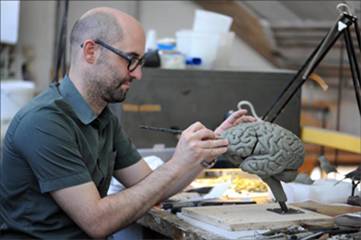
AMNH employee making a brain for the exhibition, http://www.amnh.org

The American Museum of Natural History in New York has a new exhibit called “Brain: The Inside Story“. Mindhacks.com‘s New York correspondent, Ben Ehrlich, sends this report:

I remember being a kid. I remember being a kid and going on field trips. I remember being a seventh-grade kid in New York City and going on field trips to the American Museum of Natural History. That’s why, standing at the threshold of a new exhibit there – Brain: The Inside Story, curated by Rob DeSalle – I try to imagine that I am once again a child, beholding with that ceaseless curiosity and wide-eyed wonderment all that is around me.
This proves not-so-difficult. The “tunnel” at the start the exhibition is draped with tangled clumps of recycled wire – 1500 pounds of material. It looks like some mischievous giants had a food fight with giant sticky spaghetti. Meanwhile, beads of light are moving through the thick-and-thin strands. The installation, by the Spanish artist Daniel Canogar, is meant to represent neurons firing their electrical impulses. On a plain, white pedestal at the door, a preserved brain-small and shriveled-sits understatedly in a glass case, as if daring someone to underestimate it. But the “tunnel” transports me inside its magical, gray matter, where I can walk beneath a sparkling canopy of nervous connectivity, a whole world alive within the wrinkles and folds, and I am as amazed as ever that all this happens inside of that.

Emerging from the “tunnel,” I am met by a life-sized projected image of a young dancer, sort of like the Princess Leah hologram only in spandex and a light sweat. She is in the process of an audition; she is thinking, emoting, and moving. As a recorded voice explains the correlating brain activity, a large three-dimensional brain model simultaneously lights its corresponding regions up in colors. This multimedia exhibit demonstrates the concept of regional specialization, while reminding that a brain controls a person who lives a life and has a story. From the “tunnel”-which contains an interpretation of the anatomy and functionality of brain cells-to the dancer, which illustrates cognitive, emotional, and behavioral phenomena, Brain: The Inside Story highlights some different approaches to neuroscience research, and their interrelatedness.

The rest of the exhibition is organized into five categories: The Sensing Brain, The Emotional Brain, The Thinking Brain, The Changing Brain, and The 21st Century Brain. At every turn are sights and sounds, and I am reminded of a carnival. Stand here! Look through here! Build this brain! Play this game! Touch this screen! There are illusions like an upside-down Mona Lisa made from spools of thread, and a picture of a rainy day coupled with the sound of what seems to be rainfall-until I discover it is frying bacon. (This deceptive influence of sight on sound is a demonstration of cross-modal perception). A hulking homunculus stands awkwardly with its enormous hands and mouth, a little too late, sadly, for Halloween. (The figure reflects the proportions of the somato-sensory cortex devoted to each body part). And everything shown is also explained by writing and pictures that surround every room, like an engaging textbook on a wall. Of course, unlike in school, no one has to read.

At about The Changing Brain, I notice a group of school kids making their way excitedly against the flow of we, the media. They are a diverse seventh-grade class studying neuroscience at a city secondary school. “I’ve always heard about the things memory can do, now I’m actually seeing it,” one boy tells me, excitedly. Another boy tells me how cool the exhibition is. Cool? For a kid? I ask him if it makes him want to study the brain more. He says, without hesitation, almost annoyed (because after all I should already know): “Yes.” And then he scampers off to play brain teasers with his friends. This is the main reason that Brain: The Inside Story is such an important exhibition. It informs and amuses and, although there are more and more educational resources about the brain in the public consciousness, the fact remains that-whether you are young or old or some of both-nothing beats a day at the museum.

The exhibition is open now, and is in New York until August 14 2011. After that it goes on international tour (mindhacks.com requests visits to Medellín, Colombia and Sheffield, England!)

Link to Brain: The Inside Story

Sliding into psychosis

This week’s edition of Nature is a special issue on schizophrenia and it includes an open-access feature article on the neuroscience of why the disorder only tends to appear in young-adulthood.

One of the themes to come out of the piece is how symptoms of schizophrenia, like delusions and hallucinations, lie on a continuum – the idea being that we all have reality distortions to varying degrees and that these distortions themselves may vary in intensity.

In about a third of people, these will intensify into florid psychosis and a diagnosis of schizophrenia, but for others, the experiences seem self-limiting.

One of the big questions in schizophrenia research is to understand what happens in the mind and brain during this transition and, of course, if possible, to prevent it by early treatment.

This has sparked a great deal of heated debate because up to two thirds of ‘at risk’ people will never develop schizophrenia anyway, and yet might be unnecessarily labeled and medicated.

It’s probably worth noting that the idea of a ‘continuum of psychotic symptoms’ is popular but also still not very well defined, as a locked editorial in the latest issue of Psychological Medicine makes clear.

It’s possible to see a sliding scale in the intensity of experiences, how often they occur, and the emotional impact they have, among many other things, but its not clear how you would go about disproving a continuum in many cases.

The Nature article is a remarkably broad look at the whirlwind of issues surrounding how schizophrenia develops and tackles the issue from the basic neuroscience to the ethics of early treatment.

There’s loads more great stuff on schizophrenia in the same issue, sadly most of it locked out of the internet, but if you want more neuroscience, there is another open-access article on the contentious issue of whether the brain’s glial cells communicate.
 

Link to article ‘Schizophrenia: The making of a troubled mind’.
Link to article ‘Neuroscience: Settling the great glia debate’.
Link to table of contents for this issue.

Best of both worlds

I’ve just read an incredible article on conjoined twins Tatiana and Krista Hogan who have parts of the brain in common and may be sharing thoughts and perceptions.

Adding to the conundrum, of course, are their linked brains, and the mysterious hints of what passes between them. The family regularly sees evidence of it. The way their heads are joined, they have markedly different fields of view. One child will look at a toy or a cup. The other can reach across and grab it, even though her own eyes couldn’t possibly see its location.

“They share thoughts, too,” says Louise. “Nobody will be saying anything,” adds Simms, “and Tati will just pipe up and say, ‘Stop that!’ And she’ll smack her sister.” While their verbal development is delayed, it continues to get better. Their sentences are two or three words at most so far, and their enunciation is at first difficult to understand. Both the family, and researchers, anxiously await the children’s explanation for what they are experiencing.

It’s probably worth noting that while rare, Tatiana and Krista are by no means the only conjoined twins who share a brain.

Perhaps most famous are Lori and George Schappell. If you’re not aware of the Schappells, click the link as they have led amazing lives and would be inspiring individuals even if they were they not conjoined.

This makes me wonder why the issue of shared perceptions has never been tested before.

From a scientific point of view, these studies would be important because parents often swear that their child has ‘special abilities’ which mysteriously seem to vanish when formally tested – as any child psychologist will tell you.

But perhaps it’s simply the case that none of the twins have ever been keen to take part in studies on the effect of having a shared brain.
 

Link to Macleans article ‘A piece of their mind’.

An embedded journalist for neuroscience

I’ve just discovered a new blog called The Brain Detectives by the writer-in-residence at the Montreal Neurological Institute, who has the wonderful job of hanging around and writing-up the most interesting things she hears.

Although the writer, journalist Maria Schamis Turner, has just started, the project looks very promising.

I honestly think that more research institutes should have embedded journalists. Science writing would be greatly improved if the hacks had access to the scientific literature, while the lab rats would get an eloquent interface to the outside world.

If you want a feel for the dispatches coming from the Montreal Neurological Institute, the recent post on homicidal somnambulism (murder while sleepwalking) is great.
 

Link to The Brain Detectives.
Link to piece on homicidal somnambulism.

A poetry of muddlings and loss

Art critic Tom Lubbock developed a brain tumour which estranged him from language in subtle and unpredictable ways. The Guardian has a stunning article where the writer describes how his relationship with language was altered as the tumour encroached upon his brain.

It is one of the most powerfully nuanced accounts of language impairments I have yet read and you can feel the years of art-criticism experience poured into Luddock’s analysis as he charts the effects of the glioblastoma tumour on his temporal lobe.

For a period, suddenly, I cannot speak (or read aloud) any words except the most short, simple, basic. They are fine. And all the rest, the more complex ones, come out as a kind of garbled gobbledygook or jabberwocky. Yet the stress of all the words and sentences – sense or nonsense – is equally and perfectly accurate. I know what I mean to say and to a hearer what I say moves fluently, though in and out of meaningfulness. Simple and comprehensible words punctuate a sequence vocalised out of nonsense.

It is a permanent mystery how we summon up a word. Where are these connections located in the mind? How do we know how we do it and get it right? This mystery only becomes evident when our ability to summon up our words fails.

There are many vivid passages in the piece but I was particularly struck by the most recent October 2010 entry. It is genuinely poetry in the truest sense as it captures the state of the author’s fractured language in both its content and form while subtly communicating the emotional resonance of the changes.
 

Link to Tom Lubbock on when words slip away (thanks @bakadesuyo).

What price sobriety (in vouchers)?

BBC Radio 4 recently ran a fascinating one-off programme called Sugaring the Pill on schemes that pay people to lose weight, get vaccinated or stay off drugs. Payment turns out to be particularly effective at keeping addicts clean and this caught my eye because it seems to go against some of the core scientific beliefs about persistent drug users.

The programme explores the ethics of payment programmes and the public’s discomfort, particularly when applied to drugs, with handing out rewards for something we should perhaps be doing anyway.

Payment as treatment is known in the medical literature as ‘contingency management’ and has been found to be most effective in keeping heroin and cocaine addicts clean.

As the programme, and the research summary linked above, describe, a typical payment scheme will give a ticket for every clean urine test – usually starting with a small value like £1, and increasing by 50p each time.

Only when the patient has completed a whole series of clean drug tests, maybe after a month or two, can they exchange their tickets for shopping vouchers which they can spend in the high street.

The fact that these schemes are so effective is surprising, because they rely on abilities thought to be lacking or impaired in addicts – mainly the capacity to delay rewards and gratification.

There is now a host of research showing that addicts have problems with temporal discounting. We all have the tendency to judge future benefits as significantly less important than immediate ones but this seems to be enhanced in drug users who greatly overly prioritise rewards that arrive sooner.

Also, persistent drug use is widely believed to alter the brain’s reward system so positive reinforcement (wanting benefits) becomes less persuasive than negative reinforcement (the desire to escape an unpleasant sensation).

Similarly, research suggests that in addiction, the desire to take drugs become less modifiable by our executive system and so less amenable to voluntary control.

So, for people who should be primarily motivated by immediate chemical rewards over long-term abstract benefits, a slowly accumulating shopping voucher scheme would be the last thing you would predict to have such a reliable effect on keeping people off the smack or blow.

I note this purely as a curious inconsistency and if you have any suggestions that might explain it, do add them in the comments.

The BBC programme is excellent, by the way, and is also available as a podcast.
 

Link to Sugaring the Pill info and streamed version.
Link to page with podcast (for four weeks).

Khat among the pigeons

All in the Mind kicks off a new three-part series on ‘Cultural Chemistry’ with a programme about the effects and politics of the stimulant khat which has an important place in several East African cultures.

The plant is used widely in Somalia, Ethiopia and Yemen and when chewed it causes a mild buzz owing to low levels of a naturally occurring amphetamine-like compound called cathinone.

Although originally rooted in Africa, the plant is available across the world although its legal status varies – from banned in the USA to completely legal in Britain.

It is used traditionally like coffee to perk people up and make them more chatty although it is often the subject of controversy because it has been linked with triggering psychosis and aggression in some people – although the scientific evidence is far from clear.

I managed to try khat once after I discovered it on sale at a grocery in Leicester. Although it did cause a slight buzz I was most struck by the taste as it is incredibly tannin-like, making the experience a little like chewing on a tea bag.

But as All in the Mind notes, as the plant is strongly linked to specific social settings, it’s difficult to understand its effects without considering the environment in which it’s taken and the programme does a fantastic job of exploring the complex mix.

Coffee is next up in the ‘Cultural Chemistry’ series which should be worth keeping an eye on as there might be something a little special later on. Also, there’s more on the All in the Mind blog and a call for you to contribute your own recordings.
 

Link to All in the Mind Cultural Chemistry series on khat.
Link to more details and additional audio on the AITM blog.

It only exists if I can see colours on a brain scan

Bad Science has an excellent piece on the recent hot air from a researcher who claimed that brain activity differences between people with high and low sex drive proved that ‘hypoactive sexual desire disorder’ was ‘a genuine physiological disorder and not made up.’

This strikes me as an unusual world view. All mental states have physical correlates, if you believe that the physical activity of the brain is what underlies our sensations, beliefs and experiences: so while different mental states will be associated with different physical states, that doesn’t tell you which caused which. If I do not have the horn, you may well fail to see any increased activity in the part of my brain that lights up when I do have the horn. That doesn’t tell you why I don’t have the horn: maybe I’ve got a lot on my plate, maybe I have a physical problem in my brain, maybe I was raped last year. There could be any number of reasons.

But far stranger is the idea that a subjective experience must be shown to have a measurable physical correlate in the brain before we can agree that the subjective experience is real, even for matters that are plainly experiential. If someone is complaining of persistent low sex drive, then they have persistent low sex drive, and even if you could find no physical correlate in the brain whatsoever, that wouldn’t matter, they do still have low sex drive.

One of the reasons why attempts to make problems of behaviour or experience seem ‘biological’ is that the concept is strongly linked to the idea that if something is a ‘biological disorder’ we are less to blame because we have less control over the symptoms.

This is daft, of course, because although biology uses less talk of free will and agency, it is really just another level of explanation.

The beauty of a captivating picture doesn’t somehow disappear if we discuss the molecules of the paint and, in a similar way, discussing the interactions of neurons won’t mean that the problem of free will no longer applies.

But the drive to try and eliminate free will is, in part, because of the stigma still attached to many types of problems. Instead of trying to tackle stigma we often try to misguidedly reclassify the object of the stigma.

It’s like trying to fight racism by classifying a wider range of skin colours as white – it really misses the point and actually maintains the prejudice. In the same way, we should be working towards accepting all human difficulties, however they are most appropriately described by scientific theories, as valid and worthy of concern.

This does not mean all necessarily need to be classified and treated as medical disorders, but it does mean that we should respect the difficulties people face and think about constructive ways of helping ourselves and other people to tackle them.
 

Link to Bad Science on ‘Neuro-realism’.

Lights, camera, action potential

The Loom has a wonderful photo essay taken from a new book called ‘Portraits of the Mind: Visualizing the Brain from Antiquity to the 21st Century’.

The photos range from the first ever known drawing of the nervous system, made by 11th century Arab scientist Ibn al-Haytham, to the beautiful pictures of the ‘brainbow‘ fluorescent neurons.

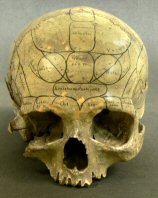
Don’t miss the caption below each picture that describes its origin and significance. The photo on the right is genuine human skull with phrenology markings.
 

Link to Loom photo essay.
Link to details of the book ‘Portraits of the Mind’.

Impaled by comparison

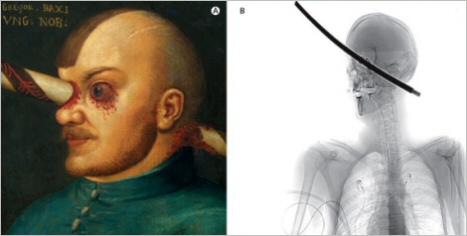
The picture on the left is a famous 1550 portrait of the Hungarian nobleman Gregor Baci who was impaled through the head by a lance.

It was never known whether the picture had been exaggerated. Recently, a medical team from Austria reported a remarkably similar case in The Lancet where the patient survived and recovered with no ill effects. The CT scan of this modern-day Gregor Baci is visible on the right.
 

Although case reports of trauma describe single events only, they can contain very useful scientific information for applied surgery. The portrait of Gregor Baci from the collection of Archduke Ferdinand II of Austria (figure A) provokes the question: is the legend that Baci survived a piercing injury with a lance only a myth, or does medical fact indicate that such severe impalement of the head and neck can be survived? We were able to provide the answer, when a similar case of impalement presented to us.

The patient, a craftsman, was injured when a metal bar fell from the ceiling of a church with an altitude of about 14 m, impaling his head in an anterior-posterior direction (figure B)…

The patient had to undergo surgical treatment twice, and had a year of episodes with headache and moderate diplopia, but now, about 5 years after the accident, the patient does not show any related clinical symptoms…


Link to DOI entry for brief Lancet case report.