Execution rests on IQ test

daryl_atkins.jpgThe BBC are reporting that convicted murderer Daryl Atkins may be executed by the state of Virginia, based on a recent IQ test where he scored 74, four points above the legal definition of retardation, which had previously excluded him from the death penalty.

When first tested in 1998, his IQ measured 59, well below the 70 points cut-off level. The cut-off of 70 is significant, owing to design of the IQ test.

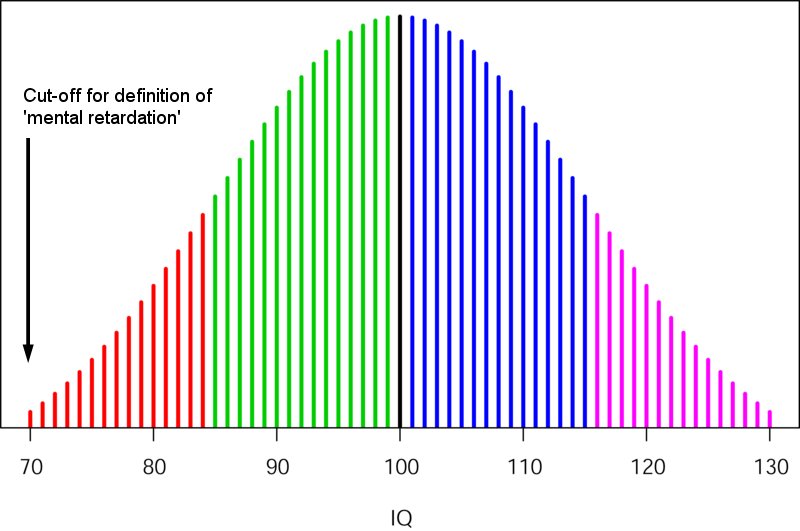
Intelligence shows a specific sort of distribution in the population, and follows a common pattern, known as a normal distribution.

Rather than design a test with arbitrary figures, modern IQ tests have been created with specific statistical properties to make them easier to interpret: the average IQ is 100, and the standard deviation (the average variation from the average) is 15. Click here to see a graph of this in a pop-up window.

The cut-off of 70 is two standard-deviations below the average. It is known that 95% of the population will score within two standard deviations on either side of the average. This makes the legal definition of retardation, at least in Virginia, as having an IQ score in the bottom 2.5% of the population.

There is no easy explanation as to why someone’s IQ score might rise during a 7-year period. Prosecutors are arguing that he ‘pulled-punches’ on the original test, the defence argue that his interaction with lawyers has raised his IQ – although many factors, such as distraction, the skill and reliability of the tester, and familiarity with the tests can affect the score.

Interestingly, the prosecution are arguing that his IQ is actually 76, 2 points higher than the defence claim. Why quibble over two points?

Possibly because of another statistical property of IQ. It has a standard error of measurement (the average error in assessing the presumed true score) of 5 points.

Even taking into account a standard error of measurement of 5 points, a score of 76 would definitely be above the level of retardation – making Atkins eligible for the death penalty, whereas a score of 74 is still ambiguous.

Interestingly, it was a supreme court decision, based on Atkins case, that first made it illegal to execute convicts considered legally retarded.

Statistical properties aside, the whole concept of IQ itself is still controversial among some psychologists, and was most notably criticised in Stephen Jay Gould’s book The Mismeasure of Man.

Link to BBC News story.
Link to story from Daily Telegraph.

Cognitive neuroscience quilts

fabric_brain_art.jpgThe Museum of Scientifically Accurate Fabric Brain Art has a collection of scans from brain imaging studies – reproduced as lush hand-stitched fabrics.

The detail on the work is intricate and enthralling, and includes the reinterpretation of both PET and MRI scans.

Link to The Museum of Scientifically Accurate Fabric Brain Art.

UPDATE: Thanks to an email from their creator, I can tell you that the quilts were made by psychologist Marjorie Taylor, whose work on children’s imaginary friends has been previously featured on Mind Hacks. Thanks Marjorie!

All in the Mind: The Intimate Unconscious

ABC Radio’s All in the Mind has so many good shows, we almost require a permanent feed. This week is no exception with an excellent edition on ‘An Intimate History of the Unconscious’.

Our minds are wayward beasts. Many of the quirks of our conscious experience go unexplained. Could our conscious mind be but the tip of an iceberg, underpinned by the seething underbelly of the unconscious? Freud famously thought so. The Ancients appealed to gods, the gremlins and the underworld to explain our strange ways. Cognitive scientist Guy Claxton has unearthed the unconscious throughout history. Despite the exciting triumphs of neuroscience, he argues that mystical metaphors of the hidden mind still have their place.

Guy Claxton has written a book on the same topic, entitled The Wayward Mind: An Intimate History of the Unconscious, and shares some of the insights he discovered while writing it.

mp3 or realaudio to programme audio.
Link to transcript.

NewSci on speed, fatigue, denial and terrorism

ns20050723.jpgThis week’s New Scientist has a mixed bag of articles on psychology and neuroscience, covering the effects of amphetamine on the brain, and developments in understanding chronic fatigue syndrome, anosognosia and suicide bombers.

The effects of amphetamine are a hot topic at the moment, owing to recent sharp increases in its use, illegally – in the form of street speed, particularly methamphetamine or ‘crystal meth’, and on prescription – in the form or dexamphetamine and ADHD drug Adderall.

New Scientist has one of its lead articles on the debates over the potential damaging effects of amphetamine, and what this means for recreational users and the millions of children prescribed amphetamine-like drugs.

One worry is a lack of long-term studies into the effects of using such stimulant drugs in childhood, on adult health and functioning.

Another, shorter article, in the same issue, discusses a condition called anosognosia, where a brain-injured patient may be unaware of, or seem to deny, sometimes quite striking disabilities – for example, being blind or paralysed.

Other short articles tackle the social psychology of terrorism and the role of intra-group declarations of commitment in motivating suicide bombers, and recent findings on contributory genes for the still, largely mysterious, chronic fatigue syndrome.

None of the articles are online (grumble grumble), but your local library may have it if your newsagent doesn’t.

Link to New Scientist contents page.

2005-07-22 Spike activity

Quick links from the past week in mind and brain news:

spike.jpg

A thought-controlled voice synthesiser might be the next logical step for ‘neuroprosthetics’.

Marketing companies are developing software to profile personal characteristics from blogs.

One we missed from the week before: Great Cognitive Daily article on research into eliciting false confessions.

Wired looks at the research of the ‘Princeton Engineering Anomalies Research program’ who investigate whether mental events can affect machines.

Children as young as 7 can detect self-interest in a speaker’s claims.

Scientific American takes a look at how neuroscience is advancing treatment for Parkinson’s disease.

Adolescent girls show changes in slang and colloquial language before boys.

Architects and designers are starting to use findings from neuroscience to design better buildings.

Researchers claim to have found one of the genes that increase risk for autism.

Study finds 80% of 14-16 year old girls want to crash diet to “attract boys’ attention and achieve self-confidence”.

Art, mind and belief

jerusalem_doorway.jpgThe Haunch of Venison Gallery in London has a show that has collected art on the themes of mind and belief. It has pieces by a number of renowned contemporary artists, and includes an intriguing piece by Nathan Coley, who focuses on the Jerusalem syndrome.

This controversial condition was first identified by psychiatrist Yair Bar El, who claimed some people who ended up in psychiatric care in Jerusalem, were previously stable tourists who had become overwhelmed, and had distinct religious delusions that seemed to abate when they left the area.

Others have disputed the fact that these people were mentally stable beforehand, and argue that this was simply a case of pre-existing psychosis flavoured by the environment.

Coley’s contribution to the exhibition is a video about the syndrome, including interviews with psychiatrists who have encountered presumed cases in Jerusalem.

The show runs from 7th July to 25th August.

PDF of press release for show ‘Changes of Mind: Belief and Transformation’.
Link to story from The Guardian on the exhibition.
Link to Haunch of Venison Gallery.

Social science research forum launches

An internet discussion board has been launched to allow psychologists and social scientists to swap advice, queries and concerns about research into human behaviour.

It’s free to join and should be a useful resource for researchers wanting advice on anything from ethics and implementation, to statistics and presentation.

Link to the ‘Research Companion Forum’.

Attack of the porno-zombies

zombies.jpgThe Guardian reports on psychologist Judith Reisman, who argues that pornography is an ‘erototoxin’ that damages the brain, impairing cognition and rational thought:

“According to Dr Judith Reisman, pornography affects the physical structure of your brain turning you into a porno-zombie. Porn, she says, is an “erototoxin”, producing an addictive “drug cocktail” of testosterone, oxytocin, dopamine and serotonin with a measurable organic effect on the brain.”

In the first instance, she’s right. Pornography does physically affect the brain. In fact, everything we experience physically changes the brain in some way.

What Reisman is trying to do, is portray this physical effect as ‘damage’. Furthermore, she argues the damage could be so severe, that an affected person would not be rational enough to engage in ‘free speech’ (notice the leap?).

Unfortunately, her self-published paper The Psychopharmacology of Pictorial Pornography Restructuring Brain, Mind & Memory & Subverting Freedom of Speech (PDF) is highly selective when reviewing the published neuroscience research.

Many of her arguments are based on one-reference claims, and some only on what she calls “extensive documentation”. One unmentioned implication is the fact that, if sexual arousal from pornography causes ‘brain damage’, then so will real-life sex!

Critics note that Reisman is associated with the Lighted Candle Society, a right-wing Christian organisation aiming to promote ‘moral values’ and fund anti-porn brain scanning studies.

Ironically, her paper is prefaced by a note saying it is restricted to adults over 18, as it contains ‘graphic images from mainstream pornography’.

Link to Guardian piece ‘Sex on the brain’.
PDF of ‘The Psychopharmacology of Pictorial Pornography Restructuring Brain, Mind & Memory & Subverting Freedom of Speech’ by Judith Reisman.
Link to critical piece on Reisman’s work.
Link to story from Desert News on the funding of anti-porn MRI studies.

What on earth is ‘brain sex’ ?

brain_sex_pic.jpgOn Sunday night, the BBC ran the first part of their Secrets of the Sexes series which claimed to rank the show’s participants by ‘brain sex‘, on a scale from 100% male brain to 100% female brain.

The trouble is, there is no objective measure of the sex of the brain, making the whole idea of ‘brain sex’ questionable.

During the show, a number of participants complete various tasks, and their performance allows them to be placed along the scale. The BBC even has an online test allowing you to rate yourself.

The rating of ‘brain sex’ seems to be based on Simon Baron-Cohen’s theory that males and females are likely to differ in skills he calls empathising and systemising.

Empathising is described as the ability to understand and relate to others’ emotions, systemising the tendency to understand things in terms of rules or component parts.

Females tend to score higher on Baron-Cohen’s test of empathising, and males on systemising. So how does this get transformed into the concept of a 100% male or female brain ?

Firstly, it assumes that Baron-Cohen is correct about his theory. This is a big assumption as it is still controversial. Among others, psychologist Elizabeth Spelke has noted several important objections.

Secondly, it involves making an absolute statement (e.g. ‘there is a 100% female brain’) from relative data – e.g. ‘females have a tendency to score higher on the empathising test’.

By using another test, however, alternative differences between males and females can be found. In other words, the rating of how ‘male’ or ‘female’ a person’s brain is, depends on what test is used – something which seems to rubbish the idea of describing any brain as a particular sex.

Instead of describing someone as having a ‘50% female brain’, it is more accurate to say, “compared to everyone else’s performance, on these tasks you scored mid-way through the range of typical female scores”.

Some might say the BBC are just trying to communicate science in a straightforward way, but consider how misleading this sounds: “You have a 50% female foot”. Oversimplified to the point of confusion.

Link to BBC ‘Secrets of the Sexes’ website.

Are antidepresssants any better than placebo ?

pills.jpgA review article in this week’s British Medical Journal questions whether antidepressants have any more effect than placebo.

The report, authored by psychiatrist Joanna Moncrieff and psychologist Irving Kirsch, analyzes data used in previous healthcare recommendations, concerning a class of antidepressants called SSRIs, of which Prozac is the most famous.

They argue that the improvements found in previous reviews of the data have either been so small that they are clinically insignificant, or have been due to errors or biases in analysis.

In response, Darrel Reiger from the American Psychiatric Association is quoted as saying the researchers have “written an article that selectively pulls out negative studies and conveniently ignores or mischaracterizes positive studies.”

Link to BMJ article ‘Efficacy of antidepressants in adults’.
Link to story from Yahoo News.
Link to story from WebMd.com

Wisdom, old age, and maintaining the brain’s edge

Mind Hacks favourite All in the Mind has an special on wisdom, learning and the development of the brain through the lifespan:

None of us are getting any younger. As our bodies show signs of wear, so do our brains. We get forgetful, are confronted by new ideas and perplexed by new technologies. The world appears to be moving way too fast, as we sink into memories of the good ol’ days. Eminent neurologist and author Elkhonon Goldberg argues we have no excuse. His message – make your brain sweat if you want to enjoy your mental life to its fullest. And his suggestion is that the two hemispheres of our brain age differently as we wise up.

mp3 or realaudio of programme.
Link to programme transcript.
Link to ABC Radio National ‘All in the Mind’ website.

Coldwar nuclear fallout used to date brain cells

mushroom_cloud.jpgA paper in science journal Cell reports on a technique for carbon dating brain cells, based on the rise in atmospheric radiation from the testing of nuclear weapons during the Cold War.

This testing resulted in a large rise in world-wide levels of environmental radiation, peaking in the mid-1960s. Because this radiation was absorbed via CO2, the decay of radioactive carbon in the DNA of neurons can be used to date when these cells were ‘born’.

The study, led by neuroscientist Kirsty L. Spalding, examined the age of neurons in the occipital cortex – an area at the back of the brain important for the visual system.

The researchers found that the cells in this area were as old as the people studied, suggesting that new neurons are not created there.

Until a few years ago, it was thought that humans did not grow new brain cells after birth. It was discovered, however, that neurons regenerate in an area of the brain called the hippocampus, a structure known to be crucial for memory.

It is still unclear whether other areas of the brain regenerate, although this study suggests that, in the occipital lobe at least, neurons are not created anew.

Link to summary of study ‘Retrospective Birth Dating of Cells in Humans’.

2005-07-15 Spike activity

Quick links from the past week in mind and brain news:

spike.jpg

The Guardian has an article on the ethics and technology of ‘smart drugs‘.

National Geographic on findings that dopamine boosting drugs for Parkinson’s disease can lead to compulsive gambling, sex and drinking.

Why are auditory hallucinations (‘hearing voices’) usually male ? Sheffield researchers think they have the answer.

Thinking about an allergen free environment can reduce allergy symptoms by a third, report researchers studying self-hypnosis.

During ovulation, women prefer the scent of ‘alpha males‘ compared to other times in the menstrual cycle.

Smithsonian hosts exhibition inspired by synaesthesia (via BoingBoing).

People with the genetic condition William’s syndrome often seem fearless and ‘overfriendly’. Researchers suggest differences in amygdala function may explain it.

Forwarding entertaining emails is a form of informal gift economy.

British government ignores psychiatrists, service users to develop new mental health laws.

Petra Boyton’s guide on how to take part in sex research.

NewSci on music, depression and brain-cooling chips

ns_20050716.jpgThis week’s New Scientist has three articles relevant to mind and brain science: An interview with controversial psychiatrist Peter Kramer, an article on the evolution of music, and an article on the development of brain-cooling anti-epilepsy chips.

The chips are being developed by neurologist Steven Rothman and work on the principle that brain cells stop working when cooled.

Some epilepsy is triggered by the activity of a small identifiable area, known as the foci, and spreads to the rest of the brain with catastrophic effect.

The idea is to implant a microchip that can detect when seizure activity starts, which subsequently starts a cooling device to temporarily deactivate the area of brain, stopping the seizure before it spreads.

The other articles include an interview with champion of biological psychiatry, and author of Listening to Prozac – Peter D. Kramer, and an article on evolutionary explanations for the existence of music.

Unfortunately, none are available online, although locked articles are occasionally freed-up after a few days, so we’ll link to them if they appear. Otherwise, it may require a trip to the newsagents or the local library.

Link to contents of New Scientist

The psychology of terrorism

london_crest.jpgIn the wake of suspicion that the London bombings were carried out by British nationals, many have asked what motivates acts of terror. Psychologist Andrew Silke studies the psychology of terrorism to try and find out.

Despite the insanity of the acts, one of the most common myths is that terrorists are mentally unbalanced in some way. In an article written shortly after 9/11 (PDF) he noted that even for suicide bombers, evidence for psychopathology or personality disorders is scant.

Work on the impact of terrorist attacks has been most recently focused on the aftermath of the 9/11 attacks. Silke notes in a more recent article (PDF), that although, in general, being closer to the Twin Towers was related to higher levels of Post Traumatic Stress Disorder, for other people, stress was related to exposure to television reporting.

The effects on people’s desire for revenge was, perhaps, contrary to expectation:

It was interesting to note, however, that Johll and Brant (2002) also found that New York City residents actually reported a lower need for
vengeance than other Americans. As one firefighter in their study put it: “I wouldn’t wish what happened to us on anyone.”

Suggesting that experience of terrorist attacks, can make people less likely to want more violence to return.

Needless to say, the psychology of terrorism and terrorists is now being heavily researched, as very little was known about it before 2000.

PDF of 2004 article ‘Terrorism, 9/11 and Psychology’ by Andrew Silke
PDF of 2001 article ‘Terrorism’ by Andrew Silke
Link 1 , link 2 and link 3 to coverage from PsyBlog on psychology of terrorism.
Link to summary fof 2004 conference from BBC News.

Health Report on coping with negative emotions

The latest edition of ABC Radio’s Health Report focuses on coping with negative thoughts and emotions, and the differing responses to fear in the brains of men and women.

down_eyes.jpg

The programme also discusses research into how well young people can spot the signs of clinical depression and psychosis, an approach to helping people cope with suicidal thoughts, and how depression can affect people through generations.

One highlight is an interview with Dr Simon Bridge, an australian GP with a special interest in mental health, and who has experienced suicidal thoughts himself as a part of his experience with bipolar disorder.

He developed a pamphlet that gives advice on coping with suicidal thoughts which is available online as a PDF.

Link to Health Report website.
mp3 or realaudio of programme audio.