The amazing technicolour dream hoax?

Dream researchers in the 1950s concluded that people typically dreamed in black and white whereas modern dream research reports most people dream in colour. Philosopher Eric Schwitzgebel discusses this curious finding in a 2002 article, arguing that it is unlikely dreaming has changed so radically and that this is likely evidence of how bad we are at introspection into our dream lives.

Schwitzgebel discusses a whole range of theories and ideas, but begins by summarising the evidence from a time when it was largely assumed that people dream in monochrome:

In 1951, Calvin S. Hall announced in Scientific American that 29% of dreams are either entirely colored or have some little bit of color in them (Hall, 1951). He called such dreams ‘technicolored’, thereby explicitly comparing them to the colored movies that were becoming increasingly prevalent in the 1940s and ’50s, and implicitly contrasting them with lower-tech black and white movies and dreams.

Some of Hall’s contemporaries might have thought him too generous in his estimation of the proportion of colored to black and white dreams. Tapia, Werboff and Winokur (1958) found that only about 9% of a sample of people reporting to the hospital at Washington University in St. Louis for non-psychiatric medical problems reported having colored dreams, compared with 12% of neurotic men and 21% of neurotic women. Middleton (1942) found that 40% of his college sophomores claimed never to see colors in their dreams, 31% claimed rarely to do so, and only 10% claimed to do so frequently or very frequently.

The first objection you might think of is that perhaps these results are accurate, owing to the fact people watched lots of black and white TV and films.

But in an age when people still spent a relatively small proportion of their time in the cinema or in front of the TV (which only had restricted broadcasts) it is unlikely to account for the virtual ‘absence’ of coloured dreaming, especially considering that ‘real life’ is experienced in colour.

One of the most interesting hypothesis tackled by the article is that dreams are like narratives, and do not necessarily have colour, but black and white media might just have led people to interpret their dreams in this way.

Consider, as an analogy, a novel. While novels surely are not in black and white, it also seems a little strange to say that they are ‚Äòin color‚Äô. Certainly novels make fictional attributions of color (‚Äòshe strode into the room in a dazzling red dress‚Äô) and refer to objects that normally have a particular color (‚Äòshe promptly chopped a carrot‚Äô). Maybe it makes sense to describe such fictional claims as ‚Äòin color‚Äô or partly in color. However, most elements of most scenes in novels do not have determinate colors in that way…

If you find yourself disinclined to think that novels, or the images evoked by novels, are properly described as being either in black and white or in full color, then you might likewise find yourself hesitant to apply the terms ‘black and white’ or ‘colored’ to dreams. Perhaps dream-objects and dream-events are similar to fictional objects and events, or to the images evoked by fiction, in having, typically, a certain indeterminacy of color, neither cerise nor taupe nor burnt umber, nor gray either.

The article goes on to suggest that this reconstructive aspect is a core feature of consciousness and that is further evidence that we are just not very good at introspecting our own minds because as soon as we do, we alter the contents of what we’re attempting to experience.

pdf of ‘Why did we think we dreamed in black and white?’

Reminiscence tickets competition

The lovely production team behind the London neurology and reality play Reminiscence have been kind enough to offer Mind Hacks readers the chance to win two tickets to see the piece on the date of your choice.

It runs until the 20th September in Jackson’s Lane Theatre in Highgate and all you have to do to enter is just email before about 9am Friday Morning (Queen’s Standard Time) when I shall stick all the email addresses into a spreadsheet, sort by a randomly generated number, and pick out the one on top.

If you want enter, just send an email to:

reminiscencetickets@googlemail.com

I’ve caught it in rehearsal and shall be seeing it ‘live’ for the first time tonight, and I can’t wait!

Just to reiterate, I’m not financially connected to the play in anyway but have had the pleasure of working with the team to discuss the mind, brain and disturbances of reality and I hope as many people get to see it as possible.

Link to more information in earlier post.

Taking responsibility

Cato Unbound has a thought-provoking essay arguing that we need to radically re-think our relationship to psychoactive substances of all kinds to encourage informed responsible drug use rather than relying on the impossibility of prohibition to protect society.

The piece is by the founders of the Erowid drugs information and experience exchange site, who have been at the forefront of promoting education and information as the basis of responsible drug use.

“Know your body. Know your mind. Know your substance. Know your source.” One of Erowid’s earliest slogans, this directive encourages people to pay close attention to multiple aspects of their psychoactive substance use. These include understanding the individuality of response; avoiding drugs contraindicated because of health issues; learning enough about each substance to avoid unexpected effects and overdoses; and choosing both substance and information sources carefully in order to reduce risks. While these principles may seem obvious, they are seldom taught in contemporary drug education.

Alcohol is a good case to study, as its use is accepted in our culture and is not illegal for those over 21. Yet healthy and pragmatic drinking practices are seldom taught by parents, schools, or the government. By the time young adults reach the legal drinking age in the United States the vast majority of them have already consumed alcohol. In 2006, according to the National Survey on Drug Use and Health, the average age at which Americans first tried alcohol was 16.5, with only one in ten waiting until they were legally of age to drink.[14] And they haven’t just had a sip; nearly 40% of 20-year-olds have gotten drunk in the last month.[15] The opportunity to teach responsible use of alcohol—the most commonly consumed and arguably one of the most dangerous strong psychoactives[16]—is missed. The situation is much worse for controlled substances.

Teaching responsible, intentional use to young people does not require giving detailed instructions on how to use illegal psychoactives. The general principles can be taught through education about prescribed medications, alcohol, or other legal drugs. There are many practical lessons about how to safely and responsibly use psychoactives, whether learned from personal subjective experience, research, or the hard-won wisdom of others.

They make the important point that this applies to all drugs, illicit, commercial, medical, natural and artificial – from aspirin to angel dust.

Link to ‘Towards a Culture of Responsible Psychoactive Drug Use’.

Reminiscence opening

Neuroscience and fabric of reality play Reminiscence opens tonight in London. For those not able to make it, the company have put images from the production online, which are quite beautiful in themselves.
Mrs O’Connor is a woman who develops a temporal lobe epilepsy that triggers hallucinated music and memories that seem to help her come to terms with a lost youth.

You’ll notice the set is actually a huge backdrop and one of the amazing things about the play is that it literally uses this fabric to model the mindscape of the main character.

It is not only the surface for some stunning visual projections, but is dynamically reshaped as Mrs O’Connor moves through the story and shifts from reality, to memory, to hallucination.

As science has told as that much of our remembering is reconstruction, the play centres around whether her seizure-sparked memories are real, or just fragments woven together to best fit what she hopes is true.

While Mrs O’Connor is tempted to succumb to her recollections, her neurologist is worried about the consequences of unchecked epilepsy, and both have to weigh neuroscience against the meaning of her memories.

All this is woven together with some stunning original music, played by the cast, who are also professional musicians and singers as well as actors.

I’ve been lucky enough to spend many happy hours discussing neuroscience with the cast and writers, and if you’re keen to come and join the discussion, I’ll be part of the free science forums that happen after the matinee performances on Sunday September 14th and Wednesday September 17th.

You can come along to these even if you saw the play on another day.

The play runs from 9 ‚Äì 20 September at the Jackson’s Lane Theatre in Highgate.

Hopefully, I should have some more exciting news shortly!

Link to Reminiscence information.
Link to online ticket sales.
Link to photos of the production.

Intuitive number sense part of formal maths skills

The ability to intuitively estimate the number objects you can see is known as automatic number sense and has been widely studied in the scientific literature, but is usually thought to be separate from the formal and precise maths abilities we learn at school.

A new study just published online in Nature suggests that these abilities are more intertwined than we might think, as the better the number sense of 14 year-olds, the better their formal maths ability.

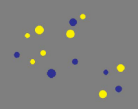
The researchers, led by psychologist Justin Halberda, flashed up a series of dot patterns to a group of 14 year-old students. Just like the one in the picture.

The kids were asked to indicate the ratio of blue and yellow dots but because the patterns flashed up so quickly, for only one fifth of a second, the kids didn’t have time to count them. They had to rely on a guestimate – their number sense – to give their answer.

After a whole set of these, the researchers calculated each kid’s accuracy, to give a measure of their overall number sense ability.

This in itself isn’t particularly interesting, as number sense has been widely tested and researched in the scientific literature. However, in the past, it’s often been considered a fuzzy, perhaps more ‘primitive’, ability unrelated to formal maths skills.

Owing to the fact that the researchers had access to the children’s maths achievement test scores, all the way back to kindergarten, they tested whether number sense and maths skills were related.

It turns out they were, and automatic number sense accounted for almost a third of the scores on formal maths tests.

This was even after controlling for the fact that some children were generally brighter or quicker than others.

What is not clear is whether just being better at maths means you develop a better number sense, or whether a better number sense encourages better maths skills.

The fact that they are related at all is interesting, however, as it suggest that intuition plays a part in the practice of mathematics – the most logical of pursuits.

Link to scientific paper.
Link to PubMed entry.
Link to write-up from ScienceNow.

Drugs for optimising morality

This month’s British Journal of Psychiatry has a fascinating essay by psychiatrist Sean Spence who argues that while most attention has been focused on ‘smart drugs’ and cognitive enhancement, medication is already been subtly used to improve ethical behaviour and we should prepare for a revolution in ‘moral pharmacology’.

Spence argues that the cognitive enhancement debate has an undertone of smarter = better, but that people with high IQs can still conduct atrocities, so perhaps we need to start thinking about focusing on ‘humane drugs’ rather than ‘smart drugs’.

Crucially, the argument does not concern medicating people against their will, an area of constant moral debate. Spence is talking about people taking medication willingly, knowing that it will improve their future behaviour towards others and improving their social responsibility.

Recent considerations of the ethics of cognitive enhancement have specifically excluded consideration of social cognitions (such as empathy, revenge or deception), on the grounds that they are less amenable to quantification. Nevertheless, it would be regrettable if this limitation entirely precluded consideration of what must be an important question for humanity: can pharmacology help us enhance human morality? Might drugs not only make us smarter but also assist us in becoming more ‘humane’?

When voiced in such a way, this proposal can sound absurd, not least since we may suspect that such mental manipulation would render us ‘artificially’ moral. Where would be the benefit of being kinder or more humane as a consequence of medication? This is an understandable (though reflexive) response. However, if we stop to consider what is actually happening in certain psychiatric settings, then we may begin to interrogate this proposal more systematically. I shall argue that within many clinical encounters there may already be a subtle form of moral assistance going on, albeit one that we do not choose to describe in these terms. I argue that we are already deploying certain medications in a way not totally dissimilar to the foregoing proposal: whenever humans knowingly use drugs as a means to improving their future conduct.

For example, someone who may be prone to impulsive actions may take a medication to make them less likely to take irresponsible decisions, or perhaps decides on a drug that reduces their level of aggression.

Indeed, this is part of what psychiatrists assist with at the moment, but Spence suggests that the moral aspect is often couched purely in medical terms when it is clear we need to consider morality to fully make sense of the ethical implications.

Link to essay ‘Can pharmacology help enhance human morality?’.
Link to PubMed entry for same.

Laughing in the face of death – unintentionally

KQED’s science programme Quest has put some completely fascinating audio and video segments online on the science of emotion and how neurological disorders can lead to almost instant laughing and crying that are not always accompanied by the strong emotions we normally associate with them.

The condition is called ‘pseudobulbar affect‘ by neurologists although virtually the same behaviour in the context of mental illness is usually called ‘labile affect’ by psychiatrists.

If you’re not familiar with the term ‘affect‘ used in this context it refers to anything to do with mood or emotion. Pseudobulbar refers to the fact that the damage can impair the control of ‘bulbar’ cranial nerves VII – XII (although the damage is not to the nerves themselves – hence the pseudo prefix) and labile simply means changeable.

One of the most difficult aspects of pseudobulbar affect is the fact that it can appear inappropriately potentially causing some awkward social situations. For example, the person in the programme, who is affected by the degenerative brain disorder ALS, describes laughing at a funeral and one video shows how easily these reactions can be triggered.

Out of place emotional reactions are not uncommon in neurological disorders. In fact, there is a type of seizure which causes laughter and has the wonderfully evocative name of gelastic epilepsy.

The other video segment is a fantastic introduction to functional neuroimaging studies of emotion. Look out for the explanation of MRI physics using Whirling Dervishes as an example of proton spin!

There’s also a fantastic audio segment specifically on researching emotion in pseudobulbar affect and how the findings might help us understand emotions in depression, obsessive compulsive disorder and PTSD.

It’s a wonderfully made piece that shows how affected people experience this rapid form of emotional weather and does a great job of communicating the scientific research. Good job KQED.

Link to video segment ‘Emotions from the Inside and Out’ (thanks Jennifer!).
Link to video segment ‘Watching the Brain at Work’.
Link to audio segment ‘Decoding the Emotional Brain’.
Link to additional online notes.

On the sweltering summers of the soul

September’s New York Review of Books has an extended piece by Oliver Sacks where he reviews Hurry Down Sunshine, a memoir of a parent’s experience of seeing their daughter spiral into mania and psychosis.

In typical Sacks style it is more than just a book review, as it takes us through the history of manic-depression and discusses its the various literary treatments over the years.

I always thought manic-depression was a much better name for what is now diagnosed as bipolar disorder, precisely for the reason Sacks states in his review – that ‘bipolar’ suggests a kind of emotional see-saw, where you’re either up or down, where in reality, mixed emotional states occur in a significant minority of people with mood disorders.

Only one thing about the article made me roll my eyes (OK, two if you count the minor quibble that psychologist Kay Redfield Jamison is misdescribed as a psychiatrist).

Sacks says that “Mania is a biological condition that feels like a psychological one” and suggests it is due to “chemical imbalance in the brain”.

Of course, mania is both a biological and psychological condition (as we think with our brains, how could it not be?) and the references to a ‘chemical imbalance’ is a misleading oversimplification.

Otherwise, it’s as clear and engaging a piece as you’d expect from one of our best writers on the mind, brain and human condition.

Link to Sacks’ NYRB review ‘A Summer of Madness’ (via MeFi).
Link to more information on Hurry Down Sunshine.

The distant sound of well-armed sociologists

If you listen carefully you can hear a distant rumble from over the horizon. It’s the sound of sociologists advancing slowly towards our online data trail, about to release the mother of all data analysis campaigns that will rain from the internet like a storm from above.

Yesterday’s New York Times had a fascinating piece about online social networking tools, discussing how different forms of social relationships are being formed through the use of ‘broadcast to subscriber’ tools like Twitter and Facebook.

These articles pop up quite frequently, discussing how young people live in a ‘post-privacy’ world, or how our personal lives become increasingly public to our friends and acquaintances, but they rarely mention the ways in which these social networks can be used to reveal and exploit the dynamics of social power.

Sociology gets a bad rap in science as being ‘wooly’ or ‘vague’, but it’s often not to do with the methods its uses, but with the way of gathering data.

When attempting to understand social networks, traditional studies may ask people to fill in questionnaires about their social contacts and then the researchers draw inferences about who are the most important players in the community.

Two developments have made this much more powerful. The first is social network analysis, or rather, the application of rigorous mathematical methods from graph theory and network theory to social network analysis.

This allows the quantification of the network in important an interesting ways – such as who is most connected, whether the network is tightly integrated or how fragile it is.

One of the most interesting findings from these studies is that the most connected people, or those with the most explicit status (such as being the boss) aren’t always the most important people in a network.

For example, ‘friend collectors’ on Facebook and MySpace may seem to be the most socially connected, but they’re not necessarily the most influential because many of the connections represent very superficial social connections. Similarly, someone who has only a few connections may be connected to people influential in other subgroups, and so might have a huge knock-on influence. Social network analysis can identify these people.

The second development that has made sociology much more powerful is that the ‘wooliness’ in gathering data is increasingly disappearing because services like Facebook and Twitter mean we are creating the data ourselves, in incredible detail.

One use of this data is to sell to advertising space to marketing companies. Targeted advertising is now common, by location, age, sex or whatever explicit data you enter into your profile.

A much more powerful approach is to target advertising so it appears on the profile of the most influential people on the network. Indeed, Google has just registered a patent that describes exactly this process.

One of the advantages is that it can take advantage of the explicit data, and can identify the key people in a group, and is fairly resistant to friend collectors because it doesn’t just rely on totting up friends, it looks at the network as a whole.

So you could identity the most influential people in the 18-25 age bracket, or the most influential in a small town, or the most influential people that like a certain type of movie.

Online networks can then sell advertising space ranked by influence, like Google sells adwords based on popularity.

Better still, it gives a quantified way of sponsoring highly selected people. You could be the David Beckham of 18-35 year old salsa fans in your town, sponsored to put the latest Latin sounds on your playlist.

Like celebrities, each of us will have an individual worth to advertisers, a price on our profile, and we will be the commodity that technology companies sell to marketers.

These new online social networking tools allow the companies that operate them an insight into the social power structures that run through our lives, and the opportunity to influence them.

Link to NYT piece ‘Brave New World of Digital Intimacy’.

Navigating the darkness of coma-like states

ABC Radio National’s All in the Mind recently broadcast a gripping programme on patients in the coma-like persistent vegetative state (PVS) and how new brain imaging techniques might be able to identify people who are conscious but unable to communicate with the outside world.

The programme talks to neuropsychologist Adrian Owen, whose work we’ve featured previously on Mind Hacks, who conducted a brain imaging study on a 23-year-old woman in PVS suggested that she could understand what was being said to her.

The neuroimaging team asked her to practice mental tasks when and could pick up and distinguish the related brain activity using an fMRI scanner.

The programme discusses Owen and colleagues research, including a peak at some ongoing studies to try and turn this into a method of communication, and debates the ethics of dealing with patients who are effectively unresponsive to the world.

It’s also got some striking excerpts from a Kate Cole-Adams’ novel Walking to the Moon about a woman who emerges from coma. If you want to hear more, another ABC show interviewed Cole-Adams and discussed the book.

Link to AITM on ‘Beyond coma’.
Link to Life Matters on ‘Walking to the Moon’.

2008-09-05 Spike activity

Quick links from the past week in mind and brain news:

To the bunkers! AI system enables <a href="http://news-service.stanford.edu/news/2008/september10/helicopter-091008.html
“>robotic helicopters to teach themselves to fly stunts by watching other helicopters – with video.

The BPS Research Digest covers an interesting neuroimaging study on whether we assign mental states to robots.

I get my four minutes of fame on the Nature podcast [mp3]. Mainly remarkable because I use the words Iron Maiden and temporal lobe epilepsy in the same sentence.

Wired News on a study suggesting humans can learn from subliminal cues alone.

Non-coding DNA section may have contributed to the evolution of manual dexterity, according to New Scientist.

Advances in the History of Psychology returns after its not very well enforced summer break.

Soldier suicide rate in the US Army may set record again, reports AP News.

The Neurocritic has a sarcastic report on a new study that finds that chewing gum may help reduce stress – funded by a chewing gum company.

Great sections of Recollections of My Life by the legendary Spanish neuroscientist Santiago Ramon y Cajal is quoted by Sharp Brains.

BBC News reports that music linked to personality. Not the first time, nor the last I suspect.

Happiness could add 10 years to your life, according to a study reviewed by PsyBlog.

Neuroanthropology discusses how colour is constructed in the brain.

5% of American kids prescribed psychiatric medication, according to new government figures found by Furious Seasons.

Cognitive Daily asks is there a separate memory region for location of sound?

Don’t fret the technique

My new favourite typo: if you’re fed up with the sound of electric rock n’ roll perhaps you’d prefer some autistic guitar.

This gentleman has an autistic guitar for sale, thankfully with an instruction book and tuner for novices.

For those of you who are a bit more advanced, this page tells you how to tune your autistic guitar using a Korg bass/guitar tuner.

If you want to see some pros in action, this guy plays “eclectic and autistic guitar”, while young Eliot has “an electric guitar and a autistic guitar and hoping to get an ovation autistic electric guitar”.

Rock on!

Is the behavioural economics bubble about to burst?

The BPS Research Digest has alerted me to a fantastic debate in this month’s Prospect magazine about whether behavioural economics is the savour of the dismal science or just fad in the boom and bust of economic theories.

It’s presented as a sarcastic exchange of letters between Pete Lunn (author of Basic Instincts: Human Nature and the New Economics) and Tim Harford (author of The Logic of Life: Uncovering the New Economics of Everything) and makes some powerful points on both sides of the discussion.

The main thrust of the criticism is that behavioural economics has some interesting lab findings but hasn’t really changed any of the large scale theories of how the economy actually works, while the main line of defence is that this is not a sign of scientific bankruptcy, just the result of it being a young science.

It’s a great complement to the recent Economist article that took a critical look at neuroeconomics.

Link to Prospect debate on behavioural economics.
Link to BPSRD commentary.

Playing doctors and nurses with sex

Psychologist Petra Boyton has written a fantastic piece about the increasing medicalisation of our sexual life as behaviours that were considered personal difficulties are now been re-packaged as disease to be treated by the medical establishment.

Petra focuses on ‘sex addiction’ and ‘female sexual dysfunction’, two concepts that get frequently discussed in the media despite them being seriously questioned as valid disorders by researchers in the field.

Because we‚Äôre used to hearing about sex addiction nowadays, criticising it can be difficult. After all doctors are telling us we have it, the media talks about it a lot, and it sounds very serious. To question it surely means denying people have problems or perhaps allowing dangerous health problems to run unchecked? Well, no. We do need to question the idea of medicalising sexual behaviour – particularly when ‚Äòtreatments‚Äô offered are frequently endorsed by people without adequate training, supervision, or awareness of the wider scientific literature on this issue.

Let’s be clear. Some people do behave in sexually risky ways. They don’t practice safer sex, they cheat on partners, they fail to control impulses or experience sex as a form of compulsive behaviour, or they use sex to make themselves feel better while inside they feel sad, lonely or angry. This is a problem and something that therapy can definitely tackle. But it doesn’t mean people who are acting in this way are ’sick’. Rather than slapping an addiction label on them we need to work with them to identify what is driving problems within their lives or relationships. And we need to get away from the idea that looking at porn, masturbating, enjoying (safer and consensual) sex with multiple partners, having pre marital sex, or being homosexual is a sign of sex addiction.

There’s also a link to an mp3 podcast of an interview with psychologist Leonore Tiefer who discusses problems with the concept of sex addiction, despite its place in popular culture.

I’ve been reading about addiction recently and I’m struck at how poorly the ‘behavioural addictions’ (i.e. non-drug compulsions) actually fit into the addiction model.

A review paper in the latest Behavioural and Brain Sciences aims to identify the core problems and breaks down each type of addiction into the various factors involved.

It includes addiction to cocaine and stimulants, opiates, nicotine, alcohol, caffeine and gambling.

What is most striking is that the authors relate gambling to one gambling-specific vulnerability that is not listed as a factor in any of the other addictions.

In other words, they had to create a mini gambling theory to account for it because it just didn’t fit in any of the other drug-based addiction evidence.

Link to Petra Boyton on medicalising sexual behaviour.
mp3 of interview with Prof Tiefer on the sex addiction con.
Link to BBS review paper on addiction.
Link to PubMed entry for same.

Lawrence of Arabia is dead, long live the crash helmet

I just found this fascinating article from a 2002 edition of Neurosurgery that tells how a brain surgeon who unsuccesfully operated on Lawrence of Arabia after his fatal motorcyle crash was inspired to research and design crash helmets that now save thousands of lives.

T.E. Lawrence, better known as Lawrence of Arabia, was a hero of the First World War who worked as a covert agent leading a revolt against the Ottoman Empire in the Middle East and was immortalised in the 1962 film.

Lawrence was also a fan of motorbikes. In fact, he’s pictured on one in the image on the left. Sadly, his interest eventually led to his death after a motorcycle crash in Dorset.

The Neurosurgery article tells the story of Hugh Cairns, a young neurosurgeon who attempted unsuccessfully to save Lawrence’s life as part of the surgical team who treated him.

His experience led him to research the benefits of early crash helmets on Army motorcycle riders during the Second World War, finding that they were one of the major life-saving factors.

He later went on to use his knowledge of how the brain becomes damaged during impact to design and test various types of crash helmet that could best protect against these forms of injury.

Cairns’ work was a major influence on both the legal system, that has mandated helmets in many countries, and the design of the headgear itself – preventing thousands of fatal brain injuries in the process.

Link to article on Lawrence, Cairns and the origin of crash helmets.
Link to PubMed entry for article.

The Gene Genie meddles with relationships

Not Exactly Rocket Science has a great <a href="http://scienceblogs.com/notrocketscience/2008/09/of_voles_and_men_exploring_the_genetics_of_commitment.php
“>article on the recent finding that the AVPR1A gene is linked to relationship problems in heterosexual men.

Unfortunately, it’s been widely reported in the mainstream media as being a ‘gene for relationship problems’ or a ‘gene for marital bliss’ but it’s really not.

In this case, the gene codes for the receptor of vasopressin, a hormone thought to play a role in bonding in some mammals, but it’s still a long way from the gene to the behaviour.

The media reporting of genetics studies often makes the common mistake of explaining these sorts of findings as ‘a gene for…’ – misdescribing the gene as being specifically for a high-level behaviour and implying a sort of mysterious Gene Genie that magically allows this tiny part of a molecule to influence our lives.

However, these studies only report a statistical association and usually do not tell us about how the gene is linked to behaviour.

This is nicely illustrated in a number of studies that have linked genes to some really quite surprising things.

One of my favourite studies has found that the gene hTAS2R16 is reliably associated with alcoholism. It would be easy to explain this as “a gene for alcoholism” but we know exactly what it codes for: a bitterness receptor on the tongue.

One hypothesis is that people with this version of the gene are less sensitive to bitter things, so they find drinks such as beer more enjoyable, so they tend to drink more, are exposed to more alcohol and so have a higher chance of becoming alcoholic.

From tongue to addiction through the fog of everyday life – maybe. We need to do further studies to test this out and you can see how complex it could get.

Even more counter-intuitive is evidence from a twin study that ‘life events’ are heritable. ‘Life events’ are what psychologists euphemistically called stressful or traumatic things that can happen to us – death of loved-ones, loss of employment, serious injuries. Essentially, they’re the shit in ‘shit happens’.

Unlike molecular genetic studies, twin studies can’t tell us which genes are involved, they just roughly estimate how much of a risk is to do with genetic vs environmental effects, and it turns out that life events are partly inherited.

In other words, we can inherit the chance of ‘shit happening’ from our parents. But in this case, it’s how we explain the ‘happens’ in ‘shit happens’ that matters.

A further study found the risk seems to be related to anxiety and depression so maybe that people with a higher chance of emotional stress might make worse choices in some instances, or maybe more likely to be fired, or keep a relationship going, or maybe have relatives with poorer health (both depression and anxiety are related to physical health problems).

Again, this is a clue, but actually working out a sound scientific explanation that covers the influence of genetics on life events is a massive task.

In other words, genetics studies don’t tell us how the link works, they just tell us it exists, and we need to be careful not to invoke the Gene Genie in our explanation before we’ve done further studies that actually explain the mechanism.

Link to NERS on exploring the genetics of commitment.
Link to study text.