Hemispheric fantasies

This is quite a remarkable study from a 1985 edition of the International Journal of Neuroscience that investigated whether the apparent greater use of mental imagery during masturbation by men than women was due to differences in hemispheric specialisation.

To test whether this might be to do with brain organisation, rather than gender itself, the researchers tested the idea by asking about imagery during masturbation in right-handed males, who typically show strong hemispheric specialisation, and left-handed men, who typically show less specialisation.

Unfortunately, I don’t have access to the full paper and have no idea whether the claim that women typically report less imagery and fantasy is still thought reliable, as these sorts of findings are notoriously influenced by how the question is asked.

However, the study seemed to find partial support for it’s own hypothesis at least.

Sex and handedness differences in the use of autoerotic fantasy and imagery: a proposed explanation.

Int J Neurosci. 1985 May;26(3-4):259-68.

Gottlieb JF.

Previous research has described a greater use of fantasy and imagery during masturbation by men, than women. This study suggests that this gender disparity results from the increased frequency of bilateral speech representation found in the female brain. Support for this theory was obtained by comparing the use of autoerotic fantasy and imagery in another group distinguished by their degree of cerebral lateralization: dextral vs. sinistral males. The prediction that masturbatory fantasy and imagery would be more common in the more lateralized dextral males was partially confirmed in this study.

I gave up looking for a suggestive yet tasteful image than combined the concepts of sex and hemispheric specialisation, so I’ve illustrated this post with picture of a flower instead.

As an aside, brain anatomy has a few rude jokes thrown in. For example, the mammillary bodies are two small round areas that are part of the limbic system. Their name comes from the fact that the look like breasts.

I was told by a neuroanatomy lecturer that one of the reasons given for why women shouldn’t study medicine in the 1900s was because they’d be offended by the blue humour.

However, the tradition has continued and there are many bawdy mnemonics that help modern students of the nervous system learn the names and functions of the cranial nerves.

Link to PubMed entry for hemispheric fantasy study.

Down on ecstasy

An unintentionally funny headline from The Telegraph: “Home Office considers downgrading ecstasy”, presumably to just a general feeling of contentment.

The serious story behind the headline is the annual ritual in the UK where the government asks a panel of scientific advisors about the link between the legal classification of drugs and the scientific evidence for their harm, and then ignores them.

This recent review is being headed up by psychopharmacologist David Nutt who was also involved in the government commissioned report that used the scientific evidence to rank recreational drugs, both legal and illegal, by their dangerousness. As is traditional, the list bore no relation to the legal classification and was ignored.

Not that it matters, as a recent World Health Organisation study that found that drug laws in any particular country were not related to the extent of drug use by the population.

There’s nothing like an evidence-based drugs policy.

Link to Telegraph story (thanks Tenyen!).
Link to World Health organisation study in PLoS Medicine.

Travels, posting frequency and Medellín

Apologies if Mind Hacks posts are a little irregular over the next week or so. I’m currently in the process of leaving London and moving to the beautiful city of Medellín, Colombia, where I’ll be working with some fantastic neuropsychiatrists at the Universidad de Antioquia and the Hospital Universitario San Vicente de Paúl.

I leave a week today and I shall be continuing with Mind Hacks although I might be a bit scrambled by the move and the jet lag for a while.

It looks like I shall be discovering a great deal about Latin American cognitive science over the next few months, so I’ll try to pass on some of the highlights here.

Other than that, normal service should continue!

If you’re interested in neuropsychiatry in Colombia, the open-access national psychiatry journal Revista Colombiana de Psiquiatría published a special issue last year that gave an impressive review of the area and it includes summaries in English.

Link to full-text of special issue.

Seeing double with Eli Lilly’s antidepressant

The Clinical Psych Blog has caught Eli Lilly publishing identical data on its new antidepressant drug in two separate scientific papers. This is a dubious practice often carried out to make a drug seem to have more supporting evidence than than has actually been collected.

The study, originally published in the Jan 2008 edition of the Journal of Clinical Psychiatry tested the new antidepressant duloxetine (trade name ‘Cymbalta’) and looked at symptoms of both depression and physical pain.

Eli Lilly have been trying to promote duloxetine as a drug that helps with physical pain for a while, despite the fact that a meta-analysis published earlier this year found that there was no evidence for its pain killing properties.

This new study looks at whether the drug helps physical pain when patients are switched from traditional SSRI medication. It finds that it does help physical pain, but doesn’t include a control group, so really doesn’t tell us anything specific about the drug. Maybe people were just getting better anyway. We can’t tell.

However, a study about to appear in the Journal of Psychiatry Research uses exactly the same data set. In fact, the only thing that’s different is there’s a couple of minor additional subscale results.

Publishing different articles on the same data is not necessarily foul play, but protocol says you do two things. The first is to say it’s the same data that’s been published before so everyone knows where they stand, and the second is you report a new and scientifically interesting analysis.

This new article does neither, contrary to the rules of the scientific journal Eli Lilly have published in, but also contrary to the general spirit of honesty and fair play that allows doctors to reasonably assess the evidence upon which they base their treatment decisions.

Clinical Psych Blog notes a few more suspicious things about the articles (new authors mysteriously appear, for example) and looks at the study in more depth if you want the full scientific details.

Also good if just want to see a major pharmaceutical company get caught with their pants down.

Link to Clinical Psych Blog on dodgy duplicate publication.

2008-09-26 Spike activity

Quick links from the past week in mind and brain news:

Cognitive Daily covers a sobering study on sex education that found “among sexually active teens, actual condom use bears no relationship to intention to use a condom or belief that using condoms is a good idea. The only factors in their study that correlate with using condoms are buying and carrying condoms”.

Neurologist Robert Burton discusses why voters tend not to change their when new facts emerge in an article for Salon.

Science News reports on an interesting study that maternal depression can increase the chances of depression in children independent of genetic influences.

A fascinating article on the use of genetics and light to investigate and control brain function has just been published by Scientific American.

The BPS Research Digest looks at a new study which exposes some holes in Libet’s classic free will study.

Neurophilosophy discovers a newly developed cyber-eye!

Research on near-death experiences is unlikely to find evidence that human consciousness can survive without a brain, says Susan Blackmore in The Guardian. Pope still Catholic says Vatican.

Channel N finds a fascinating video of how obesity ‘spreads’ through social networks.

Science Daily has a summary of a new study showing that perception of popularity can be equally as important than actual popularity in social success among teens.

Terrorist detecting ‘mind-reading‘ technology shows promise, reports New Scientist. That’s if promise means distinguishing between normal volunteers and those told to act deliberately suspiciously (presumably false beards, cackles etc).

Frontal Cortex has a wonderful discussion on the psychology of magical thinking.

Leading open-access science journal PLoS Biology has an article on ‘chandelier‘ neurons.

Newsweek has an in-depth, largely accurate but uninspiring article on cognitive neuroscience.

A wordy but rewarding essay in The New Atlantis takes a sceptical look at a new book that claims that neuroscience can help resolve the gaps between modern philosophy and everyday reasoning.

Philosophy Bites podcast interviews leading philosopher Barry Smith on how the latest discoveries in neuroscience are forcing conceptual changes in philosophy of mind.

US kids get prescribed 2-3 times as much Ritalin, Prozac and other ADHD meds and antidepressants as kids in Europe, reports Furious Seasons.

Advances in the History of Psychology is back and on fire!

Sleepless in Victorian London – Holmes on the case

The October issue of The Psychologist has just hit the wires and two of articles, freely available online, have a fascinating take on the Victorian mind. The first looks at the 19th century understanding of insomnia, and the second on what master detective Sherlock Holmes can teach modern cognitive psychology. The game is afoot!

The article on the Victorian’s view on insomnia is fascinating as it illustrates how far our thinking has come in terms of the relationship between body and mind.

Despite the fact that we now think of sleep as primarily to do with the mind and brain, early Victorian theories rarely considered these as important and instead suggested seemingly odd ‘treatments’ focused on the blood, for example.

Over time people started becoming more brain centric, seemingly due to the discovery of effective sleep-inducing medications, and more aware of the effects of stress, anxiety and thought on sleep.

The article on Holmes and cognitive psychology is by two authors who research the psychology of expertise. Case studies of experts are often used to illustrate the theories but in this case, however, they argue that Sherlock Holmes could serve equally as well.

To this day, research on expertise has devoted little attention to expert reasoning, and the few available studies on this theme mostly deal with inductive reasoning. However, experts use abductive reasoning in many situations. Abductive reasoning consists of starting from observed data and deriving from these data the most likely explanation or hypothesis. From this explanation, the data can be deduced by implication (e.g. Hanson, 1958). Holmes clearly explains the method of reasoning to Watson in A Study in Scarlet (1887):

‘In solving a problem of this sort, the grand thing is to be able to reason backward. That is a very useful accomplishment, and a very easy one, but people do not practise it much. In the everyday affairs of life it is more useful to reason forward, and so the other comes to be neglected. There are fifty who can reason synthetically for one who can reason analytically.’ ‘I confess’, said I, ‘that I do not quite follow you.’

‘I hardly expected that you would. Let me see if I can make it clearer. Most people, if you describe a train of events to them, will tell you what the result would be. They can put those events together in their minds, and argue from them that something will come to pass. There are few people, however, who, if you told them a result, would be able to evolve from their own inner consciousness what the steps were which led up to that result. This power is what I mean when I talk of reasoning backward, or analytically.’

In this example, Holmes describes in his words, but also with precision, the nature of abductive reasoning.

The only drawback is that the article finishes just as it gets going, but a great idea none-the-less.

Link to ‘Insomnia ‚Äì Victorian style’.
Link to ‘Can Sherlock Holmes help cognitive psychology?’.

Full disclosure: I’m an unpaid associate editor of The Psychologist.

When dementia releases artistic talents

KQED Quest has another excellent online feature where they discuss the curious effect where some patients with fronto-temporal dementia, a form of degenerative brain disease, suddenly have burst of creative talent creating some stunning and original works.

The videos were taken at UCSF over the course of many hours doctors spent studying Keith and his symptoms. In them, we glimpse of two of Keith’s FTD-caused obsessions: joke telling and music. (We also see one of the first symptoms to have emerged: his Jerry Garcia hairdo.)

At first glance, Keith‚Äôs behavior might strike you as more eccentric than brain-damaged, which is precisely why FTD can take so long to diagnose. If you‚Äôre a doctor with a 15-minute appointment slot, frontotemporal dementia might just look like a midlife crisis…

FTD can turn Democrats into Republicans, and vice versa. People with no interest in art begin to paint obsessively. As the neurons in Keith’s right frontotemporal lobe (just behind the right eyebrow) died, his taste in music, his sense of humor, his relationships with his family members and friends changed completely. Our self, in other words, may owe much more to the way our brains are built than we’d care to acknowledge.

It’s probably worth making clear that this is quite a rare effect. Most people with FTD will not become artistically inspired.

More common effects are problems with inhibiting behaviour sometimes leading to problems with appropriate social interaction (largely owing to frontal lobe damage) and difficulties with language and meaning (largely owing to the problems with the temporal lobes).

But because dementia trends to affect the brain in a progressive but patchy way, it can sometimes result quite unusual or surprising symptoms.

The Quest programme is a radio show, a video of Keith Jordan – a patient affected by FTD, and a narrated photo essay.

Another great production from Quest, who we featured recently because of their similarly high-quality programme on the curious pseudobulbar affect.

If you’re interested in more information on the release of artistic talents after FTD, we featured a fantastic New York Times article on the same topic which makes a great complement to the Quest programme.

Link to Quest radio programme.
Link to Quest video section.
Link to Quest narrated photo essay.

Psychiatrists still participating in banned interrogations

Using documents obtained under the freedom of information act, the New England Journal of Medicine has just published an eye-opening article on the involvement of psychiatrists on ‘war on terror’ interrogations who participate despite their professional ban.

The piece is timely because American psychologists have just been banned from these interrogations after a drawn out internal battle. However, the main psychiatric body swiftly and unequivocally banned their members from doing the same in 2006.

As we speculated previously, these bans are unlikely to have much effect on the individual level owing to the secret nature of the work and the consequent difficulty in finding and disciplining members who disregard ethical regulations.

This new article demonstrates that the ethical rules are indeed being flouted by some psychiatrists, as military documents show several have been trained as members of the Behavioural Science Consultation or ‘biscuit teams‘ that work with interrogation techniques condemned as torture by the UN and Red Cross.

Yet documents recently provided to us by the U.S. Army in response to requests under the Freedom of Information Act (FOIA) make clear that the Department of Defense still wants doctors to be involved and continues to resist the positions taken by medicine’s professional associations… The memo appears to claim that psychiatrists should be able to provide advice regarding the interrogation of individual detainees if they are not providing medical care to detainees, their advice is not based on medical information they originally obtained for medical purposes, and their input is “warranted by compelling national security interests.” The advice envisaged by the memo includes “evaluat[ing] the psychological strengths and vulnerabilities of detainees” and “assist[ing] in integrating these factors into a successful interrogation.”…

Other documents obtained under FOIA indicate that between July 2006 and October 2007, five Army psychiatrists were put through the “behavioral science consultation” training course. The policy memo raises critical questions about that course, among them, Why are consultants receiving training in “learned helplessness” ‚Äî a term that invokes the work of psychologist Martin Seligman, who used electric shocks to induce passive behavior in dogs and destroy their will to escape?

The NEJM has also made the US Military’s ‘behavioural science consultantion policy’ it gained through the freedom of information act available online and it makes for interesting if not slightly disturbing reading.

It clearly states that ‘biscuit teams’ can comprise of psychologists, psychiatrists and physicians and notes that ‘behavioural science technicians’ must have at least 10 years experience in mental health.

The document constantly re-states the ethical obligations of the team members but is full of contradictions – for example, by stating that members must remain within “professional ethical boundaries established by their professional associations” despite the fact that the document is dated after psychiatrists were banned from taking part.

It also notes later that ethical codes do not supersede “US and international law, regulations and DoD [Department of Defense] policy” suggesting that they can be overruled where necessary.

It also contains some remarkably vague statements about the confidentiality of medical and mental health information and whether it can be used in an interrogation – apparently not when it could result in “inhumane treatment or would not be in accordance with applicable law”.

This is telling, considering that the NEJM reported in 2005 that at Guantanamo Bay “health information has been routinely available to behavioral science consultants and others who are responsible for crafting and carrying out interrogation strategies”.

Link to NEJM on psychiatrists in banned interrogations (via CC).
Link to US Military’s ‘behavioural science consultantion policy’.

Measure of the Head

Neuroanthropology has alerted me to these wonderful ‘brain maps‘ from a 1912 book on phrenology that attempted to map how the bumps on the head related to the ‘higher faculties’.

Phrenology as a science was doomed owing to the simple fact that bumps on the head can’t be reliably linked to any ‘faculties’, but it did prompt scientists of the mind to start thinking that brain areas might be related to specific functions.

The opposing school of thought was that the brain was homogeneous, and that there was no specialisation of function for particular areas. This theory was most fully formed by Karl Lashley’s idea of mass action which was published in 1950.

Now we know that certain brain areas are specialised for certain functions, but the debate focuses on to what extent areas are specialised, how many specialisations there are, and as part of what network.

Unfortunately, many media stories love the “x is the brain area for y” angle, which is a vast oversimplification and ignores the wonderful complexity of our most mysterious of organs.

UPDATE: Thanks to Neuroanthropology and Neurophilosophy who mailed to say I’d got my knickers in a twist. The link is to a Neuroanthropology post (now fixed), although apparently Neurophilosophy wrote about the same thing last year. Normal service will be resumed shortly – presumably after my brain kicks back into gear.

Link to images from phrenology book.
Link to Neuroantrhpology commentary.

Political bias in the interpretation of neuroscience

Slate has an interesting article arguing that there is a pervasive liberal bias in the interpretation of studies on political beliefs that casts right-wing voters in a bad light.

You’ll have to forgive the spectacularly wrong-headed first paragraph (summary: this week the Obama campaign has been described as panicking, so why have neuroscience studies suggested liberal voters are less fearful?) but it does make an interesting and important point.

The piece riffs on a recent study published in Science that reported that conservatives show greater skin conductance and higher blink rates to threatening images than liberals, indicating higher levels of arousal.

This was widely interpreted as suggesting conservatives are more fearful than liberals. Although the study didn’t ask about fear directly, both blinking and sweating have been linked to elevated fear responses before.

The researchers themselves were very careful simply to discuss the results and didn’t make any value judgements on their claims, but the Slate article makes the point that it was widely discussed as if the study found a weakness in conservative voters.

These interpretations are interesting, because they immediately make a value judgement about whether the fear response is appropriate or not. As the Slate piece notes, another interpretation is that liberal participants were less emotionally responsive.

Most pointedly, the article also suggests a wider bias in the interpretation of studies on individual politics so differences linked to conservative views are cast in a negative light, and that this could be due to the overwhelming number of Democrats in science.

Unfortunately, the piece doesn’t do a good job of separating the scientific findings, the researchers’ interpretation and the subsequent commentaries (although no more so than other science articles) but the main thrust is relevant to the distinction between data and its meaning.

This is a pervasive problem in psychology and neuroscience and one researchers are very careful to avoid, at least in the scientific literature. That is, not to over-interpret the findings or the significance of a single study.

Individual studies cannot be interpreted without reference to other scientific work, not least because the methods are usually drawn from a base of other studies which have validated them. Individual studies also rarely provide evidence that any value-based interpretations are correct.

However, this also means that critiques that aim to counter the negative value judgements based on a dissection of the methods without reference to other studies are equally as invalid.

This was the case with a prior Slate article that had some valid points but was generally remarkably off key for this reason as it picked apart the details of the method without reference to the amount of evidence for their validity.

It’s a bit like saying “a neurologist says my friend has brain damage, but he used a Babinski sign test that involved stroking the bottom of his foot – but the foot is at the other end of the body!”.

Even seemingly implausible methods can be valid because science is full of counter-intuitive findings. The important thing is not how they seem on the surface, but what other scientific evidence supports them.

Political bias in the interpretation of studies on personal politics is widespread, so beware of any over-interpretation in either direction, and take anyone who uses a single study to make their point with a pinch of salt.

UPDATE: Wired Science has some good commentary on this post and notes I may have been too hasty (i.e. wrong!) in my judgement of the press coverage of the recent study, which was generally more careful than I had given it credit for.

Link to Slate article on bias in neuroscience interpretation.
Link to text of recent Science study.
Link to PubMed entry for same.

Harmonious analgesia

You’re in the operating theatre, about to undergo a serious surgical procedure and the anaesthetic is starting to take effect. You can hear a beautiful acapella song that seems to be a remarkably geeky composition on anaesthesiology, but you’re not sure whether it’s the consciousness altering drugs that are causing strangely harmonious hallucinations or whether the doctors are really doing multi-part harmonies.

Actually, it turns out that a group of anaesthetists are really singing an acapella song dedicated to the practice of painkilling and they’ve been kind enough to upload their version to YouTube.

The medical group is called the Laryngospasms and their strangely melodic song is replete with classic lines like “Co2 is high, I think you’re going to die”.

And if that isn’t bizarre enough, I recommend another wonderful track called ‘Waking Up Is Hard To Do’ with the line “patient’s going down, doobie doo down down”.

Unconsciousness never sounded so good.

Link to Laryngospasms song ‘Breathe’.
Link to Laryngospasms song ‘Waking Up Is Hard To Do’.

Autism’s False Prophets

Salon has a good discussion of a new book on the culture and pseudoscience of vaccination scares by a paediatrician who received death threats after his public debunking of the overblown dangers.

The book is Autism’s False Prophets: Bad Science, Risky Medicine, and the Search for a Cure and the paediatrician is Paul Offit, who examine both the claims and culture of the anti-vaccination lobby who are currently obsessed with autism.

This hasn’t always been the case though. As Ben Goldacre has noted, the US lobby seems to be concerned with thimerosal while the UK lobby believe the same thing about MMR, whereas previous unsupported scares have focused on hepatitis B jabs and multiple sclerosis.

In fact, as a BBC Radio 4 programme documented, a vaccination scare happened as the first ever vaccine for small pox appeared.

It’s a timely article, note least because yet another study has recently been published showing MMR vaccination was unrelated to autism. This is one of many many others, and an excellent article by Respectful Insolence rounds up the past evidence but also notes this latest study is particularly poignant as the first author is someone who has previously supported the scare.

Link to Salon article.
Link to more info on book Autism’s False Prophets.
Link to Respectful Insolence summary article.

Finally, APA bans work on ‘war on terror’ interrogations

After media allegations of psychologists’ role in torture, senior resignations, accusations of rigged committee votes and underhand tactics, a partial condemnation, a clarification, an ‘anti-torture’ candidate standing for the presidency and the forcing of a referendum, the American Psychological Association has finally and unequivocally banned participation of its members in military interrogations after a popular vote.

The debate has largely been sparked by the existence of psychology-led Behavioural Science Consultation Teams (aka ‘biscuit teams‘) in Guantanamo Bay who study inmates and recommend ‘personalised’ interrogation techniques – some of which were described as “tantamount to torture” in a leaked report from the International Committee of the Red Cross and explicitly condemned as torture by the United Nations.

The text of the new resolution states that “psychologists may not work in settings where persons are held outside of, or in violation of, either International Law (e.g., the UN Convention Against Torture and the Geneva Conventions) or the US Constitution (where appropriate), unless they are working directly for the persons being detained or for an independent third party working to protect human rights”.

The effect of the ban on these practices is questionable, however, and the influence is more likely to be at the organisational level.

Despite the psychiatric and medical associations’ immediate and unequivocal ban on their members’ participation in ‘war on terror’ interrogations, the complicity of medical staff is widely reported.

The fact that APA membership is optional for many psychologists and that most of the contested interrogations occur in secret or closed facilities means that disciplining individual psychologists will remain difficult at best.

However, the ban will mean that the APA will find it difficult to show any public support for the role of psychology in interrogations, and, perhaps more importantly, to make explicit organisational links between the psychologists’ governing body and the US intelligence services.

Some have speculated that the two years of APA heel dragging suggest a more chummy relationship with the military than has been admitted publicly and this new ban may be a bigger blow than is obvious if this turns out to be true.

Link to APA announcement of ballot result and full ban.
Link to good write-up from the New York Sun (via MeFi).

Fearing pharmaceutical modifications

Psychology Today journalist Matthew Hutson covers an interesting study that investigated which drug-based enhancements people are most comfortable with and which changes to the self people view negatively.
It seems drugs that potentially change our fundamental character traits are treated with most suspicion whereas those that change our abilities are thought to be the most acceptable.

Collaborators Jason Riis at NYU, Joseph Simmons at Yale, and Geoffrey Goodwin at Princeton first asked people to rate how fundamental a series of traits were to personal identity. In order of rated importance, the traits were: reflexes, rote memory, wakefulness, foreign language ability, math ability, episodic memory, concentration, music ability, absent-mindedness, self-control, creativity, emotional recovery, relaxation, social comfort, motivation, mood, self-confidence, empathy, and kindness. So people tend to think that emotional traits are more fundamental than cognitive ones.

The researchers then found that people are most reluctant to take pills that enhance the highly fundamental traits. Their most cited concern was personal authenticity…. When rating which types of enhancements should be banned, people instead based their decisions on concerns about competitions and fairness–morality rather than identity.

Link to write-up.
Link to study abstract.

2008-09-19 Spike activity

Quick links from the past week in mind and brain news:

The New York Times discusses the recent case in India where a controversial ‘brain scan lie detection’ test was used to convict someone for murder.

Screaming energy! A fan site that reviews energy drinks with, rather predictably, excessive levels of enthusiasm.

“Thinking about Not-Thinking”: Neural Correlates of Conceptual Processing during Zen Meditation. Fantastic study published in open-access science journal PLoS One.

Sharp Brains has an interview with the wife of Bob Woodruff, a reporter who has made and written about his recovery from brain injury.

Do recent neurological studies prove once and for all that homosexuality is biological? Salon has an interview with neurologist and gay activist Jerome Goldstein.

Not Exactly Rocket Science covers new research suggesting political beliefs can be reflected in more fundamental cognitive processes.

The Frontal Cortex continues the theme with a study that provides a lovely example of motivated reasoning and bias in judging political contradictions.

A reporter for Popular Mechanics throws himself out of a plane as part of an experiment on the psychology of fear.

The New York Times has a surprisingly uncritical article on ‘child bipolar disorder’. Furious Seasons has a good counterpoint.

Even music played before or after a film character is shown affects our perception of their emotion. Fascinating piece of research covered by Cognitive Daily.

Time magazine looks at the US Military’s plans for advanced brain-computer interface controlled weapons systems.

ABC Radio National’s Philosopher’s Zone has a great discussion on the concept of love while the The LA Times looks at the psychology of commitment and infidelity.

Neuroanthropology has a video discussion from behavioural economist and ‘Nudge’ author Richard Thaler.

Neuropsychiatrist and ex-English literature professor Nancy Andreasan is interviewed by The New York Times.

Electric blue

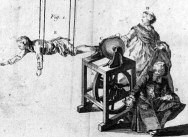
I’ve just found this fascinating article about how electricity became featured in entertainment shows shortly after it was harnessed and took on an erotic undercurrent, leading to theories of sexuality that attempted to explain the differences between male and female ‘electric fire’.

The abstract alone is wonderful to read:

Sparks in the dark: the attraction of electricity in the eighteenth century.

Bertucci P.

Electricity was the craze of the eighteenth century. Thrilling experiments became forms of polite entertainment for ladies and gentlemen who enjoyed feeling sparks, shocks and attractions on their bodies. Popular lecturers designed demonstrations that were performed in darkened salons to increase the spectacle of the so-called electric fire. Not only did the action, the machinery and the ambience of such displays match the culture of the libertine century, it also provided new material for erotic literature.

This is one of the many curious paragraphs from the actual article:

Women became essential protagonists of electrical soirées. Electrical performances staged in courts and salons counted on their active participation and played with sexual difference. Although both men and women could experience the electric fire with their bodies, they would tackle it in different ways. The most common electrical experiments provide a glimpse into the different roles salon culture codified for ladies and gentlemen. One of the most popular demonstrations of the time was the electrifying Venus, or electric kiss. Invented by the German professor Georg Matthias Bose, it was soon replicated throughout Europe. The experiment was simple to organize. The selected lady would stand on an insulated stool while an operator charged her body with an electrical machine. Gentlemen in the audience would then be invited to kiss her, but alas, as they tried to approach her lips a strong spark would discourage any attempt, while exhilarating the lady and the rest of the audience.

Link to article ‘Sparks in the dark’.
Link to PubMed entry.