Inside Intuition

Can you trust your gut instincts? A BBC Radio 4 documentary ‘Inside Intuition’ offers to address the issue. It’s on this friday – that’s the 17th August – at 11am. Those of you busy or outside of the UK, check the BBC’s fantastic Listen Again pages during the week after broadcast.

BBC Press release here and below the fold, for your convenience.

Continue reading “Inside Intuition”

The REVERB project

reverblogo.jpgA.k.a part of my day job. I’ve written a short article introducing the project. The last line summarises it pretty well (I think!)


“The goal is to reverse-engineer the computational principles that the brain uses to multi-task”, says Dr Gurney, “and to show that they work in practice, not just in theory, by incorporating them in a robot. In a sense, we’re trying to work out the real-time operating system of our own minds.”

You can read more about REVERB here and the rest of my article here

Review: Freedom & Neurobiology by John Searle

John Searle will be known to most cognitive scientists as the man behind the famous Chinese Room thought experiment. This is based around the idea that a man in a room translating Chinese symbols with the aid of a rulebook does not understand Chinese, any more than a computer producing intelligent-like (understanding-like, consciousness-like) behaviour due to programming rules has intelligence (or understanding, or consciousness). Since I found this line of argument confused, and ultimately frustrating, I didn’t expect to enjoy his new book ‘Freedom & Neurobiology: Reflections of Free Will, Language and Political Power’. I didn’t expect to, but I did.

Searle_Freedom.gifThis short book is made up of two separate lectures of Searle’s, originally published in France, along with an extensive introduction. The introduction is Searle’s tour through the history of philosophy, establishing the ‘basic facts’ as it were, to the point where we are now. A point at which we have dealt with many small problems and can now ‘advance very general accounts of mind, language, rationality, society, etc.’. This ‘large-scale philosophy’ is possible, Searle argues, because of the unity of mind with biology, and, secondly and a consequence of this, the new openness within philosophy to accounting for empirical evidence (for a particularly choice quote from the introduction, see here).

True to this manifesto, Searle’s two essays cover lots of ground. The first is ‘Free Will as a problem in neurobiology’, the second ‘social ontology and political power’. Both are very readable, full of strong arguments and interesting observations. IANAP, but there is nothing of a the obtuse Searle of the Chinese Room that I was expecting, in fact ‘Freedom & Neurobiology’ makes me think that I should go back to the original Chinese Room argument and read it again. If this new book is anything to go by there is sure to be more clarity and subtly there than I remember.

Single gene gives mice new sense of colour

The journal Science reports a study showing that mice given a single gene can develop full colour vision. Mice, like most mammals except primates, are normally colourblind. The implanted gene, which is found in humans, is responsible for making a photopigment, a light-sensitive protein in the photoreceptors of the eye. The researchers from the Howard Hughes Medical Institute validated their findings with cell recording and with behavioural tests, demonstrating pretty conclusively that the mice really can see in colour, being able to make discriminations normal mice cannot, and this is because their photoreceptors are sensitive to long wavelength red light.

Because only a single new gene has this effect, the study is reported as demonstrating that primate colour vision could have evolved very suddenly. However, this angle is perhaps less suprising if we consider that colour vision is phylogenetically ancient – primate colour vision doesn’t represent the first time it has evolved, rather primate colour vision is more of a recovery of the function which is found in many non-mammal species such as reptiles. The structural correspondence of this is that the appropriate apparatus for colour vision is extant in mammals – it is just that non-primate mammals lack the appropriate variety in their photopigments. The study is is another demonstration of the amazing ability of the brain to adapt to and take advantage of whatever sensory input is available to it (related to this, see this article on human tetrachromacy, via Slashdot)

Liars, Lovers and Heroes

Of course what makes Paris such a wonderful city is how all the parts fit together, and the same is true of the brain. Indeed a more apt use of the Parisian brain metaphor might be to think of the prefontal cortex as the Pompidou Center, a piece of modern architecture in the heart of the old city. As we shall see. at the heart of who you are is a complex blend of old and new regions, Picasso-like prefrontal cortex grounded in the old masters of more ancient brain structurs, some of them so old that humans share them with insects

This is a quote from Quartz & Sejnowski’s (2002) ‘Liars, Lovers and Heros’. It’s an excellent book, rallying an impressive range of biological and sociological material to give a nuanced opinion on ‘what the new brain science reveals about how we become who we are are’ (the book’s subtitle). The quote isn’t particularly representative, but I enjoyed ‘the Parisian Brain metaphor’ so much I thought I’d share it!

Expertise vs Randomness

A widely cited result asserts that experts superiority over novices in recalling meaningful material from their domain of expertise vanishes when random material is used. A review of recent chess experiments where random positions served as control material (presentation time between 3 and 10 seconds) shows, however, that strong players generally maintain some superiority over weak players even with random positions, although the relative difference between skill levels is much smaller than with game positions

Gobet, F. & Simon, H. A. (1996). Recall of rapidly presented random chess positions is a function of skill. Psychonomic Bulletin & Review, 3, 159-163.

Preprint as Word Doc
Gobet’s bibliography here

The Young Milgram

From onegoodmove, a short video about Stanley Milgram and his obedience experiments. Doesn’t the young Stanley Milgram look handsome, in a tweed jacket-1970s-professor kind of way?

For more on the man, and to find out about his other groundbreaking experiments, see stanleymilgram.com run by Dr Blass, Milgram’s biographer (featured in the video). And also check out this classic from Dan Wegner the ‘The Milgram Obedience Song’ which features samples from recordings made during the obediance experiments.

Extra Senses

A new five part series called ‘Extra Senses’ has just started on BBC Radio 4, looking into the science behind sensations beyond the ordinary touch, sight, smell and sound. Today’s show was on pain and features some excruciating sounds from a man eating a lightbulb (“the most painful part could be tomorrow morning”!) as well as interviews with neuroscientists who research the neurological basis and functions of pain. Next week the presenter, Graham Easton, looks at balance.

Link: Extra Senses (thanks to Harry for the tip)

waking life crossword experiment

waking-life-4.jpgIn Richard Linklater’s Waking Life (2001) two of the characters discuss the idea synchronicity. They mention an experiment where people were isolated and given daily crosswords. If the crossword puzzles were a day old, meaning that thousands of people had already completed them, then people found it easier to get the answers – because the answers were already ‘out there’ in the collective memory of course.

The question is: did anyone ever really do this experiment, or anything like it, and what are the references? I’m not expecting that it would really produce a significant effect, but I’d still love to know if anyone has tried it.

Answers in the comments please

Link: Article on The Baader-Meinhof Phenomenon from damninteresting.com

I’ve put the relevant except from the script below the fold…

Continue reading “waking life crossword experiment”

Architectures of Control blog

Dan Lockton’s Architectures of Control blog is a must-read for anyone interested in the interface between design and psychology. In a recent post welcoming new readers Dan explains what the blog is about:


Most of the posts look at ‘architectures of control‘ designed into products, systems and environments, which seek to force the user to behave in a certain way. It’s something of a broad concept, embodying aspects of computer science, interaction design, architecture, psychology, politics, marketing, economics and counterculture alongside product design and engineering

Read more at: http://architectures.danlockton.co.uk/

the society of mind

minsky.jpgMarvin Minksy, one of the founding figures in Artificial Intelligence, in his Society of Mind (1985):
People ask if machines have souls. And I ask back whether souls can learn. It does not seem a fair exchange – if souls can live for endless time and yet not use that time to learn – to trade all change for changelessness. And that’s exactly what we get with inborn souls that cannot grow: a destiny the same as death, an ending in a permanence incapable of any change and, hence, devoid of intellect.

We start as little embryos, which then build great and wonderous selves – whose merit lies entirely within their own coherancy. The value of a human self lies not in some small, precious core, but in its vast constructed crust

What are those old and fierce beliefs in spirits, souls, and essences? They’re all insinuation that we’re helpless to improve ourselves. To look for our virtues in such thoughts seems just as wrongly aimed a search as seeking art in canvas cloths by scraping off the painter’s works.

Hobbes, the first functionalist?

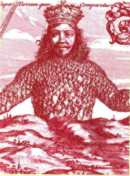
leviathan.jpgIf you thought that the founders of the Artificial Intelligence movement were the first to think that intelligence was just the product of computation, think again:


When man reasoneth, he does nothing else but conceive a sum total, from addition of parcels….For reason, in this sense, is nothing but reckoning

Thomas Hobbes, Leviathan, Chapter 5 ‘Of Reason and Science’

B Fred Skinner

In some circles behaviourism is associated with a kind of fascism, or at the very least an austere puritanism (to contrast it with its nemesis, the literary/humanistic psychoanalysis). B.F. Skinner particularly suffers from this association, because of his pivotal role in the development of the science and philosophy of behaviourism, and perhaps because of some of his political writings (e.g. ‘Beyond Freedom and Dignity‘, 1971). There’s even an entirely false story that he applied behaviourist control techniques to his family, with disastrous results.

Skinner As Self-Manager by Rober Epstein, a student and later colleague of Skinner, gives an account of Skinner, and his style of life, which is in stark contrast to the disempowering, mechanistically-clinical, image some might have of behaviourist psychology:


Each day of our collaboration brought new projects and new excitement, and, as I got to know Skinner better, my awe began to subside. He insisted, for one thing, that I call him ‚ÄòFred,‚Äô and it‚Äôs hard to be in awe of someone named Fred (his full name is Burrhus Frederic Skinner)… Fred‚Äôs manner was casual and far from intimidating. He often leaned back in his chair as he spoke, and his eyes sparkled with the energy of a man in his 20s, even though he was past 70. He told jokes and recited limericks, and he loved to hear new ones.

To my knowledge, and all of the rumors notwithstanding, Fred did not rely on ‘behavior modification’ techniques to ‘control’ people. Quite the contrary. He was relaxed, natural, and gentle in most of his dealings with other people. His interpersonal style was made milder, if anything, by the scientific principles he helped to develop, because his research convinced him that punishment was a poor tool for changing behavior, so he avoided using it in his everyday life.

Life, to Fred, was a series of joys to relish and challenges to overcome, and he did both extremely well…Fred was the most creative, most productive, and happiest person I have ever known.