Against Neuroethics

The BPS has published a discussion paper on “Neuroethics”. Neuroethics is an unnecessary phrase which covers a hodge-podge of ethical concerns for psychology researchers and broader societal concerns over the application of findings from the cognitive neurosciences.

The paper, prepared by the impressive team of Carl Senior, Patrick Haggard and John Oates, is mostly a discussion of the particular ethical issues that might arise from research using cognitive neuroscience techniques such as fMRI. Overall, it seems to me that all of the substantive ethical issues mentioned by the paper are treated at length by existing moral philosophy (and in particular by medical ethics). It is not clear that psychology and neurosciences have anything to add, which should be a first clue that the idea of “neuroethics” is inherently dubious.

A particularly revealing moment is the authors’ discussion of the evidence showing that people are more likely to believe an explanation when it is presented alongside a picture of a brain scan (McCabe & Castel, 2008 – covered on Mind Hacks here). This, for the authors of the discussion paper, raises the spectre of BPS members having “undue influence” by accompanying their explanations with pictures of brain scans.

In light of the persuasive power of brain scan imagery its use to illustrate any fact should be restricted as much as possible. Brain scan imagery should not be included on recruitment posters for participation in experiments

Here, the authors seem to have been affected by a peculiar version of the very effect they are warning against! They treat influence due to brain imagery as somehow exceptional, in the same way that people in the experiments treat explanations using brain imagery as somehow exceptional. Consider how the argument would look if it was a prescription against accompanying your communications with partcular phrases, or with offers of financial rewards. The way explanations are phrased affects how often they are believed – that does not mean psychologists should not try to be persuasive, nor that they are wrangling the minds of the public in an exceptional way if they are. There is evidence that monetary rewards, like brain imagery, can distort people’s judgement (see, e.g., Hsee, Zhang & Zhang, 2003) – the BPS has not recommended that members can’t pay people to participate in experiments.

It is part of normal cognitive function to be affected by the environment, and there are many quirks about the way we humans are affected by the exact content and structure of the environment. Examples of that influence are not automatically examples of “undue influence”, regardless of whether they involve brain imagery or not.

There are genuine ethical issues which are peculiar to cognitive neuroscience, but our duty to attend to these is better served by seeing brain related issues in the context of general ethics, rather than pandering to the kind of exceptionalism that the phrase “neuroethics” encourages.

A discussion paper: neuroethics and the british psychological society research ethics code

Hsee, C. K., Yu, F., Zhang, J., & Zhang, Y. (2003). Medium maximization. Journal of Consumer Research, 1–14.

McCabe, D. P., & Castel, A. D. (2008). Seeing is believing: The effect of brain images on judgments of scientific reasoning. Cognition, 107(1), 343-352. doi:16/j.cognition.2007.07.017

The Rough Guide to Psychology

Friend of mindhacks.com and contributor to the original Mind Hacks book, Christian Jarrett has written the “The Rough Guide to Psychology“, published this month, and a right rip roaring read it is too. It’s a whistle-stop tour through all aspects of the science of mind and behaviour, which reveals just how diverse and rich the field of psychology is. From visual perception to intelligence testing, sport psychology and gender differences to developmental disorders – Christian is the consummate guide, introducing the scientific essentials, giving the history of psychological research and highlighting links to the everyday world of our own experiences. The reader gets the benefits of Christian’s unique skills – he’s a fully trained research scientist but also has the jackdaw curiosity of the science journalist, honed by the experience of writing for the BPS Psychologist magazine and Research Digest.

It isn’t possible to download knowledge in the way Keanu does in the Matrix (“I know kung-fu“), but reading the Rough Guide to Psychology feels like the next best thing. Wonderful breadth, impressive depth and fun throughout – the next time someone asks me for an introduction to Psychology I’ll give them this book.

A history of psychology through objects

This is an early Electroconvulsive therapy (ECT) machine, from 1945.

Note the incorporation of the telephone dial for controvoling the duration of the shock.

This is a brass observation hole from St. Audry’s Hospital, Suffolk, England, 1851-1900.

Mounted in a door, this peephole allowed doctors and warders to check on a patient locked in solitary confinement.

These, and hundreds of other fascinating objects from the history of psychology and psychiatry, can be seen at the Science Museum’s Brought To Life website. Scroll down to Themes -> Mental Health and Illness for these examples, but keep yours eyes open throughout the exhibit for artifacts which reflect our changing and complex understanding of the mind and its disorders.

While you’re there, don’t miss the interactive Three Psychiatric tests which gives you a chance to see how psychiatrists from the 1930s, 40s and 50s would have used classic psychometric tests to diagnose mental illnesses such as dementia or schizophrenia.

Thanks to Philip Loring, BPS Curator of Psychology at the Science Museum, who gave a talk about this digital exhibition Sheffield last night

A note on human behaviour

Enjoying the Natural History Museum yesterday, I came across this exhibit somewhere in the geology section:

The exhibit is a serious of columns, which you pass from right to left. The penultimate column is to illustrate the idea of ice, and you’re invited by a palm shape to put your palm to the column (which is indeed cold). The interesting thing is the final column, which is meant to illustrate gravity somehow (it was broken yesterday, so I don’t know how it is supposed to do this). Notice how the metal around the IVY of gravity is worn away. None of the other columns had this. Obviously hundreds of visitors a day are drawn to this exhibit, press their palms to the ICE column and then go on to touch, in exactly the same way, the GRAVITY column even though this isn’t part of the way they are supposed to interact with the exhibit.

Psychologists know that what people have done before is the best predictor of what they will do in the future. Whole industries are devoted to helping us establish, or break, habits. This exhibit on geological forces illustrates how easily some behavioural precedents can be set. We love touching things, and although we aren’t meant to, permission to do it once is all that is required to set off an immediate repetition of the behaviour.

The (cut price) Narrative Escape

My ebook The Narrative Escape is available at a reduced price for a limited time. Publishers 40kbooks have got a February special offer, meaning that you can read my 6000 or so words about dreams, stories and morality for less than a dollar. UK readers : that’s seventy-one pence!

As if the price wasn’t enough to convince you, you can read an interview with me by Livia Blackburne here, or you can consult the five star reviews on amazon (three of ’em, which gives me a higher average than The Communist Manifesto, the only book that amazon.co.uk has under “Customers Who Bought This Item Also Bought”. Sorry Karl!).

Amazon.co.uk link
Amazon.com link
Original mindhacks.com blog post

Putting Psychology To Work

And Lo! Unto the always excellent BPS Research Digest, a child is born! The BPS Occupational Digest. is new blog which will cover news, reviews and reports on how psychology matters in the workplace. It will be curated by friend of mindhacks.com (and contributor to the Mind Hacks book) Alex Fradera.

Blogging hasn’t started yet at the BPS Occupational Digest, but we’re looking forward to what Alex serves up. Watch this space!

Link to BPS Occupational Digest.

The psychophysics of policy positions

In which I suggest applying the methods of experimental psychology to a longstanding question in political science.

Many people feel that there is no “real difference” between political parties (for example, Labour vs Conservatives in the UK). Politians are all the same, right? At least superficially, mainsteam parties will all echo commitments to values such as “community” and “education” and positions such as “tough on crime” and “for a strong economy”.

In perceptual psychology we have a number of methods of calculating how accurate and sensitive a sense, like sight or hearing, is. Using these ‘psychophysical’ methods you can come up with a number which allows you to compare across different senses, or across different people. So, for example, we could show that vision is more sensitive than hearing, or that your vision is more sensitive than mine (or even that your vision is more sensitive than my hearing). These methods account for things like base-rate biases in people’s responding (so, for example, it could account for the fact that you might be more likely to say you can see something when you are in doubt, while I might be more likely to say that I can’t when I am in doubt). This sensitivity statistic I am thinking of is called d’ (“d prime”) by psychologists.

I’ve been considering whether these methods from perceptual psychology could be used to address the question of how similar the positions of political parties are. My way of testing and tracking the difference in the stated policy positions of the parties would work like this: you take a standard public expression of party positions (election manifestos?) and sample policy statements (size of sample to be decided, somewhere between individual sentences and paragraphs). Then, after coding the statements for their year and origin, you anonymise them and ask voters to say which party they think the statements come from. With a few psychophysical calculations we can then come up with a sensitivity statistics which reveals how easy voters find it to distinguish the policy positions of the two parties, and we can then compare how this changes over time, or in different policy areas.

Friend and political scientist Will Jennings, told me that – of course – political scientists already look at this topic. The British Election Study has been asking voters since 1964 how close the parties are. Projects such as the Comparative Manifestos Project have coded party manifestos from around the world, using techniques such as automated coding of text and expert surveys (i.e. asking academics what they think).

The problem with asking voters how close the parties are, or to code the parties as more “left-wing” or more “right-wing” is that you deal with opinions of voters, not their actual ability to discriminate between the positions of the parties. The problem with coding the manifestos is that it puts a layer of intepretation (as to what counts as left-wing, or converservative, or whatever) before you can judge one manifesto as closer or further away from another.

My psychophysics approach tests directly the ability of voters to discriminate between stated policy positions. We do this by presenting many small fragments of the manifestos and asking a participant to judge which party they are from. By gathering many many judgements we can get a sense of how likely they are to name each particular party (i.e. their bias) and get a sense for how likely they are to be correct (i.e. their sensitivity). We combine these, accounting for any bias towards naming a particular party, to get an estimate of their ability to discriminate between the parties based on their stated policy positions. You can average this index across people, removing random variation in sensitivity between people, to get an estimate of how discriminable two stated positions truly are.

Cross-posted, with some informed comment, at The Monkey Cage

Poetic sensitivities

Perceptual psychologists have long been interested in limen – the threshold at which a stimulus becomes detectable. The following limen for the different senses, expressed in everyday terms rather than in terms of physical quantities, have a certain poetry to them. I got this information via email as a scan of an (unknown to me) textbook. I reproduce them here for your enjoyment:

Approximate absolute sensitivities, expressed in everyday terms:

Vision – A candle flame seen at 30 miles on a dark, clear night
Hearing – The tick of a watch under quiet conditions at 20 feet
Taste – One teaspoon of sugar in two gallons of water
Smell – One drop of perfume diffused into the entire volume of a three-room apartment
Touch – The wing of a bee falling on your cheek from a distance of one centimeter

Exact values vary between individuals and even from moment to moment with the same individual. Source: Galanter, E. (1962). Contemporary psychophysics. Holt, Rinehart, Winston.

Brain, The Inside Story – AMNH, New York

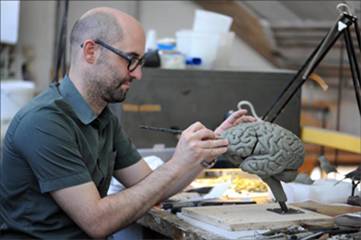
AMNH employee making a brain for the exhibition, http://www.amnh.org

The American Museum of Natural History in New York has a new exhibit called “Brain: The Inside Story“. Mindhacks.com‘s New York correspondent, Ben Ehrlich, sends this report:

I remember being a kid. I remember being a kid and going on field trips. I remember being a seventh-grade kid in New York City and going on field trips to the American Museum of Natural History. That’s why, standing at the threshold of a new exhibit there – Brain: The Inside Story, curated by Rob DeSalle – I try to imagine that I am once again a child, beholding with that ceaseless curiosity and wide-eyed wonderment all that is around me.
This proves not-so-difficult. The “tunnel” at the start the exhibition is draped with tangled clumps of recycled wire – 1500 pounds of material. It looks like some mischievous giants had a food fight with giant sticky spaghetti. Meanwhile, beads of light are moving through the thick-and-thin strands. The installation, by the Spanish artist Daniel Canogar, is meant to represent neurons firing their electrical impulses. On a plain, white pedestal at the door, a preserved brain-small and shriveled-sits understatedly in a glass case, as if daring someone to underestimate it. But the “tunnel” transports me inside its magical, gray matter, where I can walk beneath a sparkling canopy of nervous connectivity, a whole world alive within the wrinkles and folds, and I am as amazed as ever that all this happens inside of that.

Emerging from the “tunnel,” I am met by a life-sized projected image of a young dancer, sort of like the Princess Leah hologram only in spandex and a light sweat. She is in the process of an audition; she is thinking, emoting, and moving. As a recorded voice explains the correlating brain activity, a large three-dimensional brain model simultaneously lights its corresponding regions up in colors. This multimedia exhibit demonstrates the concept of regional specialization, while reminding that a brain controls a person who lives a life and has a story. From the “tunnel”-which contains an interpretation of the anatomy and functionality of brain cells-to the dancer, which illustrates cognitive, emotional, and behavioral phenomena, Brain: The Inside Story highlights some different approaches to neuroscience research, and their interrelatedness.

The rest of the exhibition is organized into five categories: The Sensing Brain, The Emotional Brain, The Thinking Brain, The Changing Brain, and The 21st Century Brain. At every turn are sights and sounds, and I am reminded of a carnival. Stand here! Look through here! Build this brain! Play this game! Touch this screen! There are illusions like an upside-down Mona Lisa made from spools of thread, and a picture of a rainy day coupled with the sound of what seems to be rainfall-until I discover it is frying bacon. (This deceptive influence of sight on sound is a demonstration of cross-modal perception). A hulking homunculus stands awkwardly with its enormous hands and mouth, a little too late, sadly, for Halloween. (The figure reflects the proportions of the somato-sensory cortex devoted to each body part). And everything shown is also explained by writing and pictures that surround every room, like an engaging textbook on a wall. Of course, unlike in school, no one has to read.

At about The Changing Brain, I notice a group of school kids making their way excitedly against the flow of we, the media. They are a diverse seventh-grade class studying neuroscience at a city secondary school. “I’ve always heard about the things memory can do, now I’m actually seeing it,” one boy tells me, excitedly. Another boy tells me how cool the exhibition is. Cool? For a kid? I ask him if it makes him want to study the brain more. He says, without hesitation, almost annoyed (because after all I should already know): “Yes.” And then he scampers off to play brain teasers with his friends. This is the main reason that Brain: The Inside Story is such an important exhibition. It informs and amuses and, although there are more and more educational resources about the brain in the public consciousness, the fact remains that-whether you are young or old or some of both-nothing beats a day at the museum.

The exhibition is open now, and is in New York until August 14 2011. After that it goes on international tour (mindhacks.com requests visits to Medellín, Colombia and Sheffield, England!)

Link to Brain: The Inside Story

The Narrative Escape

Please excuse me if I interrupt Vaughan’s normal programming to blow my own trumpet: My ebook “The Narrative Escape” was published yesterday by 40k books. ‘The Narrative Escape’ is a long essay about morality, psychology and stories and is availble in Kindle format. From the ebook blurb:


We instinctively tell stories about our experiences, and get lost in stories told by other people. This is an essay about our story-telling minds. It is about the psychological power of stories, and about what the ability to enjoy stories tells us about the fundamental nature of mind.

My argument in ‘The Narrative Escape’ begins by exploring Stanley Milgram’s famous experiments on obedience, looking at them as an example of moral decision making – particularly for that minority that choose to disobey in the experiment. A fascinating thing about these experiments is that although they tell us a lot about what makes people obey authority, they leave mysterious that quality that makes people resist tyrannical authority. I then go on to contrast this moral disobedience, with conventional psychological investigations of morality (for example the work of Lawrence Kohlberg). In using descriptions of moral dilemmas to ask people about their moral reasoning this research, I argue, misses something essential about real-world moral choices. This element is the ability to realise that you are acting according to someone else’s version of what is right and wrong, and to step outside of their definition of the situation. This is the “narrative escape” of the title. The essay also talks about dreams, stories and story-telling and other topics which I hope will be of interest to Mind Hacks readers.

The essay is also available in Italian as “La Fuga Narrativa
Amazon.com Link for the English edition.
…And coming soon in Portuguese, I’m told!

Mindhacks.com revamp

Mind Hacks book coverWe’ve refreshed the engine of mindhacks.com. moving it to WordPress. This should only improve your viewing pleasure, giving us less server downtime and easier commenting. It also means that we can easily see the viewer stats for the site – around 5,000 a day, which is great. It also lets me see that there have been 3,930 posts on mindhacks.com, nearly all of which have been Vaughan’s. So, it’s a good time to say “Great work Vaughan!”, as well as many thanks to Matt for hosting up the site up to now. Matt, myself and Vaughan were managed through the move by J.D. Hollis who provided his expertise with good humour and dazzling efficiency – thanks JD!

Our new RSS feed is : https://mindhacks.com/feed and you can follow the blog on Twitter @mindhacksblog. Vaughan is @vaughanbell and I’m @tomstafford.

Thank for everyone who joins us here, and stay tuned for more on mind and brain.

A surprising romantic reappearance

A few weeks before they are born most babies show a bias for turning their head to the right, rather than to the left. This bias continues for the first six months after birth.

Behavioural biases to one side are interesting to psychologists. They are an example of exceptions to the general rule of symmetry in biological development. The placement of language-related brain areas is another exception. Babies’ head turning bias is the first behavioural bias to occur in humans, and may be related to handedness bias, which in turn is related to the language-area asymmetry in the brain.

Mindhacks.com readers will remmeber our report of Paul Rozin’s call for more observational reports in psychology. Perhaps he’d approve of this 2003 paper in Nature: Adult persistence of head-turning asymmetry.

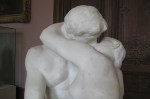
Onur Güntürkün observed adult head turning behaviour among kissing couples in the U.S, Germany and Turkey. Sure enough, his observational research, in ‘international airports, large railway stations, beaches and parks’ discovered that during most kisses (64% of the sample) couples turned their heads to the right rather than the left. A statistically significant difference and, according to Güntürkün, ‘a surprising romantic reappearance’ in later life of the neonatal head turning bias.

So, next time you hold a child in your arms and they turn their head to the right, you are seeing an echo of a bias that may be directly linked to our species’ most remarkable evolutionary achievement, language, and a bias that stays with us throughout our lives.

Reference: Gunturkun, O. (2003). Human behaviour: Adult persistence of head-turning asymmetry. Nature, 421(6924), 711. doi:10.1038/421711a which contains the line ‘It takes two people to kiss (Fig. 2)’!

Against narrativity

Photo by Flickr user happysweetmama. Click for source‘We understand ourselves through stories’ is a common, even fashionable, sentiment. Not everybody agrees. Philosopher Galen Strawson‘s 2004 article “Against Narrativity” is a both-barrels attack on this idea. Strawson identifies two theories which he wishes to emphatically reject. The psychological Narrativity thesis is the idea that it is unavoidable human nature to experience their lives as a story. The ethical Narrativity thesis is the idea that conceiving of one’s life as narrative is a good thing, essential to a moral life and true personhood.

It’s just not true that there is only one good way for human beings to experience their being in time. There are deeply non-Narrative people and there are good ways to live that are deeply non-Narrative. I think the [Narrativity theses] hinder human self-understanding, close down important avenues of thought, impoverish our grasp of ethical possibilities, needlessly and wrongly distress those who do not fit their model, and are potentially destructive in psychotherapeutic contexts.

Strawson goes on to identify two personality types, which he calls the diachronic type, the kind of person disposed to conceive of themselves connected to both their past and future selves, and the episodic type, which is the kind of person who does not tend to conceive of their momentary self as part of a chain of selves stretching into the past and future. Obviously the diachronic type, in Strawson’s scheme, will be disposed to narrativity, while the episodic won’t. Strawson suspects that

those who are drawn to write on the subject of ‘narrativity’ tend to have strongly Diachronic and Narrative outlooks or personalities, and generalize from their own case with that special, fabulously misplaced confidence that people feel when, considering elements of their own experience that are existentially fundamental for them, they take it that they must also be fundamental for everyone else.

Although Strawson makes reference to a wide range of western philosophy and literature, it is notable that he doesn’t allude to eastern philosophies such as Zen Buddhism in support of his argument. There is a strong anti-representational sentiment in Zen philosophy, which ties in with the claim that Enlightenment is the experience of reality without the mediation of abstract concepts (and thus also, presumably, unmediated by narratives also).

Link to Strawson’s article, “Against Narrativity
Previously on Mindhacks.com The story of our lives

The scientific method – lego robots edition

At the University of Sheffield we’ve been teaching psychology using lego robots. This isn’t as peculiar as it might sound. You can learn a lot about your theories by trying to build them into a machine or computer programme. But while teaching the course, I discovered that you can also learn a lot about the methods used in experimental psychology by trying them out on robots.

legorobot.jpg

This is one of the lego robots we were using. They are built using a Lego Mindstorms set and inspired by a book by Valentino Braightenberg called ‘Vehicles: Experiments in Synthetic Psychology‘.

The robot has a light sensor on each side and a nose-bumper which tells it when it has hit something. A simple brain connects these sensors with two independently powered wheels. Here’s the robot in action:

The suprising thing, and a crucial point of Braitenberg’s book, is that you can get what looks like complex behaviour (in this case line following) from simple rules. All that governs this robot’s behaviour is a positive connection between each light sensor and the wheel on the same side. This makes the robot turn away from lighter floor patches, so in this environment it traces the edge of the patten. An additional ‘fixed action pattern‘ makes it spin around and start in another direction if it bumps into something.

Many people look at these robots and over-intepret the complexity of their behaviour. You need skepticism and controlled experiments to discover exactly how simple the rules controlling the robot are. However, while I was trying to use the robots to teach this to my class, the robots and the class conspired to teach me something.

In a more advanced class I put a simple learning rule in the robot’s brain so that they could learn to slow down before hitting walls (actually, it is only true that I put the rule in the robot’s brain in the sense that Hitler invaded Poland. In truth I made a grad student programme the rule into the robot. Thanks Stuart!).

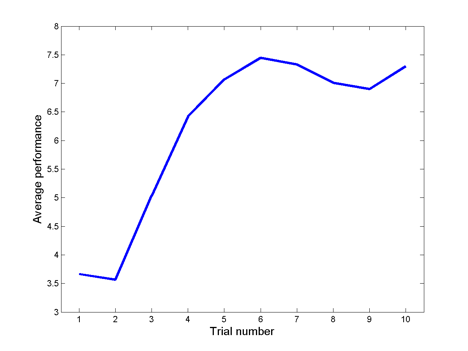
The task I set the class was simple, I thought: run an experiment to see the robot learn over successive trials. Because I’d programmed the rule into the robot I thought I’d be able to predict the robot behaviour. The predicted learning curve of the robot looked like this:

predicted.png

The results from the groups looked like this

groups.png

Since each robot was identical – same body, same brain in the way only robots can be – and all the groups were doing the same experiment, I expected to get the same results from each group. No luck there! Some get an increase, but with some the line stays almost flat. Some it goes up smoothly, some get wild swings in performance up and down.

And this got me to thinking. If the results are this variable with experimental subjects which we understand completely – their simple bodies are made of lego for goodness sake! the brains are identical and programmed by us! – how unreliable will results be if you experiment on real people? Noisy humans have bodies and brains which are both vastly more complex than lego robots, and each body and brain is unique. With so many sources of variability between individuals it ios amazing that experimental psychologists ever get any results at all.

The moral is that experimental work is hard, really hard. You’d better be sure your experiment reduces sources of variability as much as possible because there will be enough uncontrollable variability without you adding any more.

Fortunately there is a light at the end of the tunnel, in the form of statistics. If you average the different noisy group results you get something a bit more like the underlying pattern I knew to be there:

average.png

Trying a simple experiment with the lego robots gave me a new respect for the experimental method, and the difficulty psychologists face when trying to discover the rules underlying the wonderous variety in human behaviour.

The busy night

Two things I love are sleeping and data collection. Now, thanks to a new iPhone app, I can do both at once.

Sleep Cycle uses the accelerometer in the iPhone to record vibrations in your mattress caused by you moving in the night. In this way it acts as an actigraph, keeping a record of your body movement, which in this context reflects how deeply you are asleep.

sleepgraph.jpgHere is the data from my last night’s kip. As you can see I show a fairly typical pattern: sleeping deeper in the first half of the night, compared to the second half, and having alternating patterns of deep and light sleep (although I seem to cycle through the stages of sleep every hour, rather than the typically quoted every one and a half hours).

The app also has an alarm which promises to wake you up during a lighter stage of sleep, so saving you the unpleasant sensation of being woken by your alarm from deep sleep. I’ve yet to try this out but it sounds like a good thing, as long as avoiding the jarring sensation is worth forgoing the extra minutes shut-eye!

Link: to the Sleepcycle app