Simulating hysteria for fun and profit

I’ve just found pages from a 1941 French hypnotism manual on the (tastefully NSFW) Au carrefour √©trange blog that has some wonderful illustrations of hypnotism ‘in action’.

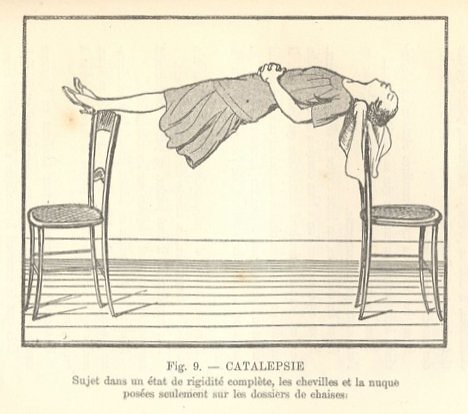
A few are particularly curious because they seem to be directly mimicking famous images of hysteria from the 1800s.

Hysteria is the presence of neurological symptoms without any detectable neurological damage that could account for it (see previous) and the top image on the right is taken from a late 1800s book ‘Lectures on the Diseases of the Nervous System’ by Jean-Martin Charcot who argued that patients with hysterical epilepsy can show this type of body posture he called the ‘Grande Hysterie Full Arch’.

It’s an iconic image and can be seen to the left of the famous painting entitled ‘A Clinical Lesson with Doctor Charcot at the Salp√™tri√®re’ by Andr√© Brouillet that Freud had hung above his couch. You can still see it there in fact, in Freud’s old house, now the Freud Museum in London.

The image below is taken from the 1941 French hypnotism manual. In fact, all the images of the woman mimic Charcot’s famous photos or drawings of hysterical patients.

For example, here’s the Charcot original of a woman between two chairs, and here’s the image from the manuel d’hypnotisme.

Unfortunately, the Au carrefour √©trange website doesn’t have text from the book, but the images suggest that it is encouraging practitioners to simulate these famous poses.

Interestingly, Charcot was the first to suggest that hypnotism and hysteria may rely on similar neurological and psychological processes owing to the fact that it is possible to temporarily simulate hysteria with hypnosis.

Over 100 years later, there is growing evidence that this is the case, as neuroimaging studies have shown that hysterial paralysis and hypnotically-induced paralysis activate remarkably similar brain areas.

However, his classifications of the different body postures of hysteria are now thought to useless, and likely caused by Charcot’s own suggestions to his patients.

The pages from the hypnotism book are on a site with tasteful but NSFW images, so be cautious at work, or be ready with your excuse about a historical interest in Charcot.

UPDATE: The same blog has images from another French hypnotism book called Nouveau cours pratique d’hypnotisme et de suggestion from 1929. Dig that cover!

Link to pages of ‘Manuel pratique d’hypnotisme’ (via MorbidAnatomy).

The cutting edge of robotics

Singularity Hub has reviewed the best commercial and research lab robots from 2008 and has videos of each and every one.

It’s a fantastic collection that has everything from exoskeletons, to violin playing humanoids, to ultra-lightweight robots that fly by flapping gossamer-thin wings.

The most curious is probably the robot self-reassembling chair or maybe the robo-shapes from the ISI Polymorphic Robotics Laboratory.

Anyway, a fascinating collection and great to see how AI and mechanical engineering are being applied to create the latest in cutting-edge robotics.

Link to ‘A Review of the Best Robots of 2008’ videos.

The shock of the few

Monsters existed in the 1800s. They were not mythical creatures, but children born with birth defects who were widely discussed in the medical literature and sometimes cruelly paraded in the travelling freak shows of the time. Curiously, one of the most popular explanations for these congenital deformities concerned the psychology of the expectant mother.

If you had asked a 19th century doctor why some children were born with unusual bodies, or even fairly common birthmarks, you might have been told that they were caused by a frightening incident experienced by the mother during pregnancy.

The theory, known as ‘maternal impression‘, suggested the trauma could symbolically imprint itself on the foetus. The 1896 book Anomalies and Curiosities of Medicine described many such cases in their chapter on obstetric anomalies, and this is a fairly typical example:

Parvin mentions an instance of the influence of maternal impression in the causation of a large, vivid, red mark or splotch on the face: “When the mother was in Ireland she was badly frightened by a fire in which some cattle were burned. Again, during the early months of her pregnancy she was frightened by seeing another woman suddenly light the fire with kerosene, and at that time became firmly impressed with the idea that her child would be marked.’

In another case history, a child with hydrocephalus with a “small and rabbit-shaped” face and deformed eyes is explained by the fact that a rabbit jumped at its mother during pregnancy where she was frightened by its ‘glare’.

Perhaps one of the most curious cases was published in 1817 and concerned a recalcitrant father who denied being responsible for an unwanted pregnancy, causing the mother a great deal of distress. The child was later born, reportedly with the name of date of birth of his father clearly visible in his eyes.

This is a curious mirror of the first, probably mythical, case of maternal impression, where Hippocrates reportedly saved the honour of an adulterous princess by explaining her dark skinned child as due to her having a portrait of a ‘negro’ in her room.

Although the theory enjoyed a long and colourful life, it peacefully passed away in the late 19th century when it became clear that the mind of the mother had no influence on birthmarks or congenital deformities.

For many years the psychological state of the expectant mother was thought to have virtually no effect on the developing child.

But then the Soviet Union invaded Finland in 1939, and that all began to change.

The quickly assembled Finnish force was vastly outnumbered and ominously outgunned but, unlike their Soviet counterparts, they were quick and comfortable in the Artic conditions and made swift and deadly attacks.

In one of history’s great military victories, they defeated the Russians but suffered heavy losses. Many of the dead were young men, and many of the grieving were young pregnant women.

Nearly 40 years later, two Finnish psychiatrists decided to look at the mental health of the children who grew up without fathers. They compared children born to women who grieved during pregnancy, to those born to women who lost their husbands after the child had been born.

Their study, published in 1978, found that mothers who had lost their husbands during pregnancy were much more likely to have children who later developed schizophrenia.

Many similar studies have found that severe maternal stress during pregnancy affects the developing brain of the child, increasing the risk of cognitive or psychiatric problems later in life, possibly due to the effect of the hormonal response of the hypothalamo-pituitary-adrenal (HPA) system.

Thankfully, we no longer think of people as monsters, whatever their size, shape or mental state, and we have long banished the monstrous myths of ‘maternal impression’.

But we do know that the mind of the mother is connected to the development of the unborn baby, and that maternal experiences can still echo through the life of the child.

Cocaine nights, moral relativism, orgasms and gangs

BBC Radio 4’s wonderfully eclectic and vastly under-rated social science programme Thinking Allowed has had some fascinating programmes lately, covering the concern of ‘cocaine girls’ in 1915 London, the history of the orgasm, moral relativism, gang culture, the social meaning of scents and the culture of detectives, to mention just a few of the topics.

The programme is a mixture of social history and the latest in sociology research on contemporary issues that looks at the most amazingly diverse range of issues.

Although there are no mp3 downloads, you can listen to all of the programmes online as streamed audio.

Some of my recent favourites have included an exploration of the social panic about the cocaine scene in 1915 London, evidence for the existence of ‘gang culture’ in the UK and the psychology of the police interviews but you’ll find discussions on pretty much anything you can think of (and probably plenty you’d never have thought about before) in the archive.

Some of the most interesting points relate to how our concerns of ‘new threats’ to society, for example the influence of popular culture or new technology, are old acquaintances but are presented as new by every generation.

Other interesting programmes often reveal a new angle to something I’d never considered. The programme on the sociology of smell discusses the ‘language’ of scents and perfumes. It asks why we think some scents are ‘feminine’ or ‘masculine’ and how have we come to associate certain smells with specific social meanings.

Link to Thinking Allowed website and archive.

Encephalon 62 – the straight dope

The 62nd edition of the Encephalon psychology and neuroscience writing carnival has just appeared on The Mouse Trap as a remarkably well-written guide to the latest in the last fortnight’s online mind and brain discussions.

A couple of my favourites include a nuanced look at the neurobiology and culture of addiction from Neurophilosophy and a look at a recent study on the psychological effects of the first human face transplant from Brain Blogger.

There are plenty of other great articles in this latest edition, all enthusiastically presented by Sandy’s engaging write-up.

Link to Encephalon 62.

The mind has a distorted reflection

Image by Flickr user dearoot. Click for sourceOur perception of how mentally sharp we are has more to do with how we’re feeling emotionally than how our cognitive functions are actually working.

In other words when someone says, ‘I think my memory has become much worse recently’, research suggests that this tells us almost nothing about how their memory is working, but reliably indicates that their mood has been low.

It’s quite amazing to think that we have such poor insight into the functioning of our own minds that we ‘mistake’ low mood for a bad memory, poor concentration or impaired problem solving but it’s a finding that has been widely replicated in healthy people, both young and old, in psychiatric patients, and most recently in patients with epilepsy – to mention but a few of the studies.

Anosognosia is a condition that can occur after serious brain injury where the patient is unaware of their disability.

In the most striking cases, a patient may be paralysed, amnesic or even blind, but be completely unaware of the fact.

In these cases, we think that the brain damage has impaired our ability to have insight into our own mental functioning, but these studies suggest that we’re actually not very good at this to start with.

Link to one of the many studies in the area.

Learning Should Be Fun

jogger.jpg

Learning can and should be fun. This is not just a moral position, but a scientific one too.

When you learn a new thing, or get a surprise, there is a shot of a chemical messenger in your brain called dopamine. Dopamine is famous among neuroscientists for its involvement in the reward and motivation systems of the brain.

You won’t be surprised to learn that the reason addictive drugs are addictive is that they hack the reward circuitry that dopamine is intimately involved in. Perhaps the most addictive drug, cocaine, directly increases the amount of dopamine at work in your brain.

Learning something new triggers a chemical release of the same kind as cocaine, albeit in a much more subtle manner. As methods of getting your kicks you can perhaps compare it to the difference between walking up a hill yourself or being strapped to a rocket and blasted up — slower, harder work, but a lot more sustainable and you’re in a better state to enjoy the view when you get there!

The reason for this electro-chemical connection between learning and drugs of reward is that our brains have obviously been designed to find learning fun.

One of the many negative things about the misconception that education is about transmitting content is the idea that any fun you have is taking time away from proper learning, and that ‘proper learning’ shouldn’t be fun.

Rather than fun being a relief from learning, or a distraction from it, for most of our history, before school, learning had to be its own motivation. Brains that learnt well had more offspring, and so learning evolved to be rewarding.

In lots of teaching situations we focus on the right and wrong answers to things, which is a venerable paradigm for learning, but not the only one. There is a less structured, curiosity-driven, paradigm which focusses not on what is absolutely right or wrong, but instead on what is surprising. A problem with rights and wrongs is that, for some people, the pressure of being correct gets in the way of experiencing what actually is.

You can try this for yourself, either in any teaching you do, or any learning. Often we will get blocked at a particular stage in our learning. A normal response is to try harder, and to focus more on what we’re doing right, and what we’re doing wrong. Sometimes this helps, but sometimes it just digs us further into our rut. The way out of the rut is to re-focus on experiencing again.

I’ll give you an example from one of the two things I know best about teaching — aikido, the japanese martial art. Aikido involves some quite intricate throws and grappling moves. Often a student is so intent on getting through the move, and on trying hard to get it right, that they become completely stuck, repeatedly doing something that doesn’t work, and usually too fast. Even if you say or show explicitly the correct movement, they can’t seem to get it. In this situation, one teaching technique I use, inspired by the ‘Inner Game’ writings of Timothy Gallway, is to tell the student to stop trying to do the move correctly, and instead do it deliberately wrong. “Try pushing over this way to the left”, I’ll say, “Now try the opposite over to the right. Now try high, or low. Which is easiest?”. By removing the obligation to get the move correct I hope to give permission to the student to just experience the effect they are having on their partner’s balance. Once they can tune into this they can figure out for themselves what the right thing to do is, without me having to tell them.

However you do it, if you can get out of the rut of right and wrong you free up a natural capacity for experience-led, curiosity-driven learning. Soon you’ll be flying along again, experiencing the learning equivalent of the jogger’s high, and all thanks to that chemical messenger dopamine and a brain that’s evolved to find things out for itself, and feel good while doing it.

Part of a series. #1 Learning Makes Itself Invisible

Cross-posted at schoolofeverything.com

Image: jogging on the beach by Naama

Bullshit Blue Monday is here

Happy Bullshit Blue Monday! Yes, today is the day where everyone feels down and gloomy about the fact that we’re assaulted with lots of completely made up news stories masquerading as psychology and misinforming everyone about science.

Methods suggested for relieving the nonexistent tosh have included everything from petting a pig to knowing that Al-Qaeda’s terrorists are being struck down by the bubonic plague.

Useful mental health coverage = precisely zero.

And on to our competition, which has been won by Kathe, who emailed in the following:

For every thing there is a season, and someone hoping to make a buck.

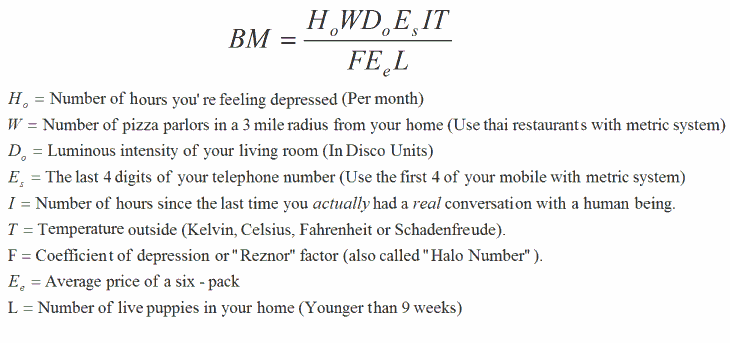
B=(S+H)T

What they hope the equation means:

T= thing
S= someone
H= hope
B= buck

What the equation really means:

T= Time spent making stupid equations
S= Amount of pseudoscience Spouted during the making of stupid equations
H= Hours of Help received from Googling ‘equations’
B= Amount of Bullshit produced

Kathe wins a £20 Kiva.org voucher, which I will send on shortly.

Although, we must say thanks to everyone for your entries, if you either added them as comments or mailed them. There are some great entries on our original competition page and an honourable mention must go to Camilo whose entry managed to not only include a New Order lyric but also used ‘disco units’.

You can see it as a pop-up if you want to experience it in all its glory.

Lycanthropy in Babylon

An interesting case series from the Babylon region of Iraq, reporting eight patients who had clinical lycanthropy where they had the delusional belief that they had changed into an animal. Seven believed they had changed into dogs, one believed he had changed into a cow.

Lycanthropy alive in Babylon: the existence of archetype.

Acta Psychiatr Scand. 2009 Feb;119(2):161-4; discussion 164-5. Epub 2008

Younis AA, Moselhy HF.

OBJECTIVE: Lycanthropy is the belief in the capacity of human metamorphosis into animal form. It has been recorded in many cultures. Apart from historic description of lycanthropy, there has been several case reports described in the medical literature over the past 30 years. METHOD: We identified eight cases of lycanthropy in 20 years, mainly in the area of Babylon, Iraq. RESULTS: The most commonly reported diagnosis was severe depressive disorder with psychotic symptoms. The type of animal that the patients changed into were mainly dogs (seven cases) and only one case changed into a cow for the first time to report. CONCLUSION: Lycanthropy delusion is a rare delusion but appears to have survived into modern times with possible archetypal existence.

Link to PubMed entry for ‘Lycanthropy alive in Babylon’.

Caffeine, hallucinations and an odd ghost obsession

A recent study hit the headlines reporting a link between caffeine intake and susceptibility to hallucinations. I’ve just read the paper and it’s an interesting well-conducted correlational study, but what struck me was the wackiness of the headlines it generated.

The study, led by researcher Simon Jones, was inspired by previous scientific work that has found a link between the stress-related hormone cortisol and psychosis.

Caffeine is known to interact with stress to increase cortisol levels further, so the researchers wondered whether there would be a direct link between caffeine intake and psychosis-type changes in thoughts and perception in people without a mental illness.

They asked 219 students to fill in well-validated standardised questionnaires relating to caffeine intake, stress, persecutory thoughts and hallucinatory experience and found that caffeine intake was associated with a small but reliable increase in susceptibility to hallucinations.

Actually, stress accounted for more hallucination susceptibility than caffeine, but as the first study to show an association between perceptual distortion and the world’s most popular stimulant in healthy people, it’s useful research.

I will now recount some of the headlines:

Coffee addicts see dead people

Caffeine, Responsible For Hallucinations

Did You See That Pink Elephant?

Too Much Coffee Can Cause You To Freak Out, Man

Coffee may make you see ghosts

Coffee linked to ‘visions’

‘Coffeeholics wake the dead’

If you think I’m cherry picking, these are actually fairly typical.

The news stories are a strange mix between an obsession with ghosts, which came from God knows where, and a profound confusion between correlation and causation.

UPDATE: I notice Bad Science has just picked up on the same study, and the same media obsession with ghosts, but also looks at a common element of the stories claiming that 7 cups of coffee a day ‘triples’ the risk of hallucinations – which didn’t appear in the paper but was apparently sourced from a bit of ad-hoc jiggery pokery for the press-release.

Link to DOI entry and study summary.
Link to sensible write-up from Science Daily.

I don’t care about the bruises, just mind the clipboard

Psychologist Jesse Bering has an interesting article in Scientific American about dangerous psychology studies where researchers have risked life and limb to carry out some of the more extreme experiments in psychology.

Some of the investigations are quite unethical by today’s standards – two researchers simulating a sexual assault in the street to see how people would react, putting periscopes in public urinals to measure urine flow – but are an interesting insight into studies of by gone years.

Actually, psychologists are wusses in comparison to sociologists and anthropologists who often do ethnographic research in the most extreme of situations.

One of my favourites examples is sociologist Simon Winlow who was in a research group studying violence in the night time economy.

After debating how one could research the sociology of night time violence in all its gory detail, he decided that the only way to fully understand the culture was to get a job as a bouncer and see what transpires.

As it turned out, what transpired was a fair amount of fighting, most of which he wrote up and published as a fascinating insight into the culture of commercial violence.

His paper, ‘Get Ready to Duck. Bouncers and the Realities of Ethnographic Research on Violent Groups’, is fascinating, and full of wonderfully euphemistic academic phrases.

I love: “Before our covert research could begin we debated the safety and ethical issues that would no doubt arise”. Translation: is it ethical to kick nine shades of shit out of your research subjects if they’re fronting up for a scrap?

He wrote the whole lot up as a book, which I’ve not read, but is apparently excellent.

However, he wasn’t the first sociologist to take a beating in the course of his research. In the paper he notes:

Sanchez-Jankowski (1990) in his ten-year study of gangs in Los Angeles, New York and Boston, was the subject of physical attack both as part of initiation rituals, and as a result of being falsely accused of being an informant, while Jacobs (1998) was robbed at gunpoint, and suffered telephone harassment by a crack dealer who was one of his research informants.

To return to Bering’s SciAm piece, it turns out he’s now writing a regular column for the magazine called ‘Bering in Mind’ which is freely available online.

As Bering is one of the most interesting evolutionary psychologists around, it should be a good read.

Link to ‘Dangerous Psychology Experiments from the Past’.
Link to Winlow’s ethnographic study of bouncers and violence.

2009-01-16 Spike activity

Quick links from the past week in mind and brain news:

A third US Army ‘Human Terrain’ researcher has died after injuries sustained in the field, reports Wired.

Scientific American Mind Matters discusses the neuroscience of noisy eyeballs – a curious synaesthesia-like condition.

The BPS Research Digest discusses research finding describing wine’s flavours helps people recognise specific types.

Channel N finds a fantastic video discussion on psychiatry’s clash over meaning, memory, and mind.

Interesting study in the British Medical Journal finds troubled / misbehaving kids have worse longer term health outcomes at a 40 year follow-up.

The New York Times has a brief piece on how tragedy and loss can lead to psychological advantages.

Top 11 compounds in US drinking water described by New Scientist include three psychiatric / neurological drugs – carbamazepine, meprobamate and phenytoin – although the last two are barely prescribed these days.

The Boston Globe has a great infographic explaining some ‘try-it-yourself’ brain tricks – most of which we’ve covered previously but handy to have in sketched out.

A psychologist in Gaza takes time out from being shelled to talk to The New York Times about the effect of total war on the population. I think you can guess the rest.

New Scientist has a short piece on a new cognitive model of surprise.

The evolution of manual dexterity is tracked by Neurophilosophy.

Corpus Callosum picks up on research on the possible antidepressant effects of vitamin D.

Death redefined as lack of engagement with the world by bioethicists mulling brain death and organ donation, reports Wired. Lack of engagement? By that definition I’m dead every dead every Sunday morning.

New Scientist discusses whether we’re over-medicalising sadness and discusses the benefits of negative emotions.

A brief article in The New York Times considers the possibility of developing an anti-love potion.

Scientific Blogging on research showing that too much TV delays language development in children.

More evidence that antipsychotics increase the risk of death by heart attack is covered by Furious Seasons.

Dr Shock discusses new research on the neurobiology of psychosocial stress and depression.

Probably the best ongoing coverage of the ‘Voodoo correlations’ controversy is on The Neurocritic. Do check it out.

Voodoo accusations false, reply ‘red list’ researchers

Some of the researchers under fire from the recent ‘Voodoo Correlations in Social Neuroscience’ article have responded to the accusations of misleading data analysis by suggesting that the accusers have misunderstood the finer points of brain imaging, leading them to falsely infer errors where none exist.

In an academic reply, available online as a pdf, and in an article on the controversy published in this week’s Nature, some of the researchers responsible for the ‘red list’ studies set out their case.

As you might expect, the responses are fairly technical points about statistical analysis in neuroimaging research but are generally well made, suggesting that the accusers don’t fully grasp which measures are related or unrelated, that they don’t account for tests which reduce spurious findings, and that they didn’t ask in sufficient detail about the methods used and so have based their analysis on incomplete information.

However, one in particular seems a little hopeful and relates to a central point made by Vul and his colleagues.

Vul suggested that the correlations shouldn’t exceed the maximum reliability of two measures. As we discussed previously, if you have two measures that are 90% reliable (accurate), on average, you wouldn’t expect correlations higher than 90% because the other 10% of the measurement is likely to be affected by randomness.

However, the response from neuroscientist Mbemba Jabbi and colleagues suggest that this should be based on the maximum reliability ever found.

Vul et al. argue that many of the brain-behavior correlations published in social neuroscience articles are “impossibly high” and that “the highest possible meaningful correlation that could be obtained would be .74”. This categorical claim is based on a statistical upper bound argument which relies on the questionable assumption that “fMRI measures will not often have reliabilities greater than about .7”. However, logically, any theoretical upper bound argument would have to be based on the highest reliability values ever reported for behavioural and fMRI data, respectively (e.g. for fMRI, near-perfect reliabilities of 0.98 have been reported in Fernandez et al. 2003).

I think they’ve caricatured the argument a little bit here. Vul’s point was that most studies suggest an average reliability of .7, therefore, it becomes increasingly unlikely as correlations exceed this limit that they reflect genuine relationships.

It’s not a ‘this is strictly impossible’ argument, it’s a ‘it’s too unlikely to believe’ argument.

However, the majority of ripostes, that Vul and his colleagues have misunderstood the analysis process, are quite a counterpunch to the heavyweight criticisms.

As an aside, there’s an interesting comment from neuroscientist Tania Singer on how the study has been discussed:

“I first heard about this when I got a call from a journalist,” comments neuroscientist Tania Singer of the University of Zurich, Switzerland, whose papers on empathy are listed as examples of bad analytical practice. “I was shocked, this is not the way that scientific discourse should take place.”

Since when? The paper was accepted by a peer-reviewed journal before it was released to the public. The idea that something actually has to appear in print before anyone is allowed to discuss it seems to be a little outdated (in fact, was this ever the case?).

UPDATE: Ed Vul has replied to the rebuttal online. You can read his responses here (via the BPSRD which also has a good piece on the controversy).

It’s interesting that Vul’s reply essentially makes the counter-claim that the ‘red list’ researchers have misunderstood the analysis process.

This really highlights the point that neuroimaging analysis is not only at the forefront of the understanding of neurophysiology, but also at the forefront of the development of statistical methods.

In other words, the maths ‘aint obvious because the data sets are large, complex, and inter-related in ways we don’t fully understand. We’re still developing methods to make sense of these. This controversy is part of that process.

 
pdf of academic reply to ‘Voodoo correlations’ paper (thanks Alex!)
Link to excellent Nature article on the controversy.

Beyond hysteria

I’ve just discovered that the eScholarship Editions site that has 500 academic books freely available online, several psychology and psychiatry books among them, including the excellent book ‘Hysteria Beyond Freud’ which takes a historical look at this fascinating and curious condition.

‘Hysteria’ has meant many things in medical history and originally the Ancient Greeks used it to describe what they thought was a ‘wandering womb’. Its modern meaning implies the presence of what seem like neurological symptoms, such as paralysis, seizures or blindness, but without any detectable neurological damage.

Borrowing an idea from Pierre Janet, Freud popularised the idea that these symptoms were physical manifestations of psychological distress or trauma as a way of diverting the psychological pain from the conscious mind – essentially ‘converting’ the emotional energy to something else.

Although the idea of hysteria ‘psychological defence’ or ’emotional conversion’ has not been well supported by the evidence, it certainly seems the case that striking physical impairments can be unconsciously triggered.

Which is amazing if you think about it.

You could go blind, despite all your visual systems seeming to work perfectly, and you’d have no conscious control over it.

Recent evidence suggests this is possibly due to attentional systems in the brain impairing perceptual functions that occur early in the stream of consciousness, but it’s not clear why this happens.

The modern diagnostic manuals label hysteria as ‘conversion disorder’ or ‘dissociative disorder’ but they’re not necessarily good names because there’s still debate about whether the disorder actually involves ‘dissociation’ or ‘conversion’.

Many clinicians and researchers still use the term hysteria, or describe the symptoms as ‘functional’ or ‘psychogenic’, or perhaps even the more mysterious ‘medically unexplained’.

The picture on the left is called ‘The hypnotized patient and the tuning fork’ and was taken in the Salp√™tri√®re Hospital in Paris in 1889, where much early work on hysteria was conducted by neurologist Jean-Martin Charcot and his colleagues.

It’s featured in a chapter of ‘Hysteria Beyond Freud’ about artistic and photographic depictions of the ‘hysteric’ which contains many such striking images.

Owing to the fact that hysteria is at once a ‘psychological’ and ‘bodily’ condition, images were an early way of studying the condition and popularising it among doctors.

Interestingly, although hysterical symptoms are not consciously produced, they can respond to suggestion. If you’re puzzled by how suggestions can have unconscious effects on the body, think placebo.

‘Hysteria Beyond Freud’ is a fascinating book that tracks the condition through history and there are several other freely available psychology and psychiatry books also available.

Link to chapter ‘The Image of the Hysteric’.

How psychiatrists think

Photo by Flickr user Felipe Ven√¢ncio. Click for sourceAn article just published in Advances in Psychiatric Treatment called ‘How Psychiatrists Think’ discusses how mental health physicians are susceptible to cognitive biases and how it’s possible to reduce the chance of error.

The article was inspired by a Jerome Groopman book we discussed in 2007 called How Doctors Think in which he tackles cognitive errors in medicine but omitted psychiatrists because he felt their thinking process were too complex.

Two psychiatrists, Niall Crumlish and Brendan D. Kelly, decided to take this as a challenge and wrote an article that applied the cognitive science of ‘heuristics‘ to psychiatric reasoning.

Heuristics are mental short-cuts we make to deal with everyday reasoning, and work made famous by Nobel-prize winning psychologist Daniel Kahneman has shown that these short cuts often lead us astray.

For example, the availability heuristic is where we judge likelihood on how easily something comes to mind – perhaps nudging psychiatrists towards incorrectly diagnosing a rare disorder if they’ve just been to a recent discussion on it.

The authors make the point that although they discuss how general reasoning biases applies equally to psychiatric decision-making, almost no experimental work has been done specifically on psychiatrists, meaning we’re still not exactly sure whether there are any speciality-specific mental errors that might regularly crop up.

However, they do note that there’s good evidence that being aware of these biases helps people overcome them.

Their article is a brief guide to some of the most common cognitive biases in us all, with an interesting insight into psychiatric thinking.

Link to ‘How psychiatrists think’.
Link to DOI entry for same.

Unusual forms of drug addiction, 1933

I’ve just found a curious paper from 1933 on unusual forms of drug addiction that contains some charming old-world views on the diversity of intoxication.

It was apparently presented at the wonderfully named ‘Society for the Study of Inebriety’ and uses the term ‘addiction’ synonymously with general drug use but does describe a number of curious ways of drug taking in different cultures.

…perhaps our author is more to be trusted in his description of the curious method used by the Zulu Kafis when indulging in the drug [cannabis]. It appears that these people place some burning manure on top of a handful of hashish, and, having covered up all with a small mound of earth, they dig air holes in the heap with their fingers.

Each man then lies down in turn and inhales the smoke through these vents. After a few whiffs they retain the vapour in their respiratory organs for a while with the object of inducing a violent attack of coughing and expectoration. It is evident that they like their dope full flavoured and take their pleasures as sadly as an Englishman is reputed to take his!

Full flavoured indeed!

It also notes that the word ‘muggles’ was used as slang for marijuana in ’30s New Orleans. Is there something you aren’t telling us J.K. Rowling?

Link to paper ‘Some Unusual Forms of Drug Addiction’.