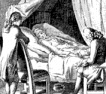
 The placebo effect is usually thought to involve the patient’s belief in a treatment, but as Tom pointed out in an earlier post, the doctor’s belief in a treatment seems also to play a part.
I just found this fantastic footnote on a page from the 1849 edition of The Journal of Psychological Medicine and Mental Pathology, where an elderly lady patient decides to select her doctors based on their faith in her treatment.
An old lady, who was attended by her physician and apothecary, seriously requested them to inform her whether she was likely to die. After a deliberate consultation, they resolved to comply with her request, and they told her they she was near the end. “Very well”, replied the sagacious old dame, “then I must dismiss you, because, if you think so, it is evident that you are not the persons to get me well again!” and she accordingly discharged them both.
There are now several historical texts and journals from the 1800s available online, in full, without restrictions via Google Books.
In fact, May’s edition of The Psychologist (full disclosure: I’m an unpaid associate editor) had an <a href="http://www.thepsychologist.org.uk/archive/archive_home.cfm?volumeID=21&editionID=160&ArticleID=1351
“>article on John Perceval, famous for his influence on 19th century mental health reform after being admitted to several institutions and writing very eloquently about his experiences.
A scanned copy of an original of Perceval’s book is available online. It has the truly wonderful title of:
A Narrative of the Treatment Experienced by a Gentleman During a State of Mental Derangement Designed to Explain the Causes and the Nature of Insanity and to Expose the Injudicious Conduct Pursued Towards Many Unfortunate Sufferers Under That Calamity.
 The Bonkers Institute for Nearly Genuine Research has added a
  Newsweek has a fascinating
  BBC Radio 4’s seasonal mind and brain programme All in the Mind has just
 During the 1960s, a sudden upsurge in anti-consumerist rebellion threatened the profits of the world’s big corporations. The solution to the problem turned out to be packaging the counter-culture and selling the concept of rebellion back to a receptive youth audience.
 The University of Utah have created a
  I’ve just noticed that the month slipped past without me realising that the May edition of Nature’s
  Cognitive Daily have just concluded a series on three classic studies in early psychology: one on Ebbinghaus who experimented on his own memory, one on Millicent Washburn Shinn who experimented on her own
  New York Magazine has a wonderful
  If you’re going to be sarcastic, make sure you do it with the full force of knowledge behind you, because there’s nothing that’ll make you look more ridiculous than being sarcastic and wrong.
 IEEE Spectrum Online magazine has a special and rather splendid
  The tip-of-the-tongue state is a common experience where you know you know something but can’t quite bring it to mind. This everyday experience has told us a great deal about how the mind and brain work, as explored in an
  Albert Bandura’s 1961 ‘
 Mind Hacks