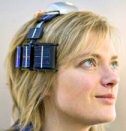
 The New Scientist Tech Blog has an interesting article on a new prototype EEG machine that, like all others, is designed to read electrical activity from the brain. The novelty is that it is totally enclosed in an earphones-like headset and is solar-powered. Apparently, it also generates power from the body’s own heat.
The new headset can generate at least 1 milliWatt of power in most circumstances. That is more than the 0.8mW needed to detect electrical activity observed in the brain, and transmit it over wifi to a computer.
“Using both power sources, you get twice as much power, so it’s roughly half the size,” say Chris van Hoof, also of IMEC, comparing the new headset to the previous device.
Van Hoof says small, preclinical trials show the headset collects data identical to those of EEGs used in hospitals. The portable headset should provide a look at the brain in environments it has not been studied in before.
This looks like it builds on research that has been going on at Imperial College in London on low power technology for ‘wearable cognition systems’.
The ‘cognition’ bit is only likely to be very approximate to what psychologists think of as cognitive processes (as we discussed previously), but I suspect the trick will be developing new applications for the technology, rather than using the technology to try and replace the precision of already existing systems.
A paper on the technology was recently published by the Imperial team. Unfortunately, I can’t find the full-text online but the summary itself is well-worth a read.
Link to article on NewSciTechBlog (via Neurophilosophy).
Link to summary of low power tech for wearable cognition paper.
 The recent UK TV docudrama, The Doctor Who Hears Voices, that we discussed
  Philosopher
  At 9 am this morning,
  The
The  I just listened to a recent
  The Devil’s Dictionary was a famously satirical
  I’ve just finished reading the wonderful Man’s Search for Meaning, a 1946
  In response to my throwaway comment about a finding a suitable chat-up line for someone with the molecular structure of serotonin
  This is an excerpt from quite possibly the geekiest forensic pathology
  The May issue of The Psychologist has a freely available cover
 Carl Zimmer has been collecting science tattoos for a while now, but recently posted this
  In the wake of the Nature
  Not a moment after I
  We’ve featured various sorts of brain candy sweets before on Mind Hacks, but the Japanese sweets Aha! Brain take the concept a
  Mind Hacks