The underground smart drug amendment

CC Licensed Image from Flickr user e-Magine Art. Click for source.Last week, some amendments were quietly slipped into the disastrous Psychoactive Substances Bill that’s currently going through parliament. Surprisingly, a new list of permitted substances has been added. Almost all are poorly evidenced substances used informally as ‘smart drugs’.

The bill is an embarrassingly bad piece of legislation that aims to ban all psychoactive substances by relying on the scientific impossibility of adequately defining ‘psychoactive’. It allows for a ‘whitelist’ of approved drugs which until last week, only included alcohol, nicotine and caffeine.

On December 15th, an amendment was added that greatly increases that list. It now includes:

Racetams
Pramiracetam, Oxiracetam, N-phenylacetyl-L-prolylglycine ethyl ester, Phenylpiracetam, Nefiracetam

Cholinergics
L-Alpha glycerylphosphorylcholine, Citicoline, Meclofenoxate

Miscellaneous
L-Theanine, Oxitriptan, Tongkat Ali, Resveratol, Trans-resveratol, Sulbutiamine

The list is followed by a note which says:

The substances in this amendment are commonly used to improve individuals’ cognitive performance and have been found to have positive effects in a number of academic studies.

The list almost entirely consists of drugs that are widely used by smart drug or nootropics enthusiasts. But to imply that there is good evidence that they have ‘positive effects’ on cognition is entirely misleading.

While some studies have claimed these effects we simply do not have the quality of evidence needed to demonstrate this. Most of the studies that have shown benefits are small and poorly designed.

We know that some of the substances are likely to be low risk in small doses. Oxitriptan, for example, is better known as 5-HTP and is a precursor to the neurotransmitter serotonin and is present in, among other things, bananas. Sulbutiamine is essentially a slightly tweaked version of vitamin B1.

But several of the others are actually quite poorly researched in terms of safety. Typically, few side-effects were reported in the not-very-good-quality studies, but we really know very little about their long-term effects.

What is most striking about this sudden addition to the bill is how odd it is. Suddenly, a list of poorly tested and little understood drugs have been exempted from a ban if the bill becomes law.

The backers of the bill claim that it is needed to protect us from an influx of new poorly tested substances from grey market labs, and then have just exempted a bunch of them based on poorly evidenced claim that they improve cognition.

It’s like someone read the pop-up banner ads for a dodgy internet ‘smart drug’ store and decided to change the proposed law as a result.

The Psychoactive Substances Bill has gone from bizarre to baffling.
 

Link to December 15th bill amendments (via @JonBuchan)

The Peer Reviewers’ Openness Initiative

pro_lockThe Peer Reviewers’ Openness Initiative” is a grassroots attempt to promote open science by organising academics’ work as reviewers. All academics spend countless hours on peer review, a task which is unpaid, often pretty thankless, and yet employs their unique and hard-won skills as scholars. We do this, despite misgivings about the current state of scholarly publishing, because we know that good science depends on review and criticism.

Often this work is hampered because papers don’t disclose the data upon which the conclusions were drawn, or even share the materials used in the experiments. When journal articles only appeared in print and space was limited this was excusable. It no longer is.

The Peer Reviewers’ Openness Initiative is a pledge scholars can take, saying that they will not recommend for publication any article which does not make the data, materials and analysis code publicly available. You can read the exact details of the initiative here and you can sign it here.

The good of society, and for the good of science, everybody should be able to benefit from, and criticise, in all details, scientific work. Good science is open science.

Link: The Peer Reviewers’ Openness Initiative

Spike activity 18-12-2015

Quick links from the past week in mind and brain news:

12% of women have eyes with four colour-detecting cone cells instead of three. Why don’t they all have superhuman colour vision? Fascinating piece from great new blog Neurosphere.

The BMJ has a genuine but wonderfully sarcastic fMRI study on a Christmas spirit network in the brain. “Further research is necessary to understand this and other potential holiday circuits in the brain”

In a mass of tissue as densely packed and hard-working as the brain, even the holes among the structural elements have jobs to do. Good piece from American Scientist.

The Maudsley Psychedelic Society launched this week with an inaugural lecture by Professor David Nutt. Visuals are suitably blurry in places but great talk.

Trying to simulate the human brain is a waste of time and energy. Critical piece in Aeon.

The Atlantic has an excellent piece on the emotional impact of working with traumatised patients if you’re a therapist. Ignore the daft headline on ‘PTSD being contagious’.

Good piece in MIT Tech Review. Can This Man Make AI More Human? One cognitive scientist thinks the leading approach to machine learning can be improved by ideas gleaned from studying children.

The Lancet has an excellent piece on hallucinated voices, identity, and meaning-making.

A Brief History of New York City’s Heroin Scene. Excellent Vice article from someone who was there.

Neurocritic covers ‘This Week in Neuroblunders: fMRI Edition’.

Why human sleep is an evolutionary anomaly. Fascinating piece in The New York Times.

Alzheimer’s from the inside

There’s an excellent short-film, featuring journalist Greg O’Brien, who describes the experience of Alzheimer’s disease as it affects him.

It’s both moving and brilliantly made, skilfully combining the neuroscience of Alzheimer’s with the raw experience of experiencing dementia.

I found it in this Nautilus article, also by O’Brien, who has taken the rare step of writing a book about the experience of Alzheimer’s disease before it affected his ability to write.
 

Link to short film Inside Alzheimer’s on vimeo.
Link to Nautilus article.

Drug control through fantasy neuroscience

I’ve got an article in today’s Observer about the disastrous Psychoactive Substances Bill, a proposed law designed to outlaw all psychoactive substances based on a fantasy land version of neuroscience.

“The bottom line is, the only way of knowing whether a mystery substance alters the mind is to take it. You simply can’t tell by chemical tests, because there is no direct mapping between molecular structure and mental experience. If you could solve the problem of working out whether a substance would affect the conscious mind purely from its chemistry, you would have done Nobel prize winning work on the the problem of consciousness. A second-rank approach is just to see whether a new substance is similar to a known family of mind-altering drugs, but even here there are no guarantees. A slight tweak can make a similar drug completely inactive and about as much fun as Theresa May at a techno night.”

Although I talk about the scientific problems of the Psychoactive Substances Bill, the whole process has been a farce.

From the minister in charge clearly not understanding his own legislation to the Government having to reassure churches that incense won’t be banned.

It’s been criticised from everyone from the Royal Society of Chemistry to traditional Tory supporters stalwarts like The Spectator.

The Medical Research Council have expressed concerns that it could “inhibit worthwhile research and/or potential new therapeutics”.

Just as the rest of the world is turning away from the failed ‘war on drugs’ approach to drug legislation, the UK has decided to make up its own scientific impossibilities to support it.

Normally, scientific impossibilities would be the death knell for proposed regulation but for drugs laws I have long since stopped believing that scientific incompetence was any barrier to enacting legislation.
 

Link to article ‘Theresa May’s futile war on psychoactive drugs’

5 classic studies of learning

Photo by Wellcome and Flickr user Rebecca-Lee. Click for source.I have a piece in the Guardian, ‘The science of learning: five classic studies‘. Here’s the intro:

A few classic studies help to define the way we think about the science of learning. A classic study isn’t classic just because it uncovered a new fact, but because it neatly demonstrates a profound truth about how we learn – often at the same time showing up our unjustified assumptions about how our minds work.

My picks for five classics of learning were:

  • Bartlett’s “War of the Ghosts”
  • Skinner’s operant conditioning
  • work on dissociable memory systems by Larry Squire and colleagues
  • de Groot’s studies of expertise in chess grandmasters, and ….
  • Anders Ericcson’s work on deliberate practice (of ‘ten thousands hours’ fame)

Obviously, that’s just my choice (and you can read my reasons in the article). Did I choose right? Or is there a classic study of learning I missed? Answers in the comments.

Link: ‘The science of learning: five classic studies

A temporary blindness during a wrongful conviction

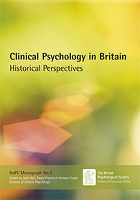
I’m just reading Clinical Psychology in Britain: Historical Perspectives which is a wonderful book if you are a clinical psychologist but probably about as exciting to non-clinical psychologists as you might expect. However, it does contain a few gems of wider interest.

This is a remarkable story from the chapter on the history of forensic clinical psychology which concerns the case of Barry George during the original trial that wrongfully convicted him for the murder of television journalist Jill Dando.

On 26 April 1999, Jill Dando, the presenter of BBC programme Crimewatch, was shot dead outside her home in Fulham, London. On 2 July 2001 Barry George, who lived nearby, was convicted of her murder. Prior to the trial, three defence experts, Gisli Gudjonsson, Susan Young and Michael Kopelman, had reported that Mr George’s fitness to stand trial was contingent on his receiving clinical psychological support in court throughout the trial, which lasted from 23 April to 2 July 2001.

Mr George had a complex presentation, including a long history of primary generalised epilepsy (first identified at age two or three), severely abnormal EEG, intellectual deterioration, significant cognitive and executive deficits, rigid and obsessive personality structure, hypochondriacal preoccupations, and an extreme reaction to stress in the form of anxiety and panic attacks, which increased the frequency of absence epileptic seizures. The court appointed Susan Young, a forensic clinical psychologist, who initially sat in the dock with Mr George and provided him with the required assistance. On 26 April 2001, on the fourth day of the legal arguments and prior to swearing in the jury, Mr George turned to Susan Young and declared, ‘I can’t see’. Prior to this Mr George had been observed having difficulties concentrating on the legal arguments and he claimed to be experiencing petit mal epileptic seizures in the dock.

The trial before the jury was due to commence on 2 May, but the court determined that the trial could only proceed if Mr George’s eyesight could be restored. On the morning of 1 May, all three defence experts were asked to meet Mr George and try to restore his eyesight by 2pm (when the court commenced that day). Michael Kopelman conducted a medical examination and informed Mr George that there was no physical explanation for his blindness. All attempts to persuade Mr George that it was in his interest to to regain his eyesight proved fruitless; he simply kept saying ‘I can’t see’.

At 12.30pm Gisli Gudjonnson, who was trained in hypnosis techniques, suggested that hypnosis might prove successful in bringing back his sight. Mr George agreed to this approach. After an initial induction to the process, Mr George was asked to imagine that he was being taken through a tunnel, accompanied by suggestions that his eyesight would gradually return during the journey and improve further during the lunchbreak (i.e. posthypnotic suggestion). After being brought out of the hypnosis, Mr George said he could see but his eyesight was blurred. He was reassured that it would continue to improve and by 2.00pm his eyesight had fully recovered and after the final legal arguments that afternoon, the trial commenced before a jury.

The defence experts construed Mr George’s blindness as being psychogenic in origin caused by the inability to cope with the stress generated by the legal arguments (i.e. putting a physical barrier between himself and the court), which was unlocked by the process of hypnosis. This was not the first time Mr George had presented with psychogenic symptoms as he had presented with a functional aphonia (i.e. nonorganic loss of speech) following a stressful environmental event in 1994. Psychogenic blindness and psychogenic aphonia are both a form of ‘conversion disorder’ and are often caused by stress that manifests itself as physical symptoms.

Gisli Gudjonnson was originally a policeman in his native Iceland but became interested in the psychological aspects of the crimes he was investigating, moved to the UK to study psychology, and has been massively influential in the development of forensic psychology.

He has been involved in some of the most high profile cases in the country and, TV producers, is the likely subject of your next Nordic detective drama.
 

Link to details of Clinical Psychology in Britain: Historical Perspectives.

Spike activity 04-12-2015

Quick links from the past week in mind and brain news:

Sleep Paralysis’ Demons: Influenced by Culture and Fed by Our Fears. Interesting piece at Brain Decoder.

The Telegraph has an excellent piece on artist Alice Evans, her work and her experience of schizophrenia.

What we can learn about the latest epidemic of opioid drug abuse from the opium wave of 100 years ago. Good piece in the New England Journal of Medicine.

Aeon has a good piece on the possibilities of stem cell therapy for fixing neurodegeneration in dementia.

Beard-envy, Freud and the gentleman’s excuse-me. Amusing look at facial furniture by neuroscientist Sophie Scott in Standard Issue.

Neuroskeptic has a fascinating piece on whether bilingual people have a cognitive advantage.

Felton et al. ranked the relative hotness quotients of professors in 36 different fields. The Monkey Cage has the data.

The New Yorker has a typically brilliant piece from Rachel Aviv on war, refugees and mental health. One of the best writers on mental health anywhere.

Was the counterculture’s favourite psychiatrist a dangerous renegade or a true visionary? The Independent has an extended piece on R.D. Laing.

TechCrunch has an excellent piece on decision science – an increasingly important area in cognitive science.

Neuroimaging in 20 minutes

Neuroscientist Matt Wall did a fascinating talk on all things neuroimaging at a recent TEDx Vienna event. It’s a gently funny, engrossing talk that both introduces brain imaging and discuss some of the cutting-edge developments.

He particularly talks about some of the recent fMRI ‘mind reading’ studies – which are more complex, limited, and interesting than many people assume.

Recommended
 

Link to Matt Wall’s TEDx Vienna talk on neuroimaging.

Why do we forget names?

A reader, Dan, asks “Why do we forget people’s names when we first meet them? I can remember all kinds of other details about a person but completely forget their name. Even after a lengthy, in-depth conversation. It’s really embarrassing.”

Fortunately the answer involves learning something fundamental about the nature of memory. It also provides a solution that can help you to avoid the embarrassing social situation of having spoken to someone for an hour, only to have forgotten their name.

To know why this happens you have to recognise that our memories aren’t a simple filing system, with separate folders for each kind of information and a really brightly coloured folder labelled “Names”.

Rather, our minds are associative. They are built out of patterns of interconnected information. This is why we daydream: you notice that the book you’re reading was printed in Paris, and that Paris is home to the Eiffel Tower, that your cousin Mary visited last summer, and Mary loves pistachio ice-cream. Say, I wonder if she ate a pistachio ice cream while up the Tower? It goes on and on like that, each item connected to every other, not by logic but by coincidence of time, place, how you learnt the information and what it means.

The same associative network means you can guess a question from the answer. Answer: “Eiffel Tower?” Question: “Paris’s most famous landmark.” This makes memory useful, because you can often go as easily from the content to the label as vice versa: “what is in the top drawer?” isn’t a very interesting question, but it becomes so when you want the answer “where are my keys?”.

So memory is built like this on purpose, and now we can see the reason why we forget names. Our memories are amazing, but they respond to how many associations we make with new information, not with how badly we want to remember it.

When you meet someone for the first time you learn their name, but for your memory it is probably an arbitrary piece of information unconnected to anything else you know, and unconnected to all the other things you later learn about them. After your conversation, in which you probably learn about their job, and their hobbies, and their family or whatever, all this information becomes linked in your memory. Imagine you are talking to a guy with a blue shirt who likes fishing and works selling cars, but would rather give it up to sell fishing gear. Now if you can remember one bit of information (“sell cars”) you can follow the chain to the others (“sells cars but wants to give it up”, “wants to give it up to sell fishing gear”, “loves fishing” and so on). The trouble is that your new friend’s name doesn’t get a look in because it is simply a piece of arbitrary information you didn’t connect to anything else about the conversation.

Fortunately, there are ways to strengthen those links so it does become entrenched with the other memories. Here’s how to remember the name, using some basic principles of memory.

First, you should repeat any name said to you. Practice is one of the golden rules of learning: more practice makes stronger memories. In addition, when you use someone’s name you are linking it to yourself, in the physical act of saying it, but also to the current topic of the conversation in your memory (“So, James, just what is it about fishing that makes you love it so much?”).

Second, you should try to link the name you have just learnt to something you already know. It doesn’t matter if the link is completely silly, it is just important that you find some connection to help the name stick in memory. For example, maybe the guy is called James, and your high school buddy was called James, and although this guy is wearing a blue shirt, high school James only ever wore black, so he’d never wear blue. It’s a silly made up association, but it can help you remember.

Finally, you need to try to link their name to something else about them. If it was me I’d grab the first thing to come to mind to bridge between the name and something I’ve learnt about them. For example, James is a sort of biblical name, you get the King James bible after all, and James begins with J, just like Jonah in the bible who was swallowed by the whale, and this James likes fishing, but I bet he prefers catching them to being caught by them.

It doesn’t matter if the links you make are outlandish or weird. You don’t have to tell anyone. In fact, probably it is best if you don’t tell anyone, especially your new friend! But the links will help create a web of association in your memory, and that web will stop their name falling out of your mind when it is time to introduce them to someone else.

And if you’re sceptical, try this quick test. I’ve mentioned three names during this article. I bet you can remember James, who isn’t Jonah. And probably you can remember cousin Mary (or at least what kind of ice cream she likes). But you can you remember the name of the reader who asked the question? That’s the only one I introduced without elaborating some connections around the name, and that’s why I’ll bet it is the only one you’ve forgotten.

This is my BBC Future column from last week. The original is here

Spike activity 20-11-2015

Quick links from the past week in mind and brain news:

Wired has a good brief piece on the history of biodigital brain implants.

Why are conspiracy theories so attractive? Good discussion on the Science Weekly podcast.

The Wilson Quarterly has a piece on the mystery behind Japan’s high child suicide rate.

The Dream Life of Driverless Cars. Wonderful piece in The New York Times. Don’t miss the video.

The New Yorker has an extended profile on the people who run the legendary Erowid website on psychedelic drugs.

Allen Institute scientists identify human brain’s most common genetic patterns. Story in Geekwire.

BoingBoing covers a fascinating game where you play a blind girl and the game world is dynamically constructed through other senses and memory and shifts with new sensory information.

Excellent article on the real science behind the hype of neuroplasticity in Mosaic Science. Not to be missed.

No more Type I/II error confusion

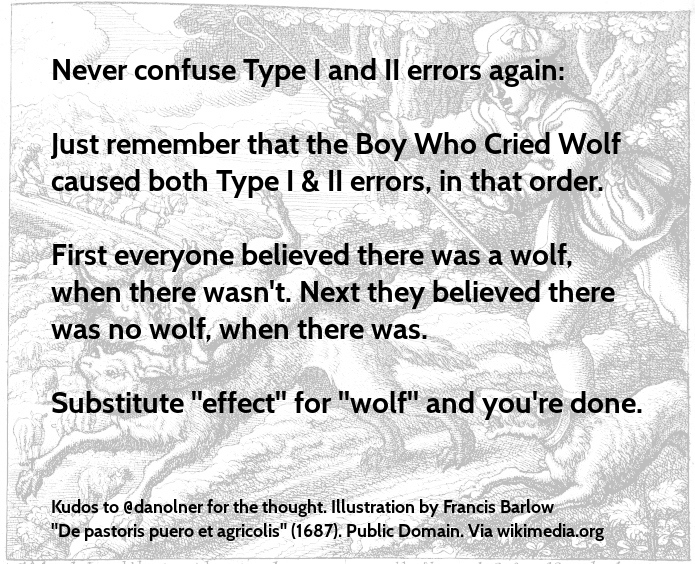
Type I and Type II errors are, respectively, when you allow a statistical test to convinces you of a false effect, and when you allow a statistical test to convince you to dismiss a true effect. Despite being fundamentally important concepts, they are terribly named. Who can ever remember which way around the two errors go? Well now I can, thanks to a comment from a friend I thought so useful I made it into a picture:

Boycriedwolfbarlow

Spike activity 13-11-2015

Quick links from the past week in mind and brain news:

The Weak Science Behind the Wrongly Named Moral Molecule. The Atlantic has some home truths about oxytocin.

Neurophilosophy reports on some half a billion year old brains found preserved in fool’s gold.

An Illuminated, 5,000-Pound Neuron Sculpture Is Coming to Boston. Boston magazine has some pictures.

Guardian Science Weekly podcast has neuroscientist David Eagleman discussing his new book.

A neurologist frustrated by the obstacles to his work on brain-machine interfaces paid a surgeon in Central America $25,000 to implant electrodes into his brain. MIT Tech Review reports.

Business Insider reports on Google’s troubled robotics division. It’s called Replicant, so I’m guessing incept dates may be a point of contention.

The real history of the ‘safe space’

There’s much debate in the media about a culture of demanding ‘safe spaces’ at university campuses in the US, a culture which has been accused of restricting free speech by defining contrary opinions as harmful.

The history of safe spaces is an interesting one and a recent article in Fusion cited the concept as originating in the feminist and gay liberation movements of the 1960s.

But the concept of the ‘safe space’ didn’t start with these movements, it started in a much more unlikely place – corporate America – largely thanks to the work of psychologist Kurt Lewin.

Like so many great psychologists of the early 20th Century, Lewin was a Jewish academic who left Europe after the rise of Nazism and moved to the United States.

Although originally a behaviourist, he became deeply involved in social psychology at the level of small group interactions and eventually became director of the Center for Group Dynamics at MIT.

Lewin’s work was massively influential and lots of our everyday phrases come from his ideas. The fact we talk about ‘social dynamics’ at all, is due to him, and the fact we give ‘feedback’ to our colleagues is because Lewin took the term from engineering and applied it to social situations.

In the late 1940s, Lewin was asked to help develop leadership training for corporate bosses and out of this work came the foundation of the National Training Laboratories and the invention of sensitivity training which was a form of group discussion where members could give honest feedback to each other to allow people to become aware of their unhelpful assumptions, implicit biases, and behaviours that were holding them back as effective leaders.

Lewin drew on ideas from group psychotherapy that had been around for years but formalised them into a specific and brief focused group activity.

One of the ideas behind sensitivity training, was that honesty and change would only occur if people could be frank and challenge others in an environment of psychological safety. In other words, without judgement.

Practically, this means that there is an explicit rule that everyone agrees to at the start of the group. A ‘safe space’ is created, confidential and free of judgement but precisely to allow people to mention concerns without fear of being condemned for them, on the understanding that they’re hoping to change.

It could be anything related to being an effective leader, but if we’re thinking about race, participants might discuss how, even though they try to be non-racist, they tend to feel fearful when they see a group of black youths, or that they often think white people are stuck up, and other group members, perhaps those affected by these fears, could give alternative angles.

The use of sensitivity groups began to gain currency in corporate America and the idea was taken up by psychologists such as the humanistic therapist Carl Rogers who, by the 1960s, developed the idea into encounter groups which were more aimed at self-actualisation and social change, in line with the spirit of the times, but based on the same ‘safe space’ environment. As you can imagine, they were popular in California.

It’s worth saying that although the ideal was non-judgement, the reality could be a fairly rocky emotional experience, as described by a famous 1971 study on ‘encounter group casualties’.

From here, the idea of safe space was taken up by feminist and gay liberation groups, but with a slightly different slant, in that sexist or homophobic behaviour was banned by mutual agreement but individuals could be pulled up if it occurred, with the understanding that people would make an honest attempt to recognise it and change.

And finally we get to the recent campus movements, where the safe space has become a public political act. Rather than individuals opting in, it is championed or imposed (depending on which side you take) as something that should define acceptable public behaviour.

In other words, creating a safe space is considered to be a social responsibility and you can opt out, but only by leaving.

Extremes of self-experimentation with brain electrodes

MIT Technology Review has jaw dropping article about brain-computer interface research Phil Kennedy. In the face of diminishing funding and increasing regulation he “paid a surgeon in Central America $25,000 to implant electrodes into his brain in order to establish a connection between his motor cortex and a computer”.

Both ethically dubious and interesting, it discusses what led Kennedy to this rather drastic decision:

Kennedy’s scientific aim has been to build a speech decoder—software that can translate the neuronal signals produced by imagined speech into words coming out of a speech synthesizer. But this work, carried out by his small Georgia company Neural Signals, had stalled, Kennedy says. He could no longer find research subjects, had little funding, and had lost the support of the U.S. Food and Drug Administration.

That is why in June 2014, he found himself sitting in a distant hospital contemplating the image of his own shaved scalp in a mirror. “This whole research effort of 29 years so far was going to die if I didn’t do something,” he says. “I didn’t want it to die on the vine. That is why I took the risk.”


Link to MIT Tech Review article.

A medieval attitude to suicide

I had always thought that suicide was made illegal in medieval times due to religious disapproval until suicidal people were finally freed from the risk of prosecution by the 1961 Suicide Act.

It turns out the history is a little more nuanced, as noted in this 1904 article from the Columbia Law Review entitled “Is Suicide Murder?” that explores the rather convoluted legal approach to suicide in centuries past.

In the UK, the legal status of suicide was first mentioned in a landmark 13th Century legal document attributed to Henry de Bracton.

But contrary to popular belief about medieval attitudes, suicide by ‘insane’ people was not considered a crime and was entirely blame free. Suicide by people who were motivated by “weariness of life or impatience of pain” received only a light punishment (their goods were forfeited but their family could still inherit their lands).

The most serious punishment of forfeiting everything to the Crown was restricted to those who were thought to have killed themselves “without any cause, through anger or ill will, as when he wished to hurt another”.

There are some examples of exactly these sorts of considerations in a British Journal of Psychiatry article that looks at these cases in the Middle Ages. This is a 1292 case from Hereford:

William la Emeyse of this vill, suffering from an acute fever which took away his senses, got up at night, entered the water of Kentford and drowned himself. The jury was asked if he did this feloniously and said no, he did it through his illness. The verdict was an accident.

We tend to think that the medieval world had a very simplistic view of the experiences and behaviour that we might now classify as mental illness but this often wasn’t the case.

Even the common assumption that all these experiences were put down to ‘demonic possession’ turns out to be a myth, as possession was considered to be a possible but rare explanation and was only accepted after psychological and physical disturbances were ruled out.