Sex survey a let down in bed

A ‘saucy sex survey’ has been doing the rounds in the media that claims to be one of the largest studies on the sex lives of UK citizens. Unfortunately, it seems to be a bit of a let down in bed.

The study has been carried out by an unholy alliance between one of the country’s most respected relationship counselling charities, Relate, and the Ann Summers chain of sex shops but, sadly, it seems the commercial fluff has won out over the genuine insight.

I’m a big fan of Relate. They provide sex and relationship counselling regardless of status, sexuality or income and do an important and often thankless task.

In fact, my mum was a counsellor for them, years ago, when they were still called ‘Marriage Guidance’, and it was one of the things that got me interested in psychology.

The charity also runs a training and research institute for psychologists, psychotherapists and the like, and have built up a reputation for an evidence-based, down-to-earth approach.

Which makes it all the more surprising that they’d get involved with a survey that is clearly designed as a marketing gimmick rather than genuinely useful research.

How do I know it was a marketing gimmick? Because it was discussed in Marketing Week magazine as an example of Ann Summer’s ongoing ‘brand overhaul’ aimed at appealing to ‘a more mature audience’.

“Both parties”, says the article, “hope to make the dual branded survey an annual census”. Lovely.

Now, I’m not necessarily against commercial-academic double teaming, if you’ll excuse the turn of phrase, but you’d better produce something of quality if you want to keep your head held high.

But in this case, the whole thing looks dodgy. The full report, available online as a pdf, is just a bunch of good typesetting, poor graphics and lists of percentages.

What’s more worrying is that Relate won’t release their questions or how they went about asking them. Sex ninja Dr Petra Boynton [not quite her official title] has been trying to get hold of them, in part, because the way questions about a sensitive subject like sex are asked can greatly affect the answers you get.

And of course, which questions you ask is also key. A critical article in today’s Guardian raises some uncomfortable issues about the survey noting that “It sets up a model of the normal libido as frisky and adventurous, looking to try threesomes, bondage and toys – and those things are normal, but so too is not wanting to try them”.

Except, of course, if you’re a massive retailer with an interest in selling people ‘frisky and adventurous’ accessories.
 

Link to article ‘Ann Summers and Relate ought to be unlikely bedfellows’

How the British missed a trip

The first ever medical report on the effects of magic mushrooms is featured in an article in Current Biology. The excerpt is from a 1799 report entitled ‘On A Poisonous Species of Agaric’ from an issue of The London Medical and Physical Journal.

The psychological effects of hallucinogenic, or ‘magic’ mushrooms were first documented in the medical literature in 1799: a forty year-old father of four, JS, collected wild mushrooms in London’s Green Park and cooked them as a stew for breakfast for himself and his four young children. The apothecary Everard Brande described what happened then:

“Edward, one of the children (eight years old), who had eaten a large proportion of the mushrooms, as they thought them, was attacked with fits of immoderate laughter, nor could the threats of his father or mother refrain him. To this succeeded vertigo, and a great deal of stupor, from which he was roused by being called or shaken, but immediately relapsed. […] he sometimes pressed his hands on different parts of his abdomen, as if in pain, but when roused and interrogated as to it, he answered indifferently, yes, or no, as he did to every other question, evidently without any relation to what was asked. About the same time the father, aged forty, was attacked with vertigo, and complained that everything appeared black, then wholly disappeared”

The report is curious for two reasons. The first is that, contrary to the title, the mushroom wasn’t a ‘species of Agaric’.

Agaric here refers to fly agaric which is a red and white spotted toadstool that has long been known to have deliriant properties due to its effect on the acetylcholine receptors in the brain

But the report clearly discusses the classic ‘magic mushroom’ found in the UK, psilocybe semilanceata, which is a small brown fungus that has its hallucinogenic effects through the serotonin system – as do most recreational psychedelic drugs.

The other curious thing is that this hallucinogenic mushroom is common in the UK but seemingly lay undiscovered until 1799.

In contrast, mushrooms from the same species that are equally common in South America were first recorded some 2,000 years ago and became a central part of indigenous spirituality. The Aztecs called these mushrooms teonanacatl – the God mushroom – and were considered a way of accessing the divine.

The British, it seemed, either missed or ignored the fungus, and considered it nothing more than an inedible brown pest.
 

Link to 1799 report on the effects of magic mushrooms.

As addictive as cupcakes

If I read the phrase “as addictive as cocaine” one more time I’m going to hit the bottle.

Anything that is either overused, pleasurable or has become vaguely associated with the dopamine system is compared to cocaine.

In fact, here is a list of things claimed to be as addictive as the illegal nose powder in the popular press:

World of Warcraft
Power
Nicotine
Junk food
High-Fructose Corn Syrup
Ice cream
Cannabis
Love
Gambling
Fatty foods
Porn
Facebook
Sugar
Cupcakes
Running
Stories

And here is a scientifically verified list of things genuinely addictive as cocaine:

Cocaine

In fact, the concept of ‘addictive as cocaine’ really makes very little sense. Even among drugs, cocaine has a unique chemical profile and social context that are the main things that determine its ‘addictiveness’.

Even if you wanted to make the vague analogy that rates of problematic use are similar you’d need to do a decent epidemiological study.

The classic research from the US reports that about 5% of users become cocaine dependent two years after starting the drug.

We are still waiting for a similar epidemiological study on the use of World of Warcraft or the consumption of cupcakes.
 

Link to cocaine entry on Wikipedia

Testing the foundations of teen tech panics

ABC Radio National’s technology and society programme Future Tense has a good discussion of how much evidence supports popular fears about young people and technology.

It’s got some great comments from the always insightful Danah Boyd about how restrictions on the physical freedom of young people through fears about safety have led to increasing socialisation online.

Interestingly, the inflated fears that stop children from playing in the street have also been projected online, way beyond the actual dangers.

The programme also tackles the myth that ‘digital natives’ grow up with some sort of intimate knowledge of techology when, in reality, their knowledge varies wildly leaving a clear need for education and support.
 

Link to ‘Young people and technology: fear and wellbeing’

In solitary

The new edition of the APA Monitor magazine has an article that discusses the psychological impact of solitary confinement in light of its growing use in American prisons.

One of the most interesting points is that evidence for the effect on solitary confinement on prisoners is actually quite limited due to difficulties studying incarcerated people.

Prisoners in administrative segregation are placed into isolation units for months or years. Corrections officials first turned to this strategy in response to growing gang violence inside prisons, Dvoskin says. Though critics contend that administrative segregation has never been proven to make prisons safer, use of this type of confinement has continued to rise. That’s worrisome to most psychologists who study the issue. Deprived of normal human interaction, many segregated prisoners reportedly suffer from mental health problems including anxiety, panic, insomnia, paranoia, aggression and depression, Haney says (Crime and Delinquency, 2003)…

However, much of the evidence of harm comes from cross-sectional studies or research done on people who are not in prison, such as the isolated elderly. Designing a long-term study to follow prisoners in solitary confinement is challenging. Each correctional system is unique, inmates move in and out of segregation, and many states prohibit or limit psychological studies of incarcerated individuals due to ethical concerns.

Most of our evidence, it turns out, comes from other people deprived of human contact, although the effects have been found to almost universally unpleasant until now.
 

Link to article ‘Alone, in the hole’ (via @ResearchDigest)

The rise and fall of Dark Warrior epilepsy

Of all the names for a neurological disorder in the history of medicine, the most awesome has got to be ‘Dark Warrior epilepsy’.

The condition was reported in a 1982 edition of the British Medical Journal and was so named because the patient had seizures – but only while playing the Dark Warrior video game.

The game was actually a coin-up arcade machine and, despite the dodgy graphics, it is notable for being one of the first machines with an attempt at simulated speech.

The patient was a 17-year-old girl whose father was a video game engineer. He fixed the arcade machines and so she got to play for free.

Curiously, the case report mentions that she had already mastered Space Invaders, Asteroids, and Lunar Rescue.

Old skool video game freaks will be reading this and quietly thinking to themselves, respect, but the more medically inclined might be scratching their heads wondering why a patient’s video-gaming history has been included in their case report.

I mean, I ruled at Elite, but it’s never been mentioned in my medical notes.

The reason, is that only year before, the first ever case of epilepsy triggered by a video game was reported. It was named ‘Space Invader epilepsy’ because it was triggered by the arcade game Astro Fighter and the neurologist clearly didn’t know the difference between the original arcade classic and one of the cheap knock-offs.

The 17-year-old girl from Bristol, however, wasn’t troubled by Space Invaders, nor a host of other video games. She played them all with no problems at all. It was only Dark Warrior that affected her brain and, in fact, it was only a very specific scene in the game that contained a bright multicoloured flashing sequence.

The doctors treating the girl thought it was worth sending the case to a medical journal because video games were still very new in 1982.

But despite using the name ‘Dark Warrior epilepsy’ for this particular case they came up with another name – almost as awesome – for similar seizure disorders: ‘electronic space war video game epilepsy’

They then wrote what can only be described as one of neuroscience’s great paragraphs:

The term Space Invader epilepsy is, in fact, a misnomer, since no cases have been reported with the Space Invader video game itself. We suggest, therefore, that Astro Fighter and Dark Warrior epilepsy be classified under “electronic space war video game epilepsy” and this as a special category of photoconvulsive epilepsy. Video games other than space war games – for example, Super Bug and Munch Man – appear to be less epileptogenic. Electronic space war video game epilepsy has yet to be reported with Defender, Space Fury, Lunar Rescue, or Asteroids war games.

At the time, there was much media panic about ‘video games causing epilepsy’ but the real story is actually far more interesting.

Neurology nowadays doesn’t talk about specific game titles but it still considers the effect of video games on the likelihood of triggering seizures.

Firstly, let’s make it clear that video games don’t cause epilepsy, but the reason people can have seizures while playing is not because of the video game per se, but because of a type of neurological disorder called reflex epilepsy that can be triggered by idiosyncratic features of the environment.

The most well-known and most common is photosensitive epilepsy where certain types of flashing lights can cause a seizure. About 5 in every 100 people who have epilepsy have this type.

But actually, reflex epilepsy is very diverse. Some people will have seizures triggered by certain smells, or certain patterns, or certain emotions, or certain tunes, or even doing certain sort of problem-solving – like mental calculation.

Some of the early cases of computer-triggered epilepsy were caused by certain flash sequences in games, which are now not included by common consent.

Occasionally video-game linked seizures do still appear though, but largely because the game happens to have a characteristic which coincides with the trigger of someone’s pre-existing reflex epilepsy. Maybe a specific sequence of musical notes, or a certain pattern, or even causing a specific feeling of frustration.

But sadly, neither ‘Dark Warrior epilepsy’ nor ‘electronic space war video game epilepsy’ caught on and the medical literature now largely talks about ‘video game-induced seizures’.
 

Link to 1982 case of Dark Warrior epilepsy.

Neurological knitwear

One of the disappointing things about the upcoming US presidential elections is that none of the potential candidates has promised the people a made-to-order knitted brain hat. Fear not though, as citizens can now order their own.

Etsy user Anabananna hand knits the woolly neuroogical headgear to your specification and ships them to you.

You can even have a green one if your rockin’ that zombie brain knitwear vibe this season (and who isn’t?)
 

Link to woolly brain hat (thanks @CandiceGordon)

BBC Future column: Does the internet rewire your brain?

My column for BBC Future from a few days ago. The original is here. Mindhacks.com readers will have heard most of this before, thanks to Vaughan’s coverage of the Baroness and her fellow travellers.

Being online does change your brain, but so does making a cup of tea. A better question to ask is what parts of the brain are regular internet users using.

This modern age has brought with it a new set of worries. As well as watching our weight and worrying about our souls, we now have to worry about our brain fitness too – if you believe the headlines. Is instant messaging eroding the attention centres of our brains? Are Facebook, Twitter and other social media tools preventing you from forming normal human bonds? And don’t forget email – apparently it releases the same addictive neurochemicals as crack cocaine!

Plenty of folk have been quick to capitalise on this neuro-anxiety. Amazon’s virtual shelves groan with brain-training books and games. (I confess I am not entirely innocent myself). You can fight the cognitive flab, these games promise, if you work that grey matter like a muscle.

But is this true? Are sudoku puzzles the only thing stopping the species turning into a horde of attention-deficient, socially-dysfunctional, email addicts – part human, part smartphone?

Fear not, there is some good news from neuroscience. But first, it is my duty to tell you the bad news. You may want to put down your phone and take note, this is the important bit.

The truth is that everything you do changes your brain. Everything. Every little thought or experience plays a role in the constant wiring and rewiring of your neural networks. So there is no escape. Yes, the internet is rewiring your brain. But so is watching television. And having a cup of tea. Or not having a cup of tea. Or thinking about the washing on Tuesdays. Your life, however you live it, leaves traces in the brain.

Brain workout


Worrying about the internet is just the latest in a long line of fears society has had about the changes technologies might bring. People worried about books when they first became popularly available. In Ancient Greece, Socrates worried about the effect of writing, saying it would erode young people’s ability to remember. The same thing happened with television and telephones. These technologies did change us, and the way we live our lives, but nothing like the doom-mongers predicted would stem from them.

But is the internet affecting our brains in a different, more extraordinary way? There is little evidence to suggest harm. Here we are, millions of us, including me and you, right now, using the internet, and we seem okay. Some people worry that, even though we cannot see any ill-effects of the internet on our minds, there might be something hidden going on. I am not so worried about this, and I’ll tell you why

We regularly do things that have a profound effect on our brains – such as reading or competitive sports – with little thought for our brain fitness. When scientists look at people who have spent thousands of hours on an activity they often see changes in the brain. Taxi drivers, famously, have a larger hippocampus, a part of the brain recruited for navigation. Musicians’ brains devote more neural territory to brain regions needed for playing their instruments. So much so, in fact, that if you look at the motor cortex of string players you see bulges on one side (because the fine motor control for playing a violin, for example, is only on one hand), whereas the motor cortex of keyboard players bulges on both sides (because piano playing requires fine control of both hands).

So practice definitely can change our brains. By accepting this notion, though, we replace a vague worry about the internet with a specific worry: if we use the internet regularly, what are we practicing?


Get a life


In the absence of any substantial evidence, I would hazard a guess that the majority of internet use is either information search or communication, using email and social media. If this is so, using the internet should affect our brains so that we are better at these things. Probably this is already happening, part of a general cultural change which involves us getting better and better at dealing with abstract information.

Internet use would only be a worry if it was getting in the way of us practicing some other life skill. If Facebook stopped people seeing their friends face to face that could have a harmful effect. But the evidence suggests this is not the case. If anything, people with more active internet lives have more active “meat-space” lives. Most of us are using the internet as a complement to other ways of communicating, not as a substitute.

So there is no magic extra risk from the internet. Like TV before it, and reading before that, it gives us a way of practicing certain things. Practice will change our brains, just like any habit. The important thing is that we are part of this process, it is not just something that happens to us. You can decide how much time you want to put into finding pictures of funny cats, bantering on Facebook or fitting your thoughts into 140 characters. There will be no sudden damage done to your brain, or great surprises for your brain fitness. You would be a fool to think that the internet will provide all the exercise your brain needs, but you would also be a fool to pass up the opportunities it offers. And those pictures of funny cats.

The return of All in the Minds

The two best psychology and neuroscience radio shows, both confusing called All in the Mind, have just started new series in the last couple of weeks.

BBC Radio 4’s programme, which takes more of a magazine format featuring several topics each week, has just kicked off with a programme about stress, humour and discussing personal mental health issues.

On the other side of the wires, ABC Radio National’s programme has begun with an edition on the genetics of mental illness and one on self-harm. I really recommend the genetics programme, by the way, as it takes a fresh look at the whole concept.

Both come highly recommended so do tune in your wireless. Or click your mouse. Whichever is easiest.
 

Link to BBC Radio 4’s All in the Mind
Link to ABC Radio National’s All in the Mind

BBC Future column: earworms

From a couple of weeks ago, my column from BBC Future, about everyday brain quirks (as I’ve mentioned previously). Thanks to Maria Panagiotidi for help with this one.

“Earworms”, some people call them. Songs that get stuck in your head and go round and round, sometimes for days, sometimes for months. For no apparent reason you cannot help yourself from humming or singing a tune by Lady Gaga or Coldplay, or horror upon horrors, the latest American Idol reject.

To a psychologist – or at least to this psychologist – the most interesting thing about earworms is that they show a part of our mind that is clearly outside of our control. Earworms arrive without permission and refuse to leave when we tell them to. They are parasites, living in a part of our minds that rehearses sounds.

We all get these musical memories, and people appear to have different ones, according to a team at Goldsmiths University in London, who collected a database of over 5,000 earworms. True, the songs that we get stuck with tend to be simple and repetitive, but it seems we are not all singing the same number one song at the same time.

Lost in music

Neurologist Oliver Sacks wrote in his book Musicophilia that earworms are a clear sign of “the overwhelming, and at times, helpless, sensitivity of our brains to music”. Music is defined by repetition, just like earworms, and this might make earworms so hard to shake – they are musical memories that loop, say a particular verse or a hook, forever repeating rather than running to completion. Some people report that singing an earworm to the end can help get rid of it (others report in frustration that this does not work at all).

As well as containing repetition, music is also unusual among the things we regularly encounter for being so similar each time we hear it. Fences are visually repetitive, for example, but each time you see the same fence you will look at it from a different angle, or in different light. Put a song on your stereo and the sound comes out virtually identical each time. Remembering is powerfully affected by repetition, so maybe the similarity of music engraves deep grooves in our mind. Grooves in which earworms can thrive.

Another fact about earworms is that they often seem to have something interesting or usual about them. Although they will often be simple and repetitive bits of music, tunes that become earworms have a little twist or peculiarity, something that makes them “catchy”, and perhaps this is a clue as to why they can take hold in our memory system. If there was nothing unique about them they would be swamped by all the other memories that sound similar too.

Slave to the rhythm

If you have got a particularly persistent earworm you can suffer an attack of it merely by someone mentioning the tune, without having to hear it. This proves that earworms are a phenomenon of long-term memory, rather than merely being a temporary “after-image” in sound.

But this is not the whole story. Human memory researchers have identified so called “slave systems” in our short-term memory, components of the mind which capture sights and sounds, keeping them alive for a short time while we focus on them.

One slave system is the “mind’s eye”, capturing visual information, another is the “inner ear”, the part we use for remembering phone numbers, for instance. It is this second part that seems to get infected with earworms. Rather than rehearse our plans for the day, idle thoughts, or lists of things to remember, the inner ear gets stuck on a few short bars of music or a couple of phrases from a song. A part of us that we normally do not have to think about, that should just do what we ask, has been turned against us, tormenting us with a jukebox request that we never asked for.

That our minds are not a unity is one of the basic insights of modern psychology – it is the story Dr Freud was telling, and, although it differs on many of the details, modern cognitive neuroscience says a similar thing. The sense of our selves is not the only thing going on in our minds, psychology says. The mind is an inner world which we do not have complete knowledge of, or have control over.

Mind games

Fortunately psychology can provide some vital intelligence on how to deal with an unruly mind. Consider the famous “don’t think of a white bear” problem, which as it implies involves trying not to think about white bears. Try this yourself, or you can set it as a challenge for a loved one you would like to torment. This problem is a paradox: by trying not to think of a thing you constantly have to be checking if you are still thinking of it – re-invoking precisely the thing you are trying not to think of.

The general solution for the white bear problem is to do something else, to avoid both thinking of the white bear and not thinking of the white bear. For earworms, the solution may be the same. Our inner ear, a vital part of our cognitive machinery for remembering and rehearsing sounds, has become infected with an earworm. This is a part of ourselves which is not under our control, so just sending in instructions to “shut up” is unlikely to be of much help (and has been shown to make it worse). Much better is to employ the inner ear in another task, preferably something incompatible with rehearsing the earworm.

If earworms survive because of their peculiarity, the hook that makes them catch, then my prediction for ridding yourself of an earworm is to sing songs that are similar. If your mind is poisoned by Brittany Spears’ Toxic, for instance, then try singing Kylie Minogue’s appropriately titled Can’t Get You Out Of My Head. By my theory this will erode the uniqueness of the memory habitat that lets the earworm survive. Let me know if it works!

Link: My columns at BBC Future
Link: UK readers – you’ll have to try it via here

Is the brain the centre of your universe?

The Observer has a fantastic debate between neuroscientists David Eagleman and Raymond Tallis about how much brain science tells us about free will and the unconscious.

It’s a wonderful pairing as Eagleman is a broad-thinking wonderboy of neuroscience while Tallis is a veteran street-fighter of brain debates.

The main point of contention revlves around whether we can understand the brain as the source of human nature or whether we have to look beyond the individual to make sense of our experience and behaviour.

Eagleman: It is clear at this point that we are irrevocably tied to the 3lb of strange computational material found within our skulls. The brain is utterly alien to us, and yet our personalities, hopes, fears and aspirations all depend on the integrity of this biological tissue. How do we know this? Because when the brain changes, we change…

Tallis: Yes, of course, everything about us, from the simplest sensation to the most elaborately constructed sense of self, requires a brain in some kind of working order. Remove your brain and bang goes your IQ. It does not follow that our brains are pretty well the whole story of us, nor that the best way to understand ourselves is to stare at “the neural substrate of which we are composed”.

This is because we are not stand-alone brains. We are part of community of minds, a human world, that is remote in many respects from what can be observed in brains. Even if that community ultimately originated from brains, this was the work of trillions of brains over hundreds of thousands of years: individual, present-day brains are merely the entrance ticket to the drama of social life, not the drama itself.

As an accompaniment to the piece, I also wrote a ‘brief guide to neuroscience’ that you can also read online.
 

Link to debate ‘The brain… it makes you think. Doesn’t it?’
Link to ‘A brief guide to neuroscience’.

The delightful science of laughter

Neuroscientist Sophie Scott gave a fantastic talk on the science of laughter for a recent TEDx event that you can now watch online.

Talks on the science of humour are famously humourless (usually made all the more dire by the desperate inclusion of some not very funny ‘funny cartoons’) but this discussion of laughter is appropriately delightful.

Scott describes a study her team carried out on the cross cultural recognition of non-verbal vocal sounds (like whoops of triumph) to find that only laughter was universal.

The whole talk is fully of such fascinating snippets, tackling both the social psychology and neuroscience of laughing. Well worth ten minutes of your time.
 

Link to ace talk on the science of laughter.

Mind Changers back for another series

BBC Radio 4’s brilliant psychology series Mind Changers has made a comeback and has a new season looking at some of the biggest ideas in cognitive science.
It has kicked off with programmes on South African psychologist Joseph Wolpe and the treatment of anxiety as well as an edition on Julian Rotter and the idea of locus of control or the extent to which we believe that we can control events that affect us.

As always, the series is fantastic, looking not only at the ideas but also the people behind these key theories in psychology.

Wait, you say, one of the BBC’s finest series on psychology, back for another series and available online, surely this too good to be true?

As it turns out, which is almost always the case with the Beeb’s digital offerings, it is too good to be true. The flaw this time is that there are no podcasts – only online streaming.

So in light of the BBC’s inability to keep up with the digital world, I’ve included a picture of Julian Rotter smoking a pipe. Especially pertinent as he looks like he’s thinking “torrent servers, my friends, torrent servers”.
 

Link to excellent Mind Changers series.

Snakes on a brain

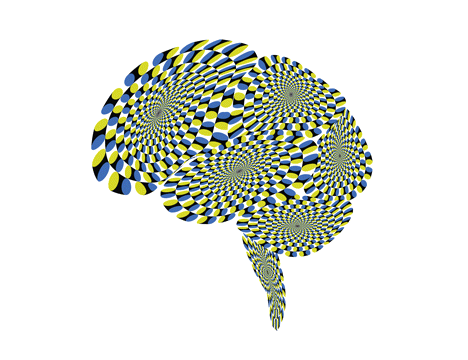
The latest Journal of Neuroscience features a study on the neuroscience behind Akiyoshi Kitaoka’s famouse Rotating Snakes illusion and to celebrate they’re made a ‘Rotating Brain’ illusion for the front cover.

This type of illusion, often called a peripheral drift illusion, was thought to occur due to slow drifting eye movements but this new study suggests that it is more likely to be explained by rapid but tiny eye movements called saccades.

Brain-shaped version of Akiyoshi Kitaoka’s “Rotating Snakes” illusion. In its usual presentation, the image consists of concentric circles of stepwise luminance gradients with curved edges, which produces a strong illusion of rotation in most observers. New evidence suggests this illusion is produced by transient oculomotor events such as microsaccades, saccades, and blinks, rather than continuous drift.

Despite the fantastic cover I expect the journal to outdo itself next time and have both an article explaining the neuroscience Brocken spectre as well as an image you can hide up a mountanside to create 20 metre tall ghost-like figures.
 

Link to study (via

Don’t tase my lobe

A case report in Forensic Science International describes a man who had a taser dart penetate his skull and damage his frontal lobes after getting in a drunken confrontation with police.

Curiously, the man was unaware he had a taser dart in his brain and only went to hospital after he got home and noticed the dart sticking out of his head.

A 27 old man was immobilized by the police while he struggled with a police officer during an identification check and attempted an escape. He had a high level of alcohol at the time of the arrest. A X26 Taser was used to incapacitate and subdue the victim.

No immediate medical examination was subsequently performed in the patient after the wires were propelled and he was allowed to return home. However, because he complained of a headache, he decided to go to the nearest hospital a few hours later.

Upon presentation at the Emergency Department the patient was conscious. The examination revealed a harpoon-like barbed electrode dart implanted in the right frontal part of the skull and a right peri-orbital bruise…

The brain CT scan revealed an encephalic injury in the right area of the frontal lobe. In fact, the probe was implanted in the frontal area of the skull and then in the right frontal cortex with a penetration depth of a few millimeters.

There’s a moral in this story somewhere but damned if I can find it.
 

Link to Forensic Science International case report.

A new symbol for epilepsy in Chinese

The Chinese character for epilepsy has been changed to avoid the inaccuracies and stigma associated with the previous label which suggested links to madness and, more unusually, animals.

The new name, which looks like this just makes reference to the brain although the story of how the original name got its meaning is quite fascinating in itself.

The following text is from an article in the medical journal Epilepsia which announced the change:

If you’re wondering where the bit about the ‘bizarre movements of goats’ came I suspect it’s from a type of fainting goat that looks like it has seizures and falls over. You can see them ‘in action’ in this YouTube video.

However, the link is mistaken as the goats do not have seizures. The effect is caused by their muscles locking up, independently of their brain, by a condition called myotonia congenita.
 

Link to ‘Announcement of a new Chinese name for epilepsy’ (via @cmaer)