Human, All Too Human

I’ve just discovered that probably one of the best series ever produced on philosophy is available on Google Video. The BBC series Human All Too Human includes three fantastic programmes on Friedrich Nietzsche, Jean Paul Sartre and Martin Heidegger – a trio of controversial thinkers who massively influenced 20th century philosophy.

It’s an interesting choice as all had fascinating and turbulent lives – Nietzsche ending his life in insanity, Heidegger a unrepentant Nazi defended by a Jewish ex-lover, and Sartre who walked the line between free love and womanising.

All had a huge influence on psychology at various stages, and you can clearly see how many struggled with concepts of mind and society.

The programmes tackle both the characters and their theories and are some of the most engaging and gripping programmes I’ve ever seen on philosophy, an essential subject that usually gets little more than satire or lip service from mainstream media.

They’re an hour each and worth every minute. Put some time aside, find a comfy chair and enjoy.

Link to programme on Jean Paul Sartre.
Link to programme on Martin Heidegger.
Link to programme on Friedrich Nietzsche.

From Stroboscope to Dream Machine

Photo from 10111.org‘From Stroboscope to Dream Machine: A History of Flicker-Induced Hallucinations’ is a wonderful article that has just appeared in medical journal European Neurology. It charts how an early finding in visual neuroscience was adopted by the Beat writer William Burroughs and became a fixture of the psychedelic sixties.

Flicker induced hallucinations have been noted throughout history and typically occur when a strong light flashes between 8 and 12hz, also known as the alpha rhythm. They most commonly trigger a type of hallucination called a form constant that comprises of geometric shapes and patterns.

Alpha rhythms have been heavily linked to the function of the occipital lobe and, as we suspect from recent research, ‘inputting’ alpha waves into the visual system via flickers seems to cause hallucinations by knocking a deep brain structure called the thalamus and the occipital lobe out of sync.

As both are part of the visual system, the effect is a bit like knocking a conversation out of sync – misperceptions occur.

Burroughs happened upon the phenomenon and set about creating a machine to produce these hallucinations:

The flicker phenomenon reminded Burroughs of a story he had recently been told by his soul mate Brion Gysin (1916-1986). At the time they both inhabited a cheap hotel in 9, rue Gît Le Coeur, a small alley in the middle of the Latin Quarter of Paris. The place has been known as the Beat Hotel ever since. Gysin was a man with many skills; he was a painter, a poet, a calligrapher, a musician and a cook, all in one lifetime.

On December 21, 1958, as his diary reports, he had been travelling on a bus in southern France. He had fallen asleep, leaning with his head against the window pane. On passing by a row of trees, sunlight came flickering through and Gysin started to hallucinate:

‘an overwhelming flood of intensely bright patterns in supernatural colours exploded behind my eyelids: a multi-dimensional kaleidoscope whirling out through space. The vision stopped abruptly when we left the trees. Was that a vision?’.

Gysin knew by experience what neurophysiologists like Walter were talking about. Burroughs was able to hand him the theoretical framework.

The next step was to manufacture a stroboscope for private use. Gysin persuaded one of his friends, Ian Sommerville (1940-1976), to make one. Sommerville, who was originally a mathematician, came up with a simple but effective design

This was later developed into the commercially produced dreammachine, essentially a light with a rotating slotted lampshade designed to produced flickers in the alpha range. It became popular as both a way of inducing hallucinations on its own and as an aide to hallucinogenic drug trips.

There are plans online from a company who still make the machines to order.

The hallucinations don’t occur in everyone (in fact, I’ve probably spent a few hours of my life in front of a frequency controlled strobe trying to trigger the effect with no luck) and in people with photosensitive epilepsy the flickers can trigger seizures.

The effect is almost unknown in the psychedelic circles circles in which it was once popular, but has now been adopted by neuroscientists wanting a lab-based method to research hallucinations.

If you’re interested in reading more about the whole fascinating story, I can’t recommend the short but fascinating book Chapel of Extreme Experience enough.

Link to full-text of article on flicker hallucinations.
Link to DOI entry for same.

2009-09-25 Spike activity

Quick links from the past week in mind and brain news:

<img align="left" src="http://mindhacks-legacy.s3.amazonaws.com/2005/01/spike.jpg&quot; width="102" height="120"

Is the Internet melting our brains? asks Slate of author Dennis Baron who says no, it’s just another cycle in the human history of technology distrust.

Neurophilosophy discusses recent research on how patients in the coma-like persistent vegetative state can show conditioned learning and that those that day are more likely to show recovery.

Psychoanalyst Susie Orbach discusses the psychology and politics of the body on ABC Radio National’s Saturday Extra.

TED Blog has an interesting interview with Oliver Sacks relating to his recent talk on hallucinations.

Thank you Developing Intelligence for being of the few places not to fall for the ‘fMRI of dead fish is an example of a voodoo correlation’ red herring. They’re different effects and the DevIntel post discusses the difference.

Neuroanthropology has an excellent and somewhat philosophical post on mind body duality in the treatment of combat-related PTSD.

Free will is not an illusion after all, much to the surprise of New Scientist who report on new research suggesting an alternative interpretation to Libet’s famous brain activation before conscious intention to move study.

The BPS Research Digest covers research on how your personality type affects the situations you place yourself in. One of many excellent post from the BPSRD this week.

ABC Radio National’s Ockham’s Razor discusses the many illness of dictionary creator Dr Samuel Johnson. You may be interested to know that another major contributor was William Chester Minor who wrote many definitions as a patient in Broadmoor Criminal Lunatic Asylum.

PsyBlog has an excellent post on how long it takes to form a habit.

A photograph of your loved one can reduced pain intensity according to a study covered by Neuronarrative.

New Scientist <a href="http://www.newscientist.com/article/dn17837-gene-for-memory-and-iq-gives-students-low-grades.html
“>covers research on how different alleles of the COMT gene are associated with exam performance. Ignore the ‘gene for x’ nonsense and it’s actually quite an interesting article.

Welcome to the rehab center from the future via a humorous photo gallery from Wired.

Neuroskeptic covers a fascinating case study of a man with a missing limbic system.

Another interesting advance in the still limited field of ‘brain scan mind reading‘ is covered by Wired.

Cognition and Culture has a short piece on how to think, say, or do precisely the worst thing for any occasion.

The Wall Street Journal has a piece on the shocking news that treating your employees well increases their productivity.

When does consciousness emerge? The Splintered Mind has a brilliantly thought-provoking post on the emergence of the conscious mind in individuals and species.

The Neurocritic has a piece on a recent but necessarily speculative paper on the neuroscience of torture and the negative effects on accurate memory recall.

It always seems worse than you think

There is a clich√© in media stories where figures for a disease or condition are quoted followed by a statement that “the true figures may be higher”. Sampling errors mean that initial figures are equally as likely to be under-estimates as over-estimates but we only ever seem to be told that the condition is under-detected.

For example, this is from a recent (actually pretty good) New Scientist article about gender identity disorder (GID) in children, a condition where children who are biologically male feel female and vice versa:

It is unclear how common GID is among children, but many transsexual adults say they felt they were “in the wrong body” from an early age. The incidence of adult transsexualism has been estimated at about 1 in 12,000 for male-to-females, and around in 1 in 30,000 for female-to-males, although transsexual lobby groups say the true figures may be far higher.

These estimates are usually drawn from prevalence studies where a maybe a few hundred or thousand people are tested. The researchers extrapolate from the number of cases to make an estimate of how many people in the population as a whole will have the condition.

These estimates are made with statistical tests which give a margin of error, meaning that within a certain range, typically described by confidence intervals, the real figure is likely to be between a range which equally includes both higher and lower values than the quoted amount.

For any individual study you can validly say that you think the estimate is too low, or indeed, too high, and give reasons for that. For instance, you might say that your sample was mainly young people who tend to be healthier than the general public, or maybe that the diagnostic tools are known to miss some true cases.

But when we look at reporting as a whole, it almost always says the condition is likely to be much more common than the estimate.

For example, have a look at the results of this Google search:

“the true number may be higher” 20,300 hits

“the true number may be lower” 3 hits

You can try variations on the phrasing and see the same sort of pattern emerges. I’m curious as to why this bias occurs, or whether there’s another explanation for it.

The English Surgeon online

Last year I posted about a wonderful film called The English Surgeon, a sublime documentary about the work of neurosurgeons Henry Marsh and Igor Kurilets in the Ukraine. It turns out you can now watch it for free online at the PBS website until 9th October.

As I mentioned last time “to say the film was just about brain surgery would be vastly under value its significance, and to describe it as a meditation on the humanity of medicine would be to confine it to a clich√©.”

As far as I can work out, it should be available wherever you are in the world.

By the way, it turns out that Henry Marsh is the husband of social anthropologist Kate Fox who wrote the book Watching the English that we discussed earlier, so interesting to see that Marsh embodies many typical English traits.

Link to The English Surgeon online (via @mocost @balajajian).

Love outside the lines

The BBC Radio 4 programme Saturday Live recently had a segment on the UK Government’s belated apology to Alan Turing for his 1952 conviction for homosexuality. The programme’s resident poet, Matt Harvey, penned this short but poignant poem to mark the occasion:

here’s a toast to Alan Turing
born in harsher, darker times
who thought outside the container
and loved outside the lines
and so the code-breaker was broken
and we’re sorry
yes now the s-word has been spoken
the official conscience woken
– very carefully scripted but at least it’s not encrypted –
and the story does suggest
a part 2 to the Turing Test:
1. can machines behave like humans?
2. can we?

 
Link to programme details. Scroll down for poem.

Transhuman nature

ABC Radio National’s All in the Mind has just had an excellent programme on ‘the singularity‘, the idea that at some point in the future computer power will outstrip the ability of the human brain and then humanity will be better off in some sort of vague and unspecified way.

The idea, is of course, ludicrous and is based on a naive notion that intelligence can measured as a type of unitary ‘power’ which we can adequately compare between computer and humans. The discussion on All in the Mind is a solid critical exploration of this wildly left-field notion as well as the community from whence it comes.

It’s a popular theme among transhumanists who, despite seeming to have a mortal fear of human limitations, I quite like.

Transhumanists are like the eccentric uncle of the cognitive science community. Not the sort of eccentric uncle who gets drunk at family parties and makes inappropriate comments about your kid sister (that would be drug reps), but the sort that your disapproving parents thinks is a bit peculiar but is full of fascinating stories and interesting ideas.

They occasionally take themselves too seriously and it’s the sort of sci-fi philosophy that has few practical implications but it’s enormously good fun and is great for making you re-evaluate your assumptions.

By the way, there’s loads of extras on the AITM blog, so do check it out.

Link to All in the Mind on ‘the singularity’.
Link to extras on AITM blog.

Migraine as inspiration

Photo by Flickr user Auntie P. Click for sourceI’ve just found a brief but interesting study finding that migraines are much more common in neurologists than the general public which inspired an interesting reply by Oliver Sacks.

The prevalence of migraine in neurologists

Neurology. 2003 Nov 11;61(9):1271-2.

Evans RW, Lipton RB, Silberstein SD.

To assess the prevalence of migraine among neurologists and neurologist headache specialists, the authors performed a survey of neurologists who attended a headache review course. The 1-year and lifetime prevalences of migraine in the 220 respondents were as follows: male neurologists, 34.7%, 46.6%; male headache specialists, 59.3%, 71.9%; female neurologists, 58.1%, 62.8%; and female headache specialists, 74.1%, 81.5%. Migraine is much more prevalent among neurologists than in the general population.

Sacks later wrote to the journal to mention an earlier study finding much higher levels of migraine-related visual disturbances in doctors than other people. He also wonders:

Speculating on the possible reasons for the prevalence of migraine in neurologists, and particularly headache specialists, Evans et al. wonder, among other possibilities, whether “a personal history of migraines might stimulate an interest in neurology and headache as a subspecialty.” For myself, with a personal history of classical migraines (and, more often, isolated visual ones) going back to childhood, the extraordinary phenomena of the aura (which for me included transient or partial achromatopsia, akinetopsia, as well as visual agnosias, alexias, etc), excited an interest in the brain, and especially in visual processing, at an early age. These migraines were certainly one of the reasons I was attracted to neurology, why I chose migraine as the subject of my first book, and why I devoted a large part of this book to illustrating the varied presentations of visual auras in my patients

However, he gets short shrift from the researchers who curtly point out that their survey asked whether neurologists’ experience of migraine had influenced their career choice and they said no, so it can’t be true.

This is clearly not the finest psychological reasoning in the world and I remain fascinated by whether personal experience shapes the specialisation of clinicians.

It only happens in some cases of course. It’s probably rare that neurologists had their interest sparked after major brain damage or oncologists after experiencing cancer.

We do know, however, that psychiatrists are more likely to have experienced mental illness than other doctors and I wonder how many other links between clinical speciality and illness experience there might be.

Link to PubMed entry for study (via @anibalmastobiza)

Seeing the mind amidst the numbers

Photo by Flickr user Koen Vereeken. Click for sourceI’ve just a read a fantastic New York Times article from last year on the ongoing $1,000,000 Netflix challenge to create an algorithm that will predict what unseen films customers will liked based on their past preferences.

As well as an interesting insight into how companies are trying to guess our shopping preferences it is also a great guide to one of the central problems in scientific psychology: how we can reconcile numerical data with human thought and behaviour.

The Netflix prize teams have a bunch of data from customers who have rated films they’ve already seen and they have been challenged to write software that predicts future ratings.

Part of this process is hypothesis testing, essentially an experimental approach to find out what might be important in the decision process. For example, a team might guess that women will rate musicals higher than men. They can then test this prediction out on the data, making further predictions based on past conclusions, theories or even just hunches.

The other approach is to use mathematical techniques that look for patterns in the data. To use the jargon, these procedures look for ‘higher order properties’ – in other words, patterns in the patterns of data.

Think of it like looking at the relationship between different forests rather than thinking of everything as individual trees.

The trouble is, is that these mathematical procedures can sometimes find reliable high level patterns when it isn’t obvious to us what they represent. For example, the article discusses the use of a technique called singular value decomposition (SVD) to categorise movies based on their ratings;

There’s a sort of unsettling, alien quality to their computers’ results. When the teams examine the ways that singular value decomposition is slotting movies into categories, sometimes it makes sense to them — as when the computer highlights what appears to be some essence of nerdiness in a bunch of sci-fi movies. But many categorizations are now so obscure that they cannot see the reasoning behind them. Possibly the algorithms are finding connections so deep and subconscious that customers themselves wouldn’t even recognize them.

At one point, Chabbert showed me a list of movies that his algorithm had discovered share some ineffable similarity; it includes a historical movie, “Joan of Arc,” a wrestling video, “W.W.E.: SummerSlam 2004,” the comedy “It Had to Be You” and a version of Charles Dickens’s “Bleak House.” For the life of me, I can’t figure out what possible connection they have, but Chabbert assures me that this singular value decomposition scored 4 percent higher than Cinematch — so it must be doing something right. As Volinsky surmised, “They’re able to tease out all of these things that we would never, ever think of ourselves.” The machine may be understanding something about us that we do not understand ourselves.

In these cases, it’s tempting to think there’s some deeply psychological property of the film that’s been captured by the analysis. Maybe all trigger a wistful nostalgia, or perhaps each represents the same unconscious fantasy.

It could also be that each is under 90 minutes, or comes with free popcorn. It could even be that the grouping is entirely spurious and represents nothing significant. Importantly, the answer to these questions is not in the data to be discovered, we have to make the interpretation ourselves.

Experimental methods go from meaning to data, while exploratory methods go from data to meaning. Somewhere in the middle is our mind.

The Netflix challenge is this problem on steroids and the NYT piece brilliantly explores the practical problems in making sense of it all.

Link to NYT piece ‘If You Liked This, You‚Äôre Sure to Love That’

Going under

I’ve just found a curious historical article discussing the early debates over whether anaesthesia could trigger sexual dreams in patients. As this was Britain in the 1800s, much of the fuss was centred on whether the Victorian lady was actually capable of such things:

In January, 1849, a discussion of ‚ÄúChloroform in Midwifery‚Äù occurred during a meeting of the Westminster Medical Society in England. One of the physicians, Dr. G. T. Gream (Obstetrician, Queen Charlotte‚Äôs Lying-In Hospital, London, England) enumerated several reasons why he did not think that chloroform was appropriate for obstetric use, and in so doing, he ‚Äúalluded to several cases in which women had, under the influence of chloroform, made use of obscene and disgusting language. This latter fact alone he considered sufficient to prevent the use of chloroform in English women‚Äù…

In a subsequent issue of The Lancet, notes from the Medico-Chirurgical Society of Edinburgh of February 7, 1849, were published. Sir James Young Simpson (Obstetrician, Edinburgh, Scotland, developer of chloroform anesthesia, and President of the Royal College of Physicians in 1849; 1811–1870) stated that after 15 months of use in thousands of cases, “he had never seen, nor had he ever heard of any other person having seen, any manifestation of sexual excitement result from the exhibition of chloroform…. The excitement, he was inclined to think, existed not in the individuals anesthetized, but was the result of impressions harbored in the minds of the practitioners, not in the minds of the chloroformed.”

Of course, there are some cases of criminal clinicians who have used sedation to attack their patients, but we now know that some modern anaesthetics, particularly midazolam and propofol, really do seem to be involved in causing sexual hallucinations and imagery in patients.

As far as I know, the reason why certain anaesthetics spark sexual imagery is still a mystery.

As we discussed earlier this year, the introduction of anaesthesia was controversial, partly because of the belief that pain was useful in keeping people alive and partly because experiencing pain was considered morally virtuous.

Link to PubMed entry for paper.

Lifetime blindness prevents schizophrenia?

Rather mysteriously, no one can find anyone who has been blind from birth and has later been diagnosed with schizophrenia. I found this interesting snippet from a short article from Behavioral and Brain Sciences:

Five independent searches, varying considerably in scope, methods, and population, failed to identify even one well-defined co-occurrence of total blindness and schizophrenia (Abely & Carton 1967; Chevigny & Braverman 1950; Feierman 1982; Horrobin 1979; Riscalla 1980). We dedicated portions of 2000 and 2001 to e-mail and postal mail surveys of relevant professionals; e-mail and telephone discussions with officials of health, mental health, blindness, and schizophrenia organizations and research institutes; and extensive keyword probes of Medline, PsychINFO, and ScienceDirect databases. Some ambiguity was introduced by very low return rates for our surveys, but the consistent result of all these inquiries was that no instance of totally blind/schizophrenic co-occurrence was found.

The authors give a speculative hypothesis that this is because visual experience during development helps to shape brain pathways heavily reliant on the neurotransmitter glutamate and the NMDA receptor.

It is widely accepted that this system plays a role in the development of psychosis but the idea that it is shaped by visual experience to the point where schizophrenia is impossible is just an interesting idea at the present time.

That’s not to say no-one with schizophrenia is blind (in fact, there are numerous tragic cases of self-blinding) but it is still the case that no-one has yet produced an example of someone who has been blind from birth who later has become psychotic.

If you do hear of anyone, get in touch, contact your nearest cognitive scientist, or if you are a researcher yourself, write up a case study, as it’s an interesting anomaly in the medical literature.

Link to summary of paper on blindness and schizophrenia.

Restructuring the metaphysics of a jazz thing

I love this abstract of a scientific paper on ‘Neurological Problems of Jazz Legends’. It’s full of medical jargon but if you read it out loud it sounds like a beat poem. Try it with the same rhythm as Ginsberg’s poem Howl.

Neurological problems of jazz legends

J Child Neurol. 2009 Aug;24(8):1037-42.

Pearl PL.

A variety of neurological problems have affected the lives of giants in the jazz genre.

Cole Porter courageously remained prolific after severe leg injuries secondary to an equestrian accident, until he succumbed to osteomyelitis, amputations, depression, and phantom limb pain.

George Gershwin resisted explanations for uncinate seizures and personality change and herniated from a right temporal lobe brain tumor, which was a benign cystic glioma.

Thelonious Monk had erratic moods, reflected in his pianism, and was ultimately mute and withdrawn, succumbing to cerebrovascular events.

Charlie Parker dealt with mood lability and drug dependence, the latter emanating from analgesics following an accident, and ultimately lived as hard as he played his famous bebop saxophone lines and arpeggios.

Charles Mingus hummed his last compositions into a tape recorder as he died with motor neuron disease.

Bud Powell had severe posttraumatic headaches after being struck by a police stick defending Thelonious Monk during a Harlem club raid.

If beat poetry aint your bag, try dropping it to the beat of Gang Starr’s wonderful track Jazz Thing, which, among other things, taught me the recondite word ‘recondite‘.

Link to PubMed entry for ‘Neurological Problems of Jazz Legends’.
Link to Gang Starr’s Jazz Thing.

Rebel without a couch

I’ve just discovered that the classic James Dean movie Rebel Without a Cause was inspired by a true life account of a psychiatrist’s analysis of a young ‘psychopath’.

According to this 1944 article from Time magazine, the book, called Rebel Without A Cause: The Hypnoanalysis of a Criminal Psychopath, was written by psychiatrist Mitchell Lindner and gave the public “one of the few play-by-play accounts of a psychoanalytic treatment ever published”.

Lindner’s subject is Harold, 21, serving a long term for a serious, unnamed crime. Harold, the son of a bull-tempered Polish laborer who speaks no English, has been in trouble with the police, mostly for pilfering, since the age of twelve. His most conspicuous psychopathic symptom was a constant blinking of his eyes.

Lindner began in orthodox analytic fashion by having the boy lie on a couch and encouraging him to talk freely. (Lindner got his transcript via a microphone concealed in the couch. Told about this at the end of the analysis, Harold himself urged the analyst to publish the record.) Without much hesitation, Harold gave the details of a hair-raising career of gun-toting, stealing, vandalism, fornication. Like all psychopaths, Harold was “a rebel without a cause, a revolutionary without a program,” a grownup infant with no self-restraint and a craving for instant satisfactions.

If you’re puzzled by the term ‘hypnoanalysis’ in the title, it was a form of Freudian psychoanalysis but where the patient was put into a hypnotic trance supposedly to encourage free association and facilitate access to the unconscious.

The idea was that it was a type of cranked up psychoanalysis that could give quicker results but, as the article notes, it was considered rather suspect by the forever orthodox Freudians.

An alternative juiced up version was ‘narcoanalysis’ that typically used barbiturate drugs for the same reason. This was the origin of the truth drug as it was wrongly thought that people hiding the truth might let it slip through if their unconscious was ‘loosened’ somewhat.

The connection between the book and the film seems to be fairly cursory though, as while the movie shares the title and is also about an antisocial young man, it’s otherwise quite different.

Link to 1994 Time article on the book.

Connected by threads

The Boston Globe covers several recent studies that have been able to work out sensitive personal details from information made public on social networking sites, possibly including your sexual orientation.

As we discussed earlier this week, huge amounts of information can be gleaned about your life through social network analysis simply from the patterns in your interactions.

In computer security and counter intelligence this is part of a technique called traffic analysis which has a long history in law enforcement. For example, before the days of the internet the UK police would use the Harlequin system to work out social networks from phone call patterns as these were much easier to obtain than court orders allowing phone taps.

Now, we put much of this information online ourselves but are unaware of how much the explicit personal information that we deliberately keep private is still available implicitly in the public data trail.

Sociologists have known this for years but the rapid spread of electronic communication has spurred the development of analysis tools as well as providing the real world data on which it can be applied.

Discussions of privacy often focus on how to best keep things secret, whether it is making sure online financial transactions are secure from intruders, or telling people to think twice before opening their lives too widely on blogs or online profiles. But this work shows that people may reveal information about themselves in another way, and without knowing they are making it public.

Who we are can be revealed by, and even defined by, who our friends are: if all your friends are over 45, you’re probably not a teenager; if they all belong to a particular religion, it’s a decent bet that you do, too. The ability to connect with other people who have something in common is part of the power of social networks, but also a possible pitfall. If our friends reveal who we are, that challenges a conception of privacy built on the notion that there are things we tell, and things we don’t.

Link to Globe article on social networks and personal info (via MeFi).

Oliver Sacks on the varieties of hallucinatory experience

Oliver Sacks has done a wonderful TED talk on hallucinations that has just been released online. He particularly focuses on the hallucinations of Charles Bonnet syndrome where damage or decay of the retina can cause strikingly complex hallucinations of people and animals that seems to be a natural part of the visual scene.

Interestingly, the people affected by the condition are usually well aware that they are hallucinating and remain lucid throughout.

The talk is wonderful and Sacks is engaging as ever, but some of his neuroscience explanation seems a little dodgy.

He discusses the well-known role of an area in the temporal lobes called the fusiform gyrus in face recognition and relates disturbance in this area to face hallucinations:

There’s an area in the anterior part of [the fusiform gyrus] where teeth and eyes are represented and that part of the gyrus is activated when people get the deformed hallucinations [of people with big teeth and eyes].

There is another part of the brain that is especially activated when one sees cartoons. It is activated when one recognises cartoons, when one draws cartoons and when one hallucinates them…

There are other parts of the brain that are involved in the recognition and hallucination of buildings and landscapes.

Actually, all of this seems quite dodgy. I couldn’t find any evidence that part of the fusiform gyrus is specialised for teeth and eyes.

I found one study which linked the viewing of moving mouths or pair of eyes to activation on the superior temporal gyrus, but this is the other side of the temporal lobe. Also, he seems to be suggesting that specific face parts are mapped to specific areas of the fusiform gyrus, again, which I could find no evidence for.

I suspect the bit about specific parts of the brain for buildings, landscapes and cartoons comes from a misunderstanding of neuropsychology experiments as these sorts of pictures are also often used in experiments on face recognition.

One of the big debates in face perception research is whether the fusiform gyrus is dedicated to face recognition or whether it is specialised for any sort of expertise needed for fine grained visual distinction – for example, recognising car types, or birds and so on.

Hence, experiments often will test people on face recognition, but then also on building or drawings so the researchers can find out whether the problem is specific to faces or just a general visual recognition problem. For example, this exact procedure was used in this 2005 study on four people with prosopagnosia, a selective impairment in face recognition.

Apart from maybe a few minor hallucinations from Sacks himself, the talk is excellent and comes highly recommended.

Link to Oliver Sacks TED talk on hallucinations.

Scientists find area responsible for emotion in dead fish

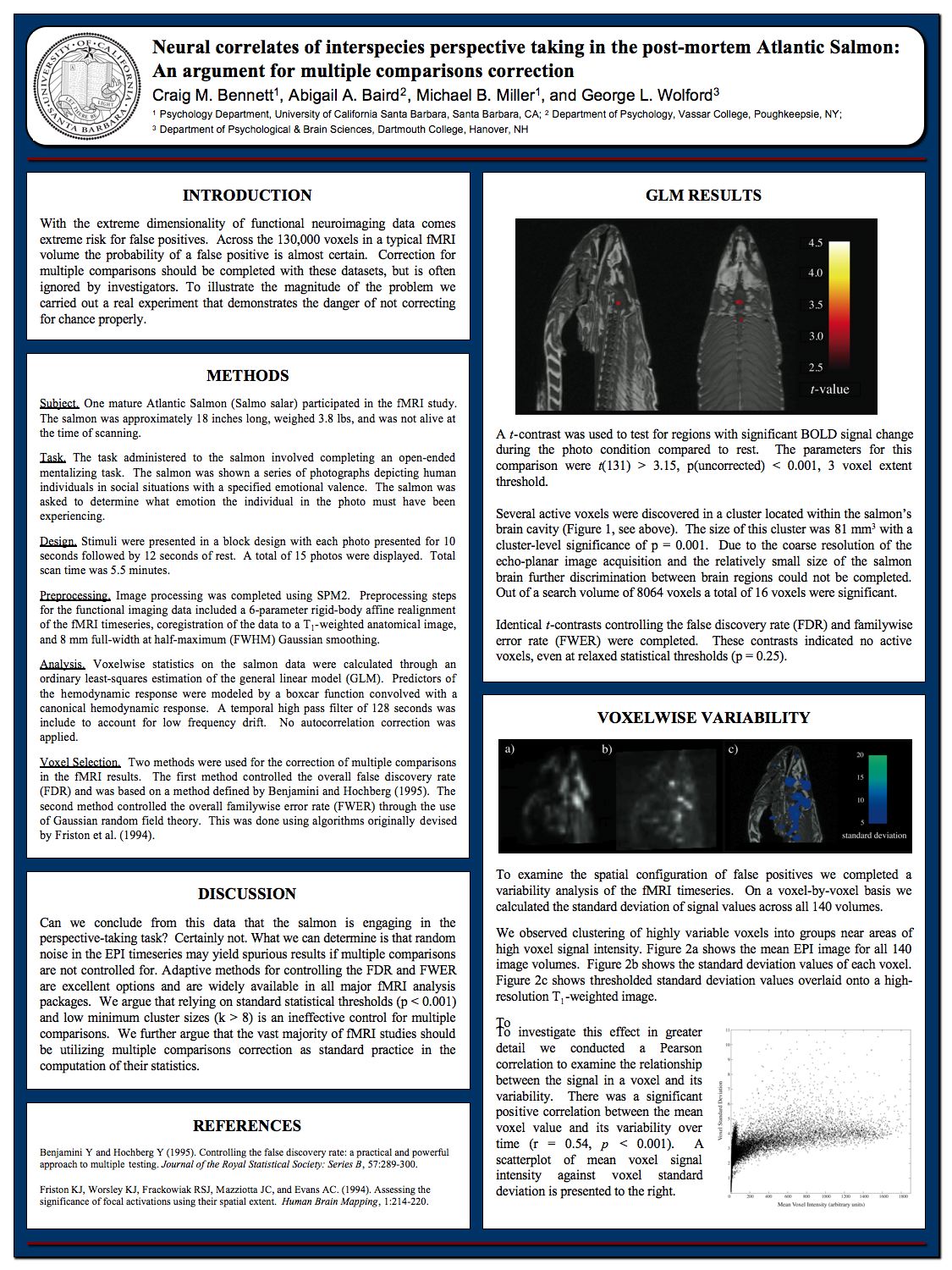
Neuroskeptic covers a hilarious new study that involved brain scanning a dead salmon and finding activation in the brain as it ‘looked’ at photos of human faces.

The authors are not genuinely arguing that dead fish have brain activity but have run the experiment to show that some common statistical methods used in fMRI research will give false positives if they’re not adequately controlled for.

The research, led by neuroscientist Craig Bennett, was presented as a poster at a recent conference and has the brilliant title of “Neural correlates of interspecies perspective taking in the post-mortem Atlantic Salmon: An argument for multiple comparisons correction” and is available online as a jpg.

I’d say that this research was justified on comedic grounds alone, but they were also making an important scientific point. The (fish-)bone of contention here is multiple comparisons correction. The “multiple comparisons problem” is simply the fact that if you do a lot of different statistical tests, some of them will, just by chance, give interesting results.

Most statistics used in psychology, and indeed brain imaging, are based on calculating a p value.

Usually, a p value of less than 0.05 is considered significant and this means that if there was genuinely no difference in the things you were comparing, you would get a false positive less than 5% of the time.

But your average fMRI brain scan analysis can involve 40,000 comparisons, so even if there’s nothing going on, some bits of the brain are going to seem active just through falsely detecting noise and measurement error as real effect.

To help prevent this, you can correct for multiple comparisons by reducing the 5% cut-off to a smaller amount. Unfortunately, some of the standard methods of doing this can be so strict as to create false negatives, when genuine differences are dismissed as statistical noise.

There is no hard and fast rule about which methods to use, but our salmon neuroscientists have graphically illustrated how misleading results can occur if we naively assume that not correcting accounting ‘multiple comparisons problem’ will give us an accurate picture of brain function.

Kudos to the Neuroskeptic blog for picking up on this and for some excellent coverage of this study.

Link to Neuroskeptic on dead salmon study.
jpg of conference poster.