Swimming in the tides of war

My recent Beyond Boundaries column for The Psychologist explores how the micro-culture of Colombian paramilitary organisations may have shaped the expression of post-traumatic stress disorder in demobilised fighters.

Dr Ricardo de la Espriella’s office is surprisingly quiet. Buried deep within San Ignacio University Hospital, the growl of the chaotic Bogotá traffic is perceptibly absent. Despite the street-level pandemonium, the capital city of Colombia remains an oasis of relative calm in a troubled country. The five-decade-old conflict has been pushed back from the urban fringes and persists, unabated, in the rural areas where it continues to devastate the country’s diverse cultural landscape. Dr de la Espriella has long promoted an understanding of how psychological distress is filtered through cultural norms. ‘There are difficulties in recognising post-traumatic stress in certain populations, which is why cultural psychiatry is so important’ he stresses, highlighting the surprising variation in response to suffering. In this case, however, he is not talking about the culture of ethnic or racial groups, but the micro-culture of illegal paramilitary organisations.

While working on a project to rehabilitate ex-members of illegal armed groups, he noticed a striking absence of post-traumatic stress disorder in his patients, despite them having experienced extreme violence both as combatants and civilians. Many had taken part in massacres and selective assassinations, and many had lost companions to equally brutal treatment. There were high levels of substance abuse, aggression and social problems, but virtually none showed signs of anxiety. Intrigued, de la Espriella decided to investigate more closely and carefully interviewed the ex-paramilitary patients again, using the Clinician Administered PTSD Scale, which asks specific and detailed questions about post-trauma symptoms. After this more detailed examination, more than half could be diagnosed with the disorder.

The reason for why none of these symptoms presented in day-to-day life seemed to lie in paramilitary subculture. While aggression and drug abuse are tolerated, anxiety is taboo to the point where members showing signs of anxiety can be killed by their compatriots for being ‘weak’. This brutal emotional environment shapes the men to neither show nor spontaneously report any form of fear or nervousness. De la Espriella reported his findings in the Colombian Journal of Psychiatry where he discusses the difficulties in treating people who have been involved in violence and killing. His work also raises the uncomfortable question of who we consider to be a victim of conflict. Can we extend compassion to those who commit the atrocities or do we allow those who swim in the tides of war to drown in its powerful currents?

Thanks to Jon Sutton, editor of The Psychologist who has kindly agreed for me to publish my column on Mind Hacks as long as I include the following text:

“The Psychologist is sent free to all members of the British Psychological Society (you can join here), or you can subscribe as a non-member by going here.
 

Link to column from The Psychologist (bottom of page).

The chaos behind a legendary portrait

I just found this fascinating account of how Vincent Van Gogh cut off his own ear while seemingly severely mentally ill, the event that led him to paint one of his most famous pictures.

The account is apparently reconstructed from known events at the time but also has van Gogh’s own description of the event, taken from letters to his sister.

On Christmas Eve 1888, after Gauguin already had announced he would leave, van Gogh suddenly threw a glass of absinthe in Gauguin’s face, then was brought home and put to bed by his companion. A bizarre sequence of events ensued. When Gauguin left their house, van Gogh followed and approached him with an open razor, was repelled, went home, and cut off part of his left earlobe, which he then presented to Rachel, his favorite prostitute.

The police were alerted; he was found unconscious at his home and was hospitalized. There he lapsed into an acute psychotic state with agitation, hallucinations, and delusions that required 3 days of solitary confinement. He retained no memory of his attacks on Gauguin, the self-mutilation, or the early part of his stay at the hospital…

At the hospital, Felix Rey, the young physician attending van Gogh, diagnosed epilepsy and prescribed potassium bromide. Within days, van Gogh recovered from the psychotic state. About 3 weeks after admission, he was able to paint Self-Portrait With Bandaged Ear and Pipe, which shows him in serene composure. At the time of recovery and during the following weeks, he described his own mental state in letters to Theo and his sister Wilhelmina: “The intolerable hallucinations have ceased, in fact have diminished to a simple nightmare, as a result of taking potassium bromide, I believe.”

“I am rather well just now, except for a certain undercurrent of vague sadness difficult to explain.” “While I am absolutely calm at the present moment, I may easily relapse into a state of overexcitement on account of fresh mental emotion.” He also noted “three fainting fits without any plausible reason, and without retaining the slightest remembrance of what I felt”

Although absinthe is commonly associated with hallucinations and madness, and the author of the article wonders whether it might have helped cause his epilepsy, this is unlikely due to the fact that the effect of absinthe’s ‘special ingredient’ is largely a myth.

The distinctive aspect of the drink, the chemical thujone from the wordwood plant, is actually present in such small quantities that absinthe has virtually no psychoactive effects beyond the alcohol.

However, epilepsy does raise the risk of psychosis and it is suspected that he had temporal lobe epilepsy which is particularly associated with this reality-bending mental state.
 

Link to AJP article on ‘The Illness of Vincent van Gogh’.

Twelfth century orgasmic brain heat

Hildegard of Bingen was a twelfth century nun, possibly with repressed lesbian desires, who had visions, was a proto-scientist, advised the Pope, composed music, and, er, wrote about the role of the brain in the female orgasm.

BBC Radio 4’s Great Lives just had a fantastic programme about her where they read out her description of the female orgasm and how it is driven by a ‘sense of heat’ in the brain.

Remember, if you could possibly forget, that this was written by a nun in the 12th century.

When a woman is making love with a man, a sense of heat in her brain, which brings forth with it sensual delight, communicates the taste of that delight during the act and summons forth the emission of the man’s seed. And when the seed has fallen into its place, that vehement heat descending from her brain draws the seed to itself and holds it.

I for one, certainly feel closer to God after reading that.

Hildegard is most well known among neuroscientists for the descriptions of her visions which Oliver Sacks has interpreted as likely stemming from migraines as these can can cause an array of visual distortions and hallucinations.

Although from now on, I shall give equal consideration to her interest in erotic brain heat.
 

Link to programme info and streaming.
mp3 of the same in different location because the BBC are a bit slow.

Escaping from the past of disaster psychology

Scientific American has a useful piece on how the immediate treatment of psychological trauma has changed since 9/11. The issue is interesting because recent progress has turned lots of psychological concepts on their head to the point where many still can’t grasp the concepts.

The article notes that at the time of the Twin Towers disaster, the standard form of treatment was Critical Incident Stress Debriefing – also known as CISD or just ‘debriefing’ – a technique where psychologists would ask survivors, usually in groups, to describe what happened and ‘process’ all the associated emotions by talking about them.

This technique is now not recommended because we know it is at best useless and probably harmful – owing to the fact that it seems to increase trauma in the long-term.

Instead, we use an approach called psychological first aid, which, instead of encouraging people to talk about all their emotions, really just focuses on making sure people feel secure and connected.

Although the article implies that 9/11 was a major turning point for our knowledge of immediate post-trauma treatment, the story is actually far more complex.

Studies had been accumulating throughout the 90s showing that ‘debriefing’ caused harm in some, although it wasn’t until around the turn of the century that two meta-analyses sealed the deal.

Unfortunately, the practice of ‘debriefing’ by aid agencies and emergency psychologists was very hard to change for a number of interesting reasons.

A lot of aid agencies don’t deal directly with the scientific literature. Sometimes, they just don’t have the expertise but often it’s because they simply have no access to it – as most of it is locked behind paywalls.

However, probably most important was that even the possibility of ‘debriefing’ having the potential to do damage was very counter-intuitive.

The treatment was based on the then-accepted foundations of psychological theory that said that emotions always need to be expressed and can do damage if not ‘processed’.

On top of this, for the first time, many clinicians had to deal with the concept that a treatment could do damage even though the patients said it was helpful and were actually and genuinely getting better.

This is so difficult to grasp that many still continue with the old and potentially damaging practices, so here’s a quick run down of why this makes sense.

The theoretical part is a hang-over from Freudian psychology. Freud believed that neuronal energy was directly related to ‘mental energy’ and so psychology could be understood in thermodynamic terms.

Particularly important in this approach is the first law of thermodynamics that says that energy cannot be created or destroyed just turned into another form. Hence Freud’s idea that emotions need to be ‘expressed’ or ‘processed’ to transform them from a pathological form to something less harmful.

We now know this isn’t a particularly reliable guide to human psychology but it still remains hugely popular so it seemed natural that after trauma, people would need to ‘release’ their ‘pent up emotions’ by talking about them lest the ‘internal pressure’ led to damage further down the line.

And from the therapists’ point of view, the patients said the intervention was helpful and were genuinely getting better, so how could it be doing harm?

In reality, the psychologists would meet with heavily traumatised people, ‘debrief’ them, and in the following weeks and months, the survivors would improve.

But this will happen if you do absolutely nothing. Directly after a disaster or similarly horrible event people will perhaps be the most traumatised they will ever be in their life, and so will naturally move towards a less intense state.

Statistically this is known as regression to the mean and it will occur even if natural recovery is slowed by a damaging treatment that extends the risk period, which is exactly what happens with ‘debriefing’.

So while the treatment was actually impeding natural recovery you would only be able to see the effect if you compare two groups. From the perspective of the psychologists who only saw the post-trauma survivors it can look as if the treatment is ‘working’ when improvement, in reality, was being interfered with.

This effect was compounded by the fact that debriefing was single session. The psychologists didn’t even get to see the evolution of the patients afterwards to help compare with other cases from their own experience.

On top of all this, after the ‘debriefing’ sessions, patients actually reported the sessions were useful even when long-term damage was confirmed, because, to put it bluntly, patients are no better than seeing the future than professionals.

In one study, 80% of patients said the intervention was “useful” despite having more symptoms of mental illness in the long-term compared to disaster victims who had no treatment. In another, more than half said ‘debriefing’ was “definitely useful” despite having twice the rate of postraumatic stress disorder (PTSD) after a year.

Debriefing involves lots of psychological ‘techniques’, so the psychologists felt they were using their best tools, while the lack of outside perspective meant it was easy to mistake instant feedback and regression to the mean for actual benefit.

It’s worth saying that the same techniques that do damage directly after trauma are the single best psychological treatment when a powerful experience leads to chronic mental health problems. Revisiting and ‘working through’ the traumatic memories is an essential part of the treatment when PTSD has developed.

So it seemed to make sense to apply similar ideas to those in the acute stage of trauma, but probably because the chance of developing PTSD is related to the duration of arousal at the time of the event, ‘going over’ the events shortly after they’ve passed probably extends the emotional impact and the long-term risks.

But while the comparative studies should have put an end to the practice, it wasn’t until the World Health Organisation specifically recommended that ‘debriefing’ not be used in response to the 2004 tsunami [pdf] that many agencies actually changed how they went about managing disaster victims.

As well as turning disaster psychology on its head, this experience has dispelled the stereotype that ‘everyone needs to talk’ after difficult events and, in response, the new approach of psychological first aid was created.

Psychological first aid is actually remarkable for the fact that it contains so little psychology, as you can see from the just released psychological first aid manual from the World Health Organisation.

You don’t need to be a mental health professional to use the techniques and they largely consist of looking after the practical needs of the person plus working toward making them feel safe and comfortable.

No processing of emotions, no ‘disaster narratives’, no fancy psychology – really just being practical, gentle and kind.

We don’t actually know if psychological first aid makes people less likely to experience trauma, as it hasn’t been directly tested, although it is based on the best available evidence to avoid harm and stabilise extreme stress.

So while 9/11 certainly focussed people’s minds on psychological trauma and its treatment (especially in the USA which is a world leader in the field) it was really just another bitter waymarker in a series of world tragedies that has shaped disaster response psychology.

So unusually for a psychologist, I’ll be hoping we’ll have the chance to do less research in this particular area and have a more peaceful coming decade.
 

Link to SciAm piece on psychology and the aftermath of 9/11.

The spark of the cognitive revolution

Monitor on Psychology has a fascinating article on Otto Selz, a little known pioneer of the cognitive revolution who was decades ahead of the rest of psychology, before being captured and killed by the Nazis.

He was so little known, in fact, that the majority of people have never heard of him. In fact, this is the first time I’ve ever seen anything written about him, despite the fact he was a major influence on the key players who launched the concept of ‘mind as information processing metaphor’ in the 1950s.

Selz began to lay the foundation for cognitive research in a series of experiments he and his colleagues conducted from 1910 to 1915. They asked participants to explain their problem-solving thought processes out loud as they tried to complete a task, such as finding a word related to but more generic than “newspaper” or “farmer,” such as “publication” or “worker,” respectively. The participants would explain how they identified the features of those words, how the features fit into larger categories and how the categories led them to new words.

Based on these statements, Selz concluded that their minds were doing more than simply associating words and images they’d heard in conjunction before. To Selz, the participants were operating under what he called a “schema,” or an organizing mental principle, that guided their thoughts. Under this schema, the mind automatically orders relationships between ideas and can anticipate the connections among novel stimuli, serving as a basis for problem-solving. The existence of such an organized mental life would later become a cornerstone of the cognitive revolution.

Selz was actually captured twice by the Nazis. He was first sent to the Dachau concentration camp but was released after five weeks on the condition that he leave the country.

He went to Holland and continued working for two years but was captured again when the Nazi’s invaded. He died while been transported to Auschwitz.

The article has an incredibly poignant moment where it mentions “His last recorded correspondence was a postcard to his colleagues, telling them he planned to begin a lecture series for his fellow inmates.”
 

Link to APA Monitor article on Otto Selz.

Casting out the epilepsy ignorance demons

The New York Times has a surprising article about stigma surrounding epilepsy in Sierra Leone that describes some quite astounding beliefs about the condition.

Stigma here is based on two myths: that epilepsy is contagious and that it is caused by demonic possession. Dr. Lisk is quick to point out that beliefs about possession traverse societal boundaries. “You think it relates to level of education, of literacy, but somehow it doesn’t,” he said. “Sometimes it’s the most educated people who will tell you that it’s demonic. They say it’s in the Bible.” (Some biblical references to possession have long been thought to describe people with epilepsy.)

As a result, discrimination against people with epilepsy here is blatant and unabashed, and it begins in elementary school. “The school authorities often ask the students with epilepsy to leave,” Mr. Bangura said. “There is the notion that epilepsy is contagious; so when somebody has an attack during school, the perception is that if somebody happens to step on the spittle of an affected student, that would be one way of contracting the disease.”…

“Wherever the kid fell, they circle it and tell people to stay away from it, because that spot is a bad spot,”…

While these beliefs seem outlandish, the idea that epilepsy is caused by demonic possession is still common among many Western churches.

Here’s a video of a pastor of a revival church casting out epilepsy demons in Germany. This is an account of how TDS Ministries cured a young mother of a ‘spirit of epilepsy’ that was attacking her.

And if you’re still not convinced, this page has a testimony from the Bethel Church of how a blind man with epilepsy was not only cured of his seizures but also had his eyeballs grow back (suck on that Big Pharma!)

Needless to say, there’s plenty more where that came from, so we still have a way to go before even the most bizarre forms of stigma are defeated in the supposedly educated West.
 

Link to NYT piece on epilepsy beliefs in Sierra Leone.

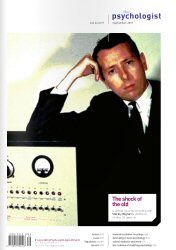
The Psychologist on Milgram and the shock of the old

The August issue of The Psychologist is an open-access special edition on Stanley Milgram and his obedience studies that continue to cast a dark shadow over our understanding of human nature.

The issue has articles that look back on the legacy of his obedience studies, his treatment by historians and a personal view written by his widow, Alexandra Milgram, on the man himself.

But a particular highlight is a piece on his pioneering and almost cinematic use of film in his appropriately dramatic studies:

…in the popular imagination, Obedience and the ‘obedience to authority’ trials have become conflated and are now one and the same, despite the fact that the film only provides substantial documentation of one condition out of more than 20 that were investigated. Milgram’s documentaries and thoughtful writings on film, television and photography point to the value of narrative and audio-visual methods of research. The Obedience footage, however, does not support his claim that people ‘mindlessly follow authority’. On the contrary, it provides detailed audio-visual evidence that people experience considerable strain and anguish in following orders that conflict with their own consciences.

All the articles are free to read as is the rest of the issue. Enjoy.
 

Link to August edition of The Psychologist.
 

Declaration of interest: I’m an unpaid associate editor and occasional columnist for The Psychologist. The editor has not yet needed to use electric shocks on me.

Human pheromones: wishful thinking

Slate has a fantastic article about the science of scents and why ‘attraction-boosting’ human pheromone products are selling nothing but myths.

The article takes a curious look at the history of misapplied pheromone research and how it’s been used to sell everything from aftershave to soap.

“The whole pheromone thing got picked up by the mass media,” says Richard Doty, director of the University of Pennsylvania’s Smell and Taste Research Center and author of The Great Pheromone Myth. It feeds into our need to believe, he said, that there “is all this subliminal stuff going on that is affecting us—who we mate with, who we want to be with. It’s this mythical perspective.” And marketers, like women’s magazines, are only too happy to exploit that myth. That’s how a whole junk-science industry of pheromone-perfumes, pheromone-soaps, and pheromone-cosmetics managed to spring up from a strange menagerie of misconstrued mammal studies.

Personally, I’ve always believed in the power of the scent of raw man, which, I have discovered, is surprisingly under-appreciated.
 

Link to Slate article on the pheromone hype.

Ecstasy for war trauma: a flashback to earlier treatments

Mother Board has a completely fascinating article on the current ongoing trial testing whether MDMA or ‘ecstasy’ could be useful in treatment combat trauma.

The piece is interesting as much for what it doesn’t say, as for what it does, and for how it ties into the history of psychological treatments for posttraumatic stress disorder or PTSD.

The trial is testing whether MDMA can assist in psychological treatment for the condition, in which a traumatic event leads to a sense of current threat and intrusive sensory impressions that are maintained by a pattern of avoiding reminders.

The most effective tried-and-tested treatments for the condition are types of therapy that are ‘trauma-focused’ that involve, among other things, a mental revisiting of the traumatic memories to ‘take the sting out of their tail’.

But this is exactly what most people who arrive in psychologists’ offices don’t want to do. This makes sense from the perspective of someone who is troubled by these memories and wants to stop thinking about them, but the avoidance actually helps maintain the problem.

This is, in part, because the person never learns to adjust to the anxiety (they don’t habituate in technical terms) and the memories remain as fragmented impressions that don’t fit into a coherent narrative, making them more likely to intrude into the conscious mind.

In other words, most people with PTSD initially arrive for treatment wanting a better form of avoidance because their current methods simply aren’t working. The mental health professional has the unenviable task of explaining that treatment involves exactly the opposite and reliving the event and experiencing the anxiety will be key.

It is so key, in fact, that anti-anxiety drugs like benzodiazapines (e.g. vallium) may reduce the effectiveness of treatment because they dull the experience of stress that the person needs to adjust to.

The MDMA trial is interesting in this regard, because ecstasy is, for many, a remarkably effective anti-anxiety drug.

So how does the drug facilitate the psychotherapy? Here’s the description from the article:

MDMA’s effects typically manifest themselves 30-45 minutes after ingestion, so it doesn’t take long for rhythms to develop in Charleston. Sessions at the clinic oscillate between stretches of silent, inward focus, where the patient is left alone to process his trauma, and unfiltered dialogue with the co-therapists. “It’s a very non-directed approach,” Michael Mithoefer told me. This allows subjects to help steer the flow of their trip. They are as much the pilots of this therapy as their overseers. “Once they get the hang of it,” Mithoefer explained, “sometimes people will talk to us for a while and then say, ‘OK, time to go back inside. I’ll come report when I’m ready.’”

That said, patients understand that if no traumas emerge, the Mithoefer’s must coax them out. But they’ve never had to. The traumas always emerge, and by now there have been over 60 sessions between an initial, smaller Phase 2 study and the present trials. Horrors are bubbling up naturally, patient after patient.

This harks back to a more psychoanalytic or Freudian-inspired idea of trauma and treatment. The goal of the therapy is to understand the inner self while the drug is intended to help us overcome psychological defences that prevent us from seeing things as they really are. In fact, this is a central assumption of the therapy.

This approach is not new. ‘Narcoanalysis’ was used widely in mid-20th Century where a range of drugs, from ether to sodium pentathal, were applied to patients with ‘war neurosis’ for exactly this purpose. Unfortunately, it was unsuccessful and abandoned.

So this is why the MDMA treatment is a gamble. All known effective psychological treatments for PTSD involve not only confronting the memories of what happened to make sense of them, but also re-experiencing the associated anxiety. A treatment with a drug that removes anxiety will, by current predictions, have limited effectiveness.

But this is also why the approach is interesting, because if it is shown to be genuinely effective, we might have to rethink our ideas about PTSD and its treatment.
 

Link to Mother Board article on the MDMA PTSD trial.

Reaching for the high notes

Science writer Emily Anthes has a fascinating interview with a speech therapist who works with male-to-female transsexuals to help make their voice sound more feminine.

It gives both an insight into a little known area of speech therapy as well as highlighting some of the often overlooked differences between male and female voices.

EA: So, how does speech therapy work for someone who’s transitioning? What does it involve?

EG: They go once a week, sometimes twice a week if they’re really eager to speed things up, and they do different vocal exercises. Pitch is one of the most important markers. Men on average speak at 110-120 [Hertz], gender neutral is 145-165, and women are 210-220. In most cases the goal is to try to get to gender neutral, which basically means that if you called somebody on the phone, and they speak in what’s known as the gender neutral pitch, you probably wouldn’t be able to tell if they were a man or a woman.

So that’s the first piece, but along with that, they have to learn other things, like posture and speech intonation. Speech intonation is how much your voice goes up and down in a sentence. Men tend to speak in a very monotone, even tone. Women speak in many, many different pitches; as they speak they go up and down, they go high, they go low. So that’s really important–a person who’s transitioning needs to learn how to use that range in their voice.


Link to ‘Learning to Speak Like a Woman’.

A culture of sacrifice to the body beautiful

The New York Times has a excellent piece on the culture of plastic surgery in Brazil by anthropologist Alexander Edmonds.

Edmonds notes that surgery is not considered to be a correction or salve against the sagging of the years but a beauty treatment in its own right that is justified by a folk psychology of self-esteem.

Yet, such desires are not simply a matter of psychology. Brazil’s pop music and TV shows are filled with talk of a new kind of celebrity: the siliconada. These actresses and models pose in medical magazines, the mainstream women’s press, and Brazilian versions of Playboy, which are read (or viewed) by female consumers. Patients are on average younger than they were 20 years ago. They often request minor changes to become, as one surgeon said, “more perfect.”

The growth of plastic surgery thus reflects a new way of working not only on the suffering mind, but also on the erotic body. Unlike fashion’s embrace of playful dissimulation and seduction, this beauty practice instead insists on correcting precisely measured flaws. Plastic surgery may contribute to a biologized view of sex where pleasure and fantasy matter less than the anatomical “truth” of the bare body.


Link to NYT piece on A ‘Necessary Vanity’ (via @moximer).

Riot psychology

In the coming weeks we can expect to see politicians and pundits lining up to give us their smash-and-grab clichés for the recent urban riots in the UK.

They’ll undoubtedly give a warm welcome to our old friends economic decay, disengaged youth and opportunistic crime, and those of a more psychological persuasion might name-drop ‘deindividuation’ – the process where we supposedly lose self-awareness and responsibility in large crowds.

This belies the fact that crowd behaviour is a complex area that is surprisingly poorly researched.

But what we do know about is the interaction between large crowds and the police and you could do much worse than check out the work of psychologist Clifford Stott who researches how crowds react to policing and what triggers violence.

In his 2009 report on the scientific evidence behind ‘Crowd Psychology and Public Order Policing,’ commissioned by the UK constabulary, he summarises what we know about public disorder and how the authorities can best manage it (you can download it as a pdf).

He notes that the old ideas about the ‘mob mentality’, deindividuation and the loss of individual responsibility are still popular, but completely unsupported by what we know about how crowds react.

People don’t become irrational and they do keep thinking for themselves, but that doesn’t mean that the influence of the crowd has no effect.

In terms of policing, one of the clearest effects to emerge from studies of riots and crowd control is that an indiscriminate kicking from riot police can massively increase the number of people in the crowd who become violent.

This is probably because the social identity of people in a group is fluid and changes according to the relationship with other groups.

For those into academic jargon, this is known as the Elaborated Social Identity Model of crowd behaviour – a well-supported theory with an overly complicated name but which is surprisingly easy to understand.

Imagine you’ve just got on a bus. It’s full of people and you have to jam into an uncomfortable seat at the back. There are people going to work, some vacant students heading home after a night on the beers, some annoying teenagers playing dance music through their tinny mobile phone speakers and some old folks heading off to buy their groceries.

You’re late and you missed your train. You feel nothing in common with anyone on the bus and, to be honest, those teenagers are really pissing you off.

Suddenly, two of the windows smash and you realise that a group of people are attacking the bus and trying to steal bags through the broken windows.

Equally as quickly, you begin to feel like one of a group. A make-shift social identity is formed (‘the passengers’) and you all begin to work together to fend off the thieves and keep each other safe.

You didn’t lose your identity, you gained a new one in reaction to a threat.

The problem police face is that in most large threatening crowds only a minority of people are engaging in anti-social acts. Lots of people ‘go along for the ride’ but aren’t the hardcore that kick-off without provocation.

If the police wade in with batons indiscriminately, lots of these riot wannabes suddenly start to feel like they’re part of the bigger group and feel justified in ripping the place apart, mostly to throw at the coppers.

Suddenly, it’s ‘them’ against ‘us’ and a small policing problem just got much much bigger – like attacking a beehive because you just got stung.

The trick for the police is to make sure they’re perceived as a legitimate force. When they have to charge in, they’re doing so for a reason – to target specific criminals. The ‘them and us’ feeling doesn’t kick in because most individuals don’t feel that the police are targeting them. It’s the other idiots the police are after.

And herein lies the problem. The psychology of crowd control is largely based on the policing of demonstrations and sports events where the majority of people will give the police the benefit of the doubt and assume their status as a legitimate force.

Clifford Stott’s report has lots of advice for forces who want to establish and maintain this impression. The cops should start out in standard uniforms, should be scattered around the crowd and should make an effort to interact. If trouble looks like it’s brewing, non-violent folks should be allowed to leave and the police ‘have a word’ with the specific people involved. Force is only ramped up in proportion to the threat.

I’m no expert and I’ve been watching the UK riots from 5,000 miles away from the safety of Colombia (a sentence I never thought I’d write) but it strikes me that most of the rioters probably never thought of the police as a legitimate force to begin with.

This goes beyond establishing police legitimacy on the day and means many of the standard assumptions of behind crowd control probably don’t work as well.

But the fact that thousands of young people across the country don’t have faith in police is a much deeper social problem that can’t be solved through street tactics.

I have no easy answers and I suspect they don’t exist. Politicians, start your clichés.
 

Link to homepage of psychologist Clifford Stott.
pdf of ‘Crowd Psychology and Public Order Policing’.

Psychology and its national styles

An interesting paragraph from a 2005 article on the history of psychological concepts.

It tracks how different styles of psychology emerged in different countries depending on the social and political problems active at the time.

In Britain, there was a noteworthy interest in individual differences, the distribution of these differences in the population and the significance of this data in social, educational and political questions. The result was a psychology intimately bound up with statistics.

In France, a clinical method and an interest in the exceptional, perhaps pathological, individual case (the hysteric, the prodigy of memory, the double personality) was characteristic of early work.

In Germany, the dominant academic interest, supported by an experimental methodology adapted from physiology, was in the conscious content of the rational adult mind. This interest interacted with philosophical questions about the foundations of knowledge.

In the United States, a pragmatic temper and the opportunity to obtain funding for a psychology aimed at the solution of social problems directed psychology towards a science of behaviour, with a methodology appropriate for the study of learning and adaptation.

In Russia, stark opposition between a conservative politics of the soul expressed in Orthodox belief and radical materialism led, in the Soviet period, to support for psychology as a theory of ‘higher nervous activity’, in Pavlov’s phrase, which threatened to make psychology part of physiology.

Such generalisations go only so far, but they do make clear the sheer variety and complexity of psychology just at the time when, as convention holds, the modern discipline emerged.


Link to locked article ‘The history of psychological categories’.

Personality profile of a magical being

A 1993 study on the personality of Dungeons and Dragons players finds kinda what you’d expect.

The personality of fantasy game players

British Journal of Psychology
Volume 84, Issue 4, pages 505–509, November 1993

Neil A. Douse, I. C. McManus

Players of a fantasy Play-By-Mail game were compared with matched controls on personality measures of decision-making style, sex-role, extraversion, neuroticism, empathy, leisure interests and personality type. Most players were male. On the Bem Sex-Role Inventory the players were less feminine and less androgynous than controls. They were more introverted, showed lower scores on the scale of empathic concern, and were more likely to describe themselves as ‘scientific’, and to include ‘playing with computers’ and ‘reading’ amongst their leisure interests than controls.

Obviously, times have changed since 1993 and now that RPGs are hip I’m sure that the personality profile of gamers is completely different. And anyone that says different will taste the cold steel of my vorpal sword. No saving throw.
 

Link to study abstract.

The science of hot

I’ve just listened to a fantastic edition of the BBC programme Am I Normal? on libido and sex drive that covers pretty much everything you might want to know about wanting sex.

Unfortunately, because the BBC isn’t normal, if you want to download the podcast you have to go to a different page or grab file from a direct link to the mp3.

Luckily, the programme is excellent. It covers everything from how often people have sex, to whether there is a difference between men and women, and the effect of ageing, lovers, marriage and medical treatments on sex drive.

A quality documentary that also starts with a wonderful poem.
 

Link to programme info and audio streaming.
mp3 of podcast.

Diagnostic dilemma, innit bruv

I’ve just been directed to a wonderful 2007 case study from the British Medical Journal that reports how middle aged doctors can mistake street slang for symptoms of schizophrenia.

Detailed and repeated assessment of [the patient’s] mental state found a normal affect, no delusions, hallucinations, or catatonia, and no cognitive dysfunction. His speech, however, was peppered with what seemed (to his middle class and older psychiatrist) to be an unusual use of words, although he said they were street slang.

It was thus unclear whether he was displaying subtle signs of formal thought disorder (manifest as disorganised speech, including the use of unusual words or phrases, and neologisms) or using a “street” argot. This was a crucial diagnostic distinction as thought disorder is a feature of psychotic illnesses and can indicate a diagnosis of schizophrenia.

We sought to verify his explanations using an online dictionary of slang (urbandictionary.com). To our surprise, many of the words he used were listed and the definitions accorded with those he gave.

The article also contains a brief test where doctors can test themselves to see if they can distinguish between slang and thought disorder symptoms.

It’s probably worth noting that traditional British and, particularly London slang, could easily seem like thought disorder to the uninitiated as it is heavily based on word play and substitution.

For example, “I was having having a ruby when I caught Susan having a butchers at my missus’ new barnet” probably makes perfect sense to lots of British people, but if you’re not familiar with cockney rhyming slang, it could be mistaken for a language impairment.

I have noted that British sarcasm can cause similar difficulties during discussions with Americans.
 

Link to ‘Street slang and schizophrenia’ (via @Matthew Broome)