 Cocktail Party Physics is running a series on neuroscience and the first article is a fantastic look at how legendary neuroscientist Santiago Ramon y Cajal laid the foundations for the modern understanding of neurobiology.
What I didn’t know, is that Cajal and Camillo Golgi, another great neuroscientist of the time with whom he shared the Nobel Prize, were rivals, and they often bickered in public and included jibes in their Nobel acceptance speeches!
The two men ended up sharing the 1906 Nobel Prize in Physiology or Medicine. It seems fair. After all, Golgi invented the staining technique used by Cajal to form his hypothesis, and used it to produce the first descriptions of the different types of neurons, and the structure of glial cells, as well as the branches given off by the axon. Also, there are those in the field who argue that if you take into account the later discovery of electrical synapses, Golgi was at least partially correct that the central nervous system is a vast interconnected network — it’s just not the cells themselves that are connected.
It made for an interesting pair of Nobel lectures, though: the two men contradicted each other in their talks, each espousing his own theory of the organization of the central nervous system. For all the intensity of their scientific disagreement, the two men nonetheless respected each other’s work. Writing about his Nobel honor, Cajal observed: “The other half was very justly adjudicated to the illustrious professor of Pavia, Camillo Golgi, the originator of the method with which I accomplished my most striking discoveries.”
Of course, if you do go to a cocktail party to discuss neuroscience, or even physics, don’t forget to experiment with your selective attention.
Link to article on Cajal and the history of neurobiology (via Neurophilo).
 The psychiatrist and philosopher
  I just found this short-but-sweet
  Journalist and campaigner Liz Spikol has written an excellent
  An interesting historical snippet from p48 of psychiatrist Giovanni Stanghellini’s
  Animal behavourist
  Psychiatrist Gerald Rosen argues that the diagnosis of post-traumatic stress disorder (PTSD) should be abandoned because it just re-describes emotional reactions that would otherwise be diagnosed as depression or anxiety, and is increasingly used where there was never any clear trauma in the first place.
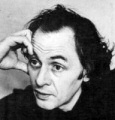 An excerpt from Knots, a book of poetry by the radical psychiatrist
 Austrian AI researchers wanted to
  I’ve just found this fascinating
  Seed Magazine has an excellent
  From p353 of The Psychology of Day-Dreams by Dr J. Varendonck, published in 1921:
 The LA Times has an
  Philosopher John Searle, most widely known for his ‘
 American Scientist has two
  Mind Hacks