Mind Changers back for another series

BBC Radio 4’s brilliant psychology series Mind Changers has made a comeback and has a new season looking at some of the biggest ideas in cognitive science.

It has kicked off with programmes on South African psychologist Joseph Wolpe and the treatment of anxiety as well as an edition on Julian Rotter and the idea of locus of control or the extent to which we believe that we can control events that affect us.

As always, the series is fantastic, looking not only at the ideas but also the people behind these key theories in psychology.

Wait, you say, one of the BBC’s finest series on psychology, back for another series and available online, surely this too good to be true?

As it turns out, which is almost always the case with the Beeb’s digital offerings, it is too good to be true. The flaw this time is that there are no podcasts – only online streaming.

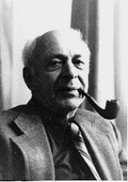
So in light of the BBC’s inability to keep up with the digital world, I’ve included a picture of Julian Rotter smoking a pipe. Especially pertinent as he looks like he’s thinking “torrent servers, my friends, torrent servers”.
 

Link to excellent Mind Changers series.

How Ghostwatch haunted psychiatry

In 1992, the BBC broadcast Ghostwatch, one of the most controversial shows in television history and one that has had a curious and unexpected effect on the course of psychiatry.

The programme was introduced as a live report into a haunted house but in reality, it was fiction. This is now a common plot device, but the broadcast happened in 1992, years before even The Blair Witch Project used the documentary format to tell a fictional story and viewers were used to news-like programmes presenting news-like facts.

But despite some subtle nods to its fictional nature, the fact it was broadcast on Halloween and the ridiculous conclusion (the poltergeist eventually escapes from the house, takes control of the BBC and possesses presenter Michael Parkinson), many people believed the ‘documentary’ was real and that the programme was capturing these astounding events as they happened. You can watch it on YouTube and see how it was introduced.

Consequently, lots of people were genuinely frightened by the programme, including many children who were watching with their families. As a result, the BBC was flooded with calls and letters and were forced to start an investigation into the programme.

As the controversy raged on, an article appeared in the British Medical Journal, written by two doctors from Gulson Hospital in Coventry, reporting post-traumatic stress disorder (PTSD) in two children that was apparently caused by watching Ghostwatch.

Case 1

This boy had been frightened by Ghostwatch and had refused to watch the ending. He subsequently expressed fear of ghosts, witches, and the dark, constantly talking about them and seeking reassurance. He suffered panic attacks, refused to go upstairs alone, and slept with the bedroom light on. He had nightmares and daytime flashbacks and banged his head to remove thoughts of ghosts. He became increasingly clingy and was reluctant to go to school or to allow his mother to go out without him.

Although not without scepticism, several other cases were published as replies to these initial reports producing a small case series of PTSD caused by the TV show.

These minor cases drifted into the history of medicine until people started to debate what event should be considered a sufficiently traumatic event in order to diagnose PTSD.

At the moment, the current DSM-IV-TR diagnosis for PTSD says that “the person experienced, witnessed, or was confronted with an event or events that involved actual or threatened death or serious injury, or a threat to the physical integrity of self or others” and that the person’s response involved “intense fear, helplessness, or horror”.

It’s the “confronted with” part that allows people who have seen distressing things on TV and reacted with “intense fear, helplessness, or horror” to be diagnosed with PTSD.

At the time Ghostwatch was broadcast the criteria required that “the person has experienced an event that is outside the range usual human experience and that would be markedly distressing to almost anyone” which could similarly be interpreted to allow TV programmes to cause the disorder.

The new proposed criteria for the DSM-5 wouldn’t allow television-triggered PTSD. In fact it specifically says that exposure to traumatic events “does not apply to exposure through electronic media, television, movies, or pictures, unless this exposure is work related.”

Ghostwatch has played a part in changing how PTSD will be diagnosed. Although a major motivation was the wave of PTSD diagnoses after watching coverage of 9/11 on TV, the fictional ghost investigation is often cited in the medical literature as an example of how the existing criteria can lead to absurd consequences.

Although the programme is more famous for its effect on the history of media, it remains a minor but significant spectre in psychiatry’s past.
 

Link to GhostWatch entry on Wikipedia.
A bipolar expedition

In 2008, The Lancet published an amazing article on the ‘psychological effects of polar expeditions’ that contains a potted history of artic madness.

Unfortunately, the paper is locked, or shall we say, frozen, behind a paywall, although this snippet on the history of mental health problems on artic expeditions makes for quite surprising reading.

Accounts of expeditions throughout the 19th and early 20th centuries rarely mentioned episodes of psychiatric disturbance or interpersonal conflict, as such was not in keeping with the image of polar explorers, who were expected to have specific qualities and characteristics, such as strength and resilience. Nevertheless, equally rare was the polar expedition that did not have at least one member who was debilitated by depression, anxiety, paranoia, alcoholism, or sleep disorders. During Sir Douglas Mawson’s second Antarctic expedition (1910–14), that person was Sydney Jeffryes, the radio operator, whom Mawson believed “surely must be going off his base. During the day he sleeps badly, gets up for dinner looking bad, husky; mutters sitting on his bunk in the dark afterward.”

Frequently, the entire crew of a polar expedition would experience melancholy and depression, as was the case of the Belgica expedition to Antarctica in 1898–99. As described by the great polar explorer and expedition physician, Frederick A Cook, “The curtain of blackness which has fallen over the outer world of icy desolation has descended upon the inner world of our souls. Around the tables, in the laboratory, and in the forecastle, men are sitting about sad and dejected, lost in dreams of melancholy from which, now and then, one arouses with an empty attempt at enthusiasm.”

Cook tried to treat these symptoms by having crew members sit in front of large blazing fires. This baking treatment, as he called it, could be the first recorded attempt to use light therapy to treat symptoms of winter depression or seasonal affective disorder. Other expeditions, such as the Greely expedition of 1881–84, met a far worse fate than the Belgica exploration. In their attempt to establish a scientific base on Ellsmere Island in the Arctic, the crew of the Greely expedition was driven to mutiny, madness, suicide, and cannibalism, leaving six survivors of a crew of 25 men.


Link to frozen Lancet article.

The hidden history of lobotomy’s non-inventor

A fascinating snippet on the notorious supposed inventor of the frontal lobotomy, Egas Moniz, from an article in the Polish Journal of Neurology and Neurosurgery:

Egas Moniz: a genius, unlucky looser or a Nobel Committee error?

Neurol Neurochir Pol. 2012;46(1):96-103.

Lass P, Sławek J, Sitek E.

Portuguese neurologist António Egas Moniz is one of the most intriguing figures in the history of medicine. While an invention of angiography in 1927 is his acknowledged merit, lobotomy, invented in 1935 became a black legend of psychiatry, although sporadically it is performed also today. There are even postulates to withdraw the Nobel Prize, which Moniz received in 1949 for inventing the lobotomy. Moniz in fact re-invented lobotomy, primarily introduced in 1888 by a Swiss psychiatrist Gottlieb Burckhardt and later forgotten. Its popularisation, including its abuses was chiefly done by American neurologists Walter Freeman and James Watts.

Aside the science, Moniz was an exceptionally colourful person, a merited politician, Portuguese minister of foreign affairs, the head of its delegation at Versailles in 1918, in 1951 he was even proposed a position of a Presidentof Portugal. He was a versatile humanist and a writer, even a gambling expert. His person is hard for black and white evaluation, definitely deserving a re-evaluation from today’s historical perspective.


Link to abstract of article on PubMed.

A fitting tribute to Alan Turing

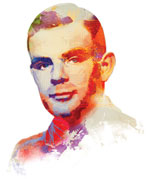
Nature has just published a fantastic Alan Turing special issue commemorating 100 years since the birth of the artificial intelligence pioneer, code-breaker and mathematician.

It’s a really wonderful edition, available to freely read online, and accompanied by a special podcast that talks to his biographer about Turing’s famous 1936 paper on computable numbers, his contribution to cracking the German Enigma ciphers, and his thoughts on machine intelligence.

The articles in the issue are no less exciting and cover everything from Turning’s impact on biology to a debate on whether the brain a good model for machine intelligence.

Essentially, stop whatever you’re doing right now, take the phone off the hook, poor yourself a drop of something thought-provoking and enjoy.

Great stuff.
 

Link to Nature special issue on Alan Turing.

Gimme Shelter

The Rolling Stones launched their career in a social therapeutic club, designed to help troubled youth with communication skills. The club became legendary in rock ‘n roll history but its therapeutic roots have almost been forgotten.


Eel Pie Island is a small patch on the River Thames famous for the underground club that earned a place in 60’s history for hosting the cream of jazz bands and rock n’ roll outfits.

Less well known, is the story of how the club was created as a therapeutic environment to help troubled youth.

Its place in music history has been recounted many times over the years but its therapeutic past has almost been forgotten. At the time, it seems only to have been discussed in a 1969 article published in the International Journal of Social Psychiatry.

The club was created by junk shop owner and sociologist Arthur Chisnall. He was both a music fan and, what we would now call an outreach worker, concerned about disaffected youth.

As a music promoter, he got the cream of the American jazz and blues scene to play the club, which attracted punters like the recently formed Rolling Stones, who were just discovering the electric-tinged blues sound that they would later champion. They shortly became the house band.

But the idea was to create a club where kids could turn up and socialise, encouraged by the underground vibe, while the staff would encourage interaction and social communication skills.

The 1969 International Journal of Social Psychiatry article described the therapeutic approach:

How is therapy accomplished? Workers at the Club convey an accepting and non-judgmental attitude toward the members. A new member can come as frequently or infrequently as he wishes and thus regulate his attendance in accordance with his ability to accept the situation, so that the Club is minimally threatening to its participants. The Island’s somewhat rakish reputation surely contributes to its appeal for many youngsters…

Communication is so central to the Club’s therapeutic rationale that the only dimension on which members are classified by the staff is in terms of their being part of either a high-, medium-, or low-communication culture. Other forces making for therapy are conversations initiated by the staff, the music itself, vocational help, and identification with the Club’s founder.

In fact, Chisnall made a point of making sure people were matched with suitable friends inside the club, what we would now called ‘enhancing social support’, while putting members in contact with suitable support organisations and agencies if needed.

Musically, the club started out as a jazz club but its “somewhat rakish reputation” increasingly attracted London’s growing rock ‘n roll scene hosting The Rolling Stones, Clapton, Jeff Beck, Jimmy Page, Bowie, Rod Stewart, Pink Floyd, The Who and Pink Floyd, among a host of others.

The club, and the social therapeutic experiment, closed in ’67, apparently because Chisnall couldn’t pay repairs demanded by the police, and the building was eventually destroyed in a fire in 1971.

Nowadays, Ell Pie Island is widely recognised as the father of the 60’s rock n’ roll scene but it is hardly known that it was also the father of community intervention projects that use everything from hip hop to graffiti to get troubled kids into a positive social environment.
 

Link to locked ’69 article “A Social-Therapeutic Jazz Club in England”
Link to BBC piece on its musical legacy.
Link to book chapter on the same.

The cowboy cure

The APA Monitor has an article on how ‘nervousness’ in 1800s America was treated by sending male intellectuals ‘out West’ for prolonged periods of cattle roping, hunting, roughriding and male bonding.

This, I suspect, sounded a great deal more innocent in the 1800s.

But nevertheless, this sort of intense deliberately masculine physical exercise was thought to be a genuine antidote to brain-exhausting intellectual life.

Among the men treated with the so-called “West Cure” were poet Walt Whitman, painter Thomas Eakins, novelist Owen Wister and future U.S. President Theodore Roosevelt.

Although the Rest and West cures involved wildly different therapeutic strategies, both were designed to treat the same medical condition: neurasthenia. First described by American neurologist George Beard in 1869, neurasthenia’s symptoms included depression, insomnia, anxiety and migraines, among other complaints. The malady was not just an illness, he said, but also a mark of American cultural superiority.

According to Beard, excessive nervousness was a byproduct of a highly evolved brain and nervous system. A “brain-worker” who excelled in business or the professions might experience nervous breakdowns if he overtaxed his intellect. His highly evolved wife and children could easily succumb to the same malady, particularly if they engaged in excessive study or “brain work.”

The famous neurologist Silas Weir Mitchell wrote of neuroaesthenia that, under great nervous stress, “The strong man becomes like the average woman.”

As a male psychologist who is regularly outclassed by his female colleagues I have learnt this, sadly, to be true, but not, I suspect, in the way Weir Mitchell meant.
 

Link to APA Monitor article on the cowboy cure.

Unlikely causes of dementia

An article on the history of dementia lists the somewhat odd causes for the degenerative brain condition as given by the pioneering French psychiatrist Jean Etienne Esquirol in 1838:

Menstrual disorders, Sequelae [consequences] of delivery, Head injuries, Progression of age, Ataxic fever, Hemorrhoids surgery, Mania and monomania, Paralysis, Apoplexy, Syphilis, Mercury abuse, Dietary excesses, Wine abuse, Masturbation, Unhappy love, Fears, Political upheavals, Unfulfilled ambitions, Poverty, Domestic problems

Although there are clearly some rather bizarre causes in the list, it’s worth noting that 19th century physicians didn’t always make a clear distinction between different forms of perceived ‘madness’ and had little grasp of what contributed to mental instability.

However, the list was clearly a big advance from the causes put forward by the Ancient Greek writer Solon who said dementia was caused by “physical pain, violence, drugs, old age or the persuasion of a woman”!

Dementia is actually a decline in mental function that happens more quickly than would be expected from normal ageing and is usually accompanied by clearly detectable neurological degeneration – such as in Alzheimer’s disease or vascular dementia.
 

Link to locked academic article on the history of dementia.

Diagnosing Tolstoy with non-existent madness

A new article on the founder of criminology, Cesare Lombroso, recounts the curious tale of how he met War and Peace author Leo Tolstoy to confirm his theory on how genius and madness were linked.

Among other things, Lombroso was convinced that mental ‘degeneration’ was reflected in the face and so could be seen externally.

The meeting, it seems, didn’t go well.

…he intended to meet Tolstoy, whom he regarded as the greatest living writer, in order to test his theory on the relationship between genius and madness… Indeed, Lombroso imagined Tolstoy as being of “aspetto cretinoso o degenerato” [“cretinous or degenerate appearance”] (like Socrates, Ibsen, Darwin and Dostoyevsky among others), as illustrated by one of his portraits published in the 6th edition of The Man of Genius…

…Once there, the Italian criminologist began his naturalistic observation with a view to verifying his theory first-hand. Indeed, he managed fully to confirm his hypothesis of the relationship between genius and degeneration, in that, in his view, Tolstoy proved to be affected by an “epileptoid psychosis”, a sign of a hereditary mental illness that was detectable both in his forebears and in some of his children. It was not a happy meeting.

On his part, Tolstoy reacted to Lombroso’s visit by confiding to his diary his contempt for Lombrosian theories (August 27, 1897: “…Lombroso came. He is an ingenuous and limited old man”: cf. Mazzarello, 2001: 983). Mazzarello (2005), who chronicles the visit extraordinarily well, makes an important connection when he notes that, in the days following Lombroso’s visit, Tolstoy would write the pages of his novel Resurrection, in which he depicts a public prosecutor’s harangue that is imbued with Lombrosian ideas; the President of the Court rebukes the official for “going too far”, while another colleague concludes that he is “a very stupid fellow”.

The great writer described his struggles with depression later in life but despite Lombroso’s instant diagnosis of “epileptoid psychosis” he was never known to have experienced psychotic episodes.
 

Link to locked academic article on Lombroso.

Brain in your medieval pants

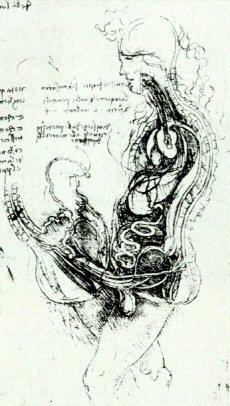
In Leonardo da Vinci’s anatomical drawings, the penis is connected directly to the brain.

A 1986 article “On the sexual intercourse drawings of Leonardo da Vinci” explains why this connection, still commonly proposed today (although mostly as a metaphor it must be said), was thought to be anatomical fact by the great master.

“A brief glance at the male character in Fig. 3 reveals the amazing internal ‘plumbing’ designed by Leonardo to describe Aristotelian physiology. He has drawn two canals in the penis, the lower of which is connected to the urogenital tract via the urethra, while the upper canal passes to the spinal cord by means of three vessels. The close-up of the penis demonstrates these two canals in fine detail. In ancient Greek writing, the ‘essence’ of a baby was provided by the ‘universal seed stuff’ of the male. This procreative ingredient was derived from animal spirit, a physiological material necessary for muscular activity. The animal spirit was manufactured from arterial blood at the base of the brain and was transferred to all parts of the body through the nerves. Hence da Vinci’s spinal connection to the penis.”

And before I hear a “Yeah, right on Leo!” from the ladies, I note a remarkably similar vagina – spinal cord connection also makes an appearance in the diagram.
 

Link to PubMed entry for article.
pdf of full text.

The rise and fall of ‘space madness’

‘Space madness’ was a serious concern for psychiatrists involved in the early space programme. A new article in history of science journal Endeavour tracks the interest in this ‘dreaded disease that never was.’

Much to the surprise of NASA mental health professionals, those who volunteered to be astronauts were neither “suicidal deviants” nor troubled by their separation from the earth, but the media ran with the ‘space travel as psychic trauma’ idea anyway.

‘In answer to the question, “‘What kind of people volunteer to be fired into orbit?” one might expect strong intimations of psychopathology’. Or so thought two Air Force psychiatrists selected to examine America’s first would-be astronauts. Researchers of the 1950s who considered the problem of human spaceflight often speculated that such work would attract only suicidal deviants, and that merely participating in such a voyage would overwhelm the human psyche of otherwise healthy people. The popular culture record of the time seemed to confirm their suspicions, with science fiction films frequently offering up megalomaniacs, egotists, and religious fanatics terrorizing planets in their cinematic space cruisers.

It is not surprising, then, that the psychiatrists working with the National Aeronautics and Space Administration in 1959 feared the worst of the men selected to be America’s first astronauts: that they would be impulsive, suicidal, sexually aberrant thrill-seekers. The examiners, though, were surprised – and a little disappointed – when tests revealed the would-be spacemen to be sane, poised professionals able to absorb extraordinary stresses. Flying jet airplanes in Cold War America had conditioned the men to control their fear, and even the most spirited among them were effective in orbit.

The idea that humans could travel into space and not be traumatized by their experiences, though, was unpalatable to large numbers of journalists and screenwriters, who expected that such journeys would produce some form of psychic transformation. By the early-1970s, popular culture depicting unhinged astronauts became commonplace, even as NASA’s astronauts demonstrated a remarkable ability to absorb the stresses of long-duration spaceflight. A Space Age malady with no incidence among human populations, ‘space madness’ is the stuff of Hollywood: a cultural manifestation of popular fears of a lonely, dehumanizing, and claustrophobic future among the stars.

Unfortunately, the article is locked, because the likes of you and me would just make the place look scruffy, but we covered some of the early discussion on what might cause ‘space madness’ previously on Mind Hacks.

And if you’re interested in the modern astronaut psychology don’t miss a 2008 article from The Psychologist on how NASA select their space travelling colleagues.

I would also like to mention that if someone from NASA is reading that I am free at *any time* to start astronaut duties. I also already own a space pen and am fully competent in its use.
 

Link to locked article. Not very space age, is it?
Link to previous Mind Hacks piece on space madness.

Chasing the dragon across the world

A summary of a fascinating 1997 article on how the practice of consuming heroin by ‘chasing the dragon‘ – inhaling vapours after heating the drug on tin foil – spread across the world.

Heroin smoking by ‘chasing the dragon’: origins and history

Addiction. 1997 Jun;92(6):673-83;

Strang J, Griffiths P, Gossop M.

The history of heroin smoking and the subsequent development and spread of ‘chasing the dragon’ are examined. The first heroin smoking originated in Shanghai in the 1920s and involved use of porcelain bowls and bamboo tubes, thereafter spreading across much of Eastern Asia and to the United States over the next decade.

‘Chasing the dragon’ was a later refinement of this form of heroin smoking, originating in or near Hong Kong in the 1950s, and refers to the ingestion of heroin by inhaling the vapours which result when the drug is heated-typically on tin-foil above a flame. Subsequent spread of ‘chasing the dragon’ included spread to other parts of South East Asia during the 1960s and 1970s, to some parts of Europe during the late 1970s and early 1980s, and to much of the Indian sub-continent during the 1980s.

At the time of writing, ‘chasing the dragon’ has now been reliably reported from many parts of the world but not from others with an established heroin problem-such as the United States and Australia. The significance of this new form of heroin use is examined, including consideration of the role of the different effect with this new form of use, the different types of heroin, and changing public attitudes to injecting.

The article also notes that the popularity of particular drugs tends to rely equally on the methods of consumption as the effects of the substances themselves.

For example, the popularity of morphine in the late 19th century was equally dependent on the development of the needle and hypodermic syringe and the development of cigarettes massively increased the number of tobacco smokers.
 

Link to locked article on the history of ‘chasing the dragon’.

I am yours for 2 coppers

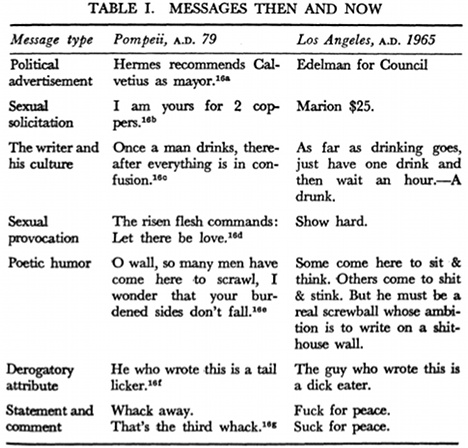
I’ve just found a wonderful 1973 study on the psychoanalysis of graffiti that discusses how unconscious desires might be expressed through public scrawlings.

It has a completely charming table that compares graffiti from A.D. 79 Pompeii with 1960’s Los Angeles to demonstrate the similarity of themes across the centuries.


The author concludes that “aggressive-destructive and incorporative wishes are similarly satisfied by the wall writer at the expense of the wall owner” although overtly sexual images should be considered as definitely expressing sexual themes.
 

Link to locked 1973 study the psychoanalysis of graffiti.

Tea in Bellevue

The entry to the historic Bellevue Hospital in New York City, famous for its psychiatric wards which have housed a long list of artists, writers, musicians and actors.

As a result of treating so many of New York’s artistic community over the years, it has turned up in many works of art as a result.

For example, jazz great Charles Mingus named one of his tracks Lock ‘Em Up (Hellview of Bellevue) after spending time on the wards.

Beat poet Allen Ginsberg, also a one time resident featured it in his epic poem Howl:

who talked continuously seventy hours from park to
pad to bar to Bellevue to museum to the Brooklyn Bridge,
lost battalion of platonic conversationalists jumping
down the stoops off fire escapes off windowsills

In fact, Ginsberg met fellow writer and then fellow patient Carl Solomon in the institution, to whom he dedicated Howl.

If you want a good overview of the hospital’s history New York Magazine has an excellent 2008 article that looks at the high and lowlights of its long existence.

Rather prosaically, I visited and had a cup of tea in the auditorium.
 

Link to New Yorker article ‘Checkout Time at the Asylum’.

Nasal mummy exit

A new study just published in the Journal of Comparative Human Biology takes an enthusiastic look at exactly how the Ancient Egyptians removed the brain from cadavers before they were mummified.

You’ll be pleased to know that a variety of techniques were used over the millennia but unfortunately none make for particularly good dinner time conversation owing to them being slightly gory.

But for those not gathered round the table, the article is joyously over-detailed. In this part, the authors consider the history of scientific attempts to understand how you get a brain out of a dead person working only through the nose.

Speculation surrounding the steps following perforation has inspired experimental attempts at excerebration in sheep and human cadavers. The general consensus is that either the brain was macerated by means of the vigorous insertion and rotation of the perforation tool or other similar instrument, or that the brain was simply allowed to liquefy in the hot Egyptian environment. The first method, consistent with the account of Herodotus, is withdrawal of residues on the perforation tool or its like and Macalister (1894) refers to a three-toothed hook pictured in Chabas’ Études sur l’Antiquité Historique (p. 79) that may have been used to this effect.

Similarly, Pirsig and Parsche (1991) suggest that a bamboo rod tied with linen may have sufficed for this piecemeal extraction of semi-liquid brain. Both of these techniques are time intensive, with the rod drawing out little of the brain on each retraction. Alternative to, or in conjunction with, the previous method it has been suggested that the liquefied or semi-liquid brain might be allowed to drain from the cranium by placing the body prone. This process might also be expedited by flushing the cranium with water or other fluids, such as the cedar oil used to dissolve organs in Herodotus’ account of the “second process” of mummification.

The ‘experimental attempt’ at trying this out on a human cadaver is referenced to a 1911 German book by Karl Sudoff which has a title that translates to ‘Egyptian mummification instruments’.

I can’t imagine exactly how the experiment came about but presumably the chap got so enamoured with the tools he was collecting he just wanted to ‘have a bit of a go himself’.
 

Link to locked article. Or rather, entombed.

Ten years of the language gene that wasn’t

It’s now ten years since mutations in the FOXP2 gene were linked to language problems, which led to lots of overblown headlines about a ‘language gene’, which it isn’t.

The actual science is no less interesting, however, and Discover Magazine has a fantastic article that looks back on the last decade since the gene’s discovery and what it tells us about the complex genetics that support lingustic development and expression.

There’s also a fascinating bit about the history of attempts to explain how humans developed language, which apparently got so ridiculous that speculation was banned by learned societies in the 19th century:

Lacking hard evidence, scholars of the past speculated broadly about the origin of language. Some claimed that it started out as cries of pain, which gradually crystallized into distinct words. Others traced it back to music, to the imitation of animal grunts, or to birdsong. In 1866 the Linguistic Society of Paris got so exasperated by these unmoored musings that it banned all communication on the origin of language. Its English counterpart felt the same way. In 1873 the president of the Philological Society of London declared that linguists “shall do more by tracing the historical growth of one single work-a-day tongue, than by filling wastepaper baskets with reams of paper covered with speculations on the origin of all tongues.”

Like a 19th century reverse scientific X-Factor where people voted to ban people from speculating further. I think I may have found a gap in the market.
 

Link to Discover article on ‘The Language Fossils’.