Dealing with delinquents in the 1920s

Canada’s The Daily Gleaner has a brief but revealing insight into the understanding of juvenile crime and delinquent behaviour in the 1920s.

Obviously the cultural standards of the day were different, so some behaviours considered ‘delinquent’ then were not be considered so now, and vice versa.

However, it is also clear from the piece that theories of how delinquency came about were influenced by very different sets of assumptions.

Prior to the emergence and expansion of psychiatry, moral and eugenic discourses dominated the understanding of juveniles and their treatment. However, Toronto Mayor Howland and other 19th-century reformers believed “allowing youth to go to the devil was a sheer waste.”

They believed there was no “such thing as a youth being really criminal at heart,” and that all deviant actions were just “surface depravity.”

Children were considered to be the product of their surroundings, and if a delinquent grew up in idleness and crime, that is what any child would be in a similar situation.

Previously, the dominant explanation for juvenile deviance was a ‘defective mind’ due to an inherited degenerate constitution. Famous at the time were life histories of degenerate families, with their poverty, prostitution, alcoholism and incest.

The brief article also mentions case reports of the time with a short excerpt which seems nothing short of jaw-dropping from a modern perspective:

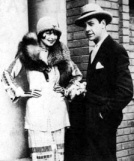
Amanda, for example, had become “impudent of late” with a tendency to become “foxy and cunning.” Physical examination of her hymen showed she “had been immoral,” so she was found guilty of vagrancy and sent to the home for girls.

When Amanda was asked by a social worker about her life goals, she said she wanted to be an actress, and the psychiatrist was appalled. He suggested that a better occupation would be milliner, with release conditional on her acceptance.


Link to psychology and delinquency in the 1920s (via @jonmsutton).

Whacking off: a psychological history

The Insight Therapy blog has a fantastic dash through the psychological history of masturbation – looking at how self-pleasuring has been linked to everything from madness to blindness and has even inspired a type of biscuit [no, not that type].

Through the 19th century, the assault on “self-abuse” continued: Reverend Sylvester Graham invented the Graham crackers to curb sexual impulses. In the 1830s, Benjamin Rush, renowned physician and signer of the declaration of Independence, argued that masturbation caused tuberculosis, memory loss, and epilepsy. JH Kellogg, turn of the century medical writer and creator of breakfast cereal, believed signs of masturbation included acne, weak back, and convulsions. Noted 19th century physician and early sex research pioneer Richard von Krafft Ebing linked masturbation to homosexuality and other types of what he considered deviance and illnesses.

The piece makes the interesting point that that the practice is more common in men than women and has been linked to range of positive health outcomes, perhaps suggesting that we should be aiming to include masturbation in the drive to close the gender gap.
 

Link to Insight Therapy on ‘The Masturbation Gap’.

Edvard Munch in 100 words

This month’s British Journal of Psychiatry has the latest in their ‘100 words’ series on the Norwegian artist Edvard Munch, famous for his iconic painting ‘The Scream’ and his own struggles with mental illness.

The Norwegian Expressionist Edvard Munch caused outrage when his paintings were first shown in Berlin but became one of the most prolific artists of his time. Often described as having had bipolar affective disorder, his low moods and sense of isolation are evident in works such as The Scream, Separation,and Evening on Karl Johan. Yet the evidence of his diaries and his many biographies suggest more plausible diagnoses of depressive disorder and comorbid alcohol dependence. Art historians acknowledge his ability to represent extreme emotional states, while debating the extent to which Munch exploited the market for his ‘flawed personality’.


Link to DOI entry for article.

Racism: the board game

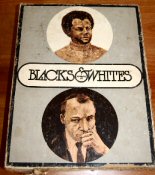
In 1970 Psychology Today published a board game where players were divided into white and black, and had to make economic progress while competing with each other. Based on Monopoly, the idea was to demonstrate how the odds were stacked against black people in society by having different rules for each race in the game.

Whites started out with $1 million, blacks with $10,000 and each race had different opportunity decks. While whites could buy property in any part of the board, blacks were limited to certain areas until they had accumulated at least $100,000 and were outright banned from property in the ‘suburban zone’.

Needless to say, it turned out to be one of the most controversial board games of all time and even merited an article in Time magazine:

The game, produced by Psychology Today Games (an off shoot of the magazine) now on sale ($5.95) at major department stores, was developed at the University of California at Davis by Psychology Department Chairman Robert Sommer. It was conceived as a painless way for middle-class whites to experience—and understand—the frustrations of blacks. In Sommer’s version, however, the black player could not win; as a simulation of frustration, the game was too successful. Then David Popoff, a Psychology Today editor, redesigned the game, taking suggestions from militant black members of “US” in San Diego. The new rules give black players an opportunity to use—and even to beat—the System.

Although turning Monopoly into an attempt to draw people’s attention to social issues seems a little bit of a long shot, it’s worth noting that the original version of Monopoly itself, called ‘The Landlord’s Game‘, was designed to demonstrate how the current economic system led to inequality and bankruptcy.

Psychology Today’s board game division seems to have been short-lived but other titles included The Cities Game – that involved ‘urban tension, corruption and the undercurrents of city politics’; and Woman and Man where ‘Each woman must accumulate enough Status Quo points (100) to prove her equality to men. Each man must collect enough Status Quo points (100) to prove once and for all a woman’s place is beneath his’.

Fun for all the family.
 

Link to 1970 Time article on the ‘Blacks and Whites’ board game.
Link to game details and photos on BoardGameGeek.

Nude psychotherapy and the quest for inner peace

The first session of nude psychotherapy was held in 1967, at a nudist resort in California. It was the brainchild of radical therapist and ordained minister Paul Bindrim who made headlines around the world with events intended to enhance emotional connectedness and dismantle body-image hangups.

Despite the massive interest at the time, ‘nude psychotherapy’ would have largely disappeared from the history of psychology if it weren’t for a truly amazing article by historian Ian Nicholson, published in the Journal of the History of the Behavioral Sciences, which you can read in full as a pdf.

Nude psychotherapy grew out of the 60s encounter group movement, where people seeking personal development would meet for intense one-off group therapy sessions where emotional honesty and group amplification led to powerful personal experiences.

The popularity of these events created a demand for groups that delivered ever more striking emotional experiences with the most intense being the marathon 24 or 36 hour encounters. Bindrim took the concept one step further and created the concept of nude psychotherapy.

He was partly inspired by the founder of humanistic psychology, the famous and significantly more respectable Abraham Maslow, who had an established but purely theoretical interest in whether nudity would make people in therapy “an awful lot freer, a lot more spontaneous, less guarded”.

Bindrim talked the language of spontaneity and authenticity, but as Nicholson notes, the groups were carefully planned:

Bindrim was convinced that the “natural state” of humanity had been lost and that disrobing would peel back layers of modernist artifice and alienation and reestablish a healthy connection with one’s body and the true self. Ironically, although a self-declared enemy of the inauthentic, Bindrim sought psychological deliverance through the very artifice he decried. Far from being spontaneous returns to “nature,” his marathons were carefully orchestrated performances of psychological ingenuity and financial opportunism…

Bindrim began this process by employing familiar encounter group techniques. Participants were invited to “eyeball” each other (stare into each other’s eyes at close range) and then to respond in some physical way (hugging, wrestling, etc.). After this ice-breaker, participants disrobed in the dark to musical accompaniment before joining a small circle to perform a “meditation-like” hum. This process, Bindrim felt, gave rise to the “feeling of being all part of one human mass”

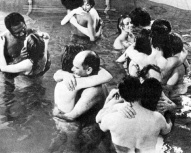
The sessions included role-playing traumatic experiences and touching exercises in a swimming pool, but perhaps most notable was an exercise called “crotch eyeballing”, designed to dispel guilt about the body, in which participants were instructed to look at each others genitals and disclose the sexual experiences they felt most guilty about while lying naked in a circle with their legs in the air.

As well as select groups of participants, Bindrim invited the press, and nude psychotherapy was featured in some of the world’s biggest publications. The Life magazine online archive has two photos from a feature on one of the events.

Psychology Today apparently featured nude therapy on its front page where a big breasted young woman was accompanied by the headline “The Quest for the Authentic Self” (which is a phrase I’ve noticed works great on almost any semi-pornographic picture, by the way).

Although the press generally took a snigger snigger approach to the proceedings, nude psychotherapy garnered a great deal of mainstream interest and headlined professional conferences and journals – even pushing Milgram’s famous ‘lost letter’ study to the back pages of American Psychologist.

It was subject to a professional ethics enquiry at one point, but because of all the nudity and free love already happening in 60s America, the committee couldn’t decide whether it violated the “the social codes and moral expectations of the community”. No serious action was taken and the attention helped raise the profile of the off-beat therapy.

Bindrim’s ego grew in proportion to the excitement and soon he was claiming nude psychotherapy could cure everything from suicidal tendencies to arthritis, before transforming it into ‘aqua energetics’ – a “theoretical framework that could address the totality of human experience”.

Although the Bindrim maintained a lively private practice, he faded into obscurity, and by the time he died he was remembered by a single snarky obituary in the LA Times.

I really can’t do justice to Ian Nicholson’s brilliant article on nude psychotherapy here, which is as well written as it is well researched. A fascinating insight into a forgotten (dare we say, repressed?) chapter of American psychology.
 

pdf of ‘Baring the Soul’.
Link to DOI entry for article.
Rare footage of physical treatments in psychiatry, 1957

I’ve just found a remarkable documentary on YouTube from a 1957 BBC series called ‘The Hurt Mind’. The programme attempts to de-stigmatise mental health for the public but also documents some of the most controversial treatments in the history of psychiatry.

The programme was an edition of a then pioneering five-part BBC series on mental health and this was the episode that specifically dealt with ‘physical treatments’ – that is, treatments which directly affect the brain, such as ECT, leucotomy, insulin coma therapy and abreaction.

This was before the days when pills were widely used in psychiatry – there were no antidepressants, antipsychotics or mood stabilisers and the only tranquilisers were heavyweight barbiturates, as benzodiazapines had yet to become available.

The psychiatrists on the programme are not named, but if I’m not mistaken, the main interviewee is William Sargant, who has a bit of sinister reputation for his enthusiasm for brain altering treatments, his interest in ‘brain washing’, and rumours he was funded by the CIA – as we’ve discussed previously.

Sargant literally wrote the book on physical treatments (titled An Introduction to Physical Methods of Treatment in Psychiatry) and the programme presents them in the most biased possible light, in line with Sargant’s enthusiasms, by dismissing side-effects and selectively presenting single cases of recovered happy patients.

For those more familiar with the frontal lobotomy – popularised by American surgeon Walter Freeman, which involved hammering an ice pick under the orbits of the eyes – you’ll notice that the British version of the operation, the leucotomy, was substantially different in its approach and involved drilling small holes in the skull.

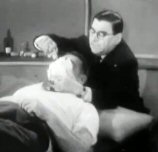
The programme also depicts abreaction, where a patient with a post-traumatic condition is given a drug – often barbiturate, or, in this case, ether – and encouraged to talk about the difficult event.

The procedure was based on the Freudian notion that emotional pain can be repressed and can ‘build up’ and cause difficulties in other areas – although a drug can be used to help break down the defences and releases the emotion in a healthy catharsis.

I suspect that the Billy Bunter-like psychiatrist who discusses and demonstrates abreaction is Eliot Slater, although I have no idea of the identity of the bespectacled doctor who discusses leucotomy (do leave a comment if you know).

The programme is classic post-war BBC: chaps with posh accents talk to cor blimey guv’ner commoners, and there are plenty uncomfortable pauses and a shaky set. As a piece of history, though, it is fascinating.

It also turns out that BBC and the Maudsley Hospital attempted to see how effective the programme was in educating the public and published a brief article in the British Medical Journal which analysed the sorts of letters that got sent in by viewers.

Interestingly, William Sargant wrote to the publication saying that he was a medical adviser to the series and had “on rare occasions appeared anonymously on such programmes” and defended how even-handed it was.

Regardless of your interest in the characters, however, the video is a rare insight into how these treatments were actually carried out.
 

Parts one, two, three and four of ‘The Hurt Mind’ on physical treatments.
Link to details of the series from the British Film Institute.
Link to good Wikipedia page on William Sargant.

Sci vs Spy

The Cold War espionage styles of the US and Soviet spy agencies are compared in a fantastic article for the history of science journal Isis that notes that while the Americans tended to invest in technology, the Russians were more focused on ‘human intelligence’.

The article, by historian Kristie Macrakis, explores the technophilia of the CIA in contrast to the KGB’s emphasis on getting spies on the ground and how these contrasting styles played out in many (now infamous) incidents.

Soviet and East Bloc spies were better at their craft—recruiting and planting agents at key institutions, acquiring secret information, and especially developing the fine art of double agents. In fact, the East Bloc’s great success in using double agents turned into the CIA’s most appalling blunder. At the end of the Cold War, the CIA discovered that all of its East German and Cuban agents were, in fact, double agents working at the behest of East German or Cuban foreign intelligence.

As former CIA chief historian Benjamin B. Fischer writes, this rendered “the CIA deaf, dumb and blind” in East Germany. Further, “the East Germans, as well as the Soviets, ran circles around SE [the CIA’s Soviet‐Eastern European Division], neutralizing its operations and tying it up in knots with double agents who fed it disinformation.” The double agent fiasco occurred, in part, because of U.S. intelligence’s dependence on technological espionage and its lack of skill in human intelligence. In a sense, the East Bloc won the spy wars but lost the Cold War.


Link to full text of article.
Link to DOI entry.

The first man with autism

The Atlantic has an amazing article about the first person ever diagnosed with autism, the now 77 year-old Donald Triplett, who plays a mean game of golf and seems to be doing just fine.

The piece tracks the history of both Triplett and our understanding of autism which has changed radically since the diagnosis was first used in the 1940s.

However, it is Triplett’s life story which really bring the article alive.

Perhaps the most remarkable aspect of Donald’s life is that he grew up to be an avid traveler. He has been to Germany, Tunisia, Hungary, Dubai, Spain, Portugal, France, Bulgaria, and Colombia—some 36 foreign countries and 28 U.S. states in all, including Egypt three times, Istanbul five times, and Hawaii 17. He’s notched one African safari, several cruises, and innumerable PGA tournaments.

It’s not wanderlust exactly. Most times, he sets six days as his maximum time away, and maintains no contact afterward with people he meets along the way. He makes it a mission to get his own snapshots of places he’s already seen in pictures, and assembles them into albums when he gets home. Then he gets to work planning his next foray, calling the airlines himself for domestic travel, and relying on a travel agent in Jackson when he’s going overseas. He is, in all likelihood, the best-traveled man in Forest, Mississippi.

This is the same man whose favorite pastimes, as a boy, were spinning objects, spinning himself, and rolling nonsense words around in his mouth.


Link to The Atlantic on ‘Autism’s First Child’.

Beyond the call of duty

Oscillatory Thoughts has a brilliant post about the self-experimentation carried out by pioneering neurologist Henry Head in the early 1900s. This involved severing nerves to see which were responsible for areas of sensation and creating a thorough map of how sensory abilities differed across the body – and no spot was left untested.

The post has a fantastic description of a 1908 study on how somatosensation recovered after… ok, ok, here’s where he dips his cock in hot water:

In the case of [Henry Head], the tip happens to be devoid of heat-spots but is sensitive to cold and to pain. When… it was dipped into water at 40° C, no sensation of heat was produced, but [Head] experienced an unusually disagreeable sensation of pain… But, as soon as the water covered the corona without reaching the foreskin, both cold and pain disappeared, giving place to an exquisitely pleasant sensation of heat.

Science. Happy now?
 

Link to Oscillatory Thoughts on Head’s self-experimentation.
Link to excellent Wikipedia article on Henry Head.

Peculiar disturbances of vision

I have found what is reportedly the first description of a hallucinogenic ‘magic mushroom’ trip in the Western medical literature. It is from a 1926 paper on different types of mushroom poisoning that was published in the Journal of Pharmacology and Experimental Therapeutics and was written by William. W. Ford.

He lists various types of poisoning, including stomach upsets, cramps, vomiting and convulsions, but the final category is where he tackles the effects of what are now known as ‘magic mushrooms’ that contain the naturally occurring hallucinogenic drug psilocybin.

5. Mycetismus cerebralis. Here the patients show peculiar cerebral symptoms four or five hours after the fungi are eaten. They are greatly exhilarated, laugh immoderately on slight occasion, develop a staggering gait and show peculiar disturbances of vision. The symptoms are transient, the patients being restored to health in twenty-four to forty-eight hours, except for a peculiar sensation which they describe as a feeling “as if they were walking on air.” This subjective sensation may last several days.

The plants responsible for this peculiar poisoning are Panaeolus papilionaceus and Panaeolus campanulatus. They are of interest to us chiefly in that they grow on lawns together with the edible mushroom, Agaricus campestris, and also rarely in beds for the artificial propagation of this species.

Although leaders of the psychedelic movement have created back histories about Western use of hallucinogenic mushrooms – suggesting they were used for spiritual purposes by druids, the Ancient Greeks, and folk healers to the present day – historian Andy Letcher has noted that the effects of these fungi have, as far as we know, always been treated as accidental poisoning.

For example, he notes in his book on the cultural history of the ‘magic mushroom’ that throughout the 18th and 19th centuries medical records describe how consumption of what we would now recognise as ‘magic mushrooms’ were treated with emetics, cathartics, the stomach pump, and occasionally leeches, as would any other poison.

The medical article by William. W. Ford, published 30 years before the active ingredient of magic mushroom would be isolated, was the first time that the hallucinogenic effects had been identified as a distinct effect.

We know now that the toxicity of psilocybin is very low and the main dangers are being inebriated (off your face) or accidentally picking and eating genuinely poisonous mushrooms.

I learnt about this early medical report from an academic article by Andy Letcher where he analysis how ‘magic mushrooms’ have been discussed in popular culture and science.
 

Link to online version of paywalled 1926 paper.
Link to NYT review of Shrooms: A Cultural History of the Magic Mushroom.

An archive of buried brains, restored

The New York Times reports how a carefully assembled archive of human brains with tumours, collected by the pioneering neurosurgeon Harvey Cushing, was left to gather dust and decay at Yale university. Recently restored, it gives a glimpse of the early days of neurosurgery before brain scans or the consistent use of anaesthetic.

These chunks of brains floating in formaldehyde bring to life a dramatic chapter in American medical history. They exemplify the rise of neurosurgery and the evolution of 20th-century American medicine — from a slipshod trial-and-error trade to a prominent, highly organized profession.

These patients had operations during the early days of brain surgery, when doctors had no imaging tools to locate a tumor or proper lighting to illuminate the surgical field; when anesthesia was rudimentary and sometimes not used at all; when antibiotics did not exist to fend off potential infections. Some patients survived the procedure — more often if Dr. Cushing was by their side.

The collection has now been restored and organised and can be seen at the Cushing Centre at Yale.

Don’t forget to have a look at some of Cushing’s original photos of post-operation patients on the left hand side of the NYT article.
 

Link to NYT piece ‘Inside Neurosurgery’s Rise’ (via @bmossop).

The psychology of advertising in the Mad Men era

Film-maker Adam Curtis has just posted a fascinating look into how the Madison Avenue advertising agencies of the 1960s first understood and applied psychology to marketing.

As well as his account of these early forays into the consumerist mind he also posts some wonderful archive footage of the ad agencies’ training and discussions and some never before broadcast interview footage he recorded himself.

You may know Curtis from his numerous sociological documentaries, most notably The Century of the Self, which is a brilliantly made four-part series which puts forward a distinct and defendable argument about how our understanding of the mind changed through the 20th Century.

Part of this covered how advertisers began to take advantage and promote the increased focus on unconscious motivations and individuality to take advantage and promote the idea of the ‘self’ as consumer, and he expands on that in his BBC article:

The story begins at the end of the 1950s. There were two distinct camps on Madison Avenue. And they loathed each other.

One group was led by Rosser Reeves who ran the Ted Bates agency. Reeves had invented the idea of the USP – the unique selling point. You found a phrase that summed up your product and you repeated it millions and millions of times on all media so it “penetrated” the minds of the consumers.

His favourite was Lucky Strike’s “It’s Toasted”

He laid this all out, with diagrams, in his “bible” – called Reality in Advertising.

The other camp were known as “the depth boys”. They believed the opposite. That you penetrated the consumer’s mind by using all sorts of subtle psychological techniques to find out what they really wanted. These were feelings the consumer often didn’t even consciously realise themselves.

Both the video and the writing are really worth checking out for a revealing insight into how different ideas about the mind played out in the post-war consumerist dream.
 

Link to ‘Experiments in the Laboratory of Consumerism’ (via MeFi).

Thumb sucking was a brain disease

I’ve just discovered an astounding article from the journal Medical History that left me, dare I say, open mouthed. It’s about how, in the early 1900s, thumb-sucking in children was considered a neurological disorder that was thought serious enough to justify paediatrics as a separate medical speciality.

It sounds ridiculous now, but at the time these were weighty concerns and thumb-sucking merited a place in medical textbooks where it was thought to be responsible for dental damage – a genuine risk to developing teeth in some cases – but less realistically, it was also cited as a cause of facial deformity and, oddly, masturbation.

Fuelled by the popularity of Freudian concepts, thumb-sucking was seen as infantile form of ‘self-pleasuring’ that had lots of knock-on effects for both child and adult development.

It’s probably worth explaining that, in those less enlightened times, whacking off was not only considered dirty, but a leading cause of insanity and hysteria. So the charge that one activity could trigger self-pleasuring was a much more serious affair.

These are genuine quotes from the medical textbooks of the time:

Many are absolutely incurable and the victim may be compelled to carry the marks of this practice and their accompanying discomforts through a long life.

So hideous is the deformity caused by this habit, that it seems incredible that it should be necessary even to call attention to it, much less to urge that action be taken to put a stop to the evil.

Probably the most pernicious result of sucking is its tendency to develop the habit of masturbation.

No consideration of the nervous and mental derangements of infancy would be complete which omitted the consideration of the curious group of minor psychoses which, for want of a more distinctive name, are usually referred to as “bad habits”.


Link to Medical History article on thumb sucking and paediatrics.

A slow motion mind during extreme danger?

NPR has a fantastic short radio segment on whether we really do experience time more slowly when our life is in danger.

The piece riffs on a 2007 study called ‘Does Time Really Slow Down during a Frightening Event?’ led by neuroscientist David Eagleman who discusses the project on the show.

The experimenters wanted a way to find a way to test whether we suddenly start experiencing time in greater detail when in mortal danger, or whether it just seems that way when we look back on it.

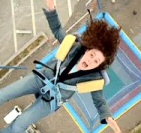
Of course, genuinely putting people in life-threatening situations is a little unethical, so the team used something called SCAD diving, where people are dropped – free fall – into a net.

SCAD diving was just what David needed — it was definitely terrifying. But he also needed a way to judge whether his subjects’ brains really did go into turbo mode. So, he outfitted everybody with a small electronic device, called a perceptual chronometer, which is basically a clunky wristwatch. It flashes numbers just a little too fast to see. Under normal conditions — standing around on the ground, say — the numbers are just a blur. But David figured, if his subjects’ brains were in turbo mode, they would be able to read the numbers.

The falling experience was, just as David had hoped, enough to freak out all of his subjects. “We asked everyone how scary it was, on a scale from 1 to 10,” he reports, “and everyone said 10.” And all of the subjects reported a slow-motion effect while falling: they consistently over-estimated the time it took to fall. The numbers on the perceptual chronometer? They remained an unreadable blur.

“Turns out, when you’re falling you don’t actually see in slow motion. It’s not equivalent to the way a slow-motion camera would work,” David says. “It’s something more interesting than that.”

The NPR piece is only short but is put together by the fantastic RadioLab guys and is probably the best 7 min 46 sec you’ll spend all day.
 

Link to NPR on fear and slow motion perception.
Link to full text of study at PLoS One.

A series of famous cases

BBC Radio 4 have just started a new season of Case Study that looks at some of the most famous and important cases in the history of psychology.

The first is on HM, and although there’s nothing in the programme that’s particularly new about the science of memory, it does give a much fuller account of how the famous amnesic patient was as a person.

His recent death has allowed the shroud of anonymity to be lifted and the programme interviews his ex-carers and researchers who worked with him about his personality, personal history and general demeanour.

One of the most interesting parts is where HM’s alterations in emotion are discussed (likely owing to the removal of his amygdala along with most of his hippocampus) which is a topic largely ignored in the scientific studies on his memory.

The new series covers four cases but each is only available online for a week after it was broadcast (your license fee in action). The HM episode is only available until Wednesday so enjoy it while you can.
 

Link to HM episode of BBC Case Study series.