In the blood

Wikipedia has a page on the idea that blood type predicts personality, a discredited theory that nevertheless remains widespread in Japanese and Korean popular culture.

The idea seems to hold a similar cultural position as star signs and astrology and is used as a platform for discussing relationship compatibility and vague personality characteristics.

This is from a 1998 article from the Journal of Cross Cultural Psychology:

For example, in Southeast Asia, one can find many ideas about personality ranging from typologies based on blood types, horoscopes and fortune telling of various kinds, to personality theories similar to the “Big Five“. For example, since World War II, it has been popular in both Japan and Korea to classify people according to their blood types and elaborate theories of the qualities and characteristics of people with type A, B, AB, or O blood. Type A people, for instance, are considered to be serious and ordinary and type Bs to be unique and “going my own way.” Young Japanese commonly exchange this information about themselves and make predictions about the course of their relationships based on this information.

The Wikipedia notes that many Japanese video games often list the blood types of the characters, presumably to reflect their presumed personality.

Link to Wikipedia page on blood type and personality beliefs.
Link to summary of cross cultural personality article.

Slaves of the Crystal Brain

A fantastic cover from a May 1950 issue of Amazing Stories where a man has some sort of futuristic power station inside his head.

Unfortunately, I can’t find anything about the story so who knows what the intriguing title refers to.

However, I’ve linked to a larger version of the cover if you want to see it in all it’s glory.

Link to ‘Slaves of the Crystal Brain’ cover.

Brain skulls on the front, splatters on the back

You wait ages for a neuroscience-themed dress to appear (and believe me, I have) and then two come along at once.

After my discovery of neuro streetwear for the female fashonista last week, comes a brain themed tutu dress for the riotgrrl neuroscientist.

The description is actually quite poetic:

Brain skulls on the front, splatters on front and back. Distressed style: Imagery has unique cracks, splatters, smears, asymmetry, fading. Adjustable halter straps tie behind your neck for customizable fit. Shredded cotton ruffles underneath tulle ruffles to prevent see-through look. All garment edges raw (hemless) for a deconstructed / shredded look. Shredded cotton bust ruffles.

I have no idea what ‘shredded cotton bust ruffles’ are but surely a great name for an all-girl indie band.

Link to Brianskull tutu dress.

Neuro street wear

Herb is a hip Berlin fashion label who have a fantastic collection of women’s clothing with a subtle brain scan motif.

The label is the work of designer Angela Herb and there are actually two collections inspired by the MRI scan.

It’s definitely a street wear collection but the clothes have a wonderfully understated futuristic feel.

Unfortunately, it seems like clothes are exclusively sold through boutiques in Germany so you may have to contact the label directly if you want to get hold of something from outside the country.

We occasionally feature mind and brain t-shirts on Mind Hacks but rarely anything this stylish.

Link to Herb collection one.
Link to Herb collection two.

John Cleese on neuroanatomy

British comedian John Cleese tackles the brain and gives a tour of the organ’s major anatomical landmarks in this short video from 2008.

It’s a tour de force of descriptive neuroanatomy and even the most experienced neuroscientist is likely to encounter much that is new and interesting.

It also finished on a short but important piece of advice that is worth bearing in mind in all lab situations.

Link to John Cleese on the brain (via @brainshow).

Coming down like a ton of clicks

BoingBoing has found a brilliant spoof video report on ‘Does the Internet make you dumber?’ which finishes on a surprisingly profound note.

It’s a hugely entertaining riff on some of the recent ‘is the internet affecting the brain?’ hang-wringing from the tech savvy chaps from the popular Search Engine podcast.

Link to brilliant ‘Does the Internet make you dumber?’ video.

The case of the haunted scrotum

This is quite possibly the oddest example of an illusory face I have ever discovered.

Seeing meaningful information in meaningless data is a psychological effect known as pareidolia or apophenia and this is an example that was published in the Journal of the Royal Society of Medicine in 1996:

The case of the haunted scrotum

A 45-year-old man was referred for investigation of an undescended right testis by computed tomography (CT). An ultrasound scan showed a normal testis and epididymis on the left side. The right testis was not visualized in the scrotal sac or in the right inguinal region. On CT scanning of the abdomen and pelvis, the right testis was not identified but the left side of the scrotum seemed to be occupied by a screaming ghostlike apparition (Figure 1). By chance, the distribution of normal anatomical structures within the left side of the scrotum had combined to produce this image. What of the undescended right testis? None was found. If you were a right testis, would you want to share the scrotum with that?

J R Harding
Consultant Radiologist, Royal Gwent Hospital

Link to PubMed entry for ‘The case of the haunted scrotum’.

Not your usual memento

Probably not everyone’s definition of what might be included in the “personal effects” of a recently departed loved one. From a brief article in Las Cruces Sun-News:

ALBUQUERQUE – Members of a New Mexico family are suing an Espanola funeral home after their grandmother’s brain was sent home in a bag of personal effects given to them after her death.

The discovery was made the day after interment, when relatives “smelled a foul odor coming from the bag” they received from DeVargas Funeral Home and Crematory of the Espanola Valley, according to a lawsuit filed on behalf of four family members in state District Court in Albuquerque. The Albuquerque Journal reported on the lawsuit in a copyright story published Wednesday.

Link to story in Las Cruces Sun-News (via @bengoldacre).

Super thinker

Superman in the pose of Rodin’s statue The Thinker outside the headquarters of Bancolombia in Medell√≠n.

I’m not quite sure about the intention of the statue as in the UK it would probably be considered an ironic take on the stereotype of the financial whiz kid and unfortunately I found it on the weekend so there was no-one around to ask.

However, popular culture is well represented in serious art here, in a large part due to the influence of Medell√≠n’s most famous artist, the painter and sculptor Fernando Botero.

Psychopath junior

The Onion has a satirical piece on how a funny but fictional study has found high numbers of psychopaths among the nation’s children who have “little regard for anything other than their own egocentric interests and pleasures”.

Mateo added that even when subjects were directly confronted with the consequences of their inexplicable behavior, they had little or no capacity for expressing guilt, other than insincere utterances of “sorry” that were usually coerced.

Because children are so skilled at mimicking normal human emotions and will say anything without consideration for accuracy or truth, Mateo said that people often don’t realize that they’ve been exploited until it is too late. Though he maintained that anyone can fall victim to a child’s egocentric behavior, Mateo warned that grandmothers were especially susceptible to the self- serving machinations of tiny little sociopaths.

While The Onion is riffing on how the ego-centric world-view of children has a vague similarity to being a psychopath, there is quite a bit of genuine research on psychopathy-related features in children.

Known as ‘callous-unemotional traits’ (described here) they have been weakly related to future offending and a diagnosis of psychopathy, but as there are many ‘routes’ to adult antisocial behaviour they are not a guarantee of later problems.

Link to satirical Onion piece on childhood psychopaths.

President Trips

Two different types of Barack Obama themed drugs have appeared on US streets. BoingBoing notes that an LSD blotter with the President’s image on it has been found in the wild, while Drug Monkey covers a US Drug Enforcement Administration bulletin reporting Obama shaped ecstasy tablets.

There’s probably some witty political joke to be made here but I’m damned if I can rustle up enough cleverness, so you’ll have to devise one yourself.

See the links below for more images.

Link to BoingBoing on the Obama LSD blotter.
Link to Drug Monkey on Obama ecstasy tablets.

Think hard

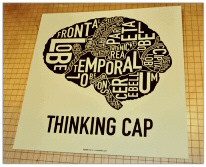
Online poster shop Ork Posters! have this fantastic brain poster which is not only brilliantly designed but anatomically correct as well.

They do a Tan and Black version, which is pictured here and an identical one in Burgundy, which turns out to be a little more expensive.

So if you want some retro-typeface neuroscience fusion design on your wall, you know where to go.

Link to Ork Posters! ‘Think Hard’ print (via @mocost)

All tied up

If you’re attending one of those high class neuroscience events, you probably need a stylish neuron tie to set off your lounge jacket and flannel slacks.

I’m assuming, of course, that you get invited to high class neuroscience events. I tend not to get many invitations these days on account of that unfortunate Rocky Horror / Royal Society mix up.

If you’ve managed to avoid such embarrassing mistakes (and if you think turning up to a scientific meeting in suspenders is bad, try asking Dr. Frank-N-Furter for his raw data) you can get a tie in either microfibre or silk.

UPDATE: It seems the ties have all sold out! There is one more here but otherwise you may have to contact the chap to request some more.

Link to microfibre neuron tie.
Link to silk neuron tie.

Psychologist says

I’ve discovered that if you search for “says psychologist” on Google, you get a giant avalanche of wtf. I encourage you to try it for yourself, but here are a few of the highlights, all taken from headlines of news stories.

Twitter makes you dumb, says psychologist
Boys have it worse, says psychologist
Faith schools breed terrorism, says psychologist
Change is possible for gays, says psychologist
Music tugs at monkeys’ hearts, says psychologist
Pakistan no longer fear failure, says psychologist
Killer of 4 feared loss of love, says psychologist
Britney has lost control and needs help, says psychologist

You get the idea. There are plenty more where they came from.

As has been noted by Dr Petra for a while now, you can get virtually anything, and anyone, into the media just by describing them as a psychologist, even when they aren’t.

We are at a point in history where there is a huge popular interest in the mind and brain and so psychological sounding explanations are given huge weight and plenty of airtime.

If you have a look at the stories brought up by the “says psychologist” search you’ll notice that they range from charlatans giving their opinion on celebrities they’ve never met to the results of research published in the scientific literature, and everything in between.

But no matter, because it can all be condensed into the handy format of “…says psychologist”. This seems to be such a pervasive format that even the American Psychological Association use it for press releases.

Actually, I’ve just discovered that if you search Google Images for the same you get a stream of random images with “says psychologist” underneath. It’s kind of poetic in a surreal sort of way.

Link to “says psychologist” search.