Why the truth will out but doesn’t sink in

Bin Laden used a woman as a human shield and fired at the commando team sent to kill him – at least according to the first reports. These have just been corrected to say he was unarmed and standing alone, but the retractions follow a useful pattern – media friendly version first, accurate version later – because the updates make little impact on our beliefs.

In this particular case, I can’t speculate why the corrections came as they did. Maybe it was genuinely the ‘fog of war’ that led to mistaken early reports, but the fact that the media friendly version almost always appears first in accounts of war is likely, at least sometimes, to be a deliberate strategy.

Research shows that even when news reports have been retracted, and we are aware of the retraction, our beliefs are largely based on the initial erroneous version of the story. This is particularly true when we are motivated to approve of the initial account.

Psychologist Stephan Lewandowsky has been studying this effect for several years and not just with abstract test material. Here’s a summary of his study study on retracted reports of the Iraq war:

Media coverage of the 2003 Iraq War frequently contained corrections and retractions of earlier information. For example, claims that Iraqi forces executed coalition prisoners of war after they surrendered were retracted the day after the claims were made. Similarly, tentative initial reports about the discovery of weapons of mass destruction were all later disconfirmed.

We investigated the effects of these retractions and disconfirmations on people’s memory for and beliefs about war-related events in two coalition countries (Australia and the United States) and one country that opposed the war (Germany). Participants were queried about (a) true events, (b) events initially presented as fact but subsequently retracted, and (c) fictional events.

Participants in the United States did not show sensitivity to the correction of misinformation, whereas participants in Australia and Germany discounted corrected misinformation. Our results are consistent with previous findings in that the differences between samples reflect greater suspicion about the motives underlying the war among people in Australia and Germany than among people in the United States.

More recent studies have supported the remarkable power of first strike news. The emotional impact of the first version has little influence on its power to persuade after correction, and the misinformation still has an effect even when it is remembered more poorly than the retraction.

Even explicitly warning people that they might be misled doesn’t dispel the lingering impact of misinformation after it has been retracted.

So while the latest reports say Bin Laden was alone and unarmed, the majority of people are likely to believe he was firing from behind a human shield, even when they can remember the corrections.

And if this isn’t being used as a deliberate strategy to manage public opinion, I shall eat my kevlar hat.
 

Link to Iraq was misinformation study DOI.
pdf of full text.
Link to related 2007 WashPost piece on the persistence of myths.


Ever had the experience of life flashing before your eyes?

Have you ever had the experience of ‘life flashing before your eyes’ when in danger? Perhaps in an accident, combat or a life threatening event?

If so I’d love to hear from you for a book I am writing on hallucinations, altered perceptions and how the brain constructs reality.

If so, feel free to drop me a brief email through this webpage as I’d be keen to hear more.

Media addicted to self-fulfilling porn survey shock

Dr Petra has an excellent breakdown of a recent UK survey that ran with the finding that a quarter of men are worried about their online porn use.

Although the piece looks at the details of this particular headline grabbing story, it really serves as a good critique of almost any media survey about sex, as it examines the process of how such surveys are conducted and subsequently reported by the media.

Porn is a topic that is of increasing interest to the media because it fills a particular niche in the way sex is reported: it allows a sexy headline grabbing topic to presented while framing it with acceptable matronly concern.

If you look at the press coverage of this survey (alongside reflecting on the discussions I had with journalists today) some very definite patterns of how journalists/the media see sex/relationships and porn.

The view from medialand is as follows:

Who looks at porn? Well, it’s men. They are all straight and the porn they are seeking out is also heterosexual. Women are constructed as having problems/concerns about pornography – but only in relation to their (male) partner’s use of it. ‘Pornography’ as a term is used to mean one genre from one format (the internet). Looking at mainstream porn in moderation is okay, but if you do it often then it becomes a problem. Quite often described in the medicalised language of addiction.

Men are naturally sexual and so can’t help liking porn, but if they do look at it they’ll become abusers or change their neurological makeup or sexual behaviour. Women don’t like porn, those who do are presented as being in a minority, probably deluded, or liking romantic/couples-based/equality-based/feminist porn. Porn within relationships is only permissible if it’s to spice things up (or encourage reluctant wives to get in the mood). LGBT folk aren’t even thought about…

If you’re starting from this as your standard position it makes thinking critically about pornography difficult. It means journalists will be tasked (or choose) to find evidence to stack up this world view. It also means it’s risky to find other ways to think about/explore porn for fear of being seen to endorse it.

By the way, the image on the right is a French cartoon from the 1800s satirising concern about the ‘pornography epidemic’.

Plus ça change, plus c’est la même chose.
 

Link to excellent Dr Petra piece on media porn surveys.

Three Christs winner

Many thanks to all who entered our Three Christs competition and what a fantastic response we had.
The entries in the comments stretch from the bizarre to the philosophical to the profound and are enormously good fun to read. However we do have a winner.

In answer to the question “You’re working in a psychiatric hospital and suddenly everyone thinks you’re a patient. How would you convince them you’re really a psychiatrist?” the winning entry was from hat_eater:

Why do I have to convince them I’m a psychiatrist? It says so plain as a day on my admittance form.

Thank you very much and we’ll be in touch to organise your winning copy of The Three Christs of Ypsilanti.

There were many wonderful answers, some of them too long to fit in a blog post so do check them out, but here are a few of the shorter and wittier ones that caught my eye:

natselrox: “Explain to them that according to Godel, it’ll be impossible for me to prove my true identity in a system where subjects can only be either psychiatrists or patients.”

pete: “I would show them my country club membership.”

Kathy: “By not responding to the antipsychotics prescribed for me–’cos the real patients all do get better, don’t they?”

Darrin: “Just tell everyone to speak to my registrar. They will look after things while I’m at an important meeting.”

karen foley: “I would log onto the New York Times as a paying subscriber. While that may be crazy, only doctors can afford the rates!”

Bill: “Have them page you. Only doctors are crazy enough to carry pagers.”

Many thanks to all of you for the fantastic interest in the competition and many thanks to the New York Review of Books Classics for offering a copy for our somewhat odd competition.
 

Link to competition blog post with fantastic entries in the comments.
Link to details of the The Three Christs of Ypsilanti reprint.

The (cut price) Narrative Escape

My ebook The Narrative Escape is available at a reduced price for a limited time. Publishers 40kbooks have got a February special offer, meaning that you can read my 6000 or so words about dreams, stories and morality for less than a dollar. UK readers : that’s seventy-one pence!

As if the price wasn’t enough to convince you, you can read an interview with me by Livia Blackburne here, or you can consult the five star reviews on amazon (three of ’em, which gives me a higher average than The Communist Manifesto, the only book that amazon.co.uk has under “Customers Who Bought This Item Also Bought”. Sorry Karl!).

Amazon.co.uk link
Amazon.com link
Original mindhacks.com blog post

A liberal dose of controversy

The New York Times covers an important and provocative speech made at a recent big name social psychology conference where the keynote speaker Jonathan Haidt questioned whether social psychologists are blind ‘to the hostile climate they’ve created for non-liberals’.

It’s a brave move and he brings up some important points about the narrow perspective the field has cultivated and its impact on our ways of understanding the world.

“Anywhere in the world that social psychologists see women or minorities underrepresented by a factor of two or three, our minds jump to discrimination as the explanation,” said Dr. Haidt, who called himself a longtime liberal turned centrist. “But when we find out that conservatives are underrepresented among us by a factor of more than 100, suddenly everyone finds it quite easy to generate alternate explanations.”…

Dr. Haidt (pronounced height) told the audience that he had been corresponding with a couple of non-liberal graduate students in social psychology whose experiences reminded him of closeted gay students in the 1980s. He quoted — anonymously — from their e-mails describing how they hid their feelings when colleagues made political small talk and jokes predicated on the assumption that everyone was a liberal.

Haidt highlights an interesting taboo about criticising the victims of discrimination, where even voicing these ideas – regardless of their accuracy – are enough to have someone cast out from the ‘tribal moral community’.

Even if you don’t agree with all his points, the lack of political diversity in social psychology is an important issue that has been glossed (glazed?) over for too long.
 

Link to NYT piece ‘Social Scientist Sees Bias Within’ (via @jonmsutton)

Putting Psychology To Work

And Lo! Unto the always excellent BPS Research Digest, a child is born! The BPS Occupational Digest. is new blog which will cover news, reviews and reports on how psychology matters in the workplace. It will be curated by friend of mindhacks.com (and contributor to the Mind Hacks book) Alex Fradera.

Blogging hasn’t started yet at the BPS Occupational Digest, but we’re looking forward to what Alex serves up. Watch this space!

Link to BPS Occupational Digest.

A wave of neuroscience

The Royal Society has just released a fantastic collection of articles aimed to introduce both the cutting edge of neuroscience and the sometimes fierce debates sparked by its implications.

The collection covers everything from neural interfaces to neuroethics and the articles are written by some of the leading lights in brain research.

This publication is a collection of essays that together provide a primer of current developments in neuroscience and highlight interesting issues and questions for society and policy. The essays, authored by leading experts in neuroscience, bioethics, and science and technology policy, review the state of development of neuroscience and neurotechnology – such as neuroimaging, neuropsychopharmacology, and neural interfaces – and discuss the translation of this knowledge into useful applications. The authors discuss their own views on how developments might impact on society, examining some of the opportunities and risks, as well as the ethical questions and governance issues.

The collection has been dubbed ‘Brain Waves Module 1: Neuroscience, society and policy’ and apparently three other ‘modules’ are on their way.

You can see previews of the other modules from the links at the bottom of the collection’s web page and if they’re as good as this first one, they should make for a fantastic scientific introduction to our current understanding of the brain.
 

Link to Royal Society first Brain Waves collection.

A violent reaction to sad news

I’ve written article for Slate about the Arizona shooting and why many are too quick to use “mental illness” as a catch-all explanation for violence.

I suspect we’re going to hear a great deal more about the issue in the coming weeks, and not all of it positive or well-informed.

This article looks at some of the relevant scientific evidence and some of the misconceptions that invariably arise when such tragic circumstances make headlines.

Shortly after Jared Lee Loughner had been identified as the alleged shooter of Arizona Rep. Gabrielle Giffords, online sleuths turned up pages of rambling text and videos he had created. A wave of amateur diagnoses soon followed, most of which concluded that Loughner was not so much a political extremist as a man suffering from “paranoid schizophrenia.”

For many, the investigation will stop there. No need to explore personal motives, out-of-control grievances or distorted political anger. The mere mention of mental illness is explanation enough. This presumed link between psychiatric disorders and violence has become so entrenched in the public consciousness that the entire weight of the medical evidence is unable to shift it. Severe mental illness, on its own, is not an explanation for violence, but don’t expect to hear that from the media in the coming weeks.


Link to Slate article ‘Crazy Talk’.

Science and the legal high

Nature News has an article by a psychopharmacologist whose experimental drugs appeared on the street – with fatal consequences in some cases – even though he’d only mentioned them in initial scientific studies.

The scientist is David Nichols who was working on drugs chemically related to MDMA or ‘Ecstasy’. However, the compounds he created were being reported for the first time and had never been tested in humans.

A few weeks ago, a colleague sent me a link to an article in the Wall Street Journal. It described a “laboratory-adept European entrepreneur” and his chief chemist, who were mining the scientific literature to find ideas for new designer drugs — dubbed legal highs. I was particularly disturbed to see my name in the article, and that I had “been especially valuable” to their cause. I subsequently received e-mails saying I should stop my research, and that I was an embarrassment to my university.

I have never considered my research to be dangerous, and in fact hoped one day to develop medicines to help people. I have worked for nearly four decades synthesizing and studying drugs that might improve the human condition. One type is designed to alleviate the symptoms of Parkinson’s disease, and it works superbly in monkey models of the disease. That same research seeks drugs to improve memory and cognition in patients who have schizophrenia, one of the most devastating human conditions. The other substances I work on are psychedelic agents such as LSD and mescaline. It’s in that latter area of research that I have published papers about numerous molecules that probably have psychoactive properties in humans. It seems that many of these are now being manufactured and sold as ‘legal highs’.

The article that Nichols refers to is itself both worrying and fascinating as it charts how an out-of-work businessman decided to go into the legal high business and now scours the scientific literature for new compounds to try.

They end up as legal highs, presumably with the minimum of safety testing, and Nichols notes that some deaths have occurred as a result of people taking compounds he never intended to be given to humans.

I recommend both articles as they give an insight into the legal high business from two very different perspectives.
 

Link to NN ‘Legal highs: dark side of medicinal chemistry’ (via @mocost)
Link to WSJ In Quest for ‘Legal High,’ Chemists Outfox Law.

The war of the manual of mental illness

Wired covers the battle raging over the next version of the ‘manual of mental illness’ – the American Psychiatric Association’s DSM-5.

The piece discusses how the chief editors of two previous version of the manual, Robert Spitzer and Allen Frances – who edited the DSM-III and DSM-IV, have heavily criticised the proposed new manual for lack of transparency in development (non-disclosure agreements are required) and for ever-widening categories.

We’ve covered the (surprisingly personal ) battle on a couple of occasions but the Wired piece does a great job of getting into the nitty gritty of the arguments.

What the battle over DSM-5 should make clear to all of us—professional and layman alike—is that psychiatric diagnosis will probably always be laden with uncertainty, that the labels doctors give us for our suffering will forever be at least as much the product of negotiations around a conference table as investigations at a lab bench. Regier and Scully are more than willing to acknowledge this.

As Scully puts it, “The DSM will always be provisional; that’s the best we can do.” Regier, for his part, says, “The DSM is not biblical. It’s not on stone tablets.” The real problem is that insurers, juries, and (yes) patients aren’t ready to accept this fact. Nor are psychiatrists ready to lose the authority they derive from seeming to possess scientific certainty about the diseases they treat. After all, the DSM didn’t save the profession, and become a best seller in the bargain, by claiming to be only provisional.

My only gripe with the article is it seems a little star-struck by the idea that mental illness could be validated or even wholly defined by reference to neuroscience, which is a huge category error.

How would we know which aspects of neuroscience to investigate? Clearly, the ones associated with distress and impairment – mental and behavioural concepts that can’t be completely substituted by facts about the function of neurons and neurotransmitters.

That’s not to say that neuroscience isn’t important, essential even, but we can’t define disability purely on a biological basis.

It would be like trying to define poverty purely on how much money you had, without reference to quality of life. We need to know what different amounts of money can do for the people in their real-life situations. Earning $5 a day is not the same in New York and Papua New Guinea.

Not even physical medicine pretends to have completely objective diagnoses, as, by definition, a disorder is defined by the impact it has.

An infectious disease is not solely defined by whether we have certain bacteria or not. First, it must be established that those bacteria cause us problems.

The urge to try and define all mental illnesses in terms of neuroscience is, ironically, more an emotional reaction to criticisms about psychiatry’s vagueness than an achievable scientific aim.
 

Link to article ‘Inside the Battle to Define Mental Illness’.

Change of pace

Mind Hacks posts may be a little irregular in the future as I’ve just moved location and job. I’ve left the wonderful city of Medellín and am now living in Colombia’s impressive capital, Bogotá.

I’ve also started working as a psychologist for Médecins sans Frontières (Doctors Without Borders if you’re American) and, as you might expect, the pace of work is a little more intense and unpredictable than usual – not least because I will be spending quite a bit of time ‘on the road’ to work with some of the many MSF projects in the rather more troubled areas of the country.

In fact, I hear that some of areas we work in are so badly affected that they don’t even have Twitter, so blogging is likely to be a bit restricted at times.

However, Tom and I are mulling over some interesting new plans and we’ll still both be posting when in internet enabled zones, but you might see a change of pace.

This also seems a great opportunity to thank the psychologists and psychiatrists I had the pleasure of working with in Medellín, especially from the Department of Psychiatry at the University of Antioquia, from whom I learnt a great deal and with whom I had some incredibly enjoyable times.

Muchas gracias a todos!

The psychology of shoulder-to-shoulder

The consistently sublime RadioLab has a wonderful programme on the psychology of altruism which manages to capture the psychology of supporting others in gripping stories of human interaction.
The standard view of evolution is that living things are shaped by cold-hearted competition. And there is no doubt that today’s plants and animals carry the genetic legacy of ancestors who fought fiercely to survive and reproduce. But in this hour, we wonder whether there might also be a logic behind sharing, niceness, kindness … or even, self-sacrifice.

Is altruism an aberration, or just an elaborate guise for sneaky self-interest? Do we really live in a selfish, dog-eat-dog world? Or has evolution carved out a hidden code that rewards genuine cooperation?

The programme touches on everything from the mathematics of nuclear war to the motivation for heroism and, as always, is really better experienced than described.

But even given the usual exceptional quality of RadioLab, this episode is definitely not one to miss. Fantastic stuff.
 

Link to RadioLab on altruism.

Mind and brain science: an instant overview

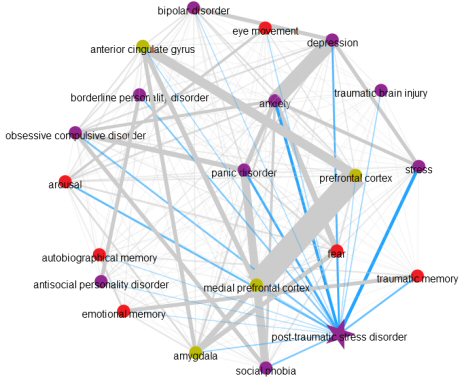
A new online tool called brainSCANr visually summarises the psychology and neuroscience literature to give you a network overview of which are the terms most connected to the target concept in scientific publications.

You can see the example for ‘post-traumatic stress disorder’, otherwise known as PTSD, below. Click here to see it full size on the actual website.
 

The target concept is in the bottom right, marked with a star, and you can immediately see the brain areas, psychological concepts and other disorders most associated with the diagnosis.

The maps are created by looking at how often different words co-occur in the scientific literature, which, as the creators note, is not the same is looking at how concepts are thought of, but it should give a rough approximation.

You can’t just tap any word into it at the moment, as it’s based on a database of concepts, although the searchable list of terms is still quite comprehensive.

However, it’s an inventive new tool which is a fantastic way of getting a quick overview of a field.
 

Link to brainSCANr.

Mind and brain bloggers: wanted for your data

If you are a mind and brain blogger, Dr Alice Bell wants to research you. Alice is at the Science Communication Group at Imperial College, London, and is asking us to complete a survey as part of an investigation into the psychology and neuroscience blogosphere.

Are you wondering whether this is you? Here’s who the research project is trying to recruit:

By ‘brain bloggers’ I mean bloggers who write about the stuff that goes in people’s heads, whatever we think this stuff is. Such bloggers might focus on neurology or psychology, or another field entirely. It might be the history, anthropology or commercial applications of these fields. It might come under ‘research blogging’, journalism, ‘public engagement’ or some form of political activism (or several of these at once, or something else entirely). This focus might be exclusively brain-y, or brain-ish issues might be topics they occasionally blog about in the course of other work.

There are more details at the link below, including all the questions.
 

Link to Alice Bell’s mind and brain blogger survey.

Brain scan of baby during birth

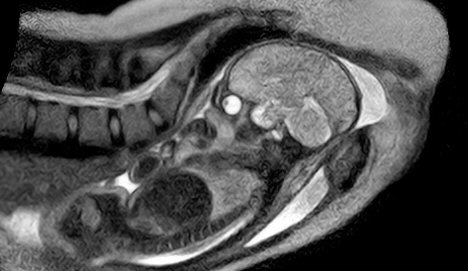
Local.de reports on the first MRI scan of a baby being born, apparently completed by Berlin’s Charité Hospital. The image shows a clear saggital section of the baby’s brain as it is being delivered.


The article reports:

A team comprised of obstetricians, radiologists and engineers have built an “open” MRI scanner that allows a mother-to-be to fit fully into the machine and give birth there, the hospital announced on Tuesday.

The MRI (magnetic resonance imaging) scanner has already taken unique images of the body of a mother and the movement of her baby through the birth canal to the point where its head emerges into the world. The birth that took place in the scanner went smoothly and both mother and baby were in good health, a hospital spokeswoman said.

All I can say is – wow!
 

Link to Local.de story ‘MRI scans live birth’ (via @BoraZ).