The curious case of Morgellons disease

morgellons_article_image.jpgMorgellons is claimed to be a new form of skin disease by its sufferers but has been largely ignored by the medical community and some have claimed it is, in reality, a psychotic syndrome akin to delusional parasitosis.

Outraged by the accusation that their symptoms may be a result of mental illness, proponents are producing fibrous outgrowths from their troubling skin lesions as evidence of its reality.

Although previously just a fringe concern, in the last few weeks Morgellons has gained a huge amount of publicity, with TV reports, magazine articles, newspaper stories and posts on some of the internet’s most popular sites.

Nevertheless, Morgellons challenges more than just the ability of the medical community to make sense of physical symptoms, and is a classic example of a syndrome on the borderlands of medicine.

Continue reading “The curious case of Morgellons disease”

Chocolate is cold comfort

chocolate_chunks.jpgA review of scientific studies has found that chocolate, long used as an emotional pick-me-up, more often prolongs a bad mood rather than helps it.

In an article currently in press for the Journal of Affective Disorders, psychiatrist Gordon Parker and his team gathered evidence from decades of studies into the mood-altering effects of the cocoa-based confectionary.

Sadly, for those hoping for a high-street mood lift, they conclude that any positive effects are limited to the anticipation and sensory properties of the popular foodstuff. Carbohydrate-heavy sweets are likely to prolong any feelings of low mood.

Link to abstract of study ‘Mood state effects of chocolate’.
pdf of full-text article.

Solaris and the philosophy of consciousness

Stanislaw_Lem.jpgStanislaw Lem was a reknowned science fiction writer. It is less known that his books are repleat with carefully thought out philosophy about the nature of consciousness and knowledge acquisition.

ABC Radio National’s The Philosopher’s Zone recently had a special examining Lem’s view on consciousness as demonstrated in his richly descriptive sci-fi works.

The novel Solaris has as a central plot, something not unfamiliar to readers of science fiction, and is replicated in many novels, and that is the notion of first contact with a completely alien intelligence. We have a central protagonist, Chris Kelvin, who goes to a space station that is orbiting a planet, Solaris, and has been orbiting this planet for hundreds of years. So by the time the novel begins the planet has been well known and it’s been the subject of scientific inquiry for over 100 years, and hundreds of volumes have been written about this planet, because it has a peculiar being inhabiting it, which is the ocean that covers most of the planet seems to be sentient, seems to be a rational being, but something completely different from anything else that human beings have encountered.

As the novel progresses, we realise that the inhabitants of the space station have all gone crazy or have died because of their continued proximity with this alien being. And our hero of course, Kelvin, and listeners who have seen either the Tarkowski film or the more recent film, will know that one of the peculiarities of this plasmatic ocean, as Lem calls it, is that it produces replica human beings, that it seems to have sourced from the deepest submerged memories of the scientists on board the space station.

mp3 or realaudio of programme.
Link to transcript.

Australian AITM on the psychology of terrorism

black_white_gunman.jpgRadio National’s excellent All the the Mind focuses on the psychology of terrorism, cutting through some of the common myths about the personalities and motivations of those who commit terrorist acts.

Contrary to the political rhetoric, there is little evidence for terrorists being mentally unbalanced, although many have suffered previous trauma in their lives.

The programme features Dr Anne Speckhard and Dr Jerrold Post both of whom research the psychology of terrorism by working with victims and the perpetrators.

There’s also more information in a previous Mind Hacks post that includes links to further articles and research on the topic.

mp3 and realaudio of programme.
Link to programme transcript.
Link to previous Mind Hacks post on psychology of terrorism.

Thalbourne on the psychology of the paranormal

blue_night_sky.jpgABC Radio National’s In Conversation had a recent discussion about paranormal belief and experience with psychologist Dr Michael Thalbourne.

Thalbourne has conducted a huge amount of experimental research on psychological correlates of belief in the paranormal and what sort of mechanisms might predispose someone to have supernatural experiences.

Although his research and views are occasionally unorthodox, he has had a significant impact on this area of research.

mp3 or realaudio of programme.
Link to programme transcript.

Mind-controlled pong

Berlin_Mind-Brain_image.jpgA online video purports to show two people playing the classic video game Pong using what looks like an an EEG machine to read electrical activity from the brain.

Although I’m no EEG expert, the kit looks authentic and it’s certainly a technically possible feat with the current state of neurofeedback research.

So if anyone can actually verify whether this was genuinely an example of ‘mental pong’, or knows more about the event being filmed, I’d be interested to find out.

Link to video of ‘Berlin Brain Computer Interface’.

A century of intelligence

yellow_light_bulb.jpgABC Radio’s science show Ockham’s Razor marks the 100th anniversary of the creation of the intelligence test by examining its history and impact on modern psychology.

The programme traces the development of the modern IQ test from the initial efforts of psychologist Alfred Binet and its roots in educational testing, to its controversial involvement in social and political debates.

mp3 or realaudio of programme audio.
Link to programme transcript.

Augmenting the mind with high technology

microchip.jpgA couple of news stories have discussed the ‘Better Humans?’ report featured earlier on Mind Hacks:

One article from The Guardian (actually an excerpt from the full report) on potential abuses of technology as ‘mind control’ by neuroscientist Steven Rose; and another on Radio 4’s Today Programme that interviewed Steven Rose and philosopher Nick Bostrom (realaudio here) about using biotech to extend life and optimise the brain.

If you want to read the report in full, it has now been published and is available for free download at the Demos site.

I’ve not read it yet, but I’m hoping that it will provide a bit of balance to the somewhat wide-eyed and uncritical acceptance of neuroscience stories that tend to make the media.

Link to article ‘We are moving ever closer to the era of mind control’.
Realaudio of interview with Rose and Bostrom on Radio 4.
Link to ‘Better Humans?’ report.

Fear of clowns

clown.jpg

Coulrophobia [fear of clowns] is most commonly triggered by a traumatic experience in childhood, said Steven Luel, a psychologist in New York specializing in anxiety and phobias.

Indeed, that was the case with Wallace. At the age of 6, she met her first clown at the circus, an encounter she still remembers clearly 25 years later.

“A clown got right up in my face, and I could see his beard stubble under his makeup. He smelled bad and his eyes were weird,” she said. “I guess I never got over it.”

Enough said.

Link to article (with fantastic title) ‘Fear of Clowns: No Laughing Matter’ from INS News.

Neuroscience lectures on your desktop

cinema_sign.jpgNeuroscientist Michael Kilgard has found videos of leading mind and brain researchers giving lectures on their areas of interest, and created an online directory so you can view the talks at your leisure.

The speakers include language researcher Steven Pinker, memory afficianado Endel Tulving and attention pioneer Michael Posner.

This list includes almost 50 lectures in total, with topics ranging from drug addiction to vision.

Popcorn anyone?

Link to ‘Online Neuroscience Lectures’.

UPDATE: Grabbed from the comments page… “The article seems to be missing lectures from Christof Koch about consciousness”. (Thanks Mxr!)

Hack #104: Change the length of your arms!

Here’s a fantastic party-trick, if it works as reported in the Journal of Vision – make your arms feel like they are different lengths using a simple cut out piece of card.

Now, we talked about perception of depth in the book (Hack #22) and about how the senses interact (Chapter 5). One common theme was how visual information often tended influence our perception of information in the other modalities (at least for spatially organisation information, see Hack #53). What Nicola Bruno from the University of Trieste, and colleagues, seem to have found is an instance where a classic illusion of visual depth can distort your perception of your own body.

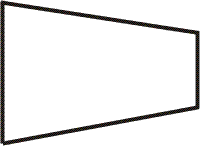
Ames’ trapaziodal window works by virtue of the assumption that things which appear larger are often just closer by. The Window (see a demo here) is a trapazoid, so that it gives the same appearence as a square with one side further away than the other. Like this:

trapazoid.gif

Just like this the retinal-image is ambiguous between a trapazoid viewed flat on, and a square viewed with one side closer than the other. Normally you can use other information, like comparing the image between your two eyes, to deduce the correct perception of depth, but if you close one eye your brain has to fall back on just the ambiguous image information. And it seems your brain thinks squares are more likely and will deliver to your consciousness the perception of a slanted object, rather than a correct, flat-on, impression.

What Bruno et al did was have participants hold versions of the trapazoidal window illusion and judge the level of slant. Not only did they systemmatically mis-judge the slant of the object (despite getting clear information on how far away both sides were via the proprioception of their hands), but some participants reported ‘a stiking prioprioceptive distortion’ – namely that one hand appeared to be further away than the other, or one arm appeared longer than the other!

Unfortunately the research is only reported in abstract form (here) so I can’t get any more details of how exactly they built the illusionary trapazoid, but you can bet that I’ll be trying it out in the next few days. I suspect that, like the body schema illusions (Hack #64), this effect will work strongly on only a few people, so I’ll have to try it on a bunch of people before getting anything. I’ll let you know the results of my experiments, and I’d love to hear from anyone else who trys it.

Susan Clancy on significance of ‘alien abduction’

clancy_abducted_cover.jpgSusan Clancy’s recently published book Abducted: How People Come to Believe They Were Kidnapped by Aliens (ISBN 0674018796) details her five year research project into the psychology of self-confessed abductees, in an attempt to better understand unusual beliefs and experiences.

This quote is from the closing pages (p154-155):

The primary lesson I learned from my research with abductees is that many of us long for contact with the divine, and aliens are a way of coming to terms with the conflict between science and religion. I agree with Jung: extraterrestrials are technological angels…. We yearn for spiritualism and comfort, magic and meaning. As Bertolt Brecht said in his play Galileo, we need something “to reassure us that the pageant of the world has been written around us,…that a part for us has been created beyond this wretched one in a useless star.” Being abducted by aliens may be a baptism into the new religion of our technological age.

Link to article on Clancy’s work at Harvard.
Link to interview with Clancy on NPR radio.
Link to book information with 1st chapter online.
Link to article on ‘The Psychology and Neuroscience of Alien Abduction’.

Four ecstasies

horizon_jump.jpgBlog The Huge Entity has a post giving four quotes on the experience of ecstasy and the thin veil of consensual reality.

My favourite is the following from author Fyodor Dostoevsky on epileptically induced ecstasy:

“There are moments, and it is only a matter of five or six seconds, when you feel the presence of the eternal harmony…a terrible thing is the frightful clearness with which it manifests itself and the rapture with which it fills you. If this state were to last more than five seconds, the soul could not endure it and would have to disappear. During these five seconds I live a whole human existence, and for that I would give my whole life and not think that I was paying too dearly….”

Link to ‘On The Nature of Experience’.

Criminal and forensic psychology on the web

murder_outline.jpgCrimePsychBlog has been keeping my attention over recent weeks as it keeps tabs on the world of forensic and criminal psychology.

It’s regularly updated with developments from the world of forensic cognitive science, and with snippets from the mainstream news that has a criminal psychology angle.

Recent posts include an account of false memory researcher Elizabeth Loftus taking the stand in a recent murder trial, the controversy over whether hypnosis can improve witnesses’ memory and a pointer to an article on ‘What makes terrorists tick?‘.

Link to CrimePsychBlog.

Perceptual distortions are common in population

pretty_colours.jpgResearchers from Cardiff University report that anomalies of sensation and perception are common in the general population, with more than 1 in 10 reporting higher levels than the average of patients diagnosed with psychosis.

The research project was inspired by a need for a comprehensive measure of anomalous sensory experience and perceptual distortion, as the majority of existing measures are derived from psychiatric assessment techniques.

Consequently, they often focus on specific forms of perceptual distortion, such as ‘visions’ or ‘voices’, and do not always cover other types of anomalous experience.

To tackle this problem the researchers designed, tested and validated, a new measure of anomalous perceptual experience that specifically uses non-clinical language to ask about a wide range of phenomena, including unusual touch sensations, changes in time perception and being unable to distinguish one sensation from another.

Sensory distortions are traditionally associated with mental or neurological illness, although recent work is now suggesting that unusual experiences are distributed throughout the population (this is known as the ‘continuum model of psychosis’).

Perhaps unsurprisingly, when patients with psychosis completed the measure high levels of unusual experience were reported.

It is not clear, however, why some people with high levels of unusual experiences become distressed and impaired by their experiences, often leading to a diagnosis of mental illness, while others are able to function and remain untroubled by them.

One possibility is that there might be different sources for different types of unusual experience. When the types of experiences reported by healthy individuals in the study were analysed for how they clustered together, three themes emerged.

One cluster was associated with relatively benign smell and taste experiences, another with experiences potentially related to temporal lobe disturbance and another with experiences traditionally linked to psychosis.

This suggests that the distribution of perceptual distortions found in the population may be driven by a number of underlying processes, all which might contribute to producing strange experiences in the individual.

The research is published as an open-access paper in the journal Schizophrenia Bulletin.

Disclaimer: This paper is from my own research group.

‘Subliminal’ marketing ploys of tobacco giants

The Sunday Observer reports on the increasingly subtle (or perhaps, desperate) ways in which tobacco firms are aiming to advertise their product in light of the increasing bans on explicit tobacco advertising.

‘All that former advertising money has to go somewhere,’ said one industry insider. ‘The tobacco firms are looking to create extensive “design languages” in bars and clubs and other venues through the use of particular types of furniture or material which will make people think of their brands.’

Link to article “Tobacco firms’ subtle tactics lure smokers to their brand”