
So how did I not know about the amazing neuroimages blog? It has plenty of beautiful pieces like this taken from neuroimaging to historical neuroscience to, er, edible brain sandwiches.
So how did I not know about the amazing neuroimages blog? It has plenty of beautiful pieces like this taken from neuroimaging to historical neuroscience to, er, edible brain sandwiches.
 If you want any evidence that drugs have won the drug war, you just need to read the scientific studies on legal highs.
If you’re not keeping track of the ‘legal high’ scene it’s important to remember that the first examples, synthetic cannabinoids sold as ‘Spice’ and ‘K2’ incense, were only detected in 2009.
Shortly after amphetamine-a-like stimulant drugs, largely based on variations on pipradrol and the cathinones appeared, and now ketamine-like drugs such as methoxetamine have become widespread.
Since 1997, 150 new psychoactive substances were reported. Almost a third of those appeared in 2010.
Last year, the US government banned several of these drugs although the effect has been minimal as the legal high laboratories have over-run the trenches of the drug warriors.
A new study just published in the Journal of Analytical Toxicology tracked the chemical composition of legal highs as the bans were introduced.
A key question was whether the legal high firms would just try and use the same banned chemicals and sell them under a different name.
The research team found that since the ban only 4.9% of the products contained any trace of the recently banned drugs. The remaining 95.1% of products contained drugs not covered by the law.
The chemicals in legal highs have fundamentally changed since the 2011 ban and the labs have outrun the authorities in less than a year.
Another new study has looked at legal highs derived from pipradrol – a drug developed in 1940s for treating obesity, depression, ADHD and narcolepsy.
It was made illegal in many countries during the 70s due to its potential for abuse because it gives an amphetamine-like high.
The study found that legal high labs have just been running through variations of the banned drug using simple modifications of the original molecule to make new unregulated versions.
The following paragraph is from this study and even if you’re not a chemist, you can get an impression of how the drug is been tweaked in the most minor ways to create new legal versions.
Modifications include: addition of halogen, alkyl or alkoxy groups on one or both of the phenyl rings or addition of alkyl, alkenyl, haloalkyl and hydroxyalkyl groups on the nitrogen atom. Other modifications that have been reported include the substitution of a piperidine ring with an azepane ring (7-membered ring), a morpholine ring or a pyridine ring or the fusion of a piperidine ring with a benzene ring. These molecules, producing amphetamine-like effects, increase the choice of new stimulants to be used as legal highs in the coming years.
New, unknown and poorly understood psychoactive chemicals are appearing faster than they can be regulated.
The market is being driven by a demand for drugs that have the same effects as existing legal highs but won’t get you thrown in prison.
The drug war isn’t only being lost, it’s being made obsolete.
 An article in Slate claims to have detectected a ‘logic hole’ in how much sympathy we feel for people with mental illness as both psychopathy and autism are ‘biological disorders’ that people ‘can’t help’ but we feel quite differently about people affected by them.
The ‘logic hole’, however, doesn’t exist because it is based on misunderstanding of the role of neuroscience in understanding behaviour and a caricature of what it means to have ‘no control’ over a condition.
Here’s what the article claims:
In the piece [recently published in The New York Times], Kahn compares psychopathy to autism, not because the two disorders are similar in their manifestation, but because psychologists believe they’re both neurological disorders, i.e. based in the brain and really something that the sufferer can’t help.
This caused me to note on Twitter that even though the conditions are similar in this way, autism garners sympathy and psychopathy doesn’t. In fact, most social discourse around psychopathy is still demonizing and utterly unsympathetic to the parents, who are often blamed for the condition. It struck me as an interesting logic hole in our cultural narrative around mental illness, since the usual assumption is that sympathy for mental illness is directly correlated with inability to control your problems.
Clearly the author has good intentions and aims to reduce the stigma associated with mental illness but in terms of behavioural problems, everything is a ‘biological disorder’ because all your behaviour originates in the brain.
The idea that because a disorder is ‘based in the brain’ it therefore follows that ‘really something that the sufferer can’t help’ is a complete fallacy.
Psychopathy, autism, depression, over-eating, persistently losing your keys and constantly getting annoyed at X Factor are all ‘based in the brain’ and this fact has nothing to do with how much control you have over the behaviour.
Putting this misunderstanding aside, however, there is also the unhelpful implication that someone ‘has’ or ‘has not’ control over their thoughts, behaviour, emotions and propensities, especially if they have a psychiatric diagnosis.
Conscious control varies between individuals, is affected by genetics, is amenable to change and training, and depends on the specific task, situation or action.
This does not mean that everyone with autism, psychopathy or any other diagnosis can just decide not to react in a certain way, but it would be equally stigmatising and simply wrong to assume that current difficulties are forever ‘fixed’.
The article finishes “I was just interested in the fact that there’s no relationship between how much we care about those with a mental disorder and how much those with it can help having it.”
In reality, sympathy for people with disorders is a complex phenomenon and the perception of ‘how much control the person has’ over the condition is only one of the factors. The (often equally bogus) moral associations also play a part as does the seriousness of the condition and the medical speciality that treats it.
Nevertheless, we need to get away from the idea that ‘biology means poor control’ because it is both a fallacy, and, ironically, known to be particularly stigmatising in itself.
Link to somewhat confused Slate article (via @ejwillingham)
 The first ever medical report on the effects of magic mushrooms is featured in an article in Current Biology. The excerpt is from a 1799 report entitled ‘On A Poisonous Species of Agaric’ from an issue of The London Medical and Physical Journal.
The psychological effects of hallucinogenic, or ‘magic’ mushrooms were first documented in the medical literature in 1799: a forty year-old father of four, JS, collected wild mushrooms in London’s Green Park and cooked them as a stew for breakfast for himself and his four young children. The apothecary Everard Brande described what happened then:
“Edward, one of the children (eight years old), who had eaten a large proportion of the mushrooms, as they thought them, was attacked with fits of immoderate laughter, nor could the threats of his father or mother refrain him. To this succeeded vertigo, and a great deal of stupor, from which he was roused by being called or shaken, but immediately relapsed. […] he sometimes pressed his hands on different parts of his abdomen, as if in pain, but when roused and interrogated as to it, he answered indifferently, yes, or no, as he did to every other question, evidently without any relation to what was asked. About the same time the father, aged forty, was attacked with vertigo, and complained that everything appeared black, then wholly disappeared”
The report is curious for two reasons. The first is that, contrary to the title, the mushroom wasn’t a ‘species of Agaric’.
Agaric here refers to fly agaric which is a red and white spotted toadstool that has long been known to have deliriant properties due to its effect on the acetylcholine receptors in the brain
But the report clearly discusses the classic ‘magic mushroom’ found in the UK, psilocybe semilanceata, which is a small brown fungus that has its hallucinogenic effects through the serotonin system – as do most recreational psychedelic drugs.
The other curious thing is that this hallucinogenic mushroom is common in the UK but seemingly lay undiscovered until 1799.
In contrast, mushrooms from the same species that are equally common in South America were first recorded some 2,000 years ago and became a central part of indigenous spirituality. The Aztecs called these mushrooms teonanacatl – the God mushroom – and were considered a way of accessing the divine.
The British, it seemed, either missed or ignored the fungus, and considered it nothing more than an inedible brown pest.
Link to 1799 report on the effects of magic mushrooms.
 Of all the names for a neurological disorder in the history of medicine, the most awesome has got to be ‘Dark Warrior epilepsy’.
The condition was reported in a 1982 edition of the British Medical Journal and was so named because the patient had seizures – but only while playing the Dark Warrior video game.
The game was actually a coin-up arcade machine and, despite the dodgy graphics, it is notable for being one of the first machines with an attempt at simulated speech.
The patient was a 17-year-old girl whose father was a video game engineer. He fixed the arcade machines and so she got to play for free.
Curiously, the case report mentions that she had already mastered Space Invaders, Asteroids, and Lunar Rescue.
Old skool video game freaks will be reading this and quietly thinking to themselves, respect, but the more medically inclined might be scratching their heads wondering why a patient’s video-gaming history has been included in their case report.
I mean, I ruled at Elite, but it’s never been mentioned in my medical notes.
The reason, is that only year before, the first ever case of epilepsy triggered by a video game was reported. It was named ‘Space Invader epilepsy’ because it was triggered by the arcade game Astro Fighter and the neurologist clearly didn’t know the difference between the original arcade classic and one of the cheap knock-offs.
The 17-year-old girl from Bristol, however, wasn’t troubled by Space Invaders, nor a host of other video games. She played them all with no problems at all. It was only Dark Warrior that affected her brain and, in fact, it was only a very specific scene in the game that contained a bright multicoloured flashing sequence.
The doctors treating the girl thought it was worth sending the case to a medical journal because video games were still very new in 1982.
But despite using the name ‘Dark Warrior epilepsy’ for this particular case they came up with another name – almost as awesome – for similar seizure disorders: ‘electronic space war video game epilepsy’
They then wrote what can only be described as one of neuroscience’s great paragraphs:
The term Space Invader epilepsy is, in fact, a misnomer, since no cases have been reported with the Space Invader video game itself. We suggest, therefore, that Astro Fighter and Dark Warrior epilepsy be classified under “electronic space war video game epilepsy” and this as a special category of photoconvulsive epilepsy. Video games other than space war games – for example, Super Bug and Munch Man – appear to be less epileptogenic. Electronic space war video game epilepsy has yet to be reported with Defender, Space Fury, Lunar Rescue, or Asteroids war games.
At the time, there was much media panic about ‘video games causing epilepsy’ but the real story is actually far more interesting.
Neurology nowadays doesn’t talk about specific game titles but it still considers the effect of video games on the likelihood of triggering seizures.
Firstly, let’s make it clear that video games don’t cause epilepsy, but the reason people can have seizures while playing is not because of the video game per se, but because of a type of neurological disorder called reflex epilepsy that can be triggered by idiosyncratic features of the environment.
The most well-known and most common is photosensitive epilepsy where certain types of flashing lights can cause a seizure. About 5 in every 100 people who have epilepsy have this type.
But actually, reflex epilepsy is very diverse. Some people will have seizures triggered by certain smells, or certain patterns, or certain emotions, or certain tunes, or even doing certain sort of problem-solving – like mental calculation.
Some of the early cases of computer-triggered epilepsy were caused by certain flash sequences in games, which are now not included by common consent.
Occasionally video-game linked seizures do still appear though, but largely because the game happens to have a characteristic which coincides with the trigger of someone’s pre-existing reflex epilepsy. Maybe a specific sequence of musical notes, or a certain pattern, or even causing a specific feeling of frustration.
But sadly, neither ‘Dark Warrior epilepsy’ nor ‘electronic space war video game epilepsy’ caught on and the medical literature now largely talks about ‘video game-induced seizures’.
Link to 1982 case of Dark Warrior epilepsy.
My column for BBC Future from a few days ago. The original is here. Mindhacks.com readers will have heard most of this before, thanks to Vaughan’s coverage of the Baroness and her fellow travellers.
Being online does change your brain, but so does making a cup of tea. A better question to ask is what parts of the brain are regular internet users using.
This modern age has brought with it a new set of worries. As well as watching our weight and worrying about our souls, we now have to worry about our brain fitness too – if you believe the headlines. Is instant messaging eroding the attention centres of our brains? Are Facebook, Twitter and other social media tools preventing you from forming normal human bonds? And don’t forget email – apparently it releases the same addictive neurochemicals as crack cocaine!
Plenty of folk have been quick to capitalise on this neuro-anxiety. Amazon’s virtual shelves groan with brain-training books and games. (I confess I am not entirely innocent myself). You can fight the cognitive flab, these games promise, if you work that grey matter like a muscle.
But is this true? Are sudoku puzzles the only thing stopping the species turning into a horde of attention-deficient, socially-dysfunctional, email addicts – part human, part smartphone?
Fear not, there is some good news from neuroscience. But first, it is my duty to tell you the bad news. You may want to put down your phone and take note, this is the important bit.
The truth is that everything you do changes your brain. Everything. Every little thought or experience plays a role in the constant wiring and rewiring of your neural networks. So there is no escape. Yes, the internet is rewiring your brain. But so is watching television. And having a cup of tea. Or not having a cup of tea. Or thinking about the washing on Tuesdays. Your life, however you live it, leaves traces in the brain.
Brain workout
Worrying about the internet is just the latest in a long line of fears society has had about the changes technologies might bring. People worried about books when they first became popularly available. In Ancient Greece, Socrates worried about the effect of writing, saying it would erode young people’s ability to remember. The same thing happened with television and telephones. These technologies did change us, and the way we live our lives, but nothing like the doom-mongers predicted would stem from them.
But is the internet affecting our brains in a different, more extraordinary way? There is little evidence to suggest harm. Here we are, millions of us, including me and you, right now, using the internet, and we seem okay. Some people worry that, even though we cannot see any ill-effects of the internet on our minds, there might be something hidden going on. I am not so worried about this, and I’ll tell you why
We regularly do things that have a profound effect on our brains – such as reading or competitive sports – with little thought for our brain fitness. When scientists look at people who have spent thousands of hours on an activity they often see changes in the brain. Taxi drivers, famously, have a larger hippocampus, a part of the brain recruited for navigation. Musicians’ brains devote more neural territory to brain regions needed for playing their instruments. So much so, in fact, that if you look at the motor cortex of string players you see bulges on one side (because the fine motor control for playing a violin, for example, is only on one hand), whereas the motor cortex of keyboard players bulges on both sides (because piano playing requires fine control of both hands).
So practice definitely can change our brains. By accepting this notion, though, we replace a vague worry about the internet with a specific worry: if we use the internet regularly, what are we practicing?
Get a life
In the absence of any substantial evidence, I would hazard a guess that the majority of internet use is either information search or communication, using email and social media. If this is so, using the internet should affect our brains so that we are better at these things. Probably this is already happening, part of a general cultural change which involves us getting better and better at dealing with abstract information.
Internet use would only be a worry if it was getting in the way of us practicing some other life skill. If Facebook stopped people seeing their friends face to face that could have a harmful effect. But the evidence suggests this is not the case. If anything, people with more active internet lives have more active “meat-space” lives. Most of us are using the internet as a complement to other ways of communicating, not as a substitute.
So there is no magic extra risk from the internet. Like TV before it, and reading before that, it gives us a way of practicing certain things. Practice will change our brains, just like any habit. The important thing is that we are part of this process, it is not just something that happens to us. You can decide how much time you want to put into finding pictures of funny cats, bantering on Facebook or fitting your thoughts into 140 characters. There will be no sudden damage done to your brain, or great surprises for your brain fitness. You would be a fool to think that the internet will provide all the exercise your brain needs, but you would also be a fool to pass up the opportunities it offers. And those pictures of funny cats.
 The Observer has a fantastic debate between neuroscientists David Eagleman and Raymond Tallis about how much brain science tells us about free will and the unconscious.
It’s a wonderful pairing as Eagleman is a broad-thinking wonderboy of neuroscience while Tallis is a veteran street-fighter of brain debates.
The main point of contention revlves around whether we can understand the brain as the source of human nature or whether we have to look beyond the individual to make sense of our experience and behaviour.
Eagleman: It is clear at this point that we are irrevocably tied to the 3lb of strange computational material found within our skulls. The brain is utterly alien to us, and yet our personalities, hopes, fears and aspirations all depend on the integrity of this biological tissue. How do we know this? Because when the brain changes, we change…
Tallis: Yes, of course, everything about us, from the simplest sensation to the most elaborately constructed sense of self, requires a brain in some kind of working order. Remove your brain and bang goes your IQ. It does not follow that our brains are pretty well the whole story of us, nor that the best way to understand ourselves is to stare at “the neural substrate of which we are composed”.
This is because we are not stand-alone brains. We are part of community of minds, a human world, that is remote in many respects from what can be observed in brains. Even if that community ultimately originated from brains, this was the work of trillions of brains over hundreds of thousands of years: individual, present-day brains are merely the entrance ticket to the drama of social life, not the drama itself.
As an accompaniment to the piece, I also wrote a ‘brief guide to neuroscience’ that you can also read online.
Link to debate ‘The brain… it makes you think. Doesn’t it?’
Link to ‘A brief guide to neuroscience’.
 Neuroscientist Sophie Scott gave a fantastic talk on the science of laughter for a recent TEDx event that you can now watch online.
Talks on the science of humour are famously humourless (usually made all the more dire by the desperate inclusion of some not very funny ‘funny cartoons’) but this discussion of laughter is appropriately delightful.
Scott describes a study her team carried out on the cross cultural recognition of non-verbal vocal sounds (like whoops of triumph) to find that only laughter was universal.
The whole talk is fully of such fascinating snippets, tackling both the social psychology and neuroscience of laughing. Well worth ten minutes of your time.
Link to ace talk on the science of laughter.
The latest Journal of Neuroscience features a study on the neuroscience behind Akiyoshi Kitaoka’s famouse Rotating Snakes illusion and to celebrate they’re made a ‘Rotating Brain’ illusion for the front cover.
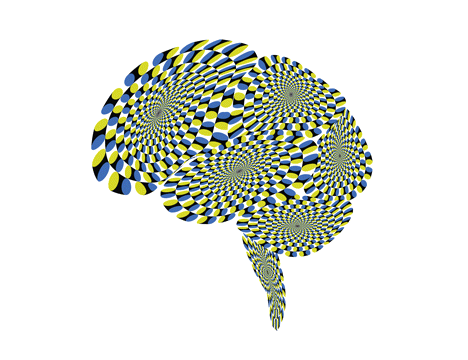
This type of illusion, often called a peripheral drift illusion, was thought to occur due to slow drifting eye movements but this new study suggests that it is more likely to be explained by rapid but tiny eye movements called saccades.
Brain-shaped version of Akiyoshi Kitaoka’s “Rotating Snakes” illusion. In its usual presentation, the image consists of concentric circles of stepwise luminance gradients with curved edges, which produces a strong illusion of rotation in most observers. New evidence suggests this illusion is produced by transient oculomotor events such as microsaccades, saccades, and blinks, rather than continuous drift.
Despite the fantastic cover I expect the journal to outdo itself next time and have both an article explaining the neuroscience Brocken spectre as well as an image you can hide up a mountanside to create 20 metre tall ghost-like figures.
Link to study (via
A case report in Forensic Science International describes a man who had a taser dart penetate his skull and damage his frontal lobes after getting in a drunken confrontation with police.

Curiously, the man was unaware he had a taser dart in his brain and only went to hospital after he got home and noticed the dart sticking out of his head.
A 27 old man was immobilized by the police while he struggled with a police officer during an identification check and attempted an escape. He had a high level of alcohol at the time of the arrest. A X26 Taser was used to incapacitate and subdue the victim.
No immediate medical examination was subsequently performed in the patient after the wires were propelled and he was allowed to return home. However, because he complained of a headache, he decided to go to the nearest hospital a few hours later.
Upon presentation at the Emergency Department the patient was conscious. The examination revealed a harpoon-like barbed electrode dart implanted in the right frontal part of the skull and a right peri-orbital bruise…
The brain CT scan revealed an encephalic injury in the right area of the frontal lobe. In fact, the probe was implanted in the frontal area of the skull and then in the right frontal cortex with a penetration depth of a few millimeters.
There’s a moral in this story somewhere but damned if I can find it.
Link to Forensic Science International case report.
 A fascinating excerpt about a hallucinogenic drug called DiPT that only causes hearing distortions – from p310 of the book Hallucinations: Research and Practice:
A member of the tryptamine chemical family, diisopropyltryptamine (DiPT) is a fascinating substance because, unlike most hallucinogens, its effect are predominantly auditory. It is also probably less sensitive than other hallucinogens to the mindset of the user, the setting in which it is ingested, and other psychological considerations, perhaps because the auditory system has become less salient to the human organism as we have evolved into a vision based species.
In general, auditory pitch is perceived as lower than normal, and harmonious sounds lose their resonance with one another. This dissonance is even perceived by people with perfect pitch, which has some implications about where in the processing stream DiPT’s effects occur. Voices are also altered and disharmonious with each other.
DiPT has a few other known effects; it would seem to call for further investigation from those interested in the neurology of sound, music and verbal language processing. For example, it would be fascinating to know the effects of this substance on perceptions of tonal languages such as Chinese, Huichol, or Dogon; would it alter the words perceived as being spoken?
Link to book details.
 Nature has an article looking at the future of fMRI brain scanning in light of its long-lasting hype and recently discovered problems.
Brain scanning has become massively popular both in the scientific community and in the media, in great part because the pictures it produces seem quite intuitive: images of the brain with colours on it which apparently represent neural activity when we’re doing something.
However, the current situation with fMRI is nicely but inadvertantly captured in the article:
It has turned psychology “into a biological science”, says Richard Frackowiak…
[two sentences later]
Perhaps the biggest conundrum in fMRI is what, exactly, the technique is measuring.
fMRI has indeed turned much of psychology into a biological science but it hasn’t really given us a fundamentally deeper understanding of neuropsychology largely due to the measurement problem.
Recent revelations that fMRI studies are not as reliable as we thought and that some common ways of analysing data may be flawed have made many people question the utility of the technique – or at least, many of the past studies that may not have been well controlled.
The Nature article looks at where the science will go next, although I can’t help thinking that if it became less expensive the gloss would rub off – and then at least we could assess it a little more reasonably.
Sadly, scientists are no less attracted to bling.
Link to Nature article ‘Brain imaging: fMRI 2.0’
 The Ailing Brain is a fantastic documentary series on the brain and its disorders that’s freely available online. It has been produced in Spanish but the first part is now on YouTube with English subtitles.
The series is among the best neuroscience documentary series I have even seen (along with Susan Greenfield’s Brain Story – made before she lost the plot) with the first part tackling the science and effects of neural implants.
If you see nothing else, go to 6:10 to watch what happens when a patient with an implanted deep brain stimulation device to treat Parkinson’s Disease switches off the machine. It’s an amazing sight.
But if you’ve got 20 minutes, you’d be very well advised to take some time to watch the whole episode as it’s both wonderfully produced and utterly compelling.
There are three programmes so far although the second and third haven’t been subtitled yet. But if you understandeas español, you can check out the whole series here. The second part is on memory disorders and the third is on mental illness.
I’ll post more on Mind Hacks when the other parts with English subtitles appear. Wonderful stuff.
Link to ‘Refurbished Brains’ episode with English subtitles.
Link to whole series in Spanish.
 The world of art, neuroscience and, er… competitive affection, collide in a delightful film about a love competition held in an fMRI scanner.
The piece is by film-maker Brent Hoff who seems to be making a series of films based on the idea of emotion competitions.
In this film, competitors are asked to ‘love someone as hard as they can’ while being brain scanned with the prize going to the person with the greatest amount of brain activity.
I was a bit thrown by the piece as I couldn’t work out whether it was a mis-representation of an actual study – the scanning is run by genuine Stanford researchers Melina Uncapher and Bob Dougherty – or an offbeat competition that brought some neuroscientists on board.
So I contacted Melina and got the back story to the unusual piece:
I should say at the outset that it was not intended to be a study, nor was it intended to discover anything new about the brain. It was intended to be a public outreach piece, to help raise awareness that science can be beautiful (in the hopes of advancing interest in science). The finding was simply this: when a group of participants were instructed to ruminate on the person or concept they associate with love, BOLD signal in the nucleus accumbens showed individual differences.
The filmmaker Brent has a thing for emotional competitions, beginning with a previous film entitled The Crying Competition. In that case, as in the Love Competition case, people were explicitly instructed that it was a competition among the other participants in the room, and the person with the highest/fastest respective metric wins.
Here, the person with the highest signal in nucleus accumbens was considered the winner. Contestants were instructed to this prior to entering in the scanner. They all met each other during the interviewing stage, so there was a bit of competitiveness in the air, but it was tempered by the fact that they were considering those they love.
Melina also explained that scans in the film not only show nucleus accumbens activity. They also included a functional connnectivity analysis – essentially seeing which other brain areas change their activity in unison with the nucleus accumbens, which is why you can also see activity across the brain.
Link to film The Love Competition (thanks Sally!)
 A fascinating snippet on the notorious supposed inventor of the frontal lobotomy, Egas Moniz, from an article in the Polish Journal of Neurology and Neurosurgery:
Egas Moniz: a genius, unlucky looser or a Nobel Committee error?
Neurol Neurochir Pol. 2012;46(1):96-103.
Lass P, Sławek J, Sitek E.
Portuguese neurologist António Egas Moniz is one of the most intriguing figures in the history of medicine. While an invention of angiography in 1927 is his acknowledged merit, lobotomy, invented in 1935 became a black legend of psychiatry, although sporadically it is performed also today. There are even postulates to withdraw the Nobel Prize, which Moniz received in 1949 for inventing the lobotomy. Moniz in fact re-invented lobotomy, primarily introduced in 1888 by a Swiss psychiatrist Gottlieb Burckhardt and later forgotten. Its popularisation, including its abuses was chiefly done by American neurologists Walter Freeman and James Watts.
Aside the science, Moniz was an exceptionally colourful person, a merited politician, Portuguese minister of foreign affairs, the head of its delegation at Versailles in 1918, in 1951 he was even proposed a position of a Presidentof Portugal. He was a versatile humanist and a writer, even a gambling expert. His person is hard for black and white evaluation, definitely deserving a re-evaluation from today’s historical perspective.
Link to abstract of article on PubMed.
 The Lancet has an extensive news piece on how the recycling of old electronics in developing countries may be a serious neurological risk owing to the high levels of neurotoxic chemicals in modern electronics.
“The recycling of e-waste is big business in developing countries”, explains Javier Carod-Artal (Virgen de la Luz Hospital, Cuenca, Spain). “But many people are working without any kind of protection—most aren’t even aware of the potential risks. It’s a serious health threat.”
Carod-Artal explains that in its destination countries, e-waste is traded to individuals who recycle it in small workshops and sometimes even in their houses, locations in which ventilation is poor and little thought is given to the control of environmental contamination.
These individuals are exposed to many neurotoxicants during the extraction process. Lead, for example, has a low melting point, meaning that it evaporates quickly and can be inhaled quite easily when burning e-waste.
Many studies have shown that exposure to lead can adversely affect brain development, but electronic devices contain many more potential toxicants. For example, among as many as 40 different elements, a mobile phone can contain known neurotoxicants such as arsenic, cadmium, and chromium.
As many modern electronics also rely on conflict minerals, that is, essential elements minded from areas controlled by illegal armed groups, we can safely say that electronics manufacture is not the most person friendly practice in the world.
If you want more details you can read the entire Lancet article for free online although, annoyingly, you have to create an account with their website first.
Link to Lancet piece on neurotoxic e-waste.
 Mind Hacks