Twenty years of fMRI

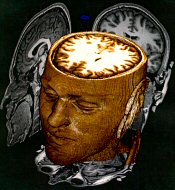
Functional magnetic resonance imaging, better known as fMRI, is 20 years old this week. October’s NeuroPod marks the celebrations by looking back at the brain scanning technology, it’s successes, and its troublesome teenage years.

The imaging technique was first announced in a 1991 study published in Science that announced how a standard MRI scanner could be used to used to track where oxygenated and deoxygenated blood flowed in the brain.

The technique takes advantage of the fact that haemoglobin, the iron containing protein that carries oxygen to essential tissues in the body, is differently magnetic when it is carrying oxygen, in comparison to when it is oxygen depleted.

The scanner is essentially a large electromagnet that aligns the proton spin of hydrogen atoms in the body, plus a radio frequency pulse that knocks them out of alignment.

Like shaking a compass, the protons move back into alignment again. The speed of return depends on the density of the body tissue, just like the speed of a compass needle returning to north depends on the density of the liquid in which it rests.

fMRI tunes in to the different magnetic echoes, or more technically, the magnetic resonance, of the protons realigning in oxygenated and deoxygenated blood.

As more active brain areas need more oxygenated blood, it’s possible to infer which tasks or mental activities are most associated with activity in certain brain areas by statistically comparing maps of magnetic resonance differences when people undertake different mental tasks in the scanner.

Although the technique can pinpoint where these changes take place in the brain, down to about the nearest millimetre, blood flow is not the same as actual brain activity, so it is not a precise measure.

Furthermore, changes can only be tracked in time slices of a second or more, clearly missing some of the changes in the fast moving brain, and statistical choices during analysis can affect the outcome sometimes as much as the task itself.

But despite the disadvantages, and with data from other types of study and imaging techniques, fMRI has become an essential scientific tool in the quest to understand the link between the mind and brain.

The piece has interviews with neuroscientists Karl Friston and Russ Poldrack, both involved in fMRI since its early days, who talk about the genuine progress and unfortunate hype that surrounds the technique.

A fantastic look back of the first two decades of fMRI and the other sections of the NeuroPod podcast are equally as interesting.
 

Link to October’s NeuroPod.
Nasal mummy exit

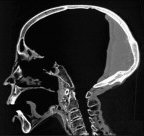
A new study just published in the Journal of Comparative Human Biology takes an enthusiastic look at exactly how the Ancient Egyptians removed the brain from cadavers before they were mummified.

You’ll be pleased to know that a variety of techniques were used over the millennia but unfortunately none make for particularly good dinner time conversation owing to them being slightly gory.

But for those not gathered round the table, the article is joyously over-detailed. In this part, the authors consider the history of scientific attempts to understand how you get a brain out of a dead person working only through the nose.

Speculation surrounding the steps following perforation has inspired experimental attempts at excerebration in sheep and human cadavers. The general consensus is that either the brain was macerated by means of the vigorous insertion and rotation of the perforation tool or other similar instrument, or that the brain was simply allowed to liquefy in the hot Egyptian environment. The first method, consistent with the account of Herodotus, is withdrawal of residues on the perforation tool or its like and Macalister (1894) refers to a three-toothed hook pictured in Chabas’ Études sur l’Antiquité Historique (p. 79) that may have been used to this effect.

Similarly, Pirsig and Parsche (1991) suggest that a bamboo rod tied with linen may have sufficed for this piecemeal extraction of semi-liquid brain. Both of these techniques are time intensive, with the rod drawing out little of the brain on each retraction. Alternative to, or in conjunction with, the previous method it has been suggested that the liquefied or semi-liquid brain might be allowed to drain from the cranium by placing the body prone. This process might also be expedited by flushing the cranium with water or other fluids, such as the cedar oil used to dissolve organs in Herodotus’ account of the “second process” of mummification.

The ‘experimental attempt’ at trying this out on a human cadaver is referenced to a 1911 German book by Karl Sudoff which has a title that translates to ‘Egyptian mummification instruments’.

I can’t imagine exactly how the experiment came about but presumably the chap got so enamoured with the tools he was collecting he just wanted to ‘have a bit of a go himself’.
 

Link to locked article. Or rather, entombed.

The cutting edge of the easy high

Perhaps the most complete scientific review of what we know about synthetic cannabis or ‘spice’ products has just appeared in Frontiers in Behavioral Neuroscience.

These ‘legal highs’ are typically sold as nudge-nudge wink-wink ‘incense’ but contain synthetic cannabinoids which have a similar effect to smoking dope but are legal in many countries.

We covered the history of these compounds recently and we also discussed the market approach of the neuroscientist-packing ‘legal high industry’ back in 2009.

Essentially, the industry is based on the fact that their psychopharmacologists can churn out new substances faster than governments can regulate against them, with the web providing a distributed marketplace that opens up the customer base.

This new article takes a scientific look at what compounds are actually appearing in ‘synthetic marijuana’ (of which there are many and various) as well as examining the known effects, good and bad.

If you’re not into phrases like “well-characterized aminoalkylindole class of ligands” you may want to skip the neurochemistry and just focus on the availability and effects.

It’s probably the most complete review of these compounds available to date, so definitely worth a look if you’re tracking the ‘synthetic blow’ story.
 

Link to ‘Beyond THC’ on cannabinoid designer drugs (via @sarcastic_f)

The New York Times wees itself in public

The New York Times has just pissed its neuroscientific pants in public and is now running round the streets announcing the fact in an op-ed that could as easily been titled ‘Smell my wee!’

The piece is written by Martin Lindström, famous for writing the ‘neuromarketing’ best-seller Buyology, but infamous for not making any of his data or studies public.

In fact, despite constantly mentioning the astounding conclusions from numerous brain imaging studies he was run, not one has appeared in the scientific literature.

But even without knowing about the reliability data or the quality of the analysis, it’s easy to see that he’s talking through his hat because the interpretations are so over-the-top that they are actually beyond what is possible with brain imaging science.

The piece is full of nonsense of various sorts.

I carried out an fMRI experiment to find out whether iPhones were really, truly addictive…

In each instance, the results showed activation in both the audio and visual cortices of the subjects’ brains. In other words, when they were exposed to the video, our subjects’ brains didn’t just see the vibrating iPhone, they “heard” it, too; and when they were exposed to the audio, they also “saw” it. This powerful cross-sensory phenomenon is known as synesthesia.

Actually, this is known as bullshit because synesthesia is where a conscious sensory experience in one sensory domain produces a conscious experience in another.

In other words, synesthesia is defined by the experiences that someone has, not where brain activity shows up.

The fact that brain activity occurs in an area previously linked to a different function does not mean it is being used for that function or that the person is having a related conscious experience.

If this is not entirely clear, think of it like this. Imagine, for the first time in your life, you just heard the sound of a guitar being played as part of a pop song. You’d be a bit daft if every time you heard guitar chords you told people that the music must be a pop song. After all, there’s a guitar in it, right?

Clearly, this is ridiculous because the guitar is an instrument that appears in lots of musical styles but Lindström is doing the neuroscience equivalent of over-interpreting guitar sounds throughout his terrible article.

He starts going on about how activation in the insula, detected in his privately conducted otherwise unknown study, means the person is experiencing love for their iPhone because insula activity has previously been linked to love.

The trouble is, as neuroimaging researcher Russ Poldrack just pointed out, it is one of the most common brain areas that turns up in fMRI studies and appears in about a third of imaging studies no matter what is being studied. In other words, it’s linked to just about every experience and behaviour you can think of.

In fact, it is probably most famous, not for its association with love, but for its association with digust, but Lindstrom apparently decided to avoid this particular interpretation.

This is just one example among many and if you want a breakdown of why the article really is full of crap, I recommend neuroscientist Tal Yarkoni’s point-by-point analysis and facepalm jamboree.

In fact, the op-ed has annoyed so many people there is now a letter to the editor signed by just about every big name in fMRI research on its way to the New York Times in an attempt to open the windows and get rid of that uncomfortable smell.
 

Link to NYT pissing itself in public.
Link to Tal Yarkoni’s excellent mopping up exercise.

Teenage kicks

National Geographic has an excellent article on teenage risk-taking and adolescent brain development.

It goes some way to explaining both the dangerous mistakes that typically peak in the late teens and, I like to think, the bad fashion sense which seems to follow a similar pattern.

Importantly, the piece goes beyond the usually ‘well the frontal lobes are still developing, aren’t they?’ explanation that gets wheeled out whenever teen neuroscience is discussed and hits on some of the gritty details.

Are these kids just being stupid? That’s the conventional explanation: They’re not thinking, or by the work-in-progress model, their puny developing brains fail them.

Yet these explanations don’t hold up. As Laurence Steinberg, a developmental psychologist specializing in adolescence at Temple University, points out, even 14- to 17-year-olds—the biggest risk takers—use the same basic cognitive strategies that adults do, and they usually reason their way through problems just as well as adults. Contrary to popular belief, they also fully recognize they’re mortal. And, like adults, says Steinberg, “teens actually overestimate risk.”

So if teens think as well as adults do and recognize risk just as well, why do they take more chances? Here, as elsewhere, the problem lies less in what teens lack compared with adults than in what they have more of. Teens take more risks not because they don’t understand the dangers but because they weigh risk versus reward differently: In situations where risk can get them something they want, they value the reward more heavily than adults do.

Probably one of the most comprehensive introductions to teen risk you’ll read in a good while.
 

Link to National Gerographic on Teenage Brains.

Crushed snails as neurology treatment

From a curious paper just published in the The Neuroscientist entitled “Plastering the Head with Crushed Snails to Treat Pediatric Hydrocephalus: An Ancient Therapy with a Pharmacological Basis.”

In the Middle Ages, medical therapy for pediatric hydrocephalus [a condition caused by the accumulation of cerebrospinal fluid inside the brain that can lead to enlargement of the head] was characterized by the application of drying substances to decrease the size of the heads of affected children.

A poultice of crushed snails applied to the head was considered to be one of the most powerful therapies for reducing swelling caused by excessive humors. Incunabula (texts printed in Europe before 1501 CE) and Renaissance texts document the extended use of this therapy, which was considered by physicians to be effective and less dangerous than surgical treatment…

It has been demonstrated that snails and slugs possess high concentrations of glycosaminoglycans and mucopolysaccharides…

Therefore, we think that the ancient practice of plastering the head with crushed snails in pediatric hydrocephalus, although not based on science as we know it, may have had at least some basis.

Negatively charged glycosaminoglycans absorb and retain large amounts of water and are important components of connective tissue. Because of these properties, glycosaminoglycans are currently used under various conditions to rehydrate the skin.


Link to closed access paper in The Neuroscientist.

Casting out the epilepsy ignorance demons

The New York Times has a surprising article about stigma surrounding epilepsy in Sierra Leone that describes some quite astounding beliefs about the condition.

Stigma here is based on two myths: that epilepsy is contagious and that it is caused by demonic possession. Dr. Lisk is quick to point out that beliefs about possession traverse societal boundaries. “You think it relates to level of education, of literacy, but somehow it doesn’t,” he said. “Sometimes it’s the most educated people who will tell you that it’s demonic. They say it’s in the Bible.” (Some biblical references to possession have long been thought to describe people with epilepsy.)

As a result, discrimination against people with epilepsy here is blatant and unabashed, and it begins in elementary school. “The school authorities often ask the students with epilepsy to leave,” Mr. Bangura said. “There is the notion that epilepsy is contagious; so when somebody has an attack during school, the perception is that if somebody happens to step on the spittle of an affected student, that would be one way of contracting the disease.”…

“Wherever the kid fell, they circle it and tell people to stay away from it, because that spot is a bad spot,”…

While these beliefs seem outlandish, the idea that epilepsy is caused by demonic possession is still common among many Western churches.

Here’s a video of a pastor of a revival church casting out epilepsy demons in Germany. This is an account of how TDS Ministries cured a young mother of a ‘spirit of epilepsy’ that was attacking her.

And if you’re still not convinced, this page has a testimony from the Bethel Church of how a blind man with epilepsy was not only cured of his seizures but also had his eyeballs grow back (suck on that Big Pharma!)

Needless to say, there’s plenty more where that came from, so we still have a way to go before even the most bizarre forms of stigma are defeated in the supposedly educated West.
 

Link to NYT piece on epilepsy beliefs in Sierra Leone.

Year two documentary on the Blue Brain project

The year two film of director Noah Hutton’s 10-year documentary-in-the-making on the progress of the ambitious Blue Brain Project is now online and well-worth watching.

The Blue Brain Project is often touted as aiming to ‘simulate the human brain’ but a more accurate description would probably be that it aims to create a simulation of cortical column circuits from the neuromolecular level up to the point where it’s as equally as complex as the human brain.

If the distinction isn’t clear imagine that you’re interested in how London works, so you decide to build a detailed computer simulation of suburban streets, but instead of aiming to replicate the geography of the genuine British city, you just make sure that it has as many roads as the capital itself.

Clearly, this is not an exact simulation of London, not least because the city is more than just suburban streets, but the complexity of the model would be incredibly useful in understanding the interaction between street level and city level activity at massive levels of complexity.

The same goes for neural simulation and the link between micro and macro levels of complexity is a major challenge for neuroscience. This is exactly what the Blue Brain Project aims to tackle.

However, as you can see in the film, project leader Henry Markham has the tendency to say that the project is about ‘understanding the brain’, which makes for good headlines, and takes nothing away from the impressiveness of the project, but is so broad that it doesn’t reflect the somewhat more neurobiological focus.

The project is, nonetheless, wonderful neuroscience and Noah Hutton’s film captures its progress during its second year.
 

Link to Noah Hutton’s ‘Blue Brain, Year Two’ film.

Bad riot neuroscience: cite the power

The Guardian Notes and Theories blog has a fantastic article on media science distortion by brain researchers whose study got falsely reported as showing a link between rioting and ‘low levels of a brain chemical’.

The actual study, which you can read online as a pdf, did not mention rioting and did not investigate it, but it got widely spun as giving an explanation for the recent looting in the UK based on the function of a neurotransmitter.

…we found that people who had lower levels of GABA in a part of their frontal lobe also reported higher “rash impulsivity”. People who score higher on rash impulsivity tend to act more rashly in response to strong emotions or urges. Our results tallied with recent genetic findings that linked GABA to alcoholism and drug abuse: disorders in which high rash impulsivity is a common feature. We wrote up our study for publication in a scientific journal and, as standard, we were encouraged by our university to issue a press release.

As the riots unfolded, news stories based on our research began appearing. On Tueday 9 August, a newswire story by the Press Association announced that “Brain chemical lack ‘spurs rioting'”, with ‘spurs rioting’ printed mischievously in quote marks, falsely implying these were our words. In a further creative leap, The Sun heralded a “Nose spray to stop drunks and brawls”, and that a “cure could be developed in the next ten years”.

The researchers reflect on how the media handles neuroscience and the hidden assumptions on the role of our brain in behaviour that pervade press reporting

In parts it’s a lament, in parts a media critique, and definitely worth reading in full.
 

Link to article ‘Riot control’.

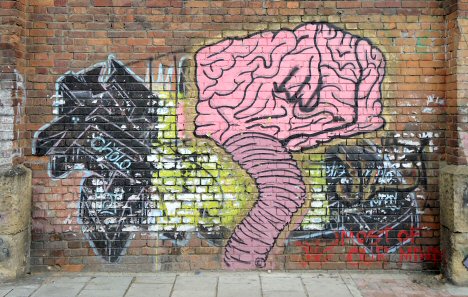
Zombie brain-eating sex kitten

Bogotá comes up with a smackdown in the Colombia brain graffiti stakes with a zombie brain-eating sex kitten found on a car park wall near Avenida Calle 63 con Carrera 17 this morning.


Medellín, represent!

UPDATE: A bit of Google Fu turns up the blog of the graffiti artist Saint Cat with some amazing pieces scattered around Bogotá and the occasional featured zombie brain.

Out of Mind online

Paul Broks is a British neuropsychologist who wrote a brilliant and insightful column on the brain and its disorders for Prospect magazine in the early 2000s, all of which are now freely available online.

The ‘Out of Mind’ column ran for the best part of five years. Alternately whimsical, profound and poetic, it recounted ephemeral scenes from meetings with brain altered individuals and spun them into reflections on the science and philosophy of human nature.

From July, 2004:

The bespectacled skeleton speaks. “Yes, I’m fine,” she says. Her jaw drops and rises squarely like a ventriloquist’s dummy. But where are the words coming from? All I can see are bones and electrodes. The view shifts and there’s the smoky shape of the heart. The tip of the catheter now appears at the bottom of the screen. This was inserted at the groin and is nudging upward, through an invisible artery, into the rib cage. The radiologist is deft and reaches the carotid in no time: base camp for the brain. He is ready now to squirt the drug into the cerebral blood vessels. Next scene: the inside of Julie’s head. There is nothing much to see.

You may recognise Broks from Into the Silent Land: Travels in Neuropsychology, quite possibly one of the most beautiful books ever written on the brain. His Prospect columns swim in the same deep blue waters.
 

Link to ‘Out of Mind’ column archive from Prospect Magazine.

A response to the Baroness

The Independent have just published a letter I wrote to them in response to their recent opinion piece by Susan Greenfield.

She claims that computers are at risk of causing ‘mind change’ while scientists are ignoring the issue. Needless to say, I was not impressed.

I was interested to read Professor Susan Greenfield’s opinion piece “Computers may be altering or brains – we must ask how” (12 August), where she laments that other scientists are refusing to debate the issue of how the internet and computer technology are affecting the mind and brain. She also claims that other scientists are dismissing her concerns by saying “there’s no evidence”.

This is clearly nonsense. There are over 3,000 scientific studies on the effect of technology on the mind and brain and a scientific community actively engaged in this debate, all of which Greenfield chooses to ignore in favour of her own alarmist conclusions. I am sure this is not simple unawareness, because Professor Greenfield specifically invited me to present the evidence to her at a debate on this topic at the House of Lords. The transcript is available on her own website. [You can download it as a pdf]

If Professor Greenfield wishes to engage in the debate about the impact of technology she is more than welcome to join the research community and discuss the evidence behind her concerns. So far, this evidence does not suggest that children’s or anyone else’s brains are being damaged by mobile phones, email, or Facebook. We know each has its own balance of effects, positive and negative, like all other media (newspapers included).

But instead of engaging with the evidence, Greenfield uses her media profile to communicate her ill-informed concerns to the public at large. This is neither helpful to science nor to concerned parents attempting to understand how they can best help their children use technology to their benefit.

The professor clearly has good intentions, but to become genuinely helpful she needs to be aware about what we actually know about the impact of technology. I would welcome her informed contribution to the debate.

Although I won’t be holding my breath.
 

Link to Independent letters page for 18th August.

Interfacing with the brain

ABC Radio National’s All in the Mind has just broadcast a fantastic edition on neural prosthetics – the science of creating artificial limbs that are controlled through direct interfaces with the nervous system.

The programme looks at the some of the cutting-edge research motivated by the US Military’s need to replace lots of limbs blown off in combat.

Some fantastic stories and fascinating science. Highly recommended.
 

Link to All in the Mind on neural prosthetics.

Musket to a brain surgeon

Phineas Gage is famous for having an iron bar being blown through his frontal lobes. Although his case is usually described as the first of its kind, this month’s edition of The Psychologist has a surprising article on many lesser known cases from the 1800s, usually due to mishaps with early firearms.

The piece is packed with amazing case vignettes of people who have suffered serious frontal lobe injury but were described as relatively unaffected.

This is one of the many striking examples:

In 1827 came a report by a Dr Rogers in the Medico-Chirurgical Transactions, where a young man received a frontal impact, again from a breech explosion. It was not until another three weeks, when the soldier, ‘discovered a piece of iron lodged within the head in the bottom of the wound from which a considerable quantity of bone had come away… it proved to be the breech pin of the gun three inches in length and three ounces in weight’. Four months later he was ‘perfectly cured’. Another case, here, was of an exploding breech pin penetrating 1½ inches into the brain, making a hole ¾ inch in diameter, resulting in an ‘escape of cerebral substance’. But ‘no severe symptoms occurred, and recovery took place in less than 24 days’.


Link to The Psychologist article ‘Blasts from the past’.

Antipsychotics and the profit panacea

Aljazeera has an interesting if not worrying article about the fact that antipsychotic drugs have become “the single top-selling therapeutic class of prescription drugs in the United States, surpassing drugs used to treat high cholesterol and acid reflux.”

The huge rise in prescriptions has been sparked by the availability of a relatively new class of drugs called ‘atypical antipsychotics’.

All antipsychotics block the D2 type of dopamine receptor and their effect on the mesolimbic dopamine pathway is what largely causes the reduction in psychotic symptoms.

The older drugs block D2 receptors fairly indiscriminately in the brain, including in the nigrostriatal pathway.

This pathway is involved in movement regulation and blocking dopamine here leads to similar problems to Parkinson’s disease (tremors, rigid and uncontrollable movements) – a type of dementia where this brain area starts to break down due to disease.

The newer ‘atypical antipsychotics’ usually also block serotonin 2A (5HT-2A) receptors in the key movement pathway.

Serotonin normally reduces dopamine release but because serotonin is being blocked, more dopamine is released in the movement pathway with the newer atypical antipsychotic drugs than with the older typical antipsychotic medications.

This means less Parkinson’s-like movement side-effects with the atypicals – a genuine advance – but unfortunately, the serotonin effect causes additional problems with weight gain and often obesity, diabetes and heart problems.

However, these problems are perhaps easier to control and more ‘socially acceptable’ (compare with someone who make strange contorted movements during conversation).

On the commercial side, many newer atypicals are still under patent, meaning one company has sole control over their manufacture and sale, while other companies are not able to make cheaper copies.

Over time, these newer drugs have been promoted, legally and illegally, by drug companies for a wider and wider range of problems – everything from depression to dementia.

Despite limited evidence for their effectiveness in these areas, the sales campaign has been a huge success and the drugs are now being widely prescribed.

Once upon a time, antipsychotics were reserved for a relatively small number of patients with hard-core psychiatric diagnoses – primarily schizophrenia and bipolar disorder – to treat such symptoms as delusions, hallucinations, or formal thought disorder. Today, it seems, everyone is taking antipsychotics. Parents are told that their unruly kids are in fact bipolar, and in need of anti-psychotics, while old people with dementia are dosed, in large numbers, with drugs once reserved largely for schizophrenics. Americans with symptoms ranging from chronic depression to anxiety to insomnia are now being prescribed anti-psychotics at rates that seem to indicate a national mass psychosis…

What’s especially troubling about the over-prescription of the new antipsychotics is its prevalence among the very young and the very old – vulnerable groups who often do not make their own choices when it comes to what medications they take. Investigations into antipsychotic use suggests that their purpose, in these cases, may be to subdue and tranquilize rather than to treat any genuine psychosis.

Antipsychotic drugs have been one of the great advances of 20th century medicine. For the first time we have an effective treatment for psychosis, one of the most disabling of any of the disorders, that works for at least a fair proportion of patients.

The side-effects of both the older and newer drugs, however, are among the worst of any medication and they should genuinely be used with caution.

Unfortunately, the well-being of patients has become secondary to the profit margins of large pharmaceutical companies who continue to promote these drugs to as many patients as possible, regardless of their benefits or adverse effects.

The Aljazeera article tracks this campaign to the point where they have become top selling medications.
 

Link to ‘How Big Pharma got Americans hooked on anti-psychotic drugs.’