Fluctuating existence

The Neurologist has a fascinating case report of a women with Parkinson’s disease who experienced a fluctuating belief that she didn’t exist.

Cotard’s delusion is usually described as the ‘belief that you’re dead’ although Jules Cotard, for whom the delusion is named, defined it as a délire des négations – the delusion of negation, or nihilism, as it’s usually translated.

In fact, in his original case report, Cotard’s patient didn’t believe they were dead but that they had “no brain, nerves, chest, or entrails, and was just skin and bone”.

This new case report in The Neurologist describes a patient with Parkinson’s disease who experiences something similar with the delusion appearing as their Parkinson’s medication began to wear off.

In December 2010, she went to follow-up visit accompanied by her caregivers and they reported that, in the last 2 months, the patient has developed a sudden onset of nihilistic delusion, mainly during the “wearing-off” condition and associated with end of dose dyskinesias and akathisia. The patient repeatedly complained of having lost both of her eyes, mouth, nose, and ears. Often during these events, she insisted to have a mirror to see herself. She expressed the false belief that she did not have the whole body and that nothing existed, including herself, without any insight. This nihilistic delusion, compatible with the diagnosis of Cotard syndrome, clearly improved with the administration of the following dose of levodopa and the associated amelioration of motor symptoms.

This is interesting because the Parkinson’s medication – levodopa – is a precursor to dopamine and is used to increase dopamine levels in the brain.

Increased dopamine levels in mid-brain areas are considered to be a key causal factor in generating the delusions and hallucinations of psychosis, but in this case delusions reliably appeared as dopamine levels were likely to have been dropping due to the medication wearing off.

Although this is a single case study, the effect was reliable when repeated, but it doesn’t mean that this would happen with everybody in the same situation.

But what it really shows is that the neurobiology of psychosis is not a simple ‘chemical imbalance’ but, in part, a complex dysregulation that can effect individuals differently due to the inherent interconnectedness of neural systems.
 

Link to PubMed entry for case report.

Actually, still no good explanation of ‘that dress’

The last time I almost went blind staring at “that dress” was thanks to Liz Hurley and on this occasion I find myself equally unsatisfied.

I’ll spare you the introduction about the amazing blue/black or white/gold dress. But what’s left me rather disappointed are the numerous ‘science of the dress’ articles that have appeared everywhere and say they’ve explained the effect through colour constancy.

Firstly, this doesn’t explain what we want to know – which is why people differ in their perceptions, and secondly, I don’t think colour constancy is a good explanation on its own.

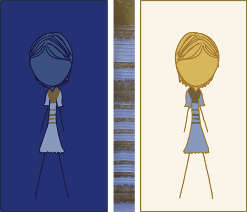
To explain a little, colour constancy is an effect of the human visual system where colours are perceived as being different depending on their context as the brain adjusts for things like assumed lighting and surroundings. Here’s a good and topical example from XKCD. The dress colours are the same in both pictures but the seem different because the background colour is different.

An important feature of the visual system is that the experience of colour is not a direct result of the wavelength of the light being emitted by the surface. The brain modifies the experiences to try and ensure that things appear the same colour in different lighting because if we just went off wavelength everything would wildly change colour as it moved through a world which is lit unevenly and has different colour light sources.

Visual illusions take advantange of this and there are plenty of examples where you can see that even completely physically identical colours can be perceived as markedly different shades if the image suggests one is in shadow and the other in direct light, for example.

Firstly, this isn’t an explanation of why people differ in perceiving the dress. In fact, all of the ‘science explanations’ have simply recounted how perceived colours can change but not the most important thing which is why people are having two stable but contradictory experiences.

Colour constancy works on everyone with normal colour vision. If you take the panels from the XKCD cartoon, people don’t markedly disagree about what the perceived colours are. The effect of each image is very reliable between individuals.

That’s not the case with the dress. Also, if you say context makes a difference, changing the surroundings of the dress should change the colours. It doesn’t.

Some have argued that individual assumptions about lighting in the picture are what’s making the difference. In other words, the context is the unconscious assumptions people make about lighting in the picture.

But if this is the case, this still isn’t an explanation because it doesn’t tell us why people have different assumptions. Psychologists called these top-down effects or, if we’re going to get Bayesian, perceptual priors.

75% of people in this BuzzFeed poll said they saw white/gold, 25% said they saw blue/black, and a small minority of people say they’ve seen the picture ‘flip’ between the two perceptions. How come?

And there’s actually a good test of the colour constancy or any other other ‘implicit interpretation’ explanation. You should be able to create images that alter the visual system’s assumptions and make perception of the dress reliably flip between white/gold and blue/black, as with the XKCD cartoon.

So, any vision scientists out there who can come up with a good explanation of why people differ in their perceptions? Psychophysicists, have I gone wildly off track?

Spike activity 28-02-2015

Quick links from the past week in mind and brain news:

Nautilus magazine has a good piece on behavioural economics and rethinking ‘nudges’. Although the rethink is really just another form of standard ‘nudge’.

The biggest hedge fund in the world, the $165 billion Bridgewater, starts an AI team to help give it the edge on investments reports Bloomberg. Well, they couldn’t get much worse than humans.

Gizmodo reports that a neuroscientist says he’ll do a head transplant ‘real soon now’. Hungover neuroscientist reads Gizmodo, thinks ‘I said what!?!’

The UK’s Post Office head of marketing has clearly been taken in by neuromarketing who thinks it will help them “better understand” their customers. Just like the stamp while we scan your brain…

The New York Times reports on pharma company Shire doing the old ‘disease marketing by the way I have a pill for that’ trick with DSM-5 newcomer binge eating disorder.

Hard Feelings: Science’s Struggle to Define Emotions. Good piece in The Atlantic.

The Human Brain Project is to be reorganised after a bit of a fuss (Americans: a significant crisis).

Being a asshole boss is bad for team performance. Interesting piece in Harvard Business Review.

Spike activity 20-02-2015

Quick links from the past week in mind and brain news:

Interesting social mapping using subway journey data from Beijing reproted in New Scientist.

BPS Research Digest has compiled a comprehensive list of mind, brain and behaviour podcasts.

That study finding a surge of p values just below 0.05 in psychology, probably not a sign of bad science, reports Daniel Lakens with a new analysis.

The Toronto Star reports that psychologists terminated a study on implanting false crime memories early due to over-effectiveness.

Why do mirrors seem to reverse left and right but not up or down? Clear explanation in a great video from Physics Girl.

Vice has an interesting piece on public reactions to celebrities who become psychotic or begin to display unusual behaviour.

Science News has a map of ambient noisyness is America.

There’s an interesting interview with Facebook AI director Yann LeCun in IEEE Spectrum magazine.

Oliver Sacks: “now I am face to face with dying”

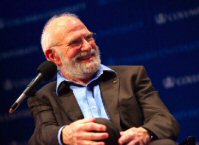
In a moving and defiant article for the The New York Times, neurologist Oliver Sacks has announced he has terminal cancer.

Over the last few days, I have been able to see my life as from a great altitude, as a sort of landscape, and with a deepening sense of the connection of all its parts. This does not mean I am finished with life.

On the contrary, I feel intensely alive, and I want and hope in the time that remains to deepen my friendships, to say farewell to those I love, to write more, to travel if I have the strength, to achieve new levels of understanding and insight.

This will involve audacity, clarity and plain speaking; trying to straighten my accounts with the world. But there will be time, too, for some fun (and even some silliness, as well).

The whole piece is a reflection on life, death and living and, fittingly, is a joy to read.

Keep on keepin’ on Dr Sacks.

We look forward to hearing about your final adventures.
 

Link to ‘My Own Life: Oliver Sacks on Learning He Has Terminal Cancer’.

Half a century of neuroscience

The Lancet has a good retrospective looking back on the last 50 years of neuroscience, which in some ways, was when the field was born.

Of course, the brain and nervous system has been the subject of study for hundreds, if not thousands, of years but the concept of a dedicated ‘neuroscience’ is relatively new.

The term ‘neuroscience’ was first used in 1962 by biologist Francis Schmitt who previously referred to the integrated study of mind, brain and behaviour by the somewhat less catchy title “biophysics of the mind”. The first undergraduate degree in neuroscience was offered by Amherst College only in 1973.

The Lancet article, by one of the first generation ‘neuroscientists’ Steven Rose, looks back at how the discipline began in the UK (in a pub, as most things do) and then widens his scope to review how neuroscience has transformed over the last 50 years.

But many of the problems that had beset the early days remain unresolved. Neuroscience may be a singular label, but it embraces a plurality of disciplines. Molecular and cognitive neuroscientists still scarcely speak a common language, and for all the outpouring of data from the huge industry that neuroscience has become, Schmitt’s hoped for bridging theories are still in short supply. At what biological level are mental functions to be understood? For many of the former, reductionism rules and the collapse of mind into brain is rarely challenged—there is even a society for “molecular and cellular cognition”—an elision hardly likely to appeal to the cognitivists who regard higher order mental functions as emergent properties of the brain as a system.

It’s an interesting reflection on how neuroscience has changed over its brief lifespan from one of the people who were there at the start.
 

Link to ’50 years of neuroscience’ in The Lancet.

Spike activity 13-02-2015

Quick links from the past week in mind and brain news:

US Governor proposes that welfare recipients should be drug screened and have negative results as a condition for a payment. A fascinating Washington Post piece looks at past data on similar schemes.

BPS Research Digest launches the PsychCrunch podcast. First episode: evidence-based dating.

The brain, interrupted: neurodevelopment and the pre-term baby. Excellent Nature piece.

Fusion has a great piece on *how* we should worry about artificial intelligence.

“The world’s first hotel staffed entirely by robots is set to open in Japan” reports the International Business Times. Clearly they’ve never visited a Travelodge.

Forbes reports on the ‘coming boom in brain medicines’. Personally, I won’t be holding my breath.

There’s an excellent update on new psychoactive substances and synthetics drugs over at Addiction Inbox.

The Scientific 23 is a great site that interviews scientists and there are lots of cognitive scientists discussing their work.

A refocus of military influence

The British media has been covering the creation of 77th Brigade, or ‘Chindits’ in the UK Army which they’ve wrongly described as PsyOps ‘Twitter troops’. The renaming is new but the plan for a significant restructuring and expansion of the UK military’s influence operations is not.

The change in focus has been prompted by a growing realisation that the success of security strategy depends as much on influencing populations at home and abroad as it does through military force.

The creation of a new military structure, designed to tackle exactly this problem, was actually reported last year in British Army 2014 – a glossy annual policy publication. The latest announcement of the 77th Brigade is really just a media-friendly re-branding of the existing plan.

You can read the document online (warning it’s a 50Mb plus pdf) but here’s a crucial section from page 121 onwards:

Our potential adversaries and partners are increasingly blurring the lines between regular and irregular and between military, political, economic and information activities. At least three nations who operate large conventional ‘traditional’ armies have now also adopted the Chinese concept of Unrestricted Warfare.

Author Steve Metz describes this as involving “diverse, simultaneous attacks on an adversary’s social, economic and political systems. It ignores and transcends the ‘boundaries the boundaries between what is a weapon and what is not, between soldier and non-combatant, between state and non-state or suprastate.” If we wish to succeed in such as environment we need to compete on an equal footing.

To do this, we must change not only our physical capabilities but our conceptual approach, our planning and our execution. This is not to say that the virtual and cognitive domains now produce a ‘silver bullet’ that will mean the end of combat, but that “superiority in the physical environment was of little value unless it could be translated into an advantage in the information environment”…

In order to shift the Army’s thinking in the approach to this new manoeuvre, the Security Assistance Group (SAG) will form in September 2014. It will form through the amalgamation of the current 15 Psychological Operations Group, the Military Stabilisation Support Group, the Media Operations Group and the Security Capacity Team.

However, these structures are merely the start point for a fully integrated capability that will harness a wide range of powers to achieve the desired effects – from cyber through to engagement, commercial, financial, stabilisation and deception. At the heart of the new structure must be a culture and attitude that is both Defence and civilian orientated.

And that is really what the ‘newly announced’ 77th Brigade is all about.

To see how seriously the British Army are taking this, the 77th is reportedly going to be made up of up to 2,000 full-time and reserve troops. Think Defence report that the combined strength of all the existing relevant groups that will be incorporated is just 300 people.

The idea is to make Information Operations a much more central part of military doctrine. This includes electronic warfare and computer hacking, physical force targeted on information resources (like taking out infrastructure), psychological operations – traditionally focused on changing belief and behaviour in the theatre of war, media operations – essentially corporate PR, and a wider use of media to influence external populations and potential adversaries.

The Daily Express reports that “the brigade will bring together specialists in media, signalling and psychological operations, with some Special Forces soldiers and possibly computer hackers” which seems likely to reflect exactly what the Army are aiming for in their new plan.

From this point of view, you can see why governments are so keen to hold on to their Snowden-era digital monitoring and intervention capabilities.

They typically justify their existence in terms of ‘breaking terrorist networks’ but they are equally as useful for their role in wider information operations – targeting groups rather than individuals – now considered key to national security.

The formation of the 77th Brigade is a mostly reflection of a wider refiguring of global conflict that puts cognition and behaviour at the centre of political objectives.

It is simultaneously more and less democratic that ‘hard power’. It makes the battle of ideas, rather than the use of force, central to determining political outcome but attempts to shape the information environment so some ideas become more equal than others.

Spike activity 30-01-2015

Quick links from the past week in mind and brain news:

PLOS Neuroscience has an excellent interview on the strengths and limitations of fMRI.

There’s an excellent profile of clinical psychologist Andrea Letamendi and her interest in comics and mental health in The Atlantic.

The Wall Street Journal has an excellent piece on hikikomori – a syndrome of ultra withdrawal by Japanese youth.

The Hearing Voices Network as an alternative approach to supporting voice hearers is covered by a good article in The Independent.

Backchannel looks at the largest ‘virtual psychology lab’ in the world.

Does subliminal advertising actually work? asks BBC News.

BPS Research Digest covers a study finding that psychologists and psychiatrists rate patients less positively when their problems are explained biologically. Along the lines of several similar studies.

In the 21st Century, project management for parents

I’ve just read an excellent book on the surprising anomaly of modern parenting called All Joy and No Fun.

It’s by the writer Jennifer Senior who we’ve featured a few times on Mind Hacks for her insightful pieces on the social mind.

In All Joy and No Fun she looks at how the modern model of childhood born after the Second World War – “long and sheltered, devoted almost entirely to education and emotional growth” – has begun to mutate in some quarters into an all consuming occupation of over-parenting that has meant childcare has been consistently rated as one of the least enjoyable family activities in a wide range of studies.

The book combines field trips with parenting in middle American (YMMV) and a look at the surprising data about how parenting has become almost a competitive sport which requires forever more money, time, restrictions and plans, lest you be accused be being a ‘bad parent’.

New parents in the United States, Mead observes, are willing to try almost any new fad or craze for their baby’s sake. “We find new schools of education, new schools of diet, new schools of human relations… And we find serious, educated people following their dictates.” Which is why attachment parenting is consdiered de rigeur one year and overbearing three years later. And why cry-it-out is all the rage one moment and then, after a couple of seasons, considered cruel. And why organic home-milled purees suddenly supplant jars of Gerber’s, though an entire generation has done just fine on Gerber’s and even gone on to write books, run companies and do Nobel-winning science. Uncertainty is why parents buy Baby Einstein products, though there’s no evidence that they do anything to alter the cognitive trajectory of a child’s life, and explains why a friend – an extremely bright and reasonable man – asked me, with the straightest of faces and finest of intentions, why I wasn’t teaching my son sign language when he was small.

Because he was writing in the 1950s, psychoanalyst Donald Winnicott talked about the ‘good enough mother’, but taking its more modern version, we could say that ‘good enough parenting’ is all that parents need to aspire to.

All Joy and No Fun is a thought-provoking exploration of how childrearing become so unenjoyable in the 21st Century, and how fads, fashions and commerce, seek to undermine ‘good enough parenting’.
 

Link to more details on All Joy and No Fun.

Hard Problem defeats legendary playwright

I’ve written a review of legendary playwright Tom Stoppard’s new play The Hard Problem at the National Theatre, where he tackles neuroscience and consciousness – or at least thinks he does.

The review is in The Psychologist and covers the themes running through Stoppard’s new work and how they combine with the subtly misfiring conceptualisation of cognitive science:

This is a typical and often pedantic criticism of plays about technical subjects but in Stoppard’s case, the work is primarily about what defines us as human, in light of the science of human nature, and because of this, the material often comes off as clunky. It’s not that the descriptions are inaccurate – allusions to optogenetics, Gödel and the computability of consciousness, game theory, and cortisol studies of risk in poker players, are all in context – but Stoppard doesn’t really understand what implications these concept have for either each other or for his main contention. Questions about mind and body, consciousness and morality, are confused at times, and it’s not clear that Stoppard really understands the true implications of the Hard Problem of consciousness.

It’s worth saying, I actually enjoyed the play, but it was Stoppard’s philosophy and unwieldy use of neuroscience that didn’t quite hang together for me.

The full piece is the link below.
 

Link to review of The Hard Problem in The Psychologist

A misdiagnosis of trauma in Ancient Babylon

Despite the news reports, researchers probably haven’t discovered a mention of ‘PTSD’ from 1300BC Mesopotamia. The claim is likely due to a rather rough interpretation of Ancient Babylonian texts but it also reflects a curious interest in trying to find modern psychiatric diagnoses in the past, which tells us more about our own clinical insecurities than the psychology of the ancient world.

The claim comes from a new article published in Early Science and Medicine and it turns out there’s a pdf of the article available online if you want to read it in full.

The authors cite some passages from Babylonian medical texts in support of the fact that ‘symptoms of posttraumatic stress disorder’ were recorded in soldiers. Here are the key translated passages from the article:

14.34 “If his words are unintelligible for three days […] his mouth [F…] and he experiences wandering about for three days in a row F…1.”

14.35 “He experiences wandering about (for three) consecutive (days)”; this means: “he experiences alteration of mentation (for three) consecutive (days).”

14.36 “If his words are unintelligible and depression keeps falling on him at regular intervals (and he has been sick) for three days F…]”

19.32 “If in the evening, he sees either a living person or a dead person or someone known to him or someone not known to him or anybody or anything and becomes afraid; he turns around but, like one who has [been hexed with?] rancid oil, his mouth is seized so that he is unable to cry out to one who sleeps next to him, ‘hand’ of ghost (var. hand of […]).”

19.33 “[If] his mentation is altered so that he is not in full possession of his faculties, ‘hand’ of a roving ghost; he will die.”

19.34 “If his mentation is altered, […] (and) forgetfulness(?) (and) his words hinder each other in his mouth, a roaming ghost afflicts him. (If) […], he will get well.”

Firstly, it’s clearly a huge stretch to suggest these are symptoms of PTSD which is defined as groupings of intrusive memories of the traumatising event, heightened arousal or emotional numbing, avoidance of reminders and, since the DSM-5, depression-like symptoms.

The authors suggest that the strongest evidence for the fact that the ancient descriptions are PTSD is that the ‘ghost’ mentioned in the text is often considered to be the ghosts of enemies whom the patient killed during military operations, and these could be PTSD-like flashbacks.

The trouble is that ‘ghosts’ are given as causes of many disorders in Babylonian medicine. Furthermore, all of the symptoms the authors describe could clearly also describe epilepsy and, in fact, are described in Babylonian texts on epilepsy.

For example, these are all symptoms described in BM 47753 a Babylonian tablet on epilepsy, discussed a 1990 article, that also describes wandering, confusion and unintelligible speech.

If he keeps going into and out of (his house) or getting into and out of his clothes .. or talks unintelligibly a great deal, does not any more eat his bread and beer rations and does not go to bed…

If, in a state of fear, he keeps getting up and sitting down, (or) if he mutters unintelligibly a great deal and becomes more and more restless…

Most symptoms are diagnosed as a form of being touched by the hand of a supernatural being. Below are some ‘ghost’ afflictions that are clearly epilepsy related, including ‘ghosts’ who have died violently in various ways, including a ‘mass killing’.

If at the end of his fit his limbs become paralysed, he is dazed (or, dizzy), his abdomen is “wasted” (sc., as of one in need of food) and he returns everything which is put into his mouth …….-hand of a ghost who has died in a mass killing.

If when his limbs become at rest again like those of a healthy person his mouth is seized so that he cannot speak,-hand of the ghost of a murderer. R: hand of the ghost of a person burned to death in a fire.

If when his limbs become at rest again like those of a healthy person he remains silent and does not eat anything,-hand of the ghost of a murderer; alternatively, hand of the ghost of a person burned to death in a fire

Oddly, the authors of the ‘ancient PTSD’ article suggest that references to slurring of speech and cognitive difficulties might reflect co-morbid drug abuse. They also admit that all their cited symptoms could be caused by head injury but as prognosis is given as non-fatal, they were probably PTSD-related. But again, epilepsy seems a much better fit here both from a contemporary and Babylonian perspective.

In fact, historians Kinnier Wilson and Reynolds, who wrote the 1990 article on Babylonian epilepsy texts, were quite convinced that references to ‘ghosts’ were ancient terms for nocturnal epilepsy, not ‘flashbacks’.

But it’s also worth mentioning that the ‘ancient PTSD’ argument is in a long-line of studies that attempt to match contemporary psychiatric diagnoses to vague historical references as a way of legitimising the modern concepts.

However, the ways in which psychological distress, particularly trauma, is expressed are massively affected by culture. PTSD is unlikely to be a concept that transcends time, place and social structure.

In fact, historians have not been able to convincingly find any PTSD-like descriptions in history and there seems a virtually complete absence of any records of flashbacks in the medical records of First and Second World War veterans, let alone in Ancient Babylon.

War, violence and tragedy has left its psychological mark on individuals from the beginning of time.

PTSD is a useful diagnosis we’ve created to help us deal with some of the consequences of these awful events in the limited but important contexts in which it occurs – but it’s not a universal feature of human nature.

Who knows whether anything like PTSD existed for the Babylonians but the fact that we can use it to help people is all we need to legitimise it.
From the machine

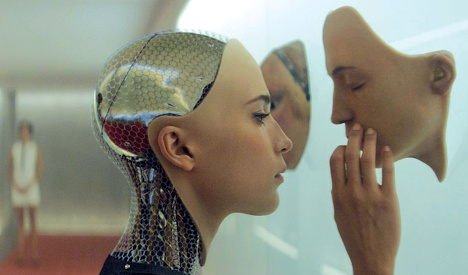
A new film, Ex Machina, is released in the UK tomorrow and it is quite possibly one of the best sci-fi films of recent times and probably the best film about consciousness and artificial intelligence ever made.

The movie revolves around startup geek turned tech corp billionaire Nathan who has created the artificially conscious android Ava. Nathan invites one of his corporate coders, Caleb, to help test whether Ava feels conscious.

The film is near-future but in the tradition of sci-fi as a theatre in which to test ideas, it focuses on the stark and unexpected issues raised by self-conscious robots designed for the human market.

Writer and debut director Alex Garland clearly put a lot of effort into getting the scientific concepts right, enlisting biologist Adam Rutherford and cognitive roboticist Murray Shanahan to finesse the philosophy of mind.

In addition, it’s brilliantly acted, paranoid, subtly disturbing and thought-provoking – long after the credits roll.

It’s also sparked some great reviews of the movie and the cognitive science behind it. The Independent has an excellent piece on the science behind the plot and there’s a great interview with the scientific advisors in Dazed.

But probably the best so far is consciousness researcher Anil Seth’s extended review in New Scientist which tackles the core of the film’s philosophical kick:

While the Turing test has provided a trope for many AI-inspired movies… Ex Machina takes things much further. In a sparkling exchange between Caleb and Nathan, Garland nails the weakness of Turing’s version of the test, a focus on the disembodied exchange of messages, and proposes something far more interesting. “The challenge is to show you that she’s a robot. And see if you still feel she has consciousness,” Nathan says to Caleb.

This shifts the goalposts in a vital way. What matters is not whether Ava is a machine. It is not even whether Ava, even though a machine, can be conscious. What matters is whether Ava makes a conscious person feel that Ava is conscious. The brilliance of Ex Machina is that it reveals the Turing test for what it really is: a test of the human, not of the machine. And Garland is not necessarily on our side.

In fact, the film constantly flips viewers between thinking of Ava as a machine, and as a conscious being, and forces us to continually check the shifting plot reality to see if it still holds together.

At the end of the film you come to realise that it’s not Ava who’s being tested, it’s you.
 

Link to Ex Machina page on Wikipedia.
Link to UK trailer on YouTube.
Link to international trailer on YouTube.

pwned by a self-learning AI

Backchannel has a fascinating profile of DeepMind founder Demis Hassabis which although an interesting read in itself, has a link to a brief, barely mentioned study which may herald a quiet revolution in artificial intelligence.

The paper (available online as a pdf) is entitled “Playing Atari with Deep Reinforcement Learning” and describes an AI system which, without any prior training, learned to play a series of Atari 2600 games to the point of out-performing humans.

The key here is ‘without any prior training’ as the system was not ‘told’ anything about the games. It worked out how to play them, and how to win them, entirely on its own.

The system was created with a combination of a reinforcement learning system and a deep learning network.

Reinforcement learning is based on the psychological theory of operant conditioning where we learning through reward and punishment what behaviours help us achieve certain goals.

One difficulty is that in video games, the reward (points) may only be distantly related to individual actions because strategy is not something that can be boiled down to ‘do this action again to win’. Mathematically there is lots of noise in the link between an action and eventual outcome.

Traditionally this has been solved by programming the structure of the game into the AI agent. Non-player characters in video games act as effective opponents because they include lots of hard-coded rules about what different aspects of the game symbolise, and what good strategy involves.

But this is a hack that doesn’t generalise. Genuine AI would work out what to do, in any given environment, by itself.

To help achieve this, the DeepMind Atari AI uses deep learning, a hierarchical neural network that is good at generating its own structure from unstructured data. In this case, the data was just what was on the screen.

To combine ‘learning effective action’ and ‘understanding the environment’ the research team plumbed together deep learning and reinforcement learning with an algorithm called Q-learning that is specialised for ‘model-free’ or unstructured learning.

So far, we have performed experiments on seven popular ATARI games – Beam Rider, Breakout, Enduro, Pong, Q*bert, Seaquest, Space Invaders. We use the same network architecture, learning algorithm and hyperparameters settings across all seven games, showing that our approach is robust enough to work on a variety of games without incorporating game-specific information…

Finally, we show that our method achieves better performance than an expert human player on Breakout, Enduro and Pong and it achieves close to human performance on Beam Rider.

The team note that the system wasn’t so good at Q*bert, Seaquest and Space Invaders, and it wasn’t asked to battle the real Ko-Dan Empire after playing Starfighter, but it’s still incredibly impressive.

It’s an AI that worked out its environment, its actions, and what it needs to do to ‘survive’, without any prior information.

Given, the environment is an Atari 2600, but the AI is a surprisingly simple system that ends up, in some instances, outperforming humans from a standing start.

Essentially, the future of humanity now rests on whether the next system is given a gun or a dildo to play with.
 

Link to Backchannel profile of Demis Hassabis.
pdf of paper “Playing Atari with Deep Reinforcement Learning”

A love beyond illusions

Articles on people’s experience of the altered states of madness often fall into similar types: tragedy, revelation or redemption. Very few do what a wonderful article in Pacific Standard manage: give an account of how a young couple learn to live with psychosis.

It’s an interesting piece because it’s not an account of how someone finds the answer to loving someone who has episodes of psychosis, it’s how a couple find an answer.

It discusses psychiatry, antipsychotics and R.D. Laing but not in terms of what we should or could think of psychosis and society, but what one couple takes from them – finding value where it helps.

Touching, genuine, unpretentious and uncensored.

It is romantic in the truest sense.
 

Link to ‘My Lovely Wife in the Psych Ward’.

Spike activity 09-01-2015

Quick links from the past week in mind and brain news:

Game theorists crack poker according to a fascinating report from Nature. First nuclear war, now poker. Whatever next!

Harvard Business Review has a genuinely interesting piece on the psychology of office politics.

Child mental health services have been secretly cut by £50m according to BBC News. What we need is some important politician to tell us how important mental health is to make this right again.

British Journal of Psychiatry puts a psychedelic portrait of the Shulgins on its front cover. Rumour has it that if you lick the pages your hallucinations disappear.

There’s an interesting piece in Wired about images specifically generated to mislead AI image recognition algorithms.

The New York Times has an extended and interesting profile of innovative neuroscientist Sebastian Seung.

Can deaf people hear hallucinated voices? An interesting piece in Mosaic tackles the issue.