Philosophy and limb amputation

darklit_arm.jpgAustralian philosophers Tim Bayne and Neil Levy have argued that people who want to be amputees should be allowed to have elective amputations, even if they have healthy limbs.

This unusual desire has been labelled ‘body integrity identity disorder‘ or BIID by psychiatrists.

It has caused much ethical concern among doctors who are bound by the hippocratic oath to ‘do no harm’, but are faced with some patients wanting healthy limbs removed.

Bayne and Levy argue that such people are not “globally irrational”, and should be considered to have the capacity to make such decisions about their body.

Tim Bayne has previously done work on delusions and rationality, and has extended this analysis into applied ethics.

Link to story from ABC News.
Link to study abstract.
Link to Tim Bayne’s homepage with full-text publications.

Maths ability without language skills

maths_formulas.jpg

Scientific American reports on three individuals who retained remarkable mathematical skills after brain damage that left them unable to use language to communicate.

Varley and her colleagues found that although the subjects could no longer grasp grammatical distinctions between, say, “The dog bit the boy” and “The boy bit the dog,” they could interpret mathematical formulas incorporating equivalent structures, such as “59 – 13” and “13 – 59.”

Although subjects easily answered simple problems expressed in mathematical symbols, words continued to stump them. Even the written sentence “seven minus two” was beyond their comprehension. The results show quite clearly that no matter how helpful language may be to mathematicians–perhaps as a mnemonic device–it is not necessary to calculation, and it is processed in different parts of the brain.

This suggests that maths ability does not necessarily rely on written or spoken language to give calculations logical order and coherence.

Link to Scientific American story ‘Math without Words’.

2005-06-24 Spike activity

Quick links from the past week in mind and brain news:

spike.jpg

Insightful, sardonic and often sharply witty blog, detailing the trials and tribulations of a mental health nurse (via PsyBlog)

Website from the Boundary Institute has online ‘Psi’ tests to look for extransensory abilities.

Raj Persaud takes us inside the mind of an adulterer, discussing the psychology of infidelity.

Violent video games activate similar brain areas to real violence.

The smell of male pheromones makes men more likely to opt for male lifestyle magazines than other titles.

Women are more afraid of dentists than men, research shows. Must be all those men’s lifestyle magazines in the waiting room.

Narcissicists seem better able to handle trauma than others.

Sex psychologist Petra Boynton critical of attempts to brain scan orgasm, but clarifies her comments after feedback.

Metafilter on what you think about when you’re not thinking about much.

Evidence for ‘grandmother cells’

This week’s edition of the science journal Nature reports that single brain cells may be specialised for recognising specific faces.

This is an interesting finding, as it provides support for a derided hypothesis known as the ‘grandmother cell‘ theory, that was thought up to ridicule attempts to reduce human experience down to smaller and smaller components of the brain.

Neuroscience often develops by trying to understanding how smaller parts of the brain support larger processes. Bologist Jerry Lettvin argued that we can’t expect everything to reduce down to the smallest level, as some things will be distributed across the brain.

It is unlikely, he argued, that there is a single brain cell to represent each person we know, a neuron that is active when we see our grandmother, for example.

This has since been used as an argument against any theory that is seen as over-simplifying how things are represented in the brain.

But now, a team led by neuroscientist Rodrigo Quian Quiroga has identified neurons which do seem to be active for individual faces.

He implanted harmless electrodes into the temporal lobes of volunteers undergoing surgery for epilepsy.

halle_berry.jpgQuiroga then showed the participants pictures of famous faces, and discovered some cells were only active for individual faces in the set – Halle Berry, or even members of The Simpsons.

Of course, it’s impossible to say whether these cells are truly selective for an individual face out of all the ones a person may know, but this level of selectivity is a great surprise for those who thought individual cells would be active for very general features of the visual world.

Link to write-up from nature.com
Link to study abstract.

Cognitive daily on ‘childhood amnesia’

Cognitive Daily has an elegant summary of research on why we don’t remember the first years of life. The results suggest that it may be because young children lack the language resources to support the necessary memories.

I would be tempted to quote some of the post here, but its described so succinctly its probably best just to read the original.

Link to ‘Why do we forget our childhood?’ from Cognitive Daily.

Optical street art of Julian Beever

Julian Beever is a street artist who takes advantage of the way the brain understands the world to create some amazing artwork.

The brain works out our 3D experience of the world from the 2D light patterns that fall onto our retina at the back of the eye.

This process takes advantage of many of our implicit assumptions of the world, such as the fact that textures will fade as they go farther away, parallel lines will tend to converge in the distance and that objects will seem larger the closer they are.

beever_swim.jpg

Julian Beever’s art uses a knowledge of these processes, so when seen from a certain angle, the pictures fool the visual system’s inbuilt processes to produce a false sense of depth.

beever_swim_wrongview.jpg

When seen from an alternative angle, the illusion breaks-down, and it’s possible to see how the artwork was created.

There’s plenty more examples of this amazing effect on Julian’s pages that are well worth checking out.

Links to Julian Beever’s homepage and street art page.
PDF of notes on ‘An Introduction to Visual Perception’.

At last! Female orgasm neuroimaged

kiss.jpgFinally, someone has done a neuroimaging study of the female orgasm.

Although the paper from this study has not been published yet, if the conference reports are anything to go by, it may be the first functional neuroimaging study of orgasm in healthy human females.

My only caveat is the rather random way this story is being reported (e.g. ‘Brain scans detect fake orgasms’) and the seemingly odd quotes from the researcher involved (from a BBC News story):

Professor Holstege said: “Women can imitate orgasm quite well. But with genuine orgasm”, he said: “What we see is an extreme deactivation of large portions of the brain hippocampus and especially the emotional parts involved with fear… And if you are fearful, it is very hard to have sex. It’s very hard to let go.” He said this was useful for men to know. “When you want to make love to a woman, you must give her the feeling of being protected.”

If reported correctly, Prof Holstege seems to have gone from a discovery about a reduction in brain activity (possibly based on a weak clich√© that the amygdala circuit is the ‘fear’ part of the brain) to advice on ‘how to make love to a woman’.

Come again ?

Link to story from newscientist.com
Link to story from BBC News.

Anaesthesia can lead to sex delusions

windows.jpgThe Arizona Daily Star is reporting that doctors are being warned that some general anaesthetics are associated with sexual dreams which some people may remember as real.

Although it is almost impossible to verify how often sexual hallucinations occur, some studies indicate it happens in 1 percent to 3 percent of anesthetized patients, Strickland said. With some anesthetic drugs – such as ketamine or propofol – the incidence is up to 5 percent.

Just why it happens is not well understood. But the risk is higher under lighter, sedating anesthesia than under deep anesthesia, doctors have found.

Link to article from Arizona Daily Star (via BoingBoing)
Links one and two to cases on PubMed.

Neurotheology via Numenware

numenware-small.jpgNumenware is a recently re-launched blog that covers the developing world of neurotheology – the neuroscience of spiritual experience and belief.

The site is authored by Bob Myers, who manages to approach the subject in a critical but non-dogmatic way and avoids scoring easy points on complex topics.

Some of my favourites include a post musing about a neurological basis of average age of enlightenment, one on developmental neurotheology, and note on the possible adaptive value of near-death experiences.

Link to numenware.com

Epilepsy and the risk of psychosis

epilepsy_eeg_trace.jpg

A study published online by the British Medical Journal suggests that people with epilepsy or a family history of epilepsy may be more likely to develop schizophrenia or psychotic symptoms.

Researchers from the University of Aarhus analysed the records of 2.27 million Danish people, and found the risk of schizophrenia-like psychosis slightly raised in people with epilepsy, or those with family members who have epilepsy.

The absolute risk still remains small however, as only 1.5% of the people with epilepsy went on to develop psychosis.

The significance of these findings are in the suggestion that epilepsy and psychosis may have some common genetic influences. This influence is likely to be complex however, as demonstrated by a curious interaction.

The study found that people with epilepsy were more likely to develop psychosis if there was no family history of psychosis or schizophrenia.

Link to story from Yahoo News.
Link to study abstract.

UPDATE: The BMJ have just published a ‘rapid response‘ I submitted about the article’s findings.

Brain scan early detection of Alzheimer’s

hipmask.jpgA research team has announced that they have developed a brain imaging technique to detect the early stages of Alzheimer’s disease with a claimed accuracy of 78%.

The technique, named HipMask and developed by neuroscientist Lisa Mosconi and her team, uses a brain scanning technique called PET. This involves injecting weakly radioactive glucose into the blood and measuring where it accumulates in the brain.

Glucose is used as ‘fuel’ by the brain, so brain activity in a particular location can be inferred from measuring the levels of radioactivity.

Mosconi’s team have discovered that poor levels of activity in a brain area called the hippocampus, a crucial memory area, predict the onset of Alzheimer’s disease up to 9 years before standard diagnosis.

Because the hippocampus is small and hidden deep within the brain, measuring its activity has been traditionally considered quite hard, as it produces a relatively weak signal.

Mosconi’s team overcame this problem by also using an MRI scan of the brain, which gives a more accurate internal picture, to complement the PET scan, which gives a clearer measure of hippocampal function.

Link to write-up of study from from Eureka Alert.
Link to story from Yahoo News.
Link to study abstract.

Walter Freeman: Controversional lobotomy surgeon

freeman.jpgJack El-Hai, the biographer of surgeon and early lobotomy enthusiast Walter Freeman is interviewed on ABC Radio’s In Conversation.

El-Hai has written The Lobotomist: a maverick medical genius and his tragic quest to rid the world of mental illness, that follows Freeman’s life, and the history of psychosurgery – the use of brain surgery to attempt to treat mental disorder.

Freeman is now a controversial character, and many see his enthusiasm for doing literally hundreds of lobotomies as verging on abuse of vulnerable patients, whereas Freeman himself argued that his was an effective treatment for otherwise untreatable people.

One of Freeman’s most notable lobotomy patients was Rosemary Kennedy, sister of JFK – an episode El-Hai describes as “one of the worst” in Freeman’s career.

Realaudio or webpage of In Conversation on Walter Freeman.
Link to New Statesman review of El-Hai’s book.
Link to the book’s website with first chapter online.

Nine-way love

rose_girl.jpgResearchers claim to have identified nine different types of love. In reality, it is more likely that they have simply classified love in nine different ways.

For the curious however, the types include:

The “Cupid’s dart” variety, in which couples – think Antony and Cleopatra or even Burt Lancaster and Deborah Kerr in From Here to Eternity – are swept away by blind passion.

Hedonistic love, concerned with personal and perhaps fleeting pleasure, the theme of much Hollywood film noir.

Love as the ultimate connection: an essentially romantic view.

I’m not sure whether it is the reporter or the researchers who are getting carried away there.

Call me a cynic, but I think that maybe they’ve just watched too many movies. Be thankful it wasn’t Dawson’s Creek.

Link to article ‘How do I love thee? Which of the nine ways?’

2005-06-17 Spike activity

Quick links from the past week in mind and brain news:

spike.jpg

RedNova reviews Plotkin’s book Evolutionary Thought in Psychology.

There’s been a recent flurry of reinterest in the effect of the cat parasite toxoplasma gondii on human personality – see also PDF of related SciAm article.

Cornell lawyers discuss the legality of using brain scans in suspect interrogation (via BoingBoing).

Kid’s asthma may be linked to mothers’ depression.

Buddhist monks can control perceptual rivalry suggesting they have exceptional control over certain mind and brain processes.

Deep brain stimulation (a brain ‘pacemaker’) is being trialled to help untreatable depression (via PsyBlog).

Discussions and deliberations continue about the classification of mental disorders.

Radio programme The Connection discusses the ethics of creating consciousness – including Marvin Minsky discussing IBM’s new Blue Brain Project.

Electronic voice phenomena: A history

evp_radio.jpg

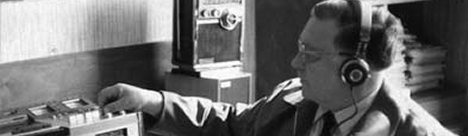
The Fortean Times has published an online article about EVP, or electronic voice phenomena, the experience of hearing ‘voices’ in the background of sound recordings.

The author of the piece has experienced EVP and believes the sounds to be spirits of the dead trying to communicate through the static.

Whether you believe this explanation (or think that EVP is more likely due to apophenia) the article remains a fascinating description of the history of the phenomena, most associated with parapsychologist Konstantin Raudive.

Link to article ‘Distant voices’.
Link to wikipedia entry on EVP.