Do americans have a propensity for hypomania?

firework_dark_background.jpgThe New York Times has a short piece on Peter Whybrow’s and John Gartner’s theory that Americans have a greater genetic propensity for hypomania, the elevated mood state sometimes found in bipolar disorder.

This, they suggest, explains aspects of American culture such as focus on energetic enthusiasm and respect for new ideas.

Interestingly, recent genetic evidence is now pointing to the fact that genes likely to be present in people diagnosed with schizophrenia overlap with those found in people diagnosed with bipolar disorder, suggesting that these may not be distinct disorders, but exist on a continuum.

If Whybrow and Gartner are right, therefore, might Americans be more likely to show traits of psychosis and schizotypy as well?

This may not necessarily be a bad thing, as high levels of these traits have been linked to greater mathematical ability and creativity.

Link to article ‘The Hypomanic American’.

Clinical neuropsychology takes to the stage

OnEgo_Image.jpgNeuropsychologist Paul Broks’ exploration of how brain injury affects selfhood, Into The Silent Land, has been made into a play that is currently showing in the Soho Theatre in London’s West End.

The production is entitled On Ego and asks the question:

“What are we? Skin, bone and a hundred billion brain cells? Or is there something more? How does the conscious “you” clamber from the numb darkness of the brain box out into a world of people and places, pleasure and pain, love and loss?”

Interestingly, this isn’t the first time that a book of case studies of brain injured patients has been turned into a theatre production, as Oliver Sack’s The Man Who Mistook His Wife for a Hat was turned into an opera.

On Ego finishes on the 7th January.

Link to information on play.
<a href="http://observer.guardian.co.uk/review/story/0,6903,1657096,00.html
“>Link to Observer article about On Ego
Link to American Scientist interview with Broks.

What lurks inside the teenage brain?

BlameMyBrain.jpgAuthor Nicola Morgan has written a book on neuroscience for teenagers, that explains why teenage experience and behaviour seems so intensely different during adolescence.

The book, Blame My Brain, manages to accurately present scientific research, without presenting any ‘just so’ stories. Various theories and approaches are given where a strong conclusion is not widely accepted.

It also manages to explain neuroscience in a straightforward yet engaging way:

For a long time, people have assumed that this inability to get out of bed is just teenagers being lazy. We have blamed it on the fact that they choose to stay up too late and therefore can’t get up in the morning. But new research shows that laziness and deliberately late nights are not entirely to blame.

When the body clock switches off, it tells our bodies to start feeling sleepy, and the brain produces a hormone called melatonin. This chemical prepares our brains to be sleepy. Tests have shown that in adolescence, melatonin is produced much later in the evening than in younger children. About the same as adults in fact. This is why you don’t often feel sleepy until late in the evening.

It also includes plenty of tests and demonstrations that the reader can try out on themselves or their friends and family!

Link to details of Blame My Brain: The amazing teenage brain revealed.

NewSci online brain channel

brain_diagram_image.jpgI’m not sure whether this is a new section to the website, or whether I’ve been asleep since it started, but I’ve just discovered the New Scientist brain channel that collects all their brain-related stories and articles in one place.

It includes an archive of their news stories, feature articles and additional web only neuroscience resources. There’s even a spiffy interactive map of the brain for those needing a brief guide to the space between the ears.

Free access as well as protected content is included, so non-subscribers can pick out the wheat from the chaff.

Link to New Scientist brain channel.

2005-12-09 Spike activity

Quick links from the past week in mind and brain news:

spike.jpg

Best Visual Illusion of the Year Contest launched!

Arguments between couples slow wound healing (presumably suffered during previous arguments).

Mirror neurons work differently in people with autism.

Colour blindness may have hidden advantages (the ability to better discriminate shades of khaki!)

Cycle helmet shaped like a brain (via BoingBoing)

Large head size linked to later development of brain cancer.

Interview with procrastination researcher and his classification of different procrastination types (‘habitual lollygagger’ anyone?).

Cognitive Daily tackles ‘Internet addiction: Anatomy of a problem‘.

Photographer Chris Combs presents a series of photos entitled ‘Inside the Spectrum, focusing on autism (via MeFi).

Rumi on science and madness

Mawlana_rumi.jpgAn untitled poem on transformation, science and insanity by the 13th century Persian poet Jalal al-Din Muhammad Rumi:

I have lived on the lip
of insanity, wanting to know reasons,
knocking on a door. It opens.
I’ve been knocking on the inside!

Real value comes with madness
matzub below, scientist above.

Whoever finds love
beneath hurt and grief

disappears into emptiness
with a thousand new disguises.

Apparently, matzub is the name for people who become ecstatic with holy enlightenment. From Rumi: Selected Poems (p281, ISBN 0140449531).

Link to wikipedia article on Rumi.

Do gay parents have happy children?

lesbian_parents.jpgThe American Psychological Association’s flagship publication Monitor on Psychology summarises the research on gay parents and finds their children are generally healthy, happy and well adjusted, despite occasional homophobic teasing.

Patterson‘s and others’ findings that good parenting, not a parent’s sexual orientation, leads to mentally healthy children may not surprise many psychologists. What may be more surprising is the finding that children of same-sex couples seem to be thriving, though they live in a world that is often unaccepting of their parents.

In fact, an as-yet-unpublished study by Nanette Gartrell, MD, found that by age 10, about half of children with lesbian mothers have been targeted for homophobic teasing by their peers. Those children tended to report more psychological distress than those untouched by homophobia.

But as a group, the children of lesbian moms are just as well-adjusted as children from more traditional families, according to the data from Gartrell’s National Longitudinal Lesbian Family Study.

Link to article in APA monitor.
Link to Patterson’s full report “Lesbian and Gay Parenting” from the APA.

Almost human

female_android.jpgThe International Robot Exhibition concluded recently in Japan, where the world’s robot manufacturers displayed their most advanced and, in some cases, human-like creations.

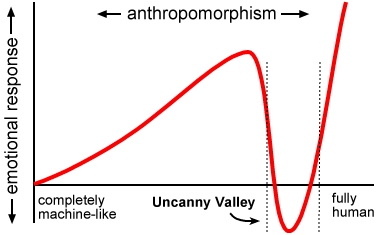
The emotional response to robots was discussed by roboticist Masahiro Mori in 1970, who created the theory of the Uncanny Valley.

He argued that that as a robot is made more humanlike in its appearance and motion, the emotional response of humans will become increasingly positive and empathic.

This is until a point at which the response suddenly becomes strongly repulsive, owing to the uncanny ‘not quite human’ aspect of the robot’s behaviour. This is the point known as the Uncanny Valley (see graph as pop-up).

However, as the appearance and motion are made to be indistinguishable to that of human being, the emotional response becomes positive once more and approaches human-to-human empathy levels.

Mori’s theory is controversial, with some researchers rejecting it out of hand. Nevertheless, it seems intuitively plausible, and still influences robot design and engineering.

Link to excellent Wikipedia article on the ‘Uncanny Valley’.
Link to 2005 International Robot Exhibition.
Link to Coriolinus’ photos of the exhibition (via BoingBoing).

New look ‘Science and Consciousness Review’

scr_image.jpgA long running web journal, the Science and Consciousness Review, has relaunched with a new look and growing content.

The journal is run by three academic scientists who want to open up consciousness research and discussion to the internet. The journal contains book reviews, summaries of new papers and internet resources.

One of the most interesting recent posts is about the increasingly comprehensive Consciousness Studies Wikibook, which is a becoming a dynamic textbook on consciousness science.

Link to Science and Consciousness Review.
Link to Consciousness Studies Wikibook.

Psychology, the soul and the immaterial

SoulMadeFlesh.jpgCarl Zimmer considers the tension between biological and psychological explanations of the mind (and, perhaps, the soul) in the conclusion to his history of early brain science Soul Made Flesh (ISBN 0099441659, p296):

Our souls are material and yet immaterial: a product of chemistry but also a pulsating network of information – a network that reaches beyond the individual brain to other brains, linked by words, glances, gestures, and other equally immaterial signals, which can leave a mark as indelible on a scan as a stroke or a swig of barium, and yet never become merely physical themselves.

Link to excerpt from Soul Made Flesh.

Study probes coffee’s effect on the brain

coffee_cup.jpgNew Scientist reports on a recent study that examines the effect of coffee on the brain. The good news is that it seems to do the frontal lobes, and the executive system, the world of good.

“The group all showed activation of the working memory part of the brain,” Koppelst√§tter explains. “But those who received caffeine had significantly greater activation in parts of the prefrontal lobe, known as the anterior cingulate and the anterior cingulate gyrus. These areas are involved in ‘executive memory’, attention, concentration, planning and monitoring.”

Just don’t mention the withdrawal headaches…

Link to article ‘Coffee’s effects revealed in brain scans’.

2005-12-02 Spike activity

Quick links from the past week in mind and brain news:

spike.jpg

The New York Times disusses the trials discusses the psychology of child prodigies.

A study finds that the chemical high from new romantic love fades after a year.

Blog ‘The Huge Entity’ presents some choice Shakespearean quotes on psychological themes.

Computer scientists create a model of ‘surprise

The more creative / schizotypal a person is, the more sexual partners they are likely to have (or, perhaps, report?)

New theory links Alzheimer’s disease to diabetes.

Wired report on the Dalai Lama’s recent meetings with neuroscientsts studying meditation

The New York Times discusses the debates over internet addiction and newly offered treatments (via Slashdot).

A new blog highlights the latests in neuroimaging and brain scanning research. Enter Brainscan.

I can’t get no sleep…

bw_insomnia.jpgPoor sleep is the common result of stress or illness, but sleep researchers are increasingly coming to believe that insomnia itself is a separate disorder. Science News discusses the science of insomnia, and new developments in the neuroscience of ‘sleeping pills’.

One problem with previous types of sleeping pill (particularly the benzodiazepines) is that they become quickly addictive and so are indicated for short-term use only. The holy grail of sleep medication research is to find a compound which is non-addictive and not ‘fun’ enough to be abused.

Science News reviews various compounds that are new or currently in development, and their aim to safely mimic earlier medications, or hormones in the body that promote sleep.

For people who are having trouble sleeping, however, there are simple techniques which can significantly improve sleep time and quality.

The Sleep Disorders Center at the University of Maryland Medical Center has some online advice to help people manage their sleeping environment and habits to get the maximum benefit out of sleep.

Link to Science News article ‘Staring into the dark’.
Link to ‘Helpful Hints to Help You Sleep’.

Dijkstra on thinking machines

The great computer scientist Edsger Dijkstra on artificial intelligence and thinking machines:

John von Neumann speculated about computers and the human brain in analogies sufficiently wild to be worthy of a medieval thinker and Alan M. Turing thought about criteria to settle the question of whether Machines Can Think, a question of which we now know that it is about as relevant as the question of whether Submarines Can Swim.”

Link to ‘The threats to computing science’ by Edsger Dijkstra.

Vibrators shrink self-perceived waistline

Ehrsson_diagram.jpgIf using vibrators to shrink your waistline makes you think of spam email, you may be surprised to find out it’s the basis of a fascinating neuroscience experiment published in open-access science journal PLoS Biology.

The study relies on an unusual effect called the Pinocchio illusion, which occurs when a vibrating sensation is applied to the outside muscle on one of the body’s joints. This causes a feeling of the joint closing, when in fact it remains in the same position.

This feeling of movement can conflict with other bodily sensations, and can produce the unusual feeling that body parts are becoming warped or elongated, just like Pinocchio’s nose.

In Ehrsson’s experiment, they applied a vibrating sensation (the blue boxes in the diagram) to the back of each wrist, which gave the false impression that the hands were moving in towards the legs.

While this was happening, Ehrsson and his team brain-scanned the participants to detect active brain areas, and compared conditions where participants were touching vs not touching their legs; and where the vibration was applied to the joint muscles vs another area on the hands.

Crucially, only in the condition when the participant’s hands were touching their legs and the wrist joint muscles were being vibrated, did it feel as if their waste was shrinking to accommodate the illusory movement.

The team found that the strength of the illusion was associated with activity in areas of the left parietal lobe, which are known to be involved in creating the sensation of body shape, also called ‘body image’.

The study suggests that the brain generates body image by making a best guess from the incoming tactile information.

In other words, because the wrist jounts were providing ‘false’ information – indicating that the hands were moving through space occupied by the legs – the brain simply ‘guessed’ that the waist must be smaller to make sense of the discrepancy.

If you want to try this effect at home, a couple of vibrating sex toys are probably your best bet. If you don’t have any, now’s your chance to freak out your local sex shop by asking them to recommend the best dildo for cognitive neuroscience experiments.

Link to study summary.
Link to full text paper.
Link to write-up from nature.com
Link to write-up from BBC News.

Newsweek on society, neuroscience and anorexia

white_scales.jpgThe cover story in December 5th’s Newsweek is available online and tackles the science and treatment of anorexia, focusing particularly on why it seems to be increasingly prevalent in children as young as eight.

At a National Institute of Mental Health conference last spring, anorexia’s youngest victims were a small part of the official agenda‚Äîbut they were the only thing anyone talked about in the hallways, says David S. Rosen, a clinical faculty member at the University of Michigan and an eating-disorder specialist. Seven years ago “the idea of seeing a 9- or 10-year-old anorexic would have been shocking and prompted frantic calls to my colleagues. Now we’re seeing kids this age all the time,” Rosen says. There’s no single explanation for the declining age of onset, although greater awareness on the part of parents certainly plays a role. Whatever the reason, these littlest patients, combined with new scientific research on the causes of anorexia, are pushing the clinical community‚Äîand families, and victims‚Äîto come up with new ways of thinking about and treating this devastating disease.

Unfortunately, the article has a somewhat oversimplified account of psychiatrist Walter Kaye’s recent research review and hypothesis about anorexia: that starvation might be a response to a disturbed serotonin system, particularly to high levels at areas in the brain with the serotonin 5HT1A receptor – a system particularly linked to anxiety and obsessiveness.

Starvation might be a response to these effects, as it is known to lower trytophan and steroid hormone metabolism, which, in turn, might reduce serotonin levels at these critical sites and, hence, ward off anxiety.

Importantly, the effects on serotonin levels are often restricted to certain brain areas. Furthermore, studies on a different type of serotonin receptor, the 5HT2A, actually suggest a decrease in serotonin activity at this type of receptor.

Kaye also suggests that disturbance to the serotonin system may arise owing to a combination of genetics, puberty-related hormone changes, stress and cultural pressures – not just a “brain disease”, as one psychiatrist is quoted as saying.

The article does, however, report moving accounts of individuals and families affected by the condition, and contains links to a podcast, including interviews with clinicians and researchers.

Link to article ‘Fighting Anorexia: No One to Blame’ (via PCSD&A).
Link to abstract of Kaye and colleagues article on serotonin and anorexia.