Hack #104: Change the length of your arms!

Here’s a fantastic party-trick, if it works as reported in the Journal of Vision – make your arms feel like they are different lengths using a simple cut out piece of card.

Now, we talked about perception of depth in the book (Hack #22) and about how the senses interact (Chapter 5). One common theme was how visual information often tended influence our perception of information in the other modalities (at least for spatially organisation information, see Hack #53). What Nicola Bruno from the University of Trieste, and colleagues, seem to have found is an instance where a classic illusion of visual depth can distort your perception of your own body.

Ames’ trapaziodal window works by virtue of the assumption that things which appear larger are often just closer by. The Window (see a demo here) is a trapazoid, so that it gives the same appearence as a square with one side further away than the other. Like this:
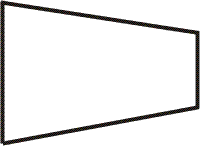
trapazoid.gif

Just like this the retinal-image is ambiguous between a trapazoid viewed flat on, and a square viewed with one side closer than the other. Normally you can use other information, like comparing the image between your two eyes, to deduce the correct perception of depth, but if you close one eye your brain has to fall back on just the ambiguous image information. And it seems your brain thinks squares are more likely and will deliver to your consciousness the perception of a slanted object, rather than a correct, flat-on, impression.

What Bruno et al did was have participants hold versions of the trapazoidal window illusion and judge the level of slant. Not only did they systemmatically mis-judge the slant of the object (despite getting clear information on how far away both sides were via the proprioception of their hands), but some participants reported ‘a stiking prioprioceptive distortion’ – namely that one hand appeared to be further away than the other, or one arm appeared longer than the other!

Unfortunately the research is only reported in abstract form (here) so I can’t get any more details of how exactly they built the illusionary trapazoid, but you can bet that I’ll be trying it out in the next few days. I suspect that, like the body schema illusions (Hack #64), this effect will work strongly on only a few people, so I’ll have to try it on a bunch of people before getting anything. I’ll let you know the results of my experiments, and I’d love to hear from anyone else who trys it.

The Mind-Body Problem – Who Cares?

Guy Claxton said this a few years ago in the Journal of Consciousness Studies:

Any discussion of the causal status of conscious experience has to start, therefore, with the recognition that what appears to be a dispassionate enquiry is actually a question of life and death importance to which there is only one permissible answer.

The preceeding context is given below the fold…

Continue reading “The Mind-Body Problem – Who Cares?”

How to read a paper

Via Ben ‘Bad Science‘ Goldacre (here) comes this hot tip: Trisha Greenhalgh’s How to read a paper. Although it focusses on medical research, many of the principles apply to all scientific papers. Although it’s great when science can be expressed in everyday language, the ability to go direct to the original research, as reported by the researcher themselves, is an invaluable skill (and one hopefully this link, and the Mind Hacks book, can give you some handles on).

Tajne uma (Croatian Mind Hacks)

tajne_uma.jpgThe Croatian translation of Mind Hacks has just been published. The full title is “Tajne uma. 100 hakerskih trikova na≈°eg mozga” and you can see it / buy it here. Kudos to the translator, Ognjen Strpic, who i discovered is not only fluent in English and Croatian, but also in Neuroscience too (Ognjen picked up on a small error I’d made in the text on the physical colour of part of the visual cortex).

Voting causes happiness? Really?

I love the New Economics Foundation and I think they do great work, but at first glance this report on Britain’s democractic deficit looks like it makes the classic correlation-is-not-causation blunder:

‘There is significant evidence that the democratic deficit at the heart of the British electoral system is making us unhappy. The 2001 post election survey shows that there is a strong link between levels of personal well-being, the health of communities and voting behaviour. People who voted in the election tended to be more trusting, have higher levels of civic duty, were more engaged in their local communities and were happier than people who didn‚Äôt vote.’

More here

Stingy Materialism

Geoffrey Miller, in an essay on the future of neuroscience, has this to say about the relationship of mind to brain:

Too many of us have become Stingy Materialists. A Stingy Materialist takes the view that subjective experiences may not be real if they have not yet been associated with particular brain areas, neurotransmitters, or genes. They suppose that if we have found the brain area for pain, then pain is a real emotion; but if we haven’t yet found the brain area for sexual jealousy or existential dread, they are probably not real emotions. Likewise, if we have found neurotransmitter deficits in schizophrenia, then it is a real disorder; but if we have not found such deficits in irritability, then perhaps it is not a real disorder.

Stingy Materialists lack confidence in their doctrine and in their consciousness, with the result that they fetishize neuroscience, and seek its approval for all things subjective. Since neuroscience is still in its infancy, this results in an infantile view of human nature, in which people are portrayed with crude outlines and primary colors, like stereotypes from a Jerry Bruckheimer action film.

Read the rest:
Miller, G. F. (2002). The science of subtlety. In J. Brockman (Ed.), The next fifty years, pp. 85-92. New York: Vintage. Link (MS Word doc, sorry)

SfN 2005

The world’s biggest scientific meeting, the Society for Neuroscience annual meeting, happens next week in Washington DC. They’ll be over 30,000 researchers and clinicians there, as well as the Dalai Lama talking about neuroscience and meditation, 17,000 presentations and a variety of side scientific meetings and social events (i’m intrigued by the Hippocampus open mike event, an evening for researchers interested in the hippocampus organised around the format of a poetry slam).

Anyway, from tomorrow I’ll be in Washington – I’m going early for the computational cognitive neuroscience conference. I’ll be there until the 16th, so if anyone has any recommendations for things to do, or if any readers fancy meeting up (maybe we could go to the hippocampus social?), let me know. tom [at] mindhacks [dot] com

Bad science on autism vaccine link

The Guardian’s Bad Science column, written by doctor Ben Goldacre, is an excellent resource for anyone who wants scientific straight talk on fashionable nonsense, and often references core ideas of the philosophy of science (which is a neat trick to pull off in a few hundred words in a newspaper column). This week Ben fires off both barrels at the Daily Mail columnist Melanie Philips for utterly misunderstanding the implications of a systematic review of studies investigating a link between the MMR vaccine and autism (there most probably isn’t one). Philips takes criticsms of existing research showing no connection between MMR and autism to jump to the opposite conclusion, supported by flimsy evidence for there being a link(Creationist watchers, does this bad science syllogism feel familiar?). Ben’s recommendation is strong, but justified:

Either learn how to interpret data yourself, or trust those who can do it for you

Details in the full article

Deafhearing

In blindsight you lose the conscious experience of vision due to loss of the visual cortex, but you retain the ability to respond to visual information (due to intact subcortical visual processing). You don’t think you can see, you have no experience of ‘seeing’, but you can make rudimentary visually guided behaviours. I’ve been told that the experience is a lot like being able to make guesses which feel completely uninformed but are startlingly accurate.

Parallel to visual processing, auditory processing is also done subcortically and cortically (replace ‘visual cortex’ with ‘auditory cortex’, replace ‘superiour colliculus’ with ‘inferior colliculus’). I’m sure the correspondence isn’t exact, but how’s this for a prediction: deafhearing – following loss of auditory cortex the conscious experience of sound would be lost, but the ability to make responses based on noises would be retained due to intact subcortical auditory processing.

I haven’t trawled the annals of neuropsychology to see if this condition has ever been documented – and I‚Äôm not going to just yet since I prefer to sit here and speculate! – but I think it is strong possibility.

(interesting tangent: the link above, and here, draws out the parallel between blindsight and normal ‘intuition’ where we are required to make choices before all the (sensory) evidence is in)

Giant Squid – woah!

giantsquid.jpg

The giant squid has the largest eye in the natural world. Although squid’s eyes evolved on a separate branch of the tangle bank of life, they are remarkably like ours, except that they don’t have the blind spot that human eyes have (Hack #16). This picture is from a book ‘Extreme Nature’ by Mark Carwardine (which the Guardian Weekend ran a piece on two weeks ago). This immature female is 17 foot long, but they go up to 49 foot apparently.

Photo from from here, some more on Giant Squid here

An Intelligently Designed Brain

A letter in the Economist (27th of August) on Intelligent Design:

SIR ‚Äì The human brain has 100 billion extremely complex neurons connected by 1,000 trillion synapses. It is mathematically impossible for anything this unimaginably complex to have been the product of an unguided evolution, even over limitless aeons. One doesn’t have to know the rules of mathematical probability to recognise this. The brain could only have been created by a limitless intelligence, call it what you may.

Aside from the fact that the letter writer is out by a factor of ten on the number of neurons in the brain (there are 1,000 billion neurons, with an average of 1,000 synapses) he is also advancing a fallacious argument. The human brain may be tremendously complex, but it isn’t a complexity designed by God. You start your life with exactly one cell, and it’s not even a brain cell. In the womb this cell turns into the 1,000 billion cells of the brain and all the other body cells besides, all without the intervention of God at any stage. The complexity of the brain, a staggering complexity which develops under the guidence of natural laws, is actually an argument against ‘Intelligent Design’, not for it.

Hack #103: See more with your eyes closed

A reader writes (thanks nick!)

Not gonna impress any girls with this one, but… I was looking at my mother’s ceiling fan the other day trying to determine how many blades it had. It was on its highest setting so it was nearly impossible to do. Until I blinked. If you blink rapidly, it disrupts the brains attempts at connecting frames of sight into continuous motion. Thus a whirling blur becomes a clear frame of sight, easily analyzed. Not sure where else this little trick could pay off. A nice illustration of the characteristics of our visual systems though.

Cool. Freed from the constraint having to make sense of continous input, your visual system can to make sense of the single ‘frame’ of input it does have. An example of less is more? I noticed something similar when riding my bike. When I glance down at the front wheel, it appears blurred. But when I look back at the road, my visual system delivers me a snapshot of the wheel, unblurred. What is happening – I’m guessing – is that as I move from looking at the wheel to the road ahead there is a moment of saccadic suppression [Hack #17] when visual input is cut off. Into this gap the ‘frame’ of the wheel is resolved. Also lending a hand may be a neural mechanism which turns off saccadic suppression if the velocity of the eyes matches that of a moving object (with your eyes stationary a moving object is blurred, with your eyes moving a stationary object is blurred, but if your eyes move at the same speed as an object you can get a clear image). For this to work the object needs to be nicely textured, so your low-level visual apparatus can gauge its velocity. Which explains why i get the effect on my mountain bike, which has big treads on the tyres, but not on a road bike, which has smooth tyres.

changing diet might allow you to see infrared

Thanks to Eric Lundquis for typing this up and putting it on the internet. It’s an experiment done by the army and cited by Rubin, M. L., and Walls, G. L. (1969). Fundamentals of visual science. Springfield, Ill.: Thomas, p. 546, which is in turn cited Sekuler, R., and Blake, R. (1994). Perception (3rd ed.). Springfield, Ill.: Thomas, pp. 62-63:

The following story dramatizes how photopigments determine what one can see. During World War II, the United States Navy wanted its sailors to be able to see infrared signal lights that would be invisible to the enemy. Normally, it is impossible to see infrared radiation because, as pointed out earlier, the wavelengths are too long for human photopigments. In order for humans to see infrared, the spectral sensitivity of some human photopigment would have to be changed. Vision scientists knew that retinal, the derivative of vitamin A, was part of every photopigment molecule and that various forms of vitamin A existed. If the retina could be encouraged to use some alternative form of vitamin A in its manufacture of photopigments, the spectral sensitivity of those photopigments would be abnormal, perhaps extending into infrared radiation. Human volunteers were fed diets rich in an alternative form of vitamin A but deficient in the usual form. Over several months, the volunteers’ vision changed, giving them greater sensitivity to light of longer wavelengths. Though the experiment seemed to be working, it was aborted. The development of the “snooperscope,” an electronic device for seeing infrared radiation, made continuation of the experiment unnecessary (Rubin and Walls, 1969). Still, the experiment demonstrates that photopigments select what one can see; changing those photopigments would change one’s vision.

Psychology’s top 10 misguided ideas

Here’s one we can all join in on. Psychology Today magazine has a column from earlier this year on The Loose Screw Awards which gives out (notional) prizes for ‘psychology’s top 10 misguided ideas’. This includes “The P.T. Barnum Medal for Mass-Market Potential” (which goes to the Mozart effect), “The Idea That Launched a Thousand Suits” (recovered memories) and “Most Bureaucratic” which goes to the idea that terminally ill people go through five distinct stages of dying (denial, anger, bargaining, depression and acceptance) and that any deviation from this strict pattern is detrimental to the patient. It has been claimed that the theory was based on interviews with patients who hadn’t been told that they were terminally ill. Which would explain their anger and denial – they were being lied to by the very people who were supposed to be looking after them!

Fun as the list in the article is, I can’t help feeling that there are a few ideas that missed out on prizes, or at least on honourable mentions. What about a “Scientific Gold-Rush Prize” (Neuroimaging?). Or a “Delusions of Grandeur Trophy” (Evolutionary Psychology? Psychoanalysis? Could be a close race…). Maybe the “Restating the Obvious in Esoteric Jargon Medal” (we’d probably need a gold, silver and bronze for this one).

A few years ago a poll of 200 psychiatrists produced a similar list of bad ideas in mental health. The Independent ran an article on it (‘Ten Things That Drive Psychiatrists To Distraction’) and there’s quite a few items (psychosurgery, electroshock therapy) that I’d put in my top ten. All in all, a sharp reminder of the sad history of ideas in psychology. Anyone got any other nominations?

Cafe Bar Scientifique in Cardiff, 9 July

Myself and Alex will be helping out at a Cafe Scientifique-type event in Cardiff tomorrow evening (Saturday the 9th), as part of the Cardiff Festival of Science.

The gig is at The Social, upstairs, from 6pm. There’ll be a discussion of material from the BBC’s ‘The Human Mind’ show (which overlaps quite a lot with some of the contents of Mind Hacks) and then a free-form Q & A session. It sounds like it’s going to be lots of fun, so if you have any questions or answers about the mind, brain or Mind Hacks, and can make it, it would be great to see you there.