Sci vs Spy

The Cold War espionage styles of the US and Soviet spy agencies are compared in a fantastic article for the history of science journal Isis that notes that while the Americans tended to invest in technology, the Russians were more focused on ‘human intelligence’.

The article, by historian Kristie Macrakis, explores the technophilia of the CIA in contrast to the KGB’s emphasis on getting spies on the ground and how these contrasting styles played out in many (now infamous) incidents.

Soviet and East Bloc spies were better at their craft—recruiting and planting agents at key institutions, acquiring secret information, and especially developing the fine art of double agents. In fact, the East Bloc’s great success in using double agents turned into the CIA’s most appalling blunder. At the end of the Cold War, the CIA discovered that all of its East German and Cuban agents were, in fact, double agents working at the behest of East German or Cuban foreign intelligence.

As former CIA chief historian Benjamin B. Fischer writes, this rendered “the CIA deaf, dumb and blind” in East Germany. Further, “the East Germans, as well as the Soviets, ran circles around SE [the CIA’s Soviet‐Eastern European Division], neutralizing its operations and tying it up in knots with double agents who fed it disinformation.” The double agent fiasco occurred, in part, because of U.S. intelligence’s dependence on technological espionage and its lack of skill in human intelligence. In a sense, the East Bloc won the spy wars but lost the Cold War.


Link to full text of article.
Link to DOI entry.

The book of reality distortions

I’m happy to announce that I’ve just finalised an agreement with Penguin to write a book on what hallucinations tell us about the mind, brain and human nature. From the proposal:

The mind and brain can generate fantastical visions and disembodied voices, illusory people and shifting landscapes, internal symphonies and sensed presences. These states happen at the extremes of human experience, in madness, terror and brain disturbance, but they are often an exaggeration of our natural tendency to hallucinate that we rely on for everyday perception – a tendency that has inspired great works of art and shaped history.

We all hallucinate, and our perception relies on it. We have blind spots in our vision that our brain fills with hallucinated experience. Occasionally we experience intense and vivid hallucinations, after taking certain drugs, during mental illness, with epilepsy or brain injury, during hypnosis, after being taken hostage, during deep-sea dives, while blacking out at high Gs, or at other extremes of human experience that tax the body and mind. But it is not just these situations that trigger hallucinations: one in ten healthy adjusted people hallucinate more than patients in hospital with psychosis. In other words, hallucinations are part of human nature.

The book explores different types of hallucinations and their historical and cultural significance, and explains how they arise and what they tell us about normal psychology and neuroscience. This is the central theme of the book: that hallucinations are not just mental junk; rather, they are windows into the workings of the mind and brain that can reveal the essence of our inner lives.

It won’t be out until 2012, but I’ll make sure Mind Hacks readers get to preview the adventure as it gets written.

Also, if you know of any fascinating research or interesting types of hallucinations – please let me know by posting in the comments or getting in touch.

I’m always pleased to receive tip offs and, as well of doing plenty of scientific investigation, I’m also planning to visit many interesting people and places.

The pleasure is all mine

Monitor on Psychology has a brief but interesting interview with psychologist Paul Bloom who has just written a book on the counter-intuitive psychology of pleasure.

Pleasure, it would seem, is a byproduct of essentialism, Bloom says. The value we assign consumer products is largely based on something deeper than just the way they look or fit or feel. We consider their potentials as status symbols, their individual histories, how much we assume other people think they are worth and so on — and from these hidden properties, we derive pleasure…

What’s surprised you the most about your studies of pleasure?

My research started off looking at artwork and the case of everyday celebrity objects. I argued that your beliefs about how something came into being and who it was in contact with affects your experience of it. At some level, it’s not so surprising. If you ask people, “What would you rather have, a Chagall or a copy of a Chagall?” people say the original. But working out the details of why this is struck me as really interesting. What really surprised me was that even for pleasures that seem incredibly simple and primitive — like the taste of meat or sexual arousal — that these are also affected by essentialist beliefs.


Link to interview with Paul Bloom on pleasure.

Dreams of a consciousness measuring device

The New York Times has an excellent article about Giulio Tononi, one of the few neuroscientists trying to understand consciousness in a way that may have a direct practical application – to create a medical device that can tell whether you are conscious or not.

To be honest, I’ve been a bit bored with consciousness, not in an existential sense you understand, but in terms of the science which tends towards tinkering with interesting but possibly inconsequential effects.

The NYT article, however, is completely riveting, as it discusses Tononi’s quest to understand consciousness to the point of building a ‘consciousness meter’.

Although it may sounds fanciful, it could have an important medical application – to help anaesthetists determine when a patient is actually aware of what’s happening to them.

If you’re not familiar with surgery you’d think this was easy enough to determine except for the fact that muscle relaxant drugs are often administered.

This means that even if you’re awake, you can’t communicate the fact, occasionally leading to terrifying cases of people who are conscious but paralysed while operated on.

So ideally, anaesthetists would like a machine that gives a consciousness ‘read out’ from the brain. There is something called the bispectral index, which claims to measure depth of anesthesia, although it turns out not to be a very good guide to consciousness.

Of course, to create a device to measure consciousness, we need to understand its neuroscience, and Tononi has a unique theory he is working on:

Consciousness, Dr. Tononi says, is nothing more than integrated information. Information theorists measure the amount of information in a computer file or a cellphone call in bits, and Dr. Tononi argues that we could, in theory, measure consciousness in bits as well. When we are wide awake, our consciousness contains more bits than when we are asleep.

For the past decade, Dr. Tononi and his colleagues have been expanding traditional information theory in order to analyze integrated information. It is possible, they have shown, to calculate how much integrated information there is in a network. Dr. Tononi has dubbed this quantity phi, and he has studied it in simple networks made up of just a few interconnected parts. How the parts of a network are wired together has a big effect on phi. If a network is made up of isolated parts, phi is low, because the parts cannot share information…

Dr. Tononi argues that his Integrated Information Theory sidesteps a lot of the problems that previous models of consciousness have faced. It neatly explains, for example, why epileptic seizures cause unconsciousness. A seizure forces many neurons to turn on and off together. Their synchrony reduces the number of possible states the brain can be in, lowering its phi.

The NYT piece is a fantastic look into the ideas behind the theory and the exciting possibilities it presents.
 

Link to NYT on ‘Sizing Up Consciousness by Its Bits’.

It’s not a date, it’s an experiment in the lab of love

There’s a fantastic discussion on the science of dating over at Dr Petra that tackles how effective the techniques used by ‘scientific matching’ companies really are, and whether common dating advice is actually any good.

Petra recently ran a ‘Science of Pulling’ event at the British Science Festival (Americans: ‘pull’ is British slang meaning ‘to gently woo’) where she covered everything from how researchers actually go about studying couples to the myths of dating advice – in light of the extensive research on relationships.

What we have learned from social research on dating is helpful – not least because it often contradicts what single people are anxious about. Westerners can expect to spend 1/3 to 1/2 of their life single or looking for a relationship (see data from here and discussed more here). The average age for heterosexual marriage (in UK) is 34 for men and 29 for women (this report also highlights how many people are single for larger parts of their life than in the past). If you try internet dating you’ve a 1:10 chance of getting a date and going out with them more than once a month. You’re also equally likely to end up in a happy long term relationship regardless of whether it started as a one night stand or emerged through a period of dating.

The piece covers everything from pick-up-artists, to finding ‘the one’, to using science to improve your gentle wooing power.
 

Link to Dr Petra on ‘The Science of Pulling’.

Memories from before nightfall

The Yale Alumni Magazine has a moving and beautifully written article that is both a tribute to a college friend who recently took his own life and a wider discussion of depression, suicide and friendship.

The writer is Andrew Solomon, perhaps best known for one of the finest books on the experience, meaning and science of depression – ‘The Noonday Demon’ – and this latest article follows in his honest and subtly powerful style.

There’s not a lot I can say that would do the piece justice except that it is warm without being sentimental and perceptive without distance. Highly recommended.
 

Link to article ‘To an Aesthete Dying Young’ (via MeFi).

New mental states for the 21st century

Writer Douglas Coupland has a playful article in the The Independent where he defines ‘new terms for new sensations’ and lists new psychological states that may be arising from 21st century life.

Coupland is known for his careful observations of how technology impacts on day-to-day living and there are many delightful entries in the list, but a few of my favourites are below:

Deselfing: Willingly diluting one’s sense of self and ego by plastering the internet with as much information as possible.

Internal Voice Blindness: The near universal inability of people to articulate the tone and personality of the voice that forms their interior monologue.

Karaokeal Amnesia: Most people don’t know all the lyrics to almost any song, particularly the ones they hold most dear. (See also Lyrical Putty)

Lyrical Putty: The lyrics one creates in one’s head in the absence of knowing a song’s real lyrics.

Zoosumnial Blurring: The notion that animals probably don’t see much difference between dreaming and being awake.


Link to ‘New terms for new sensations’ in The Indepedent.

The strange-face-in-the-mirror illusion

An intriguing article has just been published in the journal Perception about a never-before-described visual illusion where your own reflection in the mirror seems to become distorted and shifts identity.

To trigger the illusion you need to stare at your own reflection in a dimly lit room. The author, Italian psychologist Giovanni Caputo, describes his set up which seems to reliably trigger the illusion: you need a room lit only by a dim lamp (he suggests a 25W bulb) that is placed behind the sitter, while the participant stares into a large mirror placed about 40 cm in front.

The participant just has to gaze at his or her reflected face within the mirror and usually “after less than a minute, the observer began to perceive the strange-face illusion”.

The set-up was tried out on 50 people, and the effects they describe are quite striking:

At the end of a 10 min session of mirror gazing, the participant was asked to write what he or she saw in the mirror. The descriptions differed greatly across individuals and included: (a) huge deformations of one’s own face (reported by 66% of the fifty participants); (b) a parent’s face with traits changed (18%), of whom 8% were still alive and 10% were deceased; (c) an unknown person (28%); (d) an archetypal face, such as that of an old woman, a child, or a portrait of an ancestor (28%); (e) an animal face such as that of a cat, pig, or lion (18%); (f ) fantastical and monstrous beings (48%).

Caputo suggests that the dramatic effects might be caused by a combination of basic visual distortions affecting the face-specific interpretation system.

The visual system starts to adapt after we receive the same information over time (this is why you can experience visual changes by staring at anything for a long time) but we also have a system that interprets faces very easily.

This is why we can ‘see’ faces in clouds, trees, or even from just two dots and a line. The brain is always ‘looking for faces’ and it is likely that we have a specialised face detection system to allow us to recognise individuals whose faces actually only differ a small amount in statistical terms from other people’s.

According to Caputo’s suggestion, the illusion might be caused by low level fluctuations in the stability of edges, shading and outlines affecting the perceived definition of the face, which gets over-interpreted as ‘someone else’ by the face recognition system.

More mysterious, however, were the participants’ emotional reactions to the changes:

The participants reported that apparition of new faces in the mirror caused sensations of otherness when the new face appeared to be that of another, unknown person or strange `other’ looking at him/her from within or beyond the mirror. All fifty participants experienced some form of this dissociative identity effect, at least for some apparition of strange faces and often reported strong emotional responses in these instances. For example, some observers felt that the `other’ watched them with an enigmatic expression – situation that they found astonishing. Some participants saw a malign expression on the ‘other’ face and became anxious. Other participants felt that the `other’ was smiling or cheerful, and experienced positive emotions in response. The apparition of deceased parents or of archetypal portraits produced feelings of silent query. Apparition of monstrous beings produced fear or disturbance. Dynamic deformations of new faces (like pulsations or shrinking, smiling or grinding) produced an overall sense of inquietude for things out of control.

If any Mind Hacks readers try the illusion out for themselves, I’d be fascinated to hear about your experiences in the comments.
 

Link to full-text of article.
Link to PubMed entry for study.

2010-09-17 Spike activity

Quick links from the past week in mind and brain news:
There’s a fantastic discussion and video interview on America’s first prison for drug addicts, “the world’s most famous – and infamous – center for the treatment and study of drug addiction”, over at Neuroanthropology.

The Guardian has a piece by psychologist Susan Blackmore on why she’s changed her mind on the idea that religion works like a ‘meme virus’.

How political beliefs affect racial biases. Neuron Culture covers an intriguing study on how both liberals and conservatives show racial biases but in opposite directions in moral reasoning tasks.

Time has a beautiful gallery of photos depicting how different types of booze look under a microscope. Brings a whole a new meaning to the term ‘beer goggles’.

The paradoxes of pharmaco-psychiatry are discussed in excellent coverage from Neuroskeptic. If you read only one piece on mental health this week, make it this one.

The Globe and Mail discuss how popularity influences how infectious diseases spread, discussing new research showing that the cool kids get the flu first .

Why are women often chosen to lead organisations in a crisis? Fascinating counter-intuitive sex bias covered by the BPS Research Digest. Bonus dispiriting last paragraph.

Science News covers a study on how video games damage the… Sorry, my mistake, it’s another study on how action video games lead to generalisable cognitive benefits.

There’s another good piece on Evidence Based Mummy about how kids’ ability with numbers is strongly linked to how often their parents talk about numbers. I love the phrase ‘number talk’.

The New York Times publish a full-on retraction for an unrealistic story about how future Alzheimer’s could be detected with 100% accuracy. The Neuroshrink blog had called bullshit two weeks ago.

The ever-excellent forensic psychology blog In the News covers another academic attack on criminal profiling as “so vague as to be meaningless”.

Wired Science covers an interesting legal bias finding, for crimes of toxin exposure, more severe punishments are handed out for crimes with fewer victims.

I found an interesting video on YouTube where a self-identified face-taste synaesthete describes what tastes different famous faces evoke. No Shakira, but I suspect her face tastes like a choir of angels weeping gently on your tongue.

The LA Times on how endocrinologists are calling out two widely discussed conditions without a medical basis, ‘adrenal fatigue’ and ‘Wilson’s temperature fatigue’, as “internet diseases”. I suspect, without knowing what internet disease is slang for.

The Oxford English Dictionary now has a definition taken from Language Log immediately opening a recursion hole in the fabric of space and time.

University of Texas press release on a study finding that placebo improves ‘low sexual functioning’ in 1-in-3 women. “For more information, contact: Jessica Sinn”

A new study on how modern psychosurgery lifts mood in chronically depressed patients is covered by The Neurocritic.

The Sydney Morning Herald covers a study on how people who are better at introspection have structural differences in the anterior prefrontal cortex.

There’s a podcast discussion with neuroscience-inspired artist Garry Kennard over at The Beautiful Brain.

VBS.TV has a fantastic interview with Alexander Shulgin, psychedelic chemist and researcher extraordinaire.

There’s a fantastic piece on how we unintentionally ‘mirror’ other people’s speech patterns during conversation over at Sensory Superpowers.

BoingBoing interviews the Perez Hilton of Mexico’s drug war – the anonymous writer behind Blog De Narco.

There are 10 psychological insights into online dating taken from the scientific literature over at PsyBlog.

Discover Magazine has an opinion piece by tech psychologist Sherry Turkle on her vision for the near future of human society.

Can we all become delusional with hypnosis? Brief but good piece by philosopher Lisa Bortolotti on The Splintered Mind.

Seed Magazine has an intriguing piece on the psychoactive effects of food.

Perceptual and perceptive psychologist Mark Changizi guest posts on PLoS Blogs about a proposal for the ‘Red Club for Men’.

The first man with autism

The Atlantic has an amazing article about the first person ever diagnosed with autism, the now 77 year-old Donald Triplett, who plays a mean game of golf and seems to be doing just fine.

The piece tracks the history of both Triplett and our understanding of autism which has changed radically since the diagnosis was first used in the 1940s.

However, it is Triplett’s life story which really bring the article alive.

Perhaps the most remarkable aspect of Donald’s life is that he grew up to be an avid traveler. He has been to Germany, Tunisia, Hungary, Dubai, Spain, Portugal, France, Bulgaria, and Colombia—some 36 foreign countries and 28 U.S. states in all, including Egypt three times, Istanbul five times, and Hawaii 17. He’s notched one African safari, several cruises, and innumerable PGA tournaments.

It’s not wanderlust exactly. Most times, he sets six days as his maximum time away, and maintains no contact afterward with people he meets along the way. He makes it a mission to get his own snapshots of places he’s already seen in pictures, and assembles them into albums when he gets home. Then he gets to work planning his next foray, calling the airlines himself for domestic travel, and relying on a travel agent in Jackson when he’s going overseas. He is, in all likelihood, the best-traveled man in Forest, Mississippi.

This is the same man whose favorite pastimes, as a boy, were spinning objects, spinning himself, and rolling nonsense words around in his mouth.


Link to The Atlantic on ‘Autism’s First Child’.

Once and future gayness

Never one to avoid opening Pandora’s box, Bering in Mind has an excellent discussion on whether it’s possible to predict adult sexual orientation from childhood traits and behaviours.

As the article notes, there are a host of heated debates about the merits of trying to ‘predict homosexuality’ but even as a purely scientific question, it turns out to be challenging research.

For the most accurate data, prospective studies – where you see how people change over time – are ideal, but unfortunately they are difficult to implement for both social and practical reasons:

Conducting prospective studies of this sort is not terribly practical, explain Bailey and Zucker, for several reasons. First, given that only about 10 percent of the population is homosexual, a rather large number of prehomosexuals are needed to obtain a sufficient sample size of eventually gay adults, and this would require a huge oversampling of children just in case some turn out gay. Second, a longitudinal study tracking the sexuality of children into late adolescence takes a long time—around sixteen years—so the prospective approach is very slow-going. Finally, and perhaps the biggest problem with prospective homosexuality studies, not a lot of parents are likely to volunteer their children. Rightly or wrongly, this is a sensitive topic, and usually it’s only children who present significant sex-atypical behaviors—such as those with gender identity disorder—that are brought into clinics and whose cases are made available to researchers.

The article discusses the various methods researchers have used to try and uncover whether there are any childhood characteristics typical of adults who later turn out to be gay, including interviews with friends and family and analysing home videos.

While the data is, to be fair, a bit ropey, there is evidence to suggest that non-gender typical behaviour is more common, but it is unlikely that this alone is a reliable guide to future homosexuality.

Needless to say, the whole area is fraught with ethical and political debates but the Bering in Mind article is a great wide-ranging introduction to this little discussed topic.
 

Link to Bering in Mind on ‘forecasting adult sexual orientation’.

An uneven hail of bullets

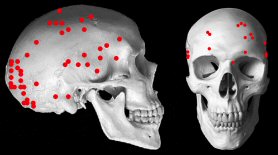
Gunshot wounds to the head are a major cause of death among soldiers in combat but little is known about where bullets are more likely to impact. A study just published in the Journal of Trauma looked at common bullet entry points among soldiers who died in combat and found clear patterns – but the researchers are not sure why.

The study, led by physician Yuval Ran, looked at Israeli combat deaths from 2000 to 2004 and tracked where bullet entries appeared on the skull (illustrated above), finding that the lower back (occipital region) and front of the temple areas (anterior-temporal regions) were most likely.

The results of our study show that in a combat setting, the occipital and anterior-temporal regions are most frequently hit, as opposed to the anterior-parietal and the posterior-temporal regions, which are rarely hit. Moreover, most of the parietal injuries were in proximity to the occipital bone. In an attempt to explain these findings, we presented them to sniper instructors, only to learn that snipers always aim to center mass, and aiming at high distances to different skull areas is not probable. At this time, we have no plausible theory to explain these findings.

Your first thought may be that the distribution is because helmets better protect certain parts of the head, but as the researchers note, helmets have been shown to be almost entirely ineffective in protecting against direct gunfire.

Getting shot in the head is not just an unfortunate event, it is the result of the interaction between the shooter and the target, and each of their behaviours could affect where bullets are more likely to land.

The researchers also note that the results are strikingly similar to the only other study looking at the location of fatal gunshot wounds to the head, despite the fact that this earlier study only included civilian shootings.

While there is no current theory as to why fatal gunshot wounds are more likely to be distributed as they are, the article suggests that this could be used to save lives in combat.

Effective helmets are not worn by soldiers because sufficient armouring would make them too heavy, but simply adding protective armour to the most common areas would make for a lighter helmet that could stop the majority of fatal bullet wounds.
 

Link to PubMed entry for study.

Touching the space between us

Slate has an excellent article on the psychology of collaborations that highlights the often underplayed role of the creative relationship and bemoans are obsession with the illusory ‘lone genius’.

The author is Joshua Wolf Shenk who you may recognise from one of the best psychology articles I’ve yet read – an Atlantic article on happiness and ageing – which we covered last year on Mind Hacks.

This new piece is part of a ongoing series that aims to pick up on our cultural neglect of the dynamic interaction between partners.

But a burgeoning field has shown that, from the very first days of life, relationships shape our experience, our character, even our biology. This research, which has flowered in the last ten years, took root in the 1970s. One reason, explains the psychologist and philosopher Alison Gopnik, was the advent of the simple video camera. It allowed researchers to easily capture and analyze the exchanges between babies and their caregivers. In video of 4-month-olds with their mothers, for example, the two mimic each other’s facial expressions and amplify them. So, a baby’s grin elicits a mother’s smile, which leads the baby to a full-on expression of joy—round mouth, big eyes. This in turn affects the mother, and so on in a continuous exchange that entwines the pair.

I also really recommend an excellent interview with Shenk over at NeuroTribes where he covers a surprising amount of ground.

Rather fittingly, the interview is all the better for the interviewer and the interviewee effortlessly bouncing ideas off each other.
 

Link to Slate piece ‘Two Is the Magic Number’.
Link to NeuroTribes interview with Shenk.

How culture can invert genetic risk

Neuron Culture has a fantastic piece on how a long touted ‘depression gene’ turned out to reduce the risk of mood problems in people in East Asians and why we can’t always understand genetic effects on behaviour without understanding culture.

The piece riffs on the long-established finding that the short variant of the serotonin transporter or 5-HTTLPR gene is more common in people with depression, until psychologist Joan Chiao found that East Asians are more than twice as likely to have the gene but only have half the rate of mood problems.

Why is this the case? Probably because 5-HTTLPR isn’t so much a gene for depression, but more likely for social sensitivity, and East Asian culture is more likely to be collectivist, where social connections matter more in your psychological make-up:

So how does individualism-v-collectivism relate to depression and depression genes? Here Chiao and Blizinsky, as well as Way and Lieberman (these connections were apparently ripe) turned to another emerging idea: That the short SERT gene seems to sensitize people not just to bad experience, but to all experience, good or bad…

This starts to explain the purported interplay of the S/S allele and a collectivist culture: If short-SERT people get more out of social support, a more supportive culture could buffer them against depression, easing any selective pressure against the gene. Meanwhile the gene’s growing prevalence would make the culture increasingly supportive, since those who carry it might be more empathetic. Studies have shown, for instance, that short-SERT people more readily recognize and react to others’ emotional states.

For those who keep an eye on such things, Neuron Culture has just become part of the newly launched Wired Science blog network which is already full of great stuff.
 

Link to Neuron Culture on ‘The Depression Map’.

Twilight novels ‘could be altering the brain’

The Twilight series of young adult novels “could be affecting the dynamic workings of the teenage brain in ways scientists don’t yet understand” according to a bizarre article from LiveScience.

To be fair, the premise of the article is quite correct, Twilight novels (along with everything) are indeed altering the brain in ways we don’t understand, because the brain changes in response to any and every experience we have – plus, we don’t have omniscient powers of all-knowing.

The report has apparently been inspired by a recent conference just held in the UK called ‘The Emergent Mind: Adolescent Literature and Culture’ which, judging by the pdf of the programme, had nothing to say about the brain.

The literature researchers quoted in the article make some vague and unhelpful generalisations about neuroscience but it’s hard to say whether they were just speculating based on the reporter’s questions.

The result, however, is an Onion-esque ‘vampire novels are changing teen brains’ article. Perhaps its only redeeming feature is that it makes an ironic scare story about books that balances out the usual scare stories about technology.

All those misinformed parents who stopped their kids using the internet and made them read novels are likely kicking themselves now. This would be funnier, of course, if it wasn’t so likely.
 

Link to fiction-inspired LiveScience article (via @stevesilberman).

The death of ‘right brain thinking’

A new study published in Psychological Bulletin has just reviewed all the neuroscience research on creative thinking and found no good evidence for the pop-culture idea that the right side of the brain is more involved in ‘creative thinking’.

Sadly, the full text isn’t available online, but the abstract of the study contains all the punchlines:

A review of EEG, ERP, and neuroimaging studies of creativity and insight.

Psychol Bull. 2010 Sep;136(5):822-48.

Dietrich A, Kanso R.

Creativity is a cornerstone of what makes us human, yet the neural mechanisms underlying creative thinking are poorly understood. A recent surge of interest into the neural underpinnings of creative behavior has produced a banquet of data that is tantalizing but, considered as a whole, deeply self-contradictory. We review the emerging literature and take stock of several long-standing theories and widely held beliefs about creativity.

A total of 72 experiments, reported in 63 articles, make up the core of the review. They broadly fall into 3 categories: divergent thinking, artistic creativity, and insight. Electroencephalographic studies of divergent thinking yield highly variegated results. Neuroimaging studies of this paradigm also indicate no reliable changes above and beyond diffuse prefrontal activation. These findings call into question the usefulness of the divergent thinking construct in the search for the neural basis of creativity.

A similarly inconclusive picture emerges for studies of artistic performance, except that this paradigm also often yields activation of motor and temporoparietal regions. Neuroelectric and imaging studies of insight are more consistent, reflecting changes in anterior cingulate cortex and prefrontal areas.

Taken together, creative thinking does not appear to critically depend on any single mental process or brain region, and it is not especially associated with right brains, defocused attention, low arousal, or alpha synchronization, as sometimes hypothesized. To make creativity tractable in the brain, it must be further subdivided into different types that can be meaningfully associated with specific neurocognitive processes.


Link to PubMed entry for studies (via @sarcastic_f).