A nasty case of misery

BBC Radio 4 has a short but excellent programme on the increasing medicalisation of human sadness which notes that even everyday talk about difficult but necessary life events is being increasingly couched in medical terms.

The writer and presenter of the piece, journalist Mary Kenny, notes, for example, how the concept of trauma is being increasingly applied to mourning, previously considered a painful but normal response to tragic circumstances. She also tackles how this tendency is being reflecting in the ongoing widening of the criteria for mental illness.

Kenny’s piece neither relies on tired simplifications of ‘evil drug companies’ nor falls back on simple explanations for mental illness and makes for a insightful short analysis of how our understanding of human distress is changing.

Unfortunately, you can only listen to a streamed version of the piece and it will disappear in four days, so catch it while you can.
 

Link to ‘Medicalising Melancholy’ on BBC Radio 4.
Link to article on BBC News website based on the programme.

Inattention to details

Neuroskeptic has excellent coverage of the recent headline-making study on the genetics of ADHD that was overly-hyped as the ‘first direct genetic link’ to the disorder and overly-slammed as a drug company ploy.

For example, BBC News has a report on the study where you can see researcher Anita Thapar making some unrealistic claims for the significance of the interesting-but-preliminary study while the science-retardant child psychologist Oliver James counters by cherry picking evidence (and not even very accurately).

Neuroskeptic does a great job of untangling the actual import of the research and discusses why the finding of copy-number variations or CNVs in about 16% of the ADHD kids compared to 7.5% of the controls is neither a ‘direct genetic link’ nor evidence against the idea that the condition is ‘socially constructed’.

However, I was particularly drawn by Thapar’s comments that discovering the genetic component “should address the issue of stigma.”

The common idea is that if we can demonstrate a particular mental disorder is a ‘brain disease’ or the result of a biological dysfunction people who have the condition will be less stigmatised due to a vague notion that their behaviour ‘is not their fault’.

Unfortunately, studies to date have shown that biological explanations for mental disorder actually increase stigma in public, patients and mental health professionals because the affected people are typically seen as more unpredictable and dangerous than when social or psychological explanations are given.

It is genuinely important that we understand the genetic influences to behavioural problems, including those that get classified as ADHD, and this new study is a small but important step toward that aim.

But we kid ourselves if we think this evidence automatically decreases stigma and we do society a disservice if we make our acceptance and compassion for people with behavioural difficulties dependent on certain types of scientific explanation.
 

Link to excellent Neuroskeptic piece on genetics and ADHD study.

Doyle’s father, Sherlock’s first portrait artist, seized

A brief piece on Charles Altamont Doyle, father of the famous Sherlock Holmes author, from an article on artists and epilepsy just published in Practical Neurology.

Probably more famous as the father of Arthur Conan, Charles Altamont Doyle (1832–1893) was said to have epilepsy for the last 10–15 years of his life. The cause on his death certificate was epilepsy of ‘many years’ standing. He was not a particularly successful artist and perhaps is best remembered for his illustrations that accompanied the Sherlock Holmes novel A Study in Scarlet (1888). Charles was another depressive, but he chose to self-medicate heavily with alcohol. It is possible that his seizures, occurring late in life, were related to his consumption of alcohol and rapid withdrawal. He was committed to the Montrose Royal Lunatic Asylum in 1881, where finding peace at last, he created some of his best work. It is said that he persevered with his art in an attempt to show that he had been wrongfully imprisoned in the institution; ironically, the recurring themes that he used to plead for his sanity were elves, fairies and other fantastical characters [above]. It is said that he died during a prolonged seizure.

Charles Altmont Doyle is best known for the picture above, named ‘A Dance Around the Moon’, although my favourite is one from the Victoria and Albert Museum in London who have a self-portrait where he is surrounded by devils, demons and a levitating woman.

Rather than looking terrified or wallowing in self-pity, he just looks fed-up.
 

Link to PubMed entry for article on epilepsy and art.
Link to Charles Altmont Doyle self-portrait at the V&A.

The murder club

I’m a bit embarrassed to say that my latest Beyond Boundaries column for The Psychologist was published last month and I managed to miss it.

It’s about how murder is one of our most social acts. Think of it as like your local community cake sale, but for killing.

Murder is not antisocial. If you want a demonstration that we are governed by society even when breaking its rules, homicide is one of the best and grimmest examples. Studies show that victim and offender tend to resemble each other to a striking degree – the young murder the young and the old murder the old, rich and poor rarely kill each other, gang bangers prey on other gang members, and you are likely to be personally acquainted with the person who later ends your life. Socially conservative it may be, but homicide remains a deeply social act.

In a remarkable 2010 study published in the American Journal of Sociology, academic Andrew Papachristos took these findings to their logical conclusion and conceptualised each murder over a three-year period in Chicago as a social interaction between groups. Surprisingly, the pattern of homicides resembled an exchange of gifts. One gang ‘presents’ a murder to another, and that group must reciprocate the ‘gift’ or risk losing their social status in the criminal underworld. From this perspective, murder is perhaps the purest of social exchanges as the individual is left in no position to reciprocate on his own.

Murder, is not, however, an equal opportunities reaper and you are considerably more likely to be dispatched if you are poor and marginalised. It was not always the case though. Historical records show that homicide was used equally by all levels of society but has become increasingly less democratic over time as access to formalised systems of dispute resolution have become more widely available. The fact that the legal system is preferentially used by those with money is perhaps not surprising, although the fact the distribution of justice is unjust should give us pause for thought.

Nowhere is this contrast more striking than in Latin America. Although the region has the highest murder rates in the world the generalisation tell us little – the devil is really in the detail. A 2008 study led by the Venezuelan sociologist Roberto Briceño-León found that poverty in the region predicted little of the homicide rate on its own. It was inequality that explained the trend: in areas where wealth and extreme poverty coexist, violence occurs more frequently.

Despite the horror, society adapts and nations with higher levels of slayings have been found to have higher acceptance of murder. If we want to prevent violence we need to understand that murder is not a stain on the fabric of society, it is one of its threads.

Thanks to Jon Sutton, editor of The Psychologist who has kindly agreed for me to publish my column on Mind Hacks as long as I include the following text:

“The Psychologist is sent free to all members of the British Psychological Society (you can join here), or you can subscribe as a non-member by emailing sarsta[at]bps.org.uk”

Taking the sponge

A curious case of a two year old infant who had a sponge-eating obsession. The report is taken from a small case series of compulsive sponge-eating in children, published in medical journal Acta Pædiatrica.

Remarkably, the child was successfully and quickly treated just by correcting low iron levels in the blood.

A general practitioner referred a 32-month-old girl with an obsession of eating sponge since the age of 7 months. The obsession for the sponge aggravated to the extent that she could rip the cushions, car seats and mattresses to get the sponge out. The child was noticed to have a strong, irresistible urge and was seen finishing a fifth of sponge from a cushion in less than half an hour. Occasionally she had been seen eating carpet fibres and tissue papers. She was otherwise a fit and medically healthy girl with a normal intelligence and behaviour. The examination including general physical and systemic resulted to be unremarkable except pallor…

The child was diagnosed to be a case of pica with IDA [iron deficiency anemia] and was kept on 4 mg/kg per day of iron. The symptoms of eating sponge disappeared fully by correcting her IDA.

The mentions of “a case of pica” refers to a psychiatric disorder where people feel compelled to eat the inedible.

We’ve discussed several unusual adults case of pica previously on Mind Hacks, including people who compulsively eat bullets, coins and roofing plates.
 

Link to PubMed entry for sponge-eating case series.

Psychotherapist to the dangerously disturbed

The Independent has a revealing article on the working life of Dr Gwen Adshead, a forensic psychiatrist and psychotherapist at Broadmoor Hospital, one of the few very high security hospital dedicated to the most dangerous psychiatric patients in the UK.

As a consultant forensic psychotherapist – a rare breed in medicine – she spends her working life in the company of men at Broadmoor whom others would dismiss with a single word – evil. Her aim is to make them safer – safe enough, ultimately, to be released from Britain’s highest security institution for mentally disordered offenders – and to achieve that they must understand the full import of the crime they have committed.

“My job is to help a man become more articulate about what he has done, about his illness and about why that might be important for his future. Even if a cure is not possible, recovery of some identity is possible. My work involves talking to them and getting them to become more self-reflective. Violence is more likely to occur when people are not thinking straight.”

Admission to Broadmoor is granted only to members of an exclusive club: the violent insane. The Yorkshire Ripper, Peter Sutcliffe, is here, convicted in 1981 of murdering 13 prostitutes; Kenneth Erskine, the Stockwell strangler who murdered seven elderly people in 1986; and London nail bomber David Copeland who targeted blacks, Bangladeshis and gays, killing three people and injuring 129, of whom four lost limbs.

The article characterises the patients Adshead works with as the ‘violent insane’ although it’s worth noting that not all will be ‘insane’ in the popular or even traditional sense of the term – that is, affected by psychosis that includes delusions and hallucinations.

Some will be ‘diagnosed’ with Dangerous and Severe Personality Disorder. I put ‘diagnosed’ in scare quotes because you may notice that no such condition is listed in either the DSM or ICD diagnostic manuals – it has been created by the UK government and on the basis of this label a patient can be locked-up indefinitely.

Unlike psychosis, personality disorder doesn’t involve any significant ‘loss of contact with reality’ (although it may be diagnosed alongside it). This is why the journalist comments that the patient he bumps into who makes “a passionate denunciation” of his detention doesn’t seem to be ‘insane’.

This is not to say he’s just a regular chap – a diagnosis of personality disorder signifies his day-to-day functioning is quite impaired because of difficulties relating to others – while the ‘dangerous and severe’ prefix is based on a still-not-very-accurate risk assessment that the person is likely to be violent in the near future.

The Broadmoor DSPD unit has now been in existence for 10 years and still lacks good evidence that it is effective in helping the patients or reducing risk. Needless to say, it is likely to remain controversial.

The Independent article is a good insight into the difficulties of working with (the very few) psychiatric patients who are dangerous, regardless of diagnosis, although do ignore the sensationalist and irrelevant headline. Apart from that, well worth a read.
 

Link to Independent on Adhead and Broadmoor.

Cultures of friendship

Neuroanthropology has an all-too-brief interview on how different cultures around the world have fundamentally different ideas about what it means to be a friend.

The interviewee is anthropologist Dan Hruschka who has just written a book summarising his research on the anthropology of friendship.

It’s a wonderfully simple idea but really challenges some of our core assumptions about social relationships:

Can you describe one of your examples that really makes us think differently about friendship?

When you look at friendship cross-culturally, there are many surprises! Consider the fact that in societies around the world, close friends will sanctify their relationships with elaborate public ceremonies not unlike American weddings or that parents or elders can arrange their children’s friendships in much the same way that marriages are arranged in many parts of the world.

I think one of the more interesting findings, and one that reveals our own American preferences and taboos, concerns the kinds of things that friends are expected to help each other with. For example, in the U.S., we often expect friends to talk through personal problems and disclose deep secrets. Indeed, U.S. researchers often impose this criterion on definitions of friendship.

However, there are many places in the world where such verbal, emotional support is only a minor concern in friendships.


Link to Neuroanthropology on ‘the book of friendship’.

Online therapy: a download off your mind

What’s it like doing psychotherapy in Second Life? New Scientist has a level-headed article that describes how personal therapeutic interactions are altered by the online world and how this may be a benefit for people with certain types of problems.

In my limited experience of Second Life, I was struck by how many people were offering commercial counselling services, many without apparent qualifications, and I’ve seen been a bit sceptical since.

The NewSci piece is by a professional counsellor and takes a critical look at the concept and its practice, relating both the experience of therapy and where its strengths and weaknesses lie, not least for people who may have social anxiety or other face-to-face difficulties.

The other major concern is the loss of body language. For people used to Second Life, this is not as much of a problem as you might think, according to Dillon. But as a therapist, I glean a great deal from seeing someone become tearful or shift in their seat.

It’s a trade-off, say avatar therapists. What you lose in body language you gain in the eloquent expression of conscious thought – at least for clients who type in their responses – as well as the loss of inhibition that comes with communicating through an avatar.

I have to say, having read so much drivel about ‘cyber therapy’ I was ready to dismiss the article but found it one of the best introductory pieces I’ve yet read that tackles online psychotherapy.
 

Link to NewSci on Avatar therapy.

Nude psychotherapy and the quest for inner peace

The first session of nude psychotherapy was held in 1967, at a nudist resort in California. It was the brainchild of radical therapist and ordained minister Paul Bindrim who made headlines around the world with events intended to enhance emotional connectedness and dismantle body-image hangups.

Despite the massive interest at the time, ‘nude psychotherapy’ would have largely disappeared from the history of psychology if it weren’t for a truly amazing article by historian Ian Nicholson, published in the Journal of the History of the Behavioral Sciences, which you can read in full as a pdf.

Nude psychotherapy grew out of the 60s encounter group movement, where people seeking personal development would meet for intense one-off group therapy sessions where emotional honesty and group amplification led to powerful personal experiences.

The popularity of these events created a demand for groups that delivered ever more striking emotional experiences with the most intense being the marathon 24 or 36 hour encounters. Bindrim took the concept one step further and created the concept of nude psychotherapy.

He was partly inspired by the founder of humanistic psychology, the famous and significantly more respectable Abraham Maslow, who had an established but purely theoretical interest in whether nudity would make people in therapy “an awful lot freer, a lot more spontaneous, less guarded”.

Bindrim talked the language of spontaneity and authenticity, but as Nicholson notes, the groups were carefully planned:

Bindrim was convinced that the “natural state” of humanity had been lost and that disrobing would peel back layers of modernist artifice and alienation and reestablish a healthy connection with one’s body and the true self. Ironically, although a self-declared enemy of the inauthentic, Bindrim sought psychological deliverance through the very artifice he decried. Far from being spontaneous returns to “nature,” his marathons were carefully orchestrated performances of psychological ingenuity and financial opportunism…

Bindrim began this process by employing familiar encounter group techniques. Participants were invited to “eyeball” each other (stare into each other’s eyes at close range) and then to respond in some physical way (hugging, wrestling, etc.). After this ice-breaker, participants disrobed in the dark to musical accompaniment before joining a small circle to perform a “meditation-like” hum. This process, Bindrim felt, gave rise to the “feeling of being all part of one human mass”

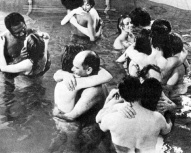
The sessions included role-playing traumatic experiences and touching exercises in a swimming pool, but perhaps most notable was an exercise called “crotch eyeballing”, designed to dispel guilt about the body, in which participants were instructed to look at each others genitals and disclose the sexual experiences they felt most guilty about while lying naked in a circle with their legs in the air.

As well as select groups of participants, Bindrim invited the press, and nude psychotherapy was featured in some of the world’s biggest publications. The Life magazine online archive has two photos from a feature on one of the events.

Psychology Today apparently featured nude therapy on its front page where a big breasted young woman was accompanied by the headline “The Quest for the Authentic Self” (which is a phrase I’ve noticed works great on almost any semi-pornographic picture, by the way).

Although the press generally took a snigger snigger approach to the proceedings, nude psychotherapy garnered a great deal of mainstream interest and headlined professional conferences and journals – even pushing Milgram’s famous ‘lost letter’ study to the back pages of American Psychologist.

It was subject to a professional ethics enquiry at one point, but because of all the nudity and free love already happening in 60s America, the committee couldn’t decide whether it violated the “the social codes and moral expectations of the community”. No serious action was taken and the attention helped raise the profile of the off-beat therapy.

Bindrim’s ego grew in proportion to the excitement and soon he was claiming nude psychotherapy could cure everything from suicidal tendencies to arthritis, before transforming it into ‘aqua energetics’ – a “theoretical framework that could address the totality of human experience”.

Although the Bindrim maintained a lively private practice, he faded into obscurity, and by the time he died he was remembered by a single snarky obituary in the LA Times.

I really can’t do justice to Ian Nicholson’s brilliant article on nude psychotherapy here, which is as well written as it is well researched. A fascinating insight into a forgotten (dare we say, repressed?) chapter of American psychology.
 

pdf of ‘Baring the Soul’.
Link to DOI entry for article.

It’s not a date, it’s an experiment in the lab of love

There’s a fantastic discussion on the science of dating over at Dr Petra that tackles how effective the techniques used by ‘scientific matching’ companies really are, and whether common dating advice is actually any good.

Petra recently ran a ‘Science of Pulling’ event at the British Science Festival (Americans: ‘pull’ is British slang meaning ‘to gently woo’) where she covered everything from how researchers actually go about studying couples to the myths of dating advice – in light of the extensive research on relationships.

What we have learned from social research on dating is helpful – not least because it often contradicts what single people are anxious about. Westerners can expect to spend 1/3 to 1/2 of their life single or looking for a relationship (see data from here and discussed more here). The average age for heterosexual marriage (in UK) is 34 for men and 29 for women (this report also highlights how many people are single for larger parts of their life than in the past). If you try internet dating you’ve a 1:10 chance of getting a date and going out with them more than once a month. You’re also equally likely to end up in a happy long term relationship regardless of whether it started as a one night stand or emerged through a period of dating.

The piece covers everything from pick-up-artists, to finding ‘the one’, to using science to improve your gentle wooing power.
 

Link to Dr Petra on ‘The Science of Pulling’.

Memories from before nightfall

The Yale Alumni Magazine has a moving and beautifully written article that is both a tribute to a college friend who recently took his own life and a wider discussion of depression, suicide and friendship.

The writer is Andrew Solomon, perhaps best known for one of the finest books on the experience, meaning and science of depression – ‘The Noonday Demon’ – and this latest article follows in his honest and subtly powerful style.

There’s not a lot I can say that would do the piece justice except that it is warm without being sentimental and perceptive without distance. Highly recommended.
 

Link to article ‘To an Aesthete Dying Young’ (via MeFi).

The first man with autism

The Atlantic has an amazing article about the first person ever diagnosed with autism, the now 77 year-old Donald Triplett, who plays a mean game of golf and seems to be doing just fine.

The piece tracks the history of both Triplett and our understanding of autism which has changed radically since the diagnosis was first used in the 1940s.

However, it is Triplett’s life story which really bring the article alive.

Perhaps the most remarkable aspect of Donald’s life is that he grew up to be an avid traveler. He has been to Germany, Tunisia, Hungary, Dubai, Spain, Portugal, France, Bulgaria, and Colombia—some 36 foreign countries and 28 U.S. states in all, including Egypt three times, Istanbul five times, and Hawaii 17. He’s notched one African safari, several cruises, and innumerable PGA tournaments.

It’s not wanderlust exactly. Most times, he sets six days as his maximum time away, and maintains no contact afterward with people he meets along the way. He makes it a mission to get his own snapshots of places he’s already seen in pictures, and assembles them into albums when he gets home. Then he gets to work planning his next foray, calling the airlines himself for domestic travel, and relying on a travel agent in Jackson when he’s going overseas. He is, in all likelihood, the best-traveled man in Forest, Mississippi.

This is the same man whose favorite pastimes, as a boy, were spinning objects, spinning himself, and rolling nonsense words around in his mouth.


Link to The Atlantic on ‘Autism’s First Child’.

Once and future gayness

Never one to avoid opening Pandora’s box, Bering in Mind has an excellent discussion on whether it’s possible to predict adult sexual orientation from childhood traits and behaviours.

As the article notes, there are a host of heated debates about the merits of trying to ‘predict homosexuality’ but even as a purely scientific question, it turns out to be challenging research.

For the most accurate data, prospective studies – where you see how people change over time – are ideal, but unfortunately they are difficult to implement for both social and practical reasons:

Conducting prospective studies of this sort is not terribly practical, explain Bailey and Zucker, for several reasons. First, given that only about 10 percent of the population is homosexual, a rather large number of prehomosexuals are needed to obtain a sufficient sample size of eventually gay adults, and this would require a huge oversampling of children just in case some turn out gay. Second, a longitudinal study tracking the sexuality of children into late adolescence takes a long time—around sixteen years—so the prospective approach is very slow-going. Finally, and perhaps the biggest problem with prospective homosexuality studies, not a lot of parents are likely to volunteer their children. Rightly or wrongly, this is a sensitive topic, and usually it’s only children who present significant sex-atypical behaviors—such as those with gender identity disorder—that are brought into clinics and whose cases are made available to researchers.

The article discusses the various methods researchers have used to try and uncover whether there are any childhood characteristics typical of adults who later turn out to be gay, including interviews with friends and family and analysing home videos.

While the data is, to be fair, a bit ropey, there is evidence to suggest that non-gender typical behaviour is more common, but it is unlikely that this alone is a reliable guide to future homosexuality.

Needless to say, the whole area is fraught with ethical and political debates but the Bering in Mind article is a great wide-ranging introduction to this little discussed topic.
 

Link to Bering in Mind on ‘forecasting adult sexual orientation’.

Touching the space between us

Slate has an excellent article on the psychology of collaborations that highlights the often underplayed role of the creative relationship and bemoans are obsession with the illusory ‘lone genius’.

The author is Joshua Wolf Shenk who you may recognise from one of the best psychology articles I’ve yet read – an Atlantic article on happiness and ageing – which we covered last year on Mind Hacks.

This new piece is part of a ongoing series that aims to pick up on our cultural neglect of the dynamic interaction between partners.

But a burgeoning field has shown that, from the very first days of life, relationships shape our experience, our character, even our biology. This research, which has flowered in the last ten years, took root in the 1970s. One reason, explains the psychologist and philosopher Alison Gopnik, was the advent of the simple video camera. It allowed researchers to easily capture and analyze the exchanges between babies and their caregivers. In video of 4-month-olds with their mothers, for example, the two mimic each other’s facial expressions and amplify them. So, a baby’s grin elicits a mother’s smile, which leads the baby to a full-on expression of joy—round mouth, big eyes. This in turn affects the mother, and so on in a continuous exchange that entwines the pair.

I also really recommend an excellent interview with Shenk over at NeuroTribes where he covers a surprising amount of ground.

Rather fittingly, the interview is all the better for the interviewer and the interviewee effortlessly bouncing ideas off each other.
 

Link to Slate piece ‘Two Is the Magic Number’.
Link to NeuroTribes interview with Shenk.

How culture can invert genetic risk

Neuron Culture has a fantastic piece on how a long touted ‘depression gene’ turned out to reduce the risk of mood problems in people in East Asians and why we can’t always understand genetic effects on behaviour without understanding culture.

The piece riffs on the long-established finding that the short variant of the serotonin transporter or 5-HTTLPR gene is more common in people with depression, until psychologist Joan Chiao found that East Asians are more than twice as likely to have the gene but only have half the rate of mood problems.

Why is this the case? Probably because 5-HTTLPR isn’t so much a gene for depression, but more likely for social sensitivity, and East Asian culture is more likely to be collectivist, where social connections matter more in your psychological make-up:

So how does individualism-v-collectivism relate to depression and depression genes? Here Chiao and Blizinsky, as well as Way and Lieberman (these connections were apparently ripe) turned to another emerging idea: That the short SERT gene seems to sensitize people not just to bad experience, but to all experience, good or bad…

This starts to explain the purported interplay of the S/S allele and a collectivist culture: If short-SERT people get more out of social support, a more supportive culture could buffer them against depression, easing any selective pressure against the gene. Meanwhile the gene’s growing prevalence would make the culture increasingly supportive, since those who carry it might be more empathetic. Studies have shown, for instance, that short-SERT people more readily recognize and react to others’ emotional states.

For those who keep an eye on such things, Neuron Culture has just become part of the newly launched Wired Science blog network which is already full of great stuff.
 

Link to Neuron Culture on ‘The Depression Map’.

You are the last piece in the puzzle

The Economist has an excellent article that discusses the increasingly diverse ways in which information from your social network – drawn from services like Facebook, or from telephone calls or payment patterns – are being used to obtain personal information about you.

This is not information which you have explicitly stated or included, but which can be found out or ‘mined’ from your patterns of behaviour and your connections to other people.

The piece looks at ways in which software, specifically designed for the task, is being increasingly deployed by companies and security agencies to profile their targets.

Telecoms operators naturally prize mobile-phone subscribers who spend a lot, but some thriftier customers, it turns out, are actually more valuable. Known as “influencers”, these subscribers frequently persuade their friends, family and colleagues to follow them when they switch to a rival operator. The trick, then, is to identify such trendsetting subscribers and keep them on board with special discounts and promotions. People at the top of the office or social pecking order often receive quick callbacks, do not worry about calling other people late at night and tend to get more calls at times when social events are most often organised, such as Friday afternoons. Influential customers also reveal their clout by making long calls, while the calls they receive are generally short.

The piece goes on to explain how such analyses have been used in everything from targeting advertising to tracking down Saddam Hussein.
 

Link to ‘Untangling the social web’.