Ring a bell and I’ll salivate

A funny clip from That 70s Show where Michael provides a unique interpretation of Pavlov’s work on classical conditioning in an attempt to help Eric with his women problems.

This is not the first time that Pavlov has been invoked as a metaphor in popular culture.

The Barenaked Ladies track, ‘Brian Wilson’, has the following verse:

It’s a matter of instinct, it’s a matter of conditioning,
It’s a matter of fact.
You can call me Pavlov’s dog
Ring a bell and I’ll salivate – how’d you like that?
Dr Landy tell me you’re not just a pedagogue,
cause right now I’m

Lying in bed just like Brian Wilson did…

The Dr Landy referred to in the lyrics was controversial psychologist Eugene Landy, who attempted to ‘treat’ Beach Boys frontman Brian Wilson’s mental difficulties (including a not inconsiderable psychosis) by taking control of his career, musical output and other substantial parts of his life.

Unsurprisingly, legal action was eventually taken against Landy and he gave up his license to practice in California.

Link to That 70s Show clip.
Link to obituary of Eugene Landy.

How to Good-Bye Depression

It’s rare than someone comes up with a truly novel treatment for mental illness, but Hiroyuki Nishigaki’s book may be a genuinely original contribution to the field.

It’s entitled How to Good-Bye Depression: If You Constrict Anus 100 Times Everyday. Malarkey? or Effective Way?

Needless to say, it’s contribution to psychiatry is only equalled by its contribution to the development of the English language.

The description of the book is a wonderful read in itself and the reviews are absolutely priceless.

I feel better already.

Link to book details on Amazon.

Enduring error

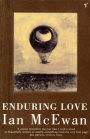
The BBC has a curious article about author Ian McEwan that makes an interesting error about his novel Enduring Love. In fact, the truth is much more subtle.

The article notes that:

McEwan made up a medical condition for the stalker and wrote a spoof article from a psychiatric journal explaining the illness and included it in the book.

His description of De Clerambault’s Syndrome fooled reviewers and psychiatrists alike.

In fact, De Clerambault’s Syndrome (where someone has the delusional belief that another person is in love with them) is well known in the medical literature and McEwan’s description is quite accurate.

Nevertheless, his book concludes with what looks like a reprint of an article from the British Review of Psychiatry that describes a case study which the book seems to be based upon.

Although also fiction (the British Review of Psychiatry doesn’t exist), its style is convincing and it’s properly referenced with studies from the real medical literature.

So convincing, in fact, that it fooled several reviewers, including those in top medical journals, into thinking the novel was based on a real case report.

A clue as to why McEwan was able to successfully imitate the medical literature is given in the acknowledgements. He thanks “Ray Dolan, friend and hiking companion, for many years of stimulating discussion”.

Dolan is a professor of neuropsychiatry at the Institute of Cognitive Neuroscience and the Functional Imaging Lab in London.

Interestingly, Dolan also played a key part in Saturday, another of McEwan’s books – which tackles a dramatic day in the life of a neurosurgeon.

As mentioned in an article in the British Medical Journal, McEwan shadowed neurosurgeon Neil Kitchen while researching the book. The article notes the pair were introduced by Dolan.

Link to Wikipedia page on De Clerambault’s Syndrome.
Link to Salon article ‘Ian McEwan fools British shrinks’.
Link to BMJ article interviewing neurosurgeon Neil Kitchen.

Yay Serotonin! T-shirt

Left-field t-shirt company ClothMoth have a fantastic t-shirt celebrating the joys of serotonin.

The shirt will cost you $18 and will allow you to advertise your love for one of the key monoamine neurotransmitters in the brain.

Tryptophan is an essential amino acid that is synthesised into serotonin. It is found in many fruits, nuts and vegetables. Walnuts are a particularly good source.

It’s not clear how many walnuts were eaten to produce this t-shirt, but the results are fantastic anyway.

Link to ClothMoth Yay Serotonin! t-shirt (via HYA).

Psychopharmacologist’s song

Well, it doesn’t get much stranger than this. OmniBrain has discovered an animation created by Prof Stephen Stahl, researcher and author of numerous academic papers and books on the neuroscience of psychoactive drugs, where he sings about his love of psychopharmacology.

If that’s not weird enough for you, it’s to the tune of a Gilbert and Sullivan operetta song and he’s dressed as a 19th century Naval officer.

I would describe more of it, but you really need to see it to fully appreciate it in all its glory.

I’m sure no-one needs to remind a professor of psychopharmacology of the maxim “don’t get high on your own supply”, so I repeat it here purely for our collective reflection.

Link to embedded video of the Psychopharmacologist’s Song.

Cerebral blood sweets

It looks like a pipette full of cerebral blood, but actually it’s a fun and harmless candy product for children. Bless!

But if you’re concerned that this might be a bit too disturbing for your sweet-toothed young ones, another product by the same company will do nothing to dispell your worries.

Because they also makes a plastic brain from which you can squeeze the liquified neural mush straight into your mouth.

After which, the gummy brains and chocolate brains just seem a bit passé really.

Link to disturbing brain candy.

Uh-oh, little girl, psychotic reaction

It’s an age old story. Boy meets girl, boys loses girl, boy suffers psychotic reaction, boy forms band to sing about his experience on live TV.

I feel depressed, I feel so bad
‘Cause you’re the best girl that I ever had
I can’t get your love, I can’t get a fraction
Uh-oh, little girl, psychotic reaction

The group is Count Five singing ‘Psychotic Reaction’ and as well as being a 1960s rock n’ roll classic, it also helpfully informs us that depression is one of the most common signs of impending relapse in psychosis.

In fact, the song preceded Herz and Melville’s pioneering study, the first to report this association in the scientific literature, by at least 15 years.

Did the two psychosis researchers lead an earlier life as garage band pioneers? I think we should be told.

Link to Count Five singing ‘Psychotic Reaction’ (actually very good).
Link to abstract of Herz and Melville study (still rocks).

Election brain scan nonsense

Neuropsychologist Martha Farah has written a highly critical commentary on a recent New York Times op-ed piece where neuroscientist Marco Iacoboni and colleagues used brain scans of people who viewed videos of US presidential candidates in an attempt to reveal voter reactions “on which this election may well turn”.

Farah quite rightly calls it “junk science” as it is a barely controlled study that relies on stereotypes and generalisation to infer that activation in one particular brain area means the viewers are experiencing a certain reaction.

So why do I doubt the conclusions reported in today’s Op Ed piece? The problems I see have less to do with brain imaging per se than with the human tendency to make up “just so” stories and then believe them. The scattered spots of activation in a brain image can be like tea leaves in the bottom of a cup – ambiguous and accommodating of a large number of possible interpretations.

For example, the story reports that “When we showed subjects the words ‚ÄúDemocrat,‚Äù ‚ÄúRepublican‚Äù and ‚Äúindependent,‚Äù they exhibited high levels of activity in the part of the brain called the amygdala, indicating anxiety”.

In brain-scanning studies, the amygdala is regularly found to be active in people who experience fear. But you can’t make the reverse inference, that amygdala activation equals fear, because it can be equally as active when people experience happiness or joy.

There’s plenty more where that came from, but what is most shocking is not that this junk made The New York Times but that it made it again, and again.

In fact, Iacoaboni’s team were on the front page of the NYT in 2004 with almost exactly the same stunt – attempting to use brain scans to predict responses when viewing political campaign ads.

The ‘study’ details have mysteriously gone from the web but are still archived if you want to see history repeating itself.

And as we reported in 2006, similar nonsense was repeated with the Super Bowl ads, by (guess who) the same team.

None of these studies have ever been published in scientific journals so why does Iacoboni, who does lots of respectable cognitive neuroscience, keep running these essentially meaningless studies?

All of these stunts are essentially PR for FKF Applied Research, a ‘neuromarketing company’ who will carry out bespoke brain scan marketing studies for a price.

Iacoboni is not listed as a staff member but he’s been associated with most of their previous media stunts and four out of five FKF staff are co-authors on the NYT article. We can bet there’s some pretty strong connection there.

Unfortunately, these sorts of stunts play on the excitement surrounding high-tech science and distort the public’s understanding of the significance of brain imaging.

They’re are neither informative nor truly newsworthy but have enough of a sugar coating to make them attractive to a media beguiled by the bright lights of brain scanning.

Link to Farah article on the Neuroethics and Law Blog.

Brain map, created by a cartographer

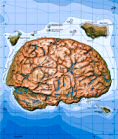
The October 25th edition of Neuron has a fantastic ‘brain map’ cover designed by Sam Brown, a cartographer based in Wellington, New Zealand.

You really need to see the cover in the flesh to see all the wonderful detail, as unfortunately, there’s no high resolution versions of the cover online.

There’s a better image currently on the Unit Seven website, which is still quite impressive though.

A handbag (shaped like a brain) is a girl’s best friend

Designer Jun Takashi has created a high fashion handbag, shaped like a brain. Why? You ask. Why not? I answer.

At this point I would like to make it clear that the idea that we only use 10% of our handbag is a myth.

Scientific studies have found that all of the handbag is in constant use, although some parts may be more active than others.

Link to Jun Takashi’s designer brain handbag (via BB).

Classified sex bomb

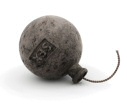
An intriguing letter in this week’s New Scientist digs out some hints on the Pentagon’s proposed ‘gay bomb‘ – an ideas to create a chemical weapon that would temporarily turn enemy troops into horny homosexual love machines.

Feedback asked what happened to the US air force’s Ig Nobel-winning “gay bomb” proposal after it was put forward in 1994 (13 October).

The Pentagon has played down the story ever since New Scientist covered it on 15 January 2005. One spokesman is quoted saying it was “rejected out of hand” and another claimed in 2005 that it was never considered “for further development“.

These claims sit awkwardly with the known facts.

In 2000 – six years after the idea was proposed – the document describing the “gay bomb” was included in a CD-ROM produced by the Pentagon’s Joint Non-Lethal Weapons Directorate, which was distributed to military and government agencies to encourage new projects.

In 2001, the proposal was one of a number which the JNLWD put forward for assessment by a scientific panel at the National Academy of Sciences.

No information has been released suggesting that the proposal was taken any further. However, aphrodisiacs would fall under the US military’s broad new definition of a “calmative agent“, the term it has chosen for “an antipersonnel chemical that leaves the victim awake and mobile but without the will or ability to meet military objectives or carry out criminal activity”.

It seems there is considerable classified research in this area.

UPDATE: An update from The Neurophilosopher: “I’ve just noticed your post about the gay bomb, and thought you might be interested in reading the original research proposal, which I found a few weeks ago when the Ig Nobels were announced”. It’s available online as a pdf. [Thanks!]

Link to NewSci letter.

These brains rule

It’s a timeless story. Boy meets girl. Boy annoys girl. Girl goes off on a brain eating rampage before battling her creator and finishing the day at a zombie pool party.

I’m not entirely sure what it’s all about, but then again, I don’t think this rather bizarre music video was designed to have any deep symbolic meaning.

It’s not entirely safe for work, mainly due to lots of swearing and flesh eating, but it’s a magical combination of brains and zombie girls, which is good enough for me.

Chat up line for a zombie: I’m conscious of how attractive you are but I’d like to know how you feel.

Note to self: go to bed, you’re rambling.

UPDATE: From Shannon Lark, director of the music video! Grabbed from the comments…

I am actually the Director of OMG BRAINS and I gotta tell you that it does have a very deep symbolic meaning!

Besides poking fun at the entertainment industry by using commercialized hot zombie chicks (who are supposed to be endless drones performing corpse-like activities), we also make a statement of the weight issue in America and how a parent’s negative comments can even hurt a dead person.

Link to zombie brain rampage music video (thanks Laurie!).

Hard cash medicine

The Bonkers Institute for Nearly Genuine Research has just published an important paper on how hard cash has had miraculous effects in two of particularly tough cases of depression and anxiety.

Elation and euphoria are the most common side effects associated with cash. The favorable side effect profile and high response rate compared to placebo are the main advantages of cash over standard pharmaceutical treatment, while the major disadvantage of cash would appear to be its prohibitive cost.

Of course, doubters may question whether the financial windfalls were genuinely the cause of the cure, but the improvements in well-being were scientifically confirmed by brain scans and a mood ring.

Link to Cash Therapy in the Treatment of Anxiety and Depression (thanks Ben!).