Scientific American web awards

eckman_surprise.jpgScientific American have given out their 2005 Science & Technology Web Awards and Mind Hacks made the list:

For anyone who ever fell asleep in their own drool while trying to read a neuroscience textbook, welcome to Mind Hacks, Tom Stafford and Matt Webb’s riveting companion blog to their book of the same name, which takes a decidedly fun approach to neuroscience. Emphasizing an empirical approach to understanding one’s own brain, the site reports on the latest developments in such areas as reasoning, memory, attention and language, plumbing the depths of journals and magazines, obscure Web sites and personal experience. A hearty banquet results: the musings of a man mistaken for a sex bot, an interview with a software developer, and reflections on why we laugh are all on the highly unpredictable and entertaining menu.

It’s always great to get awards but it’s even better to hear that there’s plenty of people out there enjoying what we’re doing and finding new angles on the fascinating world of psychology and neuroscience.

Link to Scientific American Science & Technology Web Awards 2005.

Population control – for hire

tv_faces.jpgSlate reports on the rise of psychological population control, often called PsyOps, as a form of commercial service.

According to the report, a company called Strategic Communications Laboratories Ltd was advertising itself at a notable London arms fair, suggesting that it could fool the population into believing any number of things in an attempt to divert attention from a presumed ‘actual’ catastrophe or similar dangerous situation.

When the Slate reporter suggested it sounded like propoganda, a member of staff was quoted as denying the fact, saying:

“If your definition of propaganda is framing communications to do something that’s going to save lives, that’s fine,” says Mark Broughton, SCL’s public affairs director. “That’s not a word I would use for that.”

The company’s website suggests otherwise though, stating they can provide training “for up to 250 staff, including specialised (and tailored) persuasion and propaganda courses.”

Their entry in the Defence Suppliers Directory further outlines the sort of work they’re willing to undertake:

Campaigns may range from homeland security and compliance issues to humanitarian and healthcare behaviour changes. In special circumstances the company will undertake political projects, especially if the sovereignty of the country is at stake, and – very occasionally – corporate campaigns.

Research has shown that attitudes and behaviour correlate poorly. However, SCL claim they can specifically influence behaviour: “for instance – you require a significant number of the electorate to vote for you, it is far more important to get their vote than it is for them merely to hold a favourable attitude towards you.”

The PsyOps field is certainly a murky one. As a tool it could be used both to prevent public panic during an emergency, and to prop up a failing government that would otherwise fall.

Unfortunately, it is often difficult to judge whether such companies are having a positive or negative effect on society, because by their very nature, it is difficult to see how and where they are influencing public behaviour.

Link to Slate article “You Can’t Handle the Truth: Psy-ops propaganda goes mainstream”.
Link to SCL website.
Link to SCL entry in Defence Suppliers Directory.

Will science explain mental illness?

debate.JPGThe latest issue of Prospect magazine features a juicy debate – “Will science explain mental illness?“, with Peter McGuffin, director of the social, genetic & developmental psychiatry centre at King’s College London, arguing ‘yes’, and Steven Rose (pictured right), director of the brain and behaviour research group at the Open University, arguing ‘no’.

McGuffin opens the debate by outlining how science has led to some major advances in the treatment of mental illness, including the development of cognitive behavioural therapy (CBT), anti-depressant medication and anti-psychotics. He also points to the potential of new technologies like functional magnetic resonance imaging, and the promise of psychiatric genetics, with at least one gene implicated in the uptake of serotonin (a neurotransmitter that depressed people don’t seem to have enough of) already identified. “Real advances have been made, and the pace is quickening”, McGuffin says.

But in his initial retort, Rose takes aim at the fuzziness of psychiatric diagnoses and argues that finding treatments for an illness doesn’t necessarily mean you’ve explained it. “Aspirin alleviates toothache, but we don’t conclude that the cause of toothache is too little aspirin in the brain”, he says. Rose is particularly unconvinced of the value in looking for genes implicated in mental illness. “Today’s attempts to locate causes in genes will, in 100 years, seem as misguided as Freud’s classifications”, he predicts.

Non-subscribers can click here to purchase online access to the debate.

NewSci on Coffee, Smell and Intelligence

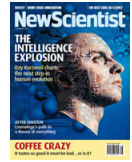
newscientist_20050924.jpgThis week’s New Scientist has three articles for those interested in human behaviour: An article on the effects of coffee, one on the effects and possible treatments for losing the sense of smell, and Ray Kurzweil speculates on the future interaction between technology and human biology:

One benefit of a full understanding of the human brain will be a deep understanding of ourselves, but the key implication is that it will expand the tool kit of techniques we can apply to create artificial intelligence. We will then be able to create non-biological systems that match human intelligence. These superintelligent computers will be able to do things we are not able to do, such as share knowledge and skills at electronic speeds.

Steady on. I think Ray may have been at the coffee himself while writing that one.

Link to New Scientist table of contents.

Beware the Jabberwack, my son

rollo_carpenter.jpgA chat program named Jabberwacky, designed by British AI researcher Rollo Carpenter, has won the Loebner Prize – the annual contest to see the most human-like chat software.

The contest takes the form of the Turing Test where human judges have to work out whether they are chatting to humans or software by typing responses into a computer.

Computer scientist Alan Turing, the designer of the contest, argued that if the judges couldn’t distinguish between humans and software, the software could be thought of as simulating human intelligence. No software has yet passed the full Turing Test (although some has passed limited versions).

The Loebner Prize is awarded to the software that the judges think creates the best simulation, regardless of the fact that it may not pass for human.

Jabberwacky is different from previous winners in that it works out its conversational rules by interacting with humans.

It has a website where visitors can chat to the software, but crucially, they can correct the software when it gives odd or meaningless responses, so the software can adapt to the correct rules of conversation.

Results of its ongoing learning process can be seen in the transcripts of the 2005 contest. Jabberwacky does surprisingly well in some instances but not so great in others.

Link to “Brit’s bot chats way to AI medal” from BBC News
Link to Jabberwacky website and chat.
Link to Loebner Prize website and 2005 transcripts.

Madness in literature

sebastian_faulks.jpgIn light of the new book by novelist Sebastian Faulks that focuses on psychiatry and madness, the BBC have put a piece online about the history of mental disturbance in literature.

Many highly regard authors have been diagnosed with some form of mental illness, not least of whom is Faulks himself, who has been treated for depression in the past.

Other famous examples, such as poet Sylvia Plath and novelist Fyodor Dostoevsky, wrote about their own experiences and played a significant part in de-stigmatising mental distrsss.

Faulks discusses his own experiences and the development of his new novel, entitled Human Traces, in a recent newspaper article.

Link to BBC article ” Literature’s love affair with the mind”
Link to article and interview with Faulks.

Are you fMRI experienced?

fMRI-Mini.jpgThe fMRI experience conference kicks off next Monday at Aston University, with the aim of encouraging new or less experienced researchers to mix with established scientists and ask the sort of burning questions that they might avoid in other symposia.

The conference is held annually in places all over the world and provides free training for those interested in psychology and neuroscience research.

I’m going to be there this Monday and Tuesday, and I’ve been kindly asked to co-chair the ‘Cognitive Neuroscience’ session on Tuesday morning with Kris Kinsey from Aston University, where I’ll certainly be taking the opportunity to question the experts and clear up grey areas in my own thinking.

It’s also a great opportunity to meet people and chat informally about mind and brain science. So, if you’re going to be there, come over and introduce yourself, as it would be great to meet you.

Link to fMRI experience website.

UK Psychologies magazine launches

psychologies_oct.jpgAs an update to a previous story on Mind Hacks – women’s psychology magazine Psychologies hit the shelves today and the website is now online.

I’ve no idea what it’s like, as I’ve yet to get hold of a copy, but I’ll post a review when I’ve had a read.

The website has some of the content from the magazine, including a (dodgy looking) online test entitled “Do you know how to follow your instincts?” and some answers from the magazine’s resident ‘agony aunts’.

Link to Psychologies website.

Reframing mental illness

mental_health_page.jpgA recently concluded confererence at London’s Institute of Psychiatry has been debating the classification and boundaries of mental illness and has been challenging the traditional views of psychiatric medicine.

There have been longstanding critics of psychiatry, notably people like R.D. Laing and Thomas Szasz, who have argued that the medical concepts of mental illness are flawed, or that they are used to unjustly silence society’s outsiders.

More recently, psychiatric classification, and particularly the separation of mental disorder into diagnoses such as ‘schizophrenia‘ and ‘bipolar disorder‘ have been challenged by mainstream psychiatrists on the basis of scientific discoveries.

For example, an editorial in May’s British Journal of Psychiatry argued that that schizophrenia and bipolar disorder are on a continuum, based on genetic evidence that is increasingly showing that similar genes are found in people who receive either diagnosis.

Other criticisms, echoed at the recent London conference, have been based on the coherence of psychiatric definitions and how well they reflect the diverse experiences of people who live through mental distress.

The conference discussed how understanding the first-person conscious experience of mental illness (as opposed to, or in combination with, scientific measures) can make for a more accurate understanding, and hopefully, treatments for those in need.

This approach is known as phenomenology and was championed by a number of continental philosophers who argued that science will only ever give a partial explanation because objective measures always leave something of the ‘lived experience’ missing.

One increasingly popular view of psychosis, the reality-bending mental state that can involve hallucinations and delusions, suggests that it is not an all or nothing state as psychiatric diagnosis suggests, but a range of experiences that are distributed throughout the population.

Recent studies have typically reported that about 10-11% of the general population score about the average of psychotic patients in psychiatric wards, on measures of unusual thinking or perceptual distortion, despite not needing psychiatric help or becoming significantly distressed or disabled.

Link to details of the recent conference on ‘Phenomenology and Psychiatry for the 21st Century’.
Link to BBC News on the conference and the boundaries of madness.

Noel Sharkey on robot intelligence

noel_sharkey.jpgABC Radio’s In Conversation has an interview with cognitive scientist and AI researcher Professor Noel Sharkey who discusses his life, his work and the creation of robot intelligence:

“Noel Sharkey left school at 15, became a singer and took substances. It was while reflecting on the effects of an acid trip (he had taken LSD) that he began wondering about the limits of the mind. Since then he has explored the nature of machine intelligence, experimented with robotic evolution and mused on what kind of thinking is beyond computers. Professor Sharkey, from the University of Sheffield, is here for National Science Week.”

Realaudio of interview.
Link to In Conversation website.

Women’s psychology magazine to launch in UK

psychologies_fr_jan.jpgA new glossy women’s magazine is due to launch in the UK that covers philosophy and psychology, as well as celebrity interviews and lifestyle stories.

Psychologies already exists in France, where the French version (pictured on the right) sells over 300,000 copies a month. It is hoped that UK women will be similarly intrigued by stories that discuss “what we’re like, not just what we look like”.

A write-up in The Independent claims that the magazine will be “academically rigorous”, presumably basing advice and analysis on established research.

It is clear that the magazine is not straying too far from the tried-and-tested format of women’s glossies, however, as beauty advice and celebrity interviews (Meg Ryan will be issue one’s cover girl) will still feature strongly.

Link to story from The Independent ‘Psychologies magazine: Not just a pretty face’.
Link to website of French Psychologies

Fortean Times on Koestler Parapsychology Unit

ft_sept_2005.jpgSeptember’s edition of the Fortean Times has a lead article on Edinburgh University’s Koestler Parapsychology Unit and the state of parapsychology research today.

The research centre is supported by money left in the will of controversial author Arthur Koestler, who had a long-standing interest, and some personal experience, with paranormal phenomena.

In contrast to much of the frankly dodgy science that the area attracts, the Koestler Unit conducts well-controlled scientific studies into potential psi abilities.

The article notes some interesting findings. For example, there seems to be a statistically significant effect, albeit very small in magnitude, when the results of the scientific studies on psi abilities are collated.

It also includes some insights from current and ex-parapsychological researchers on the future of the field, and whether the findings reflect genuine psi, or perhaps just some uncontrolled ‘noise’ in experimental design.

The article is only available in the print edition at the moment, but the Fortean Times put their lead articles online after a month or two, so look out for it on their website for those without copies on your local newstands.

Link to Fortean Times website.
Link to Koestler Parapsychology Unit website.

Cultural cognition update

As an update to the last post, on cognitive differences between Eastern and Western societies, Richard Nisbett was on BBC All in the Mind last night to discuss his findings.

He talks about the experimental results just released, as well his wider studies which have resulted in his book The Geography of Thought: How Asians and Westerners Think Differently – And Why.

Link to All in the Mind webpage for Tuesday’s edition.
Realaudio of programme.

BBC Click Online on ‘Blue Brain’ simulation project

neurons_getty_203.jpgBBC Technology TV show Click Online recently visited the team behind the (somewhat unlikely) claim that they are intending to ‘simulate the whole brain‘ with a supercomputer.

Despite the hype surrounding the launch, the project should be genuinely useful in producing simulations that will allow the function of individual brain cells and theories about more complex neural networks to be modelled and tested.

BBC Click Online went to the project’s base in Lausanne in Switzerland, and discussed the potential for advancing the field of neuroscience with the team. Video is available as a realvideo stream from the link below.

Link to programme information and realvideo streams.
Link to Blue Brain project.

Dalai Lama controversy continues

dalai_lama_small.jpgAs previously reported on Mind Hacks, neuroscientist Jianguo G. Gu started an online petition protesting the Dalai Lama’s forthcoming lecture on neuroscience and meditation to the Society for Neuroscience’s Annual Conference.

Now, the case for supporting the Dalai Lama’s appearance has been made, with an online petition supporting the invitation of the Buddhist religious leader.

The new petition has been by neuroscientist and autism researcher Matthew Belmonte.