SciAmMind on altruism, money and leadership

The August edition of Scientific American Mind has just arrived online and in the shops. The freely available articles from this edition tackle teamwork and finance as one investigates the psychology of leadership and the other looks at the role of altruism in financial decision-making.

The article on leadership contrasts the traditional view of leadership, often based on a combination of top-down charisma and coercion, with a more recent view that emphasises a leader of someone who facilitates communication and understand the group values and emotional intelligence.

It particularly explores the role of ‘social identity’ in leadership, the idea that people define part of themselves in relationship to the group and a good leader is someone who uses this as the most effective way of bonding and focusing the team.

The article on altruism in financial reasoning looks at the increasing amount of research that shows that individuals are not perfectly rational wealth accumulators and will often incorporate notions of fairness and social concern into monetary decisions, even when this can lead to a loss.

Ockenfels’s Equity, Reciprocity and Competition (ERC) theory, which he developed with economist Gary Bolton of Pennsylvania State University, states that people not only try to maximize their gains but also watch to see that they get roughly the same share as others: they are happy to get one piece of cake as long as the next person does not get two pieces. This fairness gauge apparently even has a defined place in the brain. On eBay, however, fairness takes the system only halfway, researchers have now learned; eBay’s reputation system is critical for augmenting the level of trust enough for the market to work.

Circumstance also sculpts behavior, studies have revealed, regardless of natural character traits or values. That is, whether a person is competing in a market of strangers or negotiating with a partner can make a big difference in whether fairness, reciprocity or selfishness will predominate. In fact, the ERC theory hints at ways to alter economic institutions to nudge people to compete—or cooperate—more or less than they currently do.

Other feature articles in the print edition include ones on the effect of language on decision-making, the psychology of college drop-out, the professed fantasies of school shooters, consciousness and physical sensation, and inherited prosopagnosia (face-blindness).

Link to table of contents for August SciAmMind.
Link to article ‘The New Psychology of Leadership’.
Link to article ‘Is Greed Good?’
Night Falls Fast: Jamison on understanding suicide

I’ve just finished reading Kay Redfield Jamison’s book Night Falls Fast (ISBN 0375701478), a remarkably sensitive exploration of the difficult subject of suicide.

Unlike Jamison’s better known books, An Unquiet Mind and Touched with Fire, you rarely see it in bookshops.

It’s probably her least successful book, not least, I suspect, because of the subject matter. Nevertheless, I think it’s her best and most important.

Jamison is one of the world’s leading researchers into manic depression and has the condition herself. As a result, she’s experienced periods of intense psychosis and made a near-fatal suicide attempt.

Originally, the term ‘manic depression’ was coined to describe the whole spectrum of mood disorders, but is often used these days to refer to bipolar disorder, where mood cycles between crushing depression and exuberant, or even psychotic, highs.

The name ‘bipolar’ is a bit misleading, as it suggests that mood is either high or low, when in fact it is possible to feel wired and depressed at the same time – a so-called ‘mixed state’.

These ‘mixed states’ are particularly dangerous and are perhaps one of the reasons that bipolar disorder is one of the leading causes of suicide.

It’s by no means the only cause, however, and there are a range of factors that make suicide among the top 10 causes of death in every country, and one of the three leading worldwide causes of death in the 15 to 35-year age group.

Jamison’s book is not only a comprehensive exploration of the psychology and neuroscience of suicide, but also weaves in insights from the arts and literature, as well as personal stories of suicides and their impact.

The book is emotionally difficult at times, and I often found myself having to pause and reflect mid-paragraph, but it does an admirable job of demystifying and discussing a subject that is woefully ignored in public life.

The New York Times has a brief excerpt and Jamison was interviewed about the book on the Charlie Rose show, the video of which is available online.

Link to book details.
Link to factsheet on suicide from mental health charity Mind.
Link to video of Kay Redfield Jamison interview.
Link to excerpt of Night Falls Fast.

SciAm special on the science of children and teens

Scientific American have just released one of their special editions of collected articles. This one is on ‘the early years’ and looks at the psychology and neuroscience of children, from infancy to the teenage years.

The SciAm specials are just collections of their previously published articles, but put in one themed issue with no adverts.

The printed edition of this new edition can be bought on newstands at the moment, or it can be bought online as a DRM-free PDF file for $4.95.

It follows on from a previous (and equally good) special issue on ‘The Child’s Mind’.

There’s a full content’s list on the issue’s webage but I’ve noticed that several of the articles are already freely available online, so have a search if you want to get a feeling for the theme.

Link to SciAm special edition on ‘The Early Years’.

Prototype of new brain scanning technology

Technology Review has an article on a prototype MRI scanner that could vastly improve our ability to measure brain function. It uses a lattice of small coils positioned around the head rather than large coils you lie inside.

MRI uses very strong magnets that align the spin of the atoms in your body. It then sends a radio pulse which knocks the atoms out of alignment.

After the knock, the atoms return to their previous alignment but the time taken will differ, depending on the body tissue. As they return, they send off their own pulse, this is picked up by the coils, and these are computed into a ‘map’ of the tissue.

The coil is essentially tube shaped. It might be big enough for your entire body, or just big enough for your head to fit inside, as this image shows.

The new protype scanner, developed by Siemens, instead has an overlapping series of small circular coils positioned around the head, as you can see in the picture.

The idea is that they will be more sensitive and only focus on a small area of brain, and the information from each will be combined into a complete data set.

One major hope is that the scans will have even more detail than conventional MRI, which divides the brain up into chunks that are approximately 3mm across in all direction.

Although this is quite small, it’s still too big to pick up the brain’s fine detail.

The device is likely to have important applications in functional magnetic resonance imaging (fMRI), a variation of standard MRI that tracks blood flow in the brain as an indirect measure of activity. The technique is often used to locate the parts of the brain that control specific functions, such as speech and movement. The first clinical application for the device will likely be fMRI for neurosurgery planning, says [Siemens MR vice president] Bundy. “Surgeons want to know where speech and motor areas are when they take a tumor out–the more precise, the better.”

The instrument could also impact our basic understanding of the brain. “The spatial resolution of fMRI is somewhat limited,” says Gabrieli. “We’ve hit the wall on a lot of scientific questions.” With higher-resolution images, scientists could try to determine neurological basis of various aspects of cognitive function. Gabrieli, for example, says that he’d like to figure out if different parts of the amygdala–a small structure deep in the brain that plays a key role in emotion–regulate different emotions, such as fear and joy.

One restrictive aspect of current fMRI is that the person has to be lying down and is inside a tube. This make many types of experiments (e.g. on limb movement) virtually impossible to conduct.

If, like other brain scanning technologies PET and MEG, the person could be sitting up, it would mean a far more diverse range of studies could be done in fMRI.

Sometimes the most important effects are the simplest, even if they need to be enabled by advances in high-technology.

Link to TechReview article ‘A Better Brain Scanner’.

The necessity of the brain: a slight return

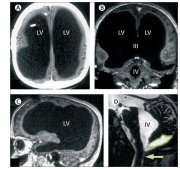
This week’s edition of medical journal The Lancet has a brief case report of a 44-year-old man who was discovered to have a severely distorted brain, due to it being displaced by a build-up of fluid.

The man’s MRI scans are shown on the right and you can clearly see that huge sections of the brain are seemingly absent.

In this case, it was due to hydrocephalus, a condition where the cerebrospinal fluid (CSF) isn’t properly drained.

This fluid bathes and protects the brain. It is produced in the ventricles and circulates around before being removed into the blood supply.

If this draining doesn’t happen properly, the fluid builds up and dangerously increases the pressure inside the skull. This can lead to the brain being malformed, particularly if it occurs in childhood.

The young brain is remarkably good at adapting to obstacles. Children who have had half their brain removed can grow up with few obvious effects.

This seems to also occur in some cases of hydrocephalus. While it is usually associated with quite profound neurological problems, in some cases, it goes undetected because the people seem relatively unaffected.

The late neurologist John Lorber studied case of hydrocephalus and reported one particularly famous case.

A CT scan suggested that the patient had a largely fluid-filled skull with less than a few millimetres of grey matter, but with a IQ of 126 and a first class maths degree. Lorber had many other cases that he said illustrated similar effects.

Lorber provocatively titled his article ‘Is the brain really necessary?’.

His finding was quite astonishing and, despite some criticisms (CT scans probably exaggerate the damage and the patients undoubtedly had some mental difficulties), he highlighted the fact that the brain can adapt to quite severe setbacks in some exceptional cases.

However, the title of his article annoyed quite a few people and it has been cited as one of the origins of the ridiculous but curiously persistent myth that we only use 10% of our brains.

In comparison to Lorber’s case, the Lancet is a man described as having ‘normal social functioning’ and an IQ of 75, on the borderline of having a mild intellectual disability, but nothing so severe you wouldn’t find it as part of normal human variation.

Nevertheless, considering the extent of distortion in the brain, it’s still quite remarkable.

‘Distortion’ is likely to be the key is these cases, as the key brain areas are likely to be ‘smeared’ around the inside of the skull, rather than missing completely.

However, we shouldn’t be too complacent in our explanations of how some people can have such severe brain distortions while functioning really quite well. Our understanding of how this occurs is still quite poor. Plenty of mystery still accompanies these cases.

Link to (closed access) Lancet case report.
Link to write-up from Nature (via Neurophilosopher).
Link to excellent SciCon article on Lorber’s cases and the 10% myth.

Schizophrenia in 15th century Islamic medicine

There’s an interesting exchange in this month’s American Journal of Psychiatry where two researchers note that there is no mention of any condition that resembles schizophrenia in the key 15th century Islamic medical text Cerrahiyyetu‚Äôl-Haniyye (Imperial Surgery).

A reply highlights the fact that it may be because medicine was only practicised on people who volunteered for treatment, which is unlikely to include people who are floridly psychotic.

The exchange contains lots of historical information about how psychosis was understood in centuries past both socially, and by doctors of the time.

Islam has been incredibly important in the history of medicine and Islamic medical texts are rich sources for historians interested in the development of medical care.

Link to AJP letter ‘Absence of Schizophrenia in a 15th-Century Islamic Medical Textbook’.
Link to reply and commentary.

‘Paranoid’ political donation contested in court

A £10 million donation to the UK Conservative party, the biggest in its history, is being contested in the high court because the late donor was allegedly psychotic, believing that Margaret Thatcher would save the world from a conspiracy of demons and satanic forces.

The donor was Branislav Kostic, a Belgrade-born businessman who made millions with Transtrade, a company dealing in pharmaceuticals and metals.

The Times reports that he became concerned about a conspiracy during the Thatcher-era and re-wrote his will to leave his money to the Conservative party, largely disinheriting his family:

The Belgrade-born tycoon was the perfect family man until he became gripped by delusions around 1984. His beliefs in plots to kill him poisoned his relationships with his wife, sister, mother, friends, advisers, bankers and colleagues. He thought that his own solicitors and accountants were part of a conspiracy to destroy the world.

The deluded Mr Kostic believed that he was victim of “a devilish organisation by three monster ladies”. He accused his wife of stealing his passport and money and being a nymphomaniac with numerous male and female lovers. He believed his mother and sister conspired to kill his father and brother-in-law.

In a note to Scotland Yard, he reported a 100-strong international vice ring was attempting to poison him. He told a detective that he had deposited their names in a yellow tennis bag.

Mr Kostic has since died and the court case concerns whether Mr Kostic was of sound mind when making the change to his will.

If Mr Kostic wanted to change his will now, he would likely be given a mental capacity assessment, as part of the UK’s new Mental Capacity Act which recently came into force.

Rather than relying on a blanket judgement that someone who is ‘mentally ill’ lacks capacity to make decisions, the new act requires that each decision be independently evaluated.

The assessment is aimed at understanding whether the person has the mental facilities to weight the evidence and understand both the situation, and the implications of their choice.

If the person is found to have these abilities, they are free to make whatever decision they lack, even if it seems eccentric or not in their best interests.

Link to report from The Times.
Link to report from The Guardian.

LSD assisted psychotherapy study to start in Switzerland

The Royal Society of Chemistry reports that a research project investigating the potential benefits of LSD assisted psychotherapy for people with terminal illnesses has been given the go-ahead by the Swiss authorities.

The Multidisciplanary Association for Psychedelic Studies, part funders of the study, have more about it on their website, including copies of the ethics application and research plan.

MAPS have done huge amounts to make the study of psychedelic drugs both scientifically respectable and acceptable to the regulatory authorities, many of whom are still twitchy from when scientific research into the area was effectively outlawed following the 1960s.

The study is an early exploration, more of a pilot study really, but is being conducted in accordance with the strict standards for clinical trials.

According to the study protocol [pdf], the plan is:

We will conduct this randomized, active-placebo controlled investigation in order to redevelop a treatment method of LSD-assisted therapy for people confronting anxiety relating to advanced-stage illnesses and to gather preliminary evidence on the safety and
efficacy of this treatment in this population using current scientific standards.

Eight of twelve participants will be assigned to the experimental intervention dose condition (called verum (“true”) dose, 200 ¬µg LSD), and four of twelve will be assigned to the low dose condition (called active placebo dose, 20 ¬µg LSD). Participants enrolled in the study will receive two sessions of LSD-assisted psychotherapy separated by a two to four week interval.

These experimental sessions will be embedded within a course of six to eight individual non-drug psychotherapy sessions that will first prepare participants for LSD assisted therapy and then help participants integrate material from the LSD-assisted sessions.

An independent rater will assess anxiety levels, quality of life, and pain throughout the study and until two months after the second experimental session. The use of anxiety and pain medications will be assessed throughout the duration of the study via diaries kept by participants.

The study is similar in design to an already approved study looking at psilocybin assisted psychotherapy for anxiety in cancer patients, and will be the first LSD psychotherapy study for 35 years.

Link to Royal Society of Chemistry news story.
Link to study info from MAPS.

Psychologist wins world poker championships

Jerry Yang, a 29 year-old psychologist and social worker who works for a fostering agency, has won a cool $8.25 million at the World Series of Poker in Las Vegas.

Yang put some of his success down to his training in psychology, but do psychologists make better poker players?

There’s no direct evidence that they do, despite what they might try to tell you at the table, but some research suggests they might have an advantage in a few of the key skills.

A study by Paul Ekman and colleagues [pdf] found that clinical psychologists are among the best professions at detecting deception in others, with academic psychologists coming just slightly behind.

In terms of dealing with the interaction between social influence and risky financial decisions, a study by Dr. Andreas Roider found that psychologists made, on average, three times as much money as economists and physicists in an online trading game because they were less swayed by the ‘herd instinct’

The scientific paper [pdf] contains an interesting snippet:

Maybe it does not come as a surprise that when we look at selected fields of study, physicists perform the best in terms of “rationality” (i.e., performance according to theory) and psychologists the worst. However, since “rational” behavior is profitable only when other subjects behave rationally as well, good performance in terms of “rationality” does not imply good performance in terms of profits. Indeed, the ranking in terms of profits is just the opposite: psychologists are the best and physicists the worst.

In other words, psychologists were better at understanding how people actually behave, as opposed to how they should behave if they were choosing the most mathematically correct strategy.

How much this applies to a game influenced heavily by chance, is, of course, another matter.

Link to Forbes article on Yang’s win.
Link to ScienceDaily on psychologists’ skills in lie detection.
Link to Medical News on psychologists as traders.
Link to Science News article on detecting deception.

US psychologists to review gay ‘conversion therapy’

Time magazine reports that the American Psychological Association is conducting a review of their policy on treating gay clients, with a particular focus on reassessing guidelines around controversial therapies aimed at assisting gay clients to ‘go straight’.

The APA already have guidelines for working with gay, lesbian and bisexual clients that make it clear that homosexuality is not to be considered a mental illness.

However, a minority of therapists, usually linked to conservative Christian organisations, practice a type of therapy known as ‘reparative’ or ‘conversion therapy’ to assist gay clients who wish to be straight.

This practice is strongly opposed by gay rights groups, who suggest that it is at best futile and at worst harmful, and feel that it is the distress of discrimination that pushes people into starting such therapies.

Neither the current guidelines, nor the APA policy statement on lesbian and gay issues, makes any mention of this issue – something that the review panel is likely to consider in detail.

Gay rights advocates are hoping that the APA will denounce ‘reparative’ or ‘conversion’ therapies while conservative religious groups have written to the APA to defend their work with consenting clients.

As with many of these policy reviews, the arguments centre as much on who has been selected for the review panel as the debate itself:

Conservatives contend that the review’s outcome is preordained because the task force is dominated by gay-rights supporters. “We’re concerned,” said Carrie Gordon Earll of Focus on the Family. “The APA does not have a good track record of listening to other views.”

Joseph Nicolosi, a leading proponent of reparative therapy, predicted the task force would propose a ban of the practice — and he vowed to resist such a move. Nicolosi, who was rejected as a task force nominee, is president of the National Association for Research and Therapy of Homosexuality.

Clinton Anderson, director of the APA’s Lesbian, Gay and Bisexual Concerns Office, insisted the panel would base its findings on scientific research, not ideology. He defended the decision to reject certain conservative applicants to the task force. “We cannot take into account what are fundamentally negative religious perceptions of homosexuality ‚Äî they don’t fit into our world view,” Anderson said.

Link to Time article ‘Psychologists to Review Stance on Gays’.

John Nash speaks to American psychiatry

John Nash, Nobel prize winning mathematician and subject of the Oscar winning biopic A Beautiful Mind, delivered a speech to the American Psychiatric Association’s annual conference. In his talk, he suggested that mental illness may be the result of the otherwise healthy evolution of mental diversity.

Applying his specialized understanding of “game theory” to an analysis of mental illness and his own experience with psychosis, the 79-year-old Nobel Laureate suggested that severe mental illness exists in nature as a consequence of the diversification of species, and that it may serve the needs of adaptation by its not infrequent association with genius.

It is a line of thinking that has been followed by such renowned psychiatric researchers as Nancy Andreasen, M.D., and Kay Redfield Jamison, Ph.D.

At the same conference, model and actress Brooke Shields spoke to the conference about her own experience of post-partum depression – the depressive disorder that occurs after giving birth in about 1 out of every 10 women.

Link to Psychiatric News on Nash’s speech (via FuriousSeasons).
Link to Psychiatric News on Shield’s speech.

Neurobiology of addiction in Time Magazine

Time magazine has an article that investigates the neuroscience of addiction and why some people find it so hard to give up drink and drugs.

The article takes an approach to addiction know as the ‘disease model’.

In its strongest form, this theory suggests that some people have a particular neurological weakness that makes them more likely to become addicted when they encounter certain substances.

Essentially, it suggests that the ‘disease’, often considered to be genetic in origin, exists before the problem behaviour.

The actual addiction is thought to be an interaction between the disease and the substance which leads to compulsive substance taking and seeking.

However, it’s also important to realise that many of the most addictive drugs directly affect a system that is also involved reward processing.

In other words, the thing that makes you feel good also affects the system that helps you judge how valuable things are.

This tends to affect your judgement of how bad you want something, and, over time, the system becomes more sensitive so it increases desire more easily,

This is known as the incentive-sensitization view and is one of the most influential neurobiological theories of addiction [pdf].

However, it has largely been developed on the basis of animal research and has been criticised for ignoring social factors.

For example, Jim Orford’s influential book Excessive Appetites (ISBN 0471499471) notes that heavy consumption of the same substance can have a very different impact depending on the cultural context.

Other than its (perhaps deliberately) narrow focus, the Time article is a competent look at the neurobiology of addiction.

UPDATE: Grabbed from the comments – a sharp-eyed observation from Resa:

I was reading this article the other day, and to my amusement, the pituitary gland had been incorrectly labeled as the amygdala in the illustration of the dopamine reward pathway. This little mishap is present in both online and print versions of the article.

You can see the offending diagram here.

Link to Time article ‘How We Get Addicted’.

SciAmMind – a slight return

Scientific American Mind usually make two of their feature articles freely available online. This issue, they seem to have substituted their articles at ‘half time’, as two new articles have become available from the June / July issue, while the two that were previously available have disappeared behind a pay wall.

One of the new articles is on how to recognise good quality advice and expertise in the cognitive, neuro and medical sciences.

The other is on the role of ‘mirror neurons’ in recovery and rehabilitation after brain injury and stroke.

I’ve got mixed feelings about this really. While its always good to have new quality mind and brain writing available, one of the attractions of SciAmMind is that freely available articles from past issues are always accessible.

Link to contents with links to freely available content (thanks Scott!)

Does your neighbourhood cause schizophrenia?

The results of two new studies suggest that the neighbourhood you live in affects your chance of developing schizophrenia. Surprisingly, neighbourhood seems to have no effect on your risk of bipolar disorder.

The received wisdom says that schizophrenia affects 1% of the population worldwide, with little variation between race, country and area.

The trouble is, the received wisdom is wrong. We now know that the prevalence (total amount of cases) and incidence (amount of new cases per year) varies globally, nationally and locally.

These two new studies, led by Dr James Kirkbride, investigated whether street-by-street differences also have an effect.

The research team examined every person who was treated by mental health services in South East London for a first episode of psychosis over a two-year period.

Psychosis involves delusions and hallucinations and most often leads to a diagnosis of schizophrenia or bipolar disorder, bipolar being most associated with mood problems such as soaring highs followed by crashing lows.

South East London is notable for many things, not all of them positive. It’s a high poverty, high crime, highly urbanised inner-city area.

We know that one of the single largest environmental risk factors for schizophrenia is living in an urban area, and, unsurprisingly, this corner of the UK’s captial has one of the highest rates of psychosis in the world.

The team looked at all the areas, and, controlling for the effects of age, sex and ethnicity, used statistics to test whether any differences between areas were likely to due to chance, or whether they varied enough to be confident that the critical influence was the neighbourhood.

The map on the left shows the variation between neighbourhoods. If you know South East London, click on the map to see how it relates to specific areas.

You”ll notice that the toughest, poorest areas tend to have a higher rate of schizophrenia. In comparison, the rates for bipolar disorder were largely the same wherever the team looked.

Even if you don’t know the area at all, the amount of neighbourhood variation is quite startling. In some cases, moving just a few streets could dramatically affect your mental health.

In a second study, the team looked at characteristics of the area to try and see what risk was linked to.

Some main influences stood out: poverty, ethnic fragmentation, and, surprisingly, local election voter turnout.

In fact, a 1% increase in the number of voters in local elections was linked to a 5% reduction in new cases of schizophrenia.

Voter turnout itself is hardly likely to affect mental health, but the researchers suggest it might reflect the sense of community in the neighbourhood: the more you’re concerned about your neighbourhood the more likely you are to vote on issues affecting the area.

Ethnic fragmentation is a measure of how many people of your ethnic background live in your neighbourhood.

Immigrants are known to be at greater risk of schizophrenia than other people in the country, and South East London has a large immigrant population.

This might mean that contact with a community of people who share your cultural experiences may be protective against mental illness, perhaps again suggesting that ‘community spirit’ is key for mental health.

So why do all these things affect schizophrenia and not bipolar disorder? The researchers don’t discuss it in detail probably because it’s a bit puzzling.

The truth, of course, is just outside the front door.

Link to abstract of ‘Neighbourhood variation in the incidence of psychotic disorders in Southeast London’.

Link to abstract of ‘Neighbourhood-level effects on psychoses: re-examining the role of context’.