The baroque art rifle

Anthropologist Wade Davis’s wonderfully vivid description of the effects of Amazonian hallucinogenic plants from page 216 of his fantastic book, One River:

In the case of yagé, some twenty one admixtures have been identified to date. Two of these are of particular interest. Psychotria viridis is a shrub in the coffee family. Chagopranga is Diplopterys cabrerana, a forest liana closely related to yagé. Unlike yagé, both of these plants contain tryptamines, powerful psychoactive compounds that when smoked or snuffed induce a very rapid, intense intoxication of short duration marked by astonishing visual imagery.

The sensation is rather like being shot out of a barrel lined with baroque paintings and landing on a sea of electricity.


Link to more information about One River.

Mind gene myths

The Guardian has an excellent article on why news stories touting a gene for a particular psychological trait, like intelligence, optimism or dyslexia, are usually misguided.

The piece is a fantastic potted guide to how science goes about untangling the effects of genes and the environment and how this applies to the increasingly popular attempt to link genetics to personality, thinking and behaviour.

What are the implications of all this for the stories we hear in the media about new genetic discoveries? The main message is that we need to be aware of the small effect of most individual genes on human traits. The idea that we can test for a single gene that causes musical talent, optimism or intelligence is just plain wrong. Even where reliable associations are found, they don’t correspond to the kind of major influences that we learned about in school biology. And we need to realise that twin studies, which consider the total effect of a person’s genetic makeup on a trait, often give very different results from molecular studies of individual genes.

Don’t be put off by the picture of Jedward. Not all twin studies are quite so gruesome.
 

Link to article on myth of ‘a gene for things like intelligence.’

Beyond the call of duty

Oscillatory Thoughts has a brilliant post about the self-experimentation carried out by pioneering neurologist Henry Head in the early 1900s. This involved severing nerves to see which were responsible for areas of sensation and creating a thorough map of how sensory abilities differed across the body – and no spot was left untested.

The post has a fantastic description of a 1908 study on how somatosensation recovered after… ok, ok, here’s where he dips his cock in hot water:

In the case of [Henry Head], the tip happens to be devoid of heat-spots but is sensitive to cold and to pain. When… it was dipped into water at 40° C, no sensation of heat was produced, but [Head] experienced an unusually disagreeable sensation of pain… But, as soon as the water covered the corona without reaching the foreskin, both cold and pain disappeared, giving place to an exquisitely pleasant sensation of heat.

Science. Happy now?
 

Link to Oscillatory Thoughts on Head’s self-experimentation.
Link to excellent Wikipedia article on Henry Head.

Beyond paddling: children and technology

One of the most sensible articles yet published on children, technology and the brain has just appeared in the scientific journal Neuron. It’s titled “Children, Wired: For Better and for Worse” and has been made open-access so you can read it in full online.

You’ll notice a few things that are different from your usual article about the impact of technology: it is written by cognitive scientists who are actually involved in the research; it is published in a peer-reviewed scientific journal; it discusses the whole range of evidence; and it hasn’t made any headlines.

Although it’s an academic article, it’s surprisingly readable and if you’re interested in the area, I highly recommend it.

This is not least because it points out lots of counter-intuitive findings in the scientific literature that are never covered by the people who usually spin the ‘I think it’s trash culture so it must be doing harm’ line.

For example, educational or ‘brain boosting’ applications may actually slow learning while ‘mindless’ video games can have sustained benefits:

Technology specifically developed for the purpose of enhancing cognitive abilities, such as infant-directed media including the ‘‘Baby Einstein’’ collection or various ‘‘brain games’’ designed for adults, may lead to no effects or, worse, may lead to unanticipated negative effects (Owen et al., 2010; Zimmerman et al., 2007). Meanwhile, technological applications that on the surface seem rather mindless (such as action video games) can result in improvements in a number of basic attentional, motor, and visual skills (Green and Bavelier, 2008; Greenfield, 2009).

It’s worth noting that there is good evidence that some educational TV programmes and software have a beneficial effect, but the point remains that you can’t guess the effect from the label.

The article is great at picking up on these complexities and noting the importance of fully considering content and context as well as the way technology delivers it.

My only quibble is a throwaway line where the authors consider addiction to video games and note we need to consider neurological evidence because: “The fronto-striatal pathway, which has been strongly implicated in both drug addiction and behavioral disorders such as pathological gambling is also activated by interaction with certain types of media technology, video games in particular”

As the ‘reward system’, of course, it’s strongly activated in lots of things we find pleasurable or useful – like listening to music, consuming soft drinks, co-operating with others and receiving a compliment.

There is nothing inherently pathological about the activity of this system so we need to be careful that we are guided by what actually impacts on people’s lives and not get too dazzled by the bright lights of brain scanners. But this is a minor point in a overwhelmingly excellent piece.

The take home point is that the ‘technology is damaging the brain / eating our children / harming our culture’ stories are over-simplified to the point of absurdity. No-one could get away with a scare story about the whole of ‘transport’ but you can with ‘technology’ because it plays to our anxious stereotypes.

This is not to say that there aren’t some genuine areas of concern but these are little different from every other media that has come before: violence has a small but significant effect on aggression and doing anything to the detriment of a balanced education and active life will affect school progress and health.
 

Link to Neuron article with full text pdf link (via @bradleyvoytek).
Link to DOI entry.

Guided by voices

RadioLab has a fantastic mini-edition about the link between our internal thought stream and the development of auditory hallucinations – the experience of ‘hearing voices’.

The programme discusses the theory that the experience of hearing hallucinated ‘voices in your head’ occurs when we lose the ability to recognise our internal thoughts as our own.

Although there is some good evidence that, for example, people diagnosed with schizophrenia who hear voices are less able to recognise their own actions as their own, one crucial aspect not explained by the theory is why many ‘voice hearers’ experience voices with distinct identities.

For example, someone might hear the voice of their dead parent along with someone they knew from childhood where someone else might have discovered the identities of their voices over time, simply from hearing them speak, and they seem to have no relation to specific people they’ve met in their lives.

The programme suggests the idea, which, as far as I know, has never been discussed in the scientific literature, that the identities of the voices could originate from when we learn to internalise voices of people who give us instructions when we’re children – an approach based on the theories of Lev Vygotsky.

It’s a delightful idea, if not a little blue sky, and is accompanied by a brilliant demonstration of the type of study that focuses on hallucinated voices.
 

UPDATE: There’s further discussion with references to Vygotsky’s work on self-talk and internalised thought from the interviewee, psychologist Charles Ferynhough, over at a great post on his blog.


Link to RadioLab ‘Voices in Your Head’ edition.

A stranger in half your body

An amazing study has just been published online in Consciousness and Cognition about a patient with epilepsy who felt the left half of his body was being “invaded by a stranger” when he had a seizure. As a result, he felt he existed in one side of his body only.

The research is from the same Swiss team who made headlines with their study that used virtual reality to make participants feel they were in someone else’s body, and one where brain stimulation triggered the sensation of having an offset ‘shadow body’ in patients undergoing neurosurgery.

The researchers suggest that having an integrated sense of our own bodies involves three types of perception: self-location – the area where we experience the self to be located; first-person perspective – the perceived centre of the conscious experience; and self-identification – the degree to which we identify sensations with our own bodies.

They report two case studies of patients with neurological disorders where self-identification goes haywire. This is the first:

Patient 1 is a 55 year old, left-handed male patient suffering from epilepsy since the age of 14 years. His simple partial sensorimotor seizures [where he remained ‘awake’ throughout] affected his left hand had been well controlled under anti-epileptic medication until the onset of paroxysmal episodes of vertigo 9 years before the current hospitalization.

At that time he additionally started to experience the following, highly stereotypical pattern of symptoms: without any prior warning he would first have the impression of an increasing pressure in the entire left hemi-body. This sensation increased progressively in strength leading eventually to the sensation that he was invaded by a stranger in his left hemi-body.

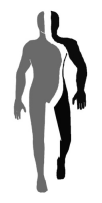
At this time he also sensed that the left half of his head, the upper part of his left trunk, his left arm and his left leg were no longer belonging to him (no misattribution), that these parts were disconnected from the rest of his body, and that his body was divided into two parts (Fig. 1A [see image above]). Sometimes this was followed by the impression that the left arm was moving unintentionally and would disappear behind the patient’s back. During these episodes he never experienced any deformation or other changes of his body or the environment.

Furthermore, no autoscopic hallucinations, no sensation of floating or disembodiment, no change in visuo-spatial or first-person perspective, no disturbance of language or vision and no loss of contact or consciousness were noted. During these sensations the patient localized the self as within the right side of his body (shown in grey in Fig. 1 [above]). He managed to remain calm and was able to continue standing, walking, and even give oral presentations while in front of audiences at work (surrounding persons usually did not notice his seizure manifestations). These simple partial seizures occurred on a daily basis and lasted about 1 min.

These sorts of cases are useful because they help us understand whether theories about the brain and its relation to our experience are realistic.

For example, one test of the idea that body self-consciousness has three components (self-location; first-person perspective; and self-identification) would be to see if there are any patients who show disturbances to only one of these experiences due to a neurological problem.

This patient shows exactly this, giving us some additional evidence that the three-component idea is useful. It is not the only evidence we need of course, but it is still makes an important contribution.
 

Link to PubMed entry for study.
Link to DOI entry.

Visions of a psychedelic future

This post is part of a Nature Blog Focus on hallucinogenic drugs in medicine and mental health, inspired by a recent Nature Reviews Neuroscience paper ‘The neurobiology of psychedelic drugs: implications for the treatment of mood disorders’ by Franz Vollenweider and Michael Kometer.

This article will be available, open-access, until September 23. For more information on this Blog Focus please visit the Table of Contents.



In a hut, in a forest, in the mountains of Colombia, I am puking into a bucket. I close my eyes and every time my body convulses I see ripples in a lattice of multi-coloured hexagons that flows out to the edges of the universe.

Two hours earlier, I had swallowed a muddy brown brew known as yagé, famous for its hallucinogenic effects, its foul taste, and the accompanying waves of nausea that eventually lead to uncontrollable vomiting.

Yagé has been used for hundreds, if not thousands, of years – not as a recreational drug – but as a psychological and spiritual aid that holds a central place in indigenous religion.

Romualdo, a displaced Witoto shaman who led the ceremony, was convinced of its mental health benefits and had confidentially assured me that, after the puking, I would remain in a state of heightened conciencia where I could “ask questions, solve difficulties and communicate with spirits.” “Come with a question,” he told me, “you’ll feel better afterwards.”

The main active ingredient in yagé, known outside Colombia as ayahuasca, is dimethyltryptamine or DMT, a hallucinogenic drug from the tryptamine family that works – like LSD and psilocybin – largely through its effect on serotonin receptors.

Psychedelic drugs, mental health and brain science have traditionally made for a heated combination, but a recent scientific article, published in September’s Nature Reviews Neuroscience, has attempted to more coolly assess the growing research on the potential of hallucinogens to treat depression and anxiety.

Lab studies and medical trials form a small but robust body of knowledge that reveal reliable benefits and promising future avenues. The dissociative anaesthetic ketamine has been found to lift mood – even in cases of severe of depression – while psilocybin, present across the world in mushrooms and fungi, has been shown to have anxiety reducing properties.

But while no serious bad reactions have happened during the trials, the full range of potential risks is still not fully understood, meaning the treatments remain firmly in the lab.

The caution is warranted. Psychiatrists are more than aware of hospital admissions triggered by the same drugs taken outside of controlled conditions, and so the compounds will remain as experimental treatments until the risks are fully known.

Nevertheless, the science is now developed enough for new ideas to be generated based solely on a neurobiological understanding of the drugs.

The authors of this latest review, neuroscientists Franz Vollenweider and Michael Kometer, note that success with psychedelics that largely work on the glutamate system – such as ketamine and PCP – may be due to the fact that these circuits regulate long-term brain changes. This suggests a potential path to extending the mood lifting effects of these drugs beyond the initial ‘trip’.

One key advance would be an understanding of how the chemical structure of a particular hallucinogen relates to the experience it creates, allowing researchers a neurological toolkit that could be used to trigger the beneficial effects while toning down the extreme unreality that some people find unpleasant.

Yet, it is still not clear whether such benefits are separable from the psychedelic effects and it may be that the ‘active ingredient’ lies somewhere between an altered state of consciousness and a reflective mind, as some studies on drug-assisted psychotherapy suggest.

It is also clear that a great number of ritual hallucinogens, widely used by indigenous people for their psychological benefits, have yet to be explored.

The preliminary studies on users of yagé indicate that it has potential benefits for mental health, although it remains largely untouched by more rigorous tests.

As my own investigation ends, I leave the isolated hut feeling exhausted and disoriented as the clear morning light refracts through my thoughts and casts bright trickling colours into unfilled spaces.

As Romualdo promised, I feel better, elated even, but the questions I brought remain unanswered and have similarly refracted into a thousand intricate doubts.
 

Link to Nature Blog Focus on psychedelics Table of Contents.
Link to Nature Reviews Neuroscience article.

Delusions of pregnancy, in a man

A 1999 case report describes a 29-year-old man who developed the delusional belief that he was pregnant.

Mr. R., a 29-year-old married man from a semi-urban background with 8 years’ education, was brought by his wife to the outpatient department at the National Institute of Mental Health and Neurosciences, Bangalore, India, with a 2-month history of suspicious and assaultive behaviour. He would look at the sky and say that everyone including God was trying to assault him. He also claimed that there was a baby in his abdomen.

He believed that he had Jesus in his abdomen to start with, but later reported that Jesus had flown away through his mouth, but was replaced by a human baby. He was sure that the child was 40 days old and it was the same child his wife was having. He could also feel the movements of the child and was sure that it was growing. However, he did not have any other symptoms of pregnancy. He was withdrawn and his food intake was inadequate.

Although the case reported here wasn’t the first case of male delusional pregnancy ever described (though, admittedly, they are rare) this one was of particular interest because, although the gentleman recovered, he later developed another brief psychosis where the delusion returned.

For the second time, he believed himself to be carrying a child. Curiously, both incidents occurred when his wife was genuinely pregnant.

Although there is no clear explanation for why it occurred in this particular case, there is, however, evidence that men show hormone changes when their female partners are pregnant, possibly linked to a well-known syndrome called ‘Couvade syndrome‘ where men can show sympathetic signs of pregnancy.

We’ve discussed delusions of pregnancy before although they are, unsurprisingly, much more common in women.
 

Link to PubMed entry for case report.

Distractingly attractive

Driver distractions are a major cause of road accidents. A new study has found that just a simple conversation with someone else in the car can be enough to increase driver errors and that the risk is greater if we fancy the passenger.

The research was conducted in a driving simulator by Cale Whitea and Jeff Caird from the Cognitive Ergonomics Research Laboratory (CERL) at the University of Calgary in Canada where they investigated something called a looked-but-failed-to-see error.

This is a form of change blindness, where we look at a scene but fail to notice something has changed. This is an important source of risk when driving, as we may be going through the motions of scanning the road but not taking in new information.

The study looked at how many of these errors would occur when drivers navigated their way through a simulated city, while also tracking their eye movements and errors with motorbikes and pedestrians on dangerous left-turns.

Crucially, the study compared how people performed when they were alone or with an opposite-sex passenger but also asked them about how attracted they were to the passenger and tested levels of extroversion and anxiety.

The results were striking:

Passenger conversations can be distracting. Higher rates of [looked-but-failed-to-see] LBFTS errors occurred when engaged in conversations with attractive passengers. In particular, those drivers who were most extroverted and attracted to the passenger also tended to be more anxious, drove slower, responded less to the pedestrian, and were involved in a greater number of emergency incidents with the motorcycle.

Considering eye gaze behavior was unaffected, the relationship between these social factors and performance variables suggest the nature of conversational distraction is cognitive. This attentional interference was sufficient in eliciting an eight-fold increase in LBFTS errors involving the motorcycle and four-times more pedestrian incidents.

In other words, conversation did not alter how people looked at the road, but it did affect how many dangerous situations people noticed – they just didn’t take them in. Fancying the passenger meant drivers missed more hazards. Their mind was clearly on other things.

Contrary to what parents might say (‘you were just showing off!’) participants actually drove more slowly when they were attracted to the passenger, but still made more errors.

It’s probably worth noting that it wasn’t the hotness of the passenger which was tested in the experiment, but the attraction of the driver, and that the distracting effect was stronger in women than men.
 

Link to PubMed entry for study.

A natural state of mind

ScienceLine has an excellent article on ecopsychology – a branch of cognitive science that looks at the impact of the environment on the mind.

Originally considered a bit wishy washy due to a lack of hard data and more than a touch of hippie chic, it’s proponents are now starting to collect good evidence on the mental benefits of the natural world.

Don’t be put off by the spectacularly bad headline (“Can a Stroll in the Park Replace the Psychiatrist’s Couch?” – what?) as the piece actually asks some tough questions about the ‘ecopsychology’ approach and discusses some of the first controlled studies, including this wonderful example:

In green spaces, for example, people’s heart rates decrease, their muscles relax, and they become calmer. It’s the difference you feel when you leave behind a busy city street for a peaceful park.

A recent study by Ruckert’s advisor Peter Kahn confirmed these findings. First, Kahn stressed out his participants by giving them a series of math tests. Then he placed some people in front of a window overlooking a grassy lawn with trees, others in front of a large plasma television screen displaying the lawn in real time, and still others in front of a blank wall.

As expected, those in front of the window experienced the quickest drop in stress levels, as measured by their decreasing heart rate. Participants also spent far more time looking out the window and at the plasma screen than at the blank wall. But the researchers found an unexpected result.

“Surprisingly, the blank wall and the plasma screen were no different in terms of stress reduction,” said Ruckert. Their study indicates that gazing at an authentic natural space reduces stress, whereas a digital replica of nature soothes only as well as a boring blank wall.


Link to ScienceLine on ecopsychology (via and by @ferrisjabr).

A slow motion mind during extreme danger?

NPR has a fantastic short radio segment on whether we really do experience time more slowly when our life is in danger.

The piece riffs on a 2007 study called ‘Does Time Really Slow Down during a Frightening Event?’ led by neuroscientist David Eagleman who discusses the project on the show.

The experimenters wanted a way to find a way to test whether we suddenly start experiencing time in greater detail when in mortal danger, or whether it just seems that way when we look back on it.

Of course, genuinely putting people in life-threatening situations is a little unethical, so the team used something called SCAD diving, where people are dropped – free fall – into a net.

SCAD diving was just what David needed — it was definitely terrifying. But he also needed a way to judge whether his subjects’ brains really did go into turbo mode. So, he outfitted everybody with a small electronic device, called a perceptual chronometer, which is basically a clunky wristwatch. It flashes numbers just a little too fast to see. Under normal conditions — standing around on the ground, say — the numbers are just a blur. But David figured, if his subjects’ brains were in turbo mode, they would be able to read the numbers.

The falling experience was, just as David had hoped, enough to freak out all of his subjects. “We asked everyone how scary it was, on a scale from 1 to 10,” he reports, “and everyone said 10.” And all of the subjects reported a slow-motion effect while falling: they consistently over-estimated the time it took to fall. The numbers on the perceptual chronometer? They remained an unreadable blur.

“Turns out, when you’re falling you don’t actually see in slow motion. It’s not equivalent to the way a slow-motion camera would work,” David says. “It’s something more interesting than that.”

The NPR piece is only short but is put together by the fantastic RadioLab guys and is probably the best 7 min 46 sec you’ll spend all day.
 

Link to NPR on fear and slow motion perception.
Link to full text of study at PLoS One.

Dark restaurant alters appetite and eating

We often assume that our appetite depends on how much food we’ve eaten, but a new study conducted in a completely dark restaurant has demonstrated that we don’t feel any more full if secretly slipped extra large portions of food. What we see, it seems, plays a big role in how hungry we feel.

The research, led by psychologist Benjamin Scheibehenne and published in the journal Appetite, invited participants to have lunch in a restaurant in downtown Berlin.

While the entrance bar was lit, the restaurant itself was pitch black and the volunteer ‘customers’ were served by blind waiters and waitresses who were capable of working in the dark.

The ‘customers’ ate two main courses in the dark dining area, but what they didn’t know, was that half were served normal-sized portions while the other half were served super-size portions that were more than a third bigger.

Afterwards, the light was switched on and they were offered a dessert that they could serve themselves.

The researchers measured how much dessert each person ate and the diners were asked to fill in a questionnaire where they estimated how hungry they were, how much they ate and whether they liked the food.

Exactly the same experiment was run a few weeks later, with different volunteers, but with everyone eating in the light, as in a normal restaurant.

For those who could see what they were eating, the size of their main course had a big effect on how full the diners felt and how much dessert they ate afterwards. But for those who dined in the dark, portion size didn’t seem to make a difference.

In other words, people were experiencing fullness based as much on their visual estimation of how much food they were eating as their actual physical consumption. Eating without seeing means we unwittingly eat more and feel less hungry.

This chimes was a 2005 study, where a research team created soup bowls that secretly refilled for some of the diners to the point where they ate three quarters more soup than others.

Despite this, those diners with the ‘bottomless soup bowls’ did not believe they had eaten more, nor did they feel themselves as more full than those eating from regular bowls.

The researchers from the Berlin study note that these findings show the importance of context for healthy eating and make an interesting point about how something as common as eating in front of the TV may affect how much we eat, simply by affecting how much we focus on our food.
 

Link to PubMed entry for study.

Disease epidemic kills without contact

The excellent Providentia blog covers a previously under-recognised psychological danger of disease epidemics: increased suicides in unaffected people.

A recently published study looked at how the suicide rate changed during the SARS epidemic in Hong Kong, which claimed almost 300 lives between November 2002 and August 2003, finding that it prompted greater levels of self-harm among those not directly affected by the outbreak.

The study also examined coroner’s reports to understand the situations surrounding the suicides and found deaths rose particularly among older people, likely because the epidemic caused worries about being a burden and fears of disconnection from other people – among other mental stresses.

In a paper published in a recent issue of Crisis: The Journal of Crisis Intervention and Suicide Prevention, the authors examined the mechanism of how the SARS outbreak resulted in a higher completed suicide rate, especially among older adults in Hong Kong. Using qualitative data analysis to uncover the association between the occurrence of SARS and older adult suicide, they evaluated Coroner Court reports to provide empirical evidence about the relationship between SARS and the excessive number of suicide deaths among the elderly.

Their results showed that SARS-related older adult suicide victims were more likely to be afraid of contracting the disease and had fears of disconnection. The suicide motives among SARS-related suicide deaths were more closely associated with stress over fears of being a burden to their families during the negative impact of the epidemic. Social disengagement, mental stress, and anxiety at the time of the SARS epidemic among a certain group of older adults resulted in an exceptionally high rate of suicide deaths.


Link to Providentia coverage.
Link to DOI entry and summary of study.

Phantom third arm appears on the chest

Phantom limbs are usually sensations that appear after an arm or leg has been amputated, but one case reports a phantom limb that appeared as an additional arm extending from the middle of the chest – despite all of the limbs being completely healthy.

The patient, reported in The Journal of Neuropsychiatry and Clinical Neurosciences, was a 31-year-old woman who didn’t have any limbs amputated but did have damage to her brain that altered how information was passed back and forth between her body and her ‘somatosensory maps’ – the areas of the brain that directly map on to and represent body parts.

During our observation period, she claimed to have the sensation of an extra arm arising from the middle of her upper chest. She explained that it was painless and of the same length as her real arms. She claimed that she was able to move the extra arm. She and her husband reported that the phenomenon occurred after the episode of tetraplegia [limb and torso paralysis]. This phenomenon continued for 14 months after her admission.

We have discussed a case of a ‘phantom third arm’ before, although this is somewhat different, as in the previous report the third arm seemed to ’emerge’ from the patient’s shoulder, just as one of the existing arms did. In this case, though, the phantom arm seems to have been relocated to the chest.

The researchers suggest that the brain damage caused the re-organisation of the somatosensory maps for body parts and a disruption to the flow of normal sensations into these areas. Notably, on the brain’s body map (which you can see drawn out as a cortical homunculus) the arm and chest lie next to each other.

The areas that previously represented the shoulder/arm but had become disconnected began to receive the information from the neurons that represented the upper chest, blending the sensations and leading to the strange sensation of feeling a chest and what seemed like an additional arm at the same time.

It must be said, that while this is a likely explanation from what we already know about the brain and phantom limbs, it is just the researchers’ best guess as they didn’t test out the ideas any further.
 

Link to full text of case report.

Through a monitor darkly

An online meth house, created in virtual world Second Life, has been created, tested and found to reliably induce drug cravings in methamphetamine users – in an experimental study just published in the journal Pharmacology Biochemistry and Behavior.

A ‘meth house’ is where methamphetamine users go to buy, take or make speed and regular users may spend long periods of time there. Being able to reliably induce drug cravings in the research lab is useful as it allows controlled studies to be more easily conducted.

The researchers in this study, led by psychiatrist Christopher Culbertson, compared the reactions of 17 speed users to four situations: a video of a meth house, a neutral video, a Second Life simulation of a meth house and an average looking flat recreated in the online world.

Below are some of the images of the meth house used in the study and you can see more in a description on the project’s web pages.

It turns out that the interactive Second Life meth house reliably induced the strongest cravings.

The study bears a sideways resemblance to Philip K. Dick’s novel A Scanner Darkly which plays with themes of shifting realities and surveillance in a community of stimulant drug users.

Link to PubMed entry for study.
Link to research team’s web page on the project.

There’s a party in my dream and everyone’s invited

The consistently amusing NCBI ROFL blog has found a fantastic case study, originally published in Sleep Medicine, of a woman who started sending emails during sleeping-walking episodes when her dose of sleeping pill zolpidem was increased.

As we’ve discussed previously, zolpidem has an association with unusual sleepwalking behaviours, but sending email invitations to dream parties is apparently a first.

Brilliantly, the case report contains copies of the emails (a bit strangely, both are printed out and scanned in). The party invite is just wonderful.

The case description is as follows:

We describe a case of a 44-year-old woman with idiopathic insomnia almost all her life. She tried various medications, psychotherapy and behavioral techniques for the treatment of her insomnia without any significant effects. She was started on Zolpidem 10 mg 4 years ago. She was able to sleep 4–5 h each night, but then the effects started wearing off. She increased the dose of Zolpidem by herself to 15 mg every night; she would take 10 mg tablet around 10 p.m. and 5 mg around 3 a.m.

With this regimen she started sleeping for 5 h every night and felt alert during the daytime. After increasing the dose, she began to have episodes of sleepwalking. During one such episode, she went to bed around 10 p.m., she woke up 2 h later, and walked to the next room on the same floor. She turned on the computer and connected to the internet. She logged in by typing her user ID and password to her email account. She sent three emails to her friend inviting her to come over for dinner and drinks. Her friend called her the next day to accept the invitation. She said that the emails had strange language. The patient was not aware of these emails. She checked her sent folder and found three emails sent at 11:47 p.m., 11:50 p.m. and 11:53 p.m. They were in upper and lower cases, not well formatted and had strange language. She was shocked when she saw these emails, as she did not recall writing them.

Link to NCBI ROFL post and copy of other sleep email.