A social history of death and dying

BBC Radio 4’s social history and sociology programme Thinking Allowed recently had a programme on how death and dying customs have changed over time and how obituaries say as much about society as they do about the deceased.

A guest on the show is sociologist Prof Allan Kelehear who discusses his book A Social History of Dying (ISBN 9780521694292) that charts how changes in the physical process of death have meant our social customs have altered to better make sense of new forms of dying.

In ancient times, death was generally quick and sudden, and so little ceremony was needed and people were generally left where they died.

However, as humans became better at avoiding a violent end, death was more often due to disease which was a slower process and so changed the social customs related to the dying process.

Kelehear argues that as we have become better at predicting death, even through the modern times, we’ve developed ways of preparing for our imminent demise, both socially and psychologically.

The other guest is sociologist Prof Bridget Fowler who has analysed obituaries through the ages to answer the question, ‘who have we considered worthy of an obituary?’

As obituary is a type of ‘social memory’, something we decided to record because we feel other people should know it for the future, it also reflects the cultural assumptions about who and what are important at the current time.

Unsurprisingly, obituaries have typically been concerned with the deaths of the upper classes, but she notes that their style is changing and has become somewhat more democratic and surprisingly frank in some instances.

Link to Thinking Allowed on the sociology of death and dying.
Link to A Social History of Dying on Google Books.

LSD, hypnosis and the Catholic Church

I found this interesting snippet, among many interesting snippets, on p194 of David Healy’s book The Creation of Psychopharmacology (ISBN 0674015991), a history of the science and medicine of psychiatric drug development.

It discusses the similarities between the reaction of the authorities to LSD in the 1960s and the reaction to hypnotism in the 18th and 19th centuries.

The LSD story has a backdrop of considerable historical resonance. It seemed that under the influence of LSD mainstream cultures were inhibited, that a dose of LSD would lead to a humanizing of society and a democratizing of values. A similar story had played out two hundred years earlier with the development of mesmerism (hypnosis).

Mesmerism led to a perception among “therapists” that the entire social order could have resulted from suggestion. Many viewed mesmerism not just as a means of correcting the problems of an individual but as a means of changing society. Quite a few of the men who signed the early documents triggering the French Revolution were also members of Franz Mesmer’s Society of Harmony.

One of the responses of the establishment was to proscribe mesmerism, and later hypnosis. Mesmerism remained officially banned for almost a hundred years; it took the influence of the most famous clinician of his day, Jean-Martin Charcot, to bring it back to the scientific doman.

But the work of Charcot and Janet on hypnotism created further problems. It began to seem that many religious phenomena, including the stigmata of saints were hypnoid phenomena, and this perception led to the suggestion that saints exhibiting such effects were in fact hysterics.

Hypnosis fell under a further cloud when its use by Freud was associated with his claims that hysteria was linked to sexual abuse during childhood. There was widespread disquiet. The Catholic Church, for example, proscribed hypnosis in the 1880s, and the ban was not lifted until 1955.

The image is part of a larger painting called ‘A Clinical Lesson with Doctor Charcot at the Salpetriere, 1887’ painted by Andr√© Brouillet.

It depicts Charcot and one of his most famous ‘hysterical’ patients Blanche, being supported by Joseph Babi≈Ñski.

Freud had a copy of this picture in his consulting room, and it can still be seen in his old house, now the Freud Museum in London.

UPDATE: Jeremy, of the excellent Advances in the History of Psychology has emailed to say that they recently posted a summary of papers that look at the history of LSD, psychology and psychiatry. Thanks!

Link to book info.
Link to The Creation of Psychopharmacology on Google books.

Hand actions fire mirror neurons in handless people

Science reports that people born without hands show ‘mirror neuron’ activity when they view hand actions, but in the area of the brain that controls the feet.

The ‘mirror neuron‘ system is a brain network that activates both when an action is being carried out, and when it is being observed, and has been hypothesised to be involved in perceiving and comprehending others’ actions.

The mirror neuron system is widely hyped but there’s no doubt it is an important brain function.

The researchers in this study were interested what sort of ‘mirror neuron’ activity would be apparent in people who had never had hands, while they watched hand actions.

The study, led by Dr Valeria Gazzola, recruited two people with arm aplasia, a developmental condition where the arms and hands are missing at birth, and sixteen comparison participants with normally developed hands.

The participants were brain scanned while being shown video of hands manipulating various objects (e.g. grabbing a glass or scooping soup out of a bowl) as well as still images of the hands resting behind the same objects.

Scans were also taken while participants completed actions with their lips, feet, and for the control group, with their hands – to see how this matched up with the ‘mirror neuron’ activity when watching the video.

When watching the hand actions, activity in the brain of two handless participants looked more like they were moving their feet.

As both participants use their feet to manipulate objects on a day-to-day basis, the researchers suggest that they are ‘mirroring’ the same goal, but using the brain systems that match how they would actually get the job done in everyday life.

One difficulty is that the activity from the two aplasic participants is quite variable, meaning the study really needs to be replicated to be sure of the effect.

However, if it bears out, it is a fascinating finding. It suggests that the mirror neuron system is much less action-based than we thought, and is, perhaps, equally as wrapped up with perceiving outcomes as movements.

Link to write-up from Science.
Link to abstract of scientific study.

Unconscious beauty primes positive emotions

We can correctly classify faces as attractive or unattractive, even when they appear so quickly that we’re not conscious of seeing them. This is according to a study that also found that subliminal attractive faces also prime positive emotions.

Profs Ingrid Olson and Christy Marshuetz flashed up photos of faces previously rated as either extremely attractive or extremely unattractive.

Each face stayed on-screen for only 13 milliseconds and was preceded by a picture of a scrambled face and was followed by a picture of a cartoon face.

Showing something just before or just after a briefly presented picture is known as ‘masking’ and helps to ensure that after it appears, the picture doesn’t stay in iconic memory – a very brief ‘after-image’ memory that extends our visual experience after something has gone.

Essentially, masking ensures the image doesn’t register consciously, and when participants were asked to classify the flashes as either attractive or unattractive faces they claimed they were just guessing because they couldn’t ‘see’ any photographs of faces.

But, on average, they managed to correctly classify the faces as attractive or unattractive, suggesting that facial attractiveness is something that is something that we process very quickly, so quick, it can happen before we’re consciously aware of it.

In another experiment, the researchers flashed up pictures of attractive and unattractive faces and houses, shortly followed by a word.

The word could either be linked to positive emotions (such as ‘laughter’) or negative emotions (such as ‘agony’) and participants were asked just to hit a button to classify the words as either good or bad.

The idea was to test whether attractive faces made participants react more quickly to positive words – strong evidence that these concepts had been ‘primed‘.

Priming is where one concept activates related concepts in the brain. So if you’re thinking of ‘football’, semantically related concepts like ‘game’, ‘crowd’ or ‘team’ will be made more available to your thoughts.

Psychologists know this because people will react more quickly to related concepts than to unrelated concepts if asked to identify them.

Olson and Marshuetz found that unconsciously presented attractive faces, but not attractive houses, primed positive emotions.

This suggests that attractive faces may have a particular attention and emotion grabbing effect. The effect seems so strong, it seems to work even when a face hasn’t registered in our conscious mind.

pdf of full-text paper.
Link to write-up from Science Daily.

Synaesthesia in one language only

New Scientist have recently published a fascinating exchange on synaesthesia which has highlighted that some bilingual people with the condition experience the effect in one language only.

A reader wrote in to suggest that the consistently found associations of certain colours with specific letters of the alphabet may be due to with the way the letters are represented in children’s ‘ABC’ books.

Psychologist Dr Julia Simner replied, noting that research shows this wasn’t the case, but most interestingly, her letter indicates that some bilingual people only experience synaesthesia in one language:

Slessenger’s proposal that synaesthetes’ colours stem simply from childhood ABC books is sensible, but has been tested, and rejected, elsewhere. Anina Rich and colleagues traced 136 ABC books published as far back as 1862 – of which, surprisingly, only 38 used colour in any prominent sense. However, only 1 in 150 of their synaesthetes experienced colours consistent with any alphabet book [pdf].

Additionally, although Slessenger’s account is plausible for the examples he provided (eg, “A is for (red) apple, it’s less tenable when the entirety of alphabetic colours are considered. Indeed if synaesthetes’ colours were indicative solely of ABC learning, this would imply they lived in a world of green elephants (E), red mothers (M), black and blue tigers (T) and yellow cats (C).

Instead, our research indicates a different cause: synaesthetes colour their alphabets with a sophisticated, unconscious rule-system, in which, for example, associations are mapped according to the frequency with which letters and colour terms are encountered in the English language. High-frequency letters such as A are significantly likely to pair with high-frequency colour terms such as “red”.

Finally, Slessenger suggests our synaesthetes should be given symbols from an unknown language to test whether associations are independent of experience. This approach has been investigated and proved unhelpful. Strangely, depth of familiarity is not a strong predictor of synaesthetic colouring since some bilingual people have colour in only one language – and some monolinguals have colour for languages they do not understand.

In original letter was in response to a May article on the condition and some of Simner’s research findings. Unfortunately, the main article is behind a pay wall, but the letters are fascinating in themselves.

Link to original letter.
Link to Dr Simner’s reply.

The relative exposure of our respective arses

In 1980, the New York Review of Books published a heated exchange between psychologist and IQ researcher Hans Eysenck and biologist and IQ skeptic Stephen Jay Gould.

It remains a classic moment in the IQ debate, not least because of the entertaining mud slinging.

The exchange followed a review of Arthur Jensen’s book Bias in Mental Testing by Stephen Jay Gould in which he slams the concept of IQ and general intelligence – the idea that there is a core resource of psychological ability that most mental tasks draw upon.

In the first exchange, Hans Eysenck, one of the world’s most famous psychologists at the time, wrote to the magazine throwing doubt on pretty much everything Gould had to say.

Gould makes a valiant comeback, dismissing most the arguments as attacking him rather than his claims, but notes that one is “the only meat in a sandwich surrounded by too much very stale (if not moldy) bread”.

You can always tell a scientific argument has got interesting when it wanders off the original point and focuses on who can see whose arse.

Eysenck starts the second exchange with “It is always interesting to note the reactions of a critic who is caught with his pants down, and Stephen Jay Gould’s reply to my letter is no exception”.

Gould, unable to resist carrying the metaphor, replies: “I don’t wish to engage Mr. Eysenck in a protracted debate about the relative exposure of our respective arses; nonetheless, I can’t resist noting that his initial remark surprised me because I thought I had caught him in the same unenviable posture he ascribes to me.”

The debate was heated largely because of Eysenck’s controversial views on intelligence. He suggested that IQ was largely determined by genetics and that small but significant differences could be seen between races as a result.

He was accused of being racist, but he claimed he was simply reporting the data from his studies and noted, in his defence, that he found that Asian people typically came out with the highest IQ – hardly the views of a white supremacist.

Gould was shortly to publish The Mismeasure of Man, a book pouring scorn on the whole concept of IQ and arguing that the tests had serious cultural biases built into them so they were never going to be a fair comparison.

The exchange is worth reading in full both to get a flavour of the debate (essentially the same points are still being made today) and, of course, just for sheer entertainment value.

Link to original book review.
Link to round one.
Link to round two.

Edelman on neural darwinism and consciousness

Biologist Gerald Edelman is interviewed in Discover magazine about his views on the brain’s own internal ‘natural selection’ process and its possible role in the development of consciousness.

Edelman won the Nobel Prize in 1972 for his work on antibodies, but later turned to neuroscience and is keen to crack the problem of consciousness.

He argues that pathways in the brain are created by a process akin to ‘natural selection, where the most useful survive.

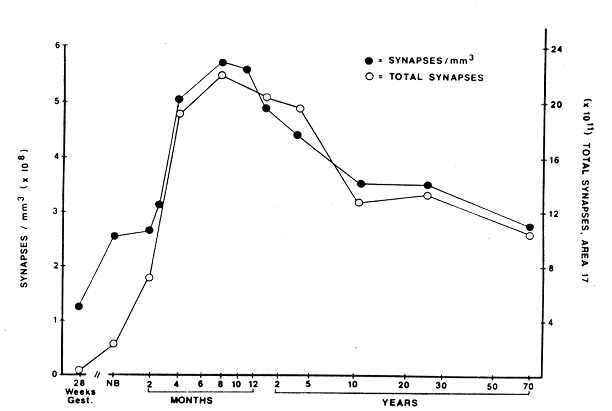
In the first few months of life, the neurons, on average, are more connected with each other than later in life.

If you click here you can see a graph of the number of synapses (inter-neuron connections) present in the human visual cortex by age.

According to the study that this graph is taken from, the peak time for synaptic connections is 6 months old. After that the number rapidly decreases.

This happens because connections that aren’t used disappear on a ‘use it or lose it’ basis, and the ones that are left form the more permanent connections in the brain.

In other words, from all the random variation, the weak connections die out and the strongest survive.

Edelman also argues that this principal applies to larger patterns of activity in the brain – with past and ongoing experience determining what can be considered useful.

Edelman talks about his theory and how he thinks it is crucial in understanding consciousness, and also how his research group is attempting to build robots based on the same principal.

Link to Edelman interview in Discover magazine.

Dreaming of the dead

The New York Times has an eye-opening article on research that has looked at how contents of dreams can be linked to emotional concerns – particularly when they relate to lost loved ones or turbulent life events.

‘Dream interpretation’ has got a bad name, partly due to the proliferation of books that claim to ‘decode’ dreams on a seemingly random basis (e.g. lemon = unrequited love), and partly because of its importance in the history of Freudian psychotherapy, which is now deeply unfashionable in some quarters.

Unfortunately, this has meant that research on the content of dreams has also fallen out of favour, despite the fact that it remains an interesting scientific topic and is still of clinical concern.

Modern psychotherapists will occasionally get into discussions about dreams, but, these days, will tend to avoid a strictly Freudian approach of trying to ‘interpret’ them.

Instead, they might use them as a point of discussion to make sense of real life concerns.

For example, if you’ve been particularly disturbed by a dream about work, it might be an opportunity to reflect on how you’ve been dealing with work-related stress, particularly if your reaction to the dream was quite a surprise in itself.

The NYT article looks research on the content of dreams, particularly ‘big dreams’: those of a more profound nature, often concerning deaths or other significant losses.

“Back to life” or “visitation” dreams, as they are known among dream specialists and psychologists, are vivid and memorable dreams of the dead. They are a particularly potent form of what Carl Jung called “big dreams,” the emotionally vibrant ones we remember for the rest of our lives.

Big dreams are once again on the minds of psychologists as part of a larger trend toward studying dreams as meaningful representations of our concerns and emotions. “Big dreams are transformative,” Roger Knudson, director of the Ph.D. program in clinical psychology at Miami University of Ohio, said in a telephone interview. The dreaming imagination does not just harvest images from remembered experience, he said. It has a “poetic creativity” that connects the dots and “deforms the given,” turning scattered memories and emotions into vivid, experiential vignettes that can help us to reflect on our lives.

Link to article ‘Winding Through ‚ÄòBig Dreams‚Äô Are the Threads of Our Lives’.

Unconscious inspiration

I’ve just found an article from The Psychologist that examines historical accounts of sometimes world-changing ideas which have seemed to arrive during sleep or dreaming.

The article looks at inspirational slumber which has inspired everything from sewing machine designs to the theory of relativity.

The author, psychologist Josephine Ross, has discovered some great examples. My favourite being from horror writer Stephen King on how the plot for his novel Misery came to him when he fell asleep on a plane.

Ross notes that people’s own insight into whether the dream was genuinely the inspiration may not be entirely accurate.

They may just have been ‘incubating’ the idea (having it ‘at the back of the mind’) and because we sleep so often, it might be easy to attribute it to last night’s dreaming.

However, a study published in Nature in 2004 suggested that sleep might genuinely help in problem solving.

The researchers found that volunteers asked to complete maths problems were three times more likely than sleep-deprived participants to figure out a hidden rule for solving the problem if they had eight hours of sleep.

Link to Psychologist article ‘Sleep on a problem… it works like a dream’.

Shapes of thought

Neurofuture has picked up on a fantastic science-art project that is creating beautiful ‘thought images’ by visualising EEG readings in 3D.

The project is part of the Einstein’s Brain collaboration which involved two artists, Alan Dunning and Paul Woodrow, and medical researcher Morley Hollenberg.

The image on the left is the visualisation of anger. The image is described:

The shape of anger. Hypnotised participant’s thought form emerges as she recalls an incident in which she became uncontrollably angry. In this visualisation the elements are separated to show background of beta activity from 15 to 25 Hz from which emerges a dynamic form generated by wild swings between beta and alpha activity in the range 4 – 30 Hz, as she oscillated between meditative recall and consciousness.

Link to Neurofuture on the project.
Link to more ‘Shapes of Thought’.

Is bigotry a mental illness?

The Psychiatric Times has an interesting article discussing whether bigotry should be classified as a mental illness. The author concludes no, but the discussion gives an important insight into how we decide what is a mental illness and what is not.

Most people might think that an opinion, no matter how disagreeable, shouldn’t get someone diagnosed with a mental disorder.

The difficulty comes when deciding what criteria you should use to decide that someone’s mental state has gone beyond what is normal and should be considered an illness.

Generally, if a mental state is considered to cause distress or impairment, it’s considered to be a sign of mental illness.

This goes for physical illness as well. A physical difference is only considered an illness if it causes problems as a result.

However, someone who is extremely racist might genuinely suffer problems as a result of their opinions.

As we reported previously, a small group of psychiatrists are pushing for a diagnosis of ‘racist disorder’ to be included in the next revision of the diagnostic manual on this basis.

One argument to be wary of in the justification of this, or any other mental disorder, is that ‘it must exist because biological differences can be found between people thought to have the condition and those without’.

As the mind and behaviour is just a reflection of brain function, any difference, no matter how trivial (ice cream preference for example), will have a related biological difference.

As with physical illness, biological differences in themselves can’t define an illness, because they have to be linked to what is considered serious distress or impairment in everyday life.

Biology might tell us why the difference occurs, but it can’t tell us whether the difference should be considered good or bad.

This decision is essentially a value judgement, because what is considered serious, distressing, impairing or relevant to everyday life aren’t cut-and-dry decisions and are made on the basis of a consensus of opinions.

In some cases, such as cancer, it’s easy, because everyone agrees that an early painful death is bad.

In other cases, particularly for mental illnesses, the issues can be a lot less straightforward because there there are few obvious and direct effects of mental states.

These issues ask us to question what we consider an illness and highlight that the decision is as based as much on social considerations and context, as on the science of biology.

The Psychiatric Times article tackles exactly these sorts of issues in its discussion of bigotry, and is a great guide to the philosophical issues involved in classifying mental disorder.

If you want to explore further, the Stanford Encyclopedia of Philosophy has a great entry on mental illness that tackles many of the conceptual difficulties.

Link to Psychiatric Times article ‘Is bigotry a mental illness?’
Link to Stanford Encyclopedia of Philosophy entry on mental illness.

Harnessing humans for subconscious computing

Technology Review has an article on using humans as part of a digital face recognition system. Uniquely, you don’t have to take part in any deliberate recognition, the system uses electrical readings to automatically measure the response of the brain – even if you’re not aware of it.

The system, developed by Microsoft Research, takes advantage of the fact that when we see something we recognise as a face, a specific electrical signal is generated by face-perception brain activity that can be picked up by electrodes.

Crucially, this brain activity happens automatically, we don’t have to make a special effort.

Last year, I wrote an article entitled ‘Hijacking Intelligence‘, noting that software is increasingly being designed to use humans as ‘biological subroutines’ for the things computers find most difficult.

Labelling pictures is one such task – it’s something humans find trivial, computers find difficult, and it’s needed in large numbers to create an index for image searches.

To get round this problem, Google designed an online game that involved labelling pictures. Humans play for fun, while Google get the benefit of your intelligence for their database.

This new system takes it a step further, as you don’t have to be doing anything related for it to take advantage of your ‘mental work’.

For example, a picture could flash up every time you hit save on a word processor, or every time you look at a certain website.

Each time your brain signals that you’ve seen a face, the system reads your recognition activity and sends it back to the main database to classify the image.

This might be one way of sifting through security images to see which should be inspected in more detail.

As a substitute for advertising, maybe you’d be offered free internet access if you had the system installed. Your brain would pay the bills.

While the system has only been developed as a proof-of-concept, it’s interesting, if not a little scary, to speculate how technology will harness our mental skills, even when we’re not aware of it.

Link to Technology Review article ‘Human-Aided Computing’.

The attractions of complex plastic bags

Another snippet from the Journal of Forensic Sciences, this time from a post-mortem case report from the July edition:

“We here report the case of a 34-year-old man who died due to asphyxia, secondary to body wrapping in the largest and most complex plastic bag ever involved in a published case of autoerotic death.”

People are sources of such surprising sexual diversity and you can just feel the curiousity radiating from the case report.

Despite the seemingly unusual nature of the death, over 400 autoerotic fatalities have been reported in the medical literature, suggesting that similar practices are probably conducted safely on a much wider basis.

For people who deal with tragic circumstances on a day-to-day basis, the intellectual fascination helps cope with the emotions these sorts of cases stir up.

I remember sitting in a cafe with a forensic psychologist happily chatting away, when the people next to us stood up and moved to another table as they seemed to be increasingly put off their food.

Being able to eat lunch while discussing gruesome case reports is one of the benefits of this form of coping strategy.

Link to abstract of ‘Complex autoerotic death with full body wrapping in a plastic body bag’.

Homosexuality in body, brain and behaviour

The New York Magazine has an in-depth article on the science of sexual orientation and whether the biological factors which may make someone more likely to be gay, also make them more likely to appear gay to others.

There are now a range of established findings that suggest that gay men are likely to have a number of physical traits not shared by straight men (the findings on gay women are a lot less clear-cut it seems).

For example, a 2004 study [pdf] found that gay men were much more likely to have a counter-clockwise hair whorl (as pictured) than straight men.

Other studies have found differences in finger lengths, size of structures in the hypothalamus (a deep brain area), and on a number of psychological abilities like mental shape rotation and navigation to name but a few.

Some researchers believe that the same biological conditions that increase the chances of homosexuality, also increase the chances of some of these body, brain and mind differences.

While genetics is thought to play a part, researchers are also interested in the time when an unborn child is developing in the womb.

Interestingly, many of the differences are linked to hormone exposure in the womb and can be seen to different degrees in both gay and straight men.

One of the critical questions is still how much of the influence is to do with biological factors and how much with social influence, opportunity and freedom of expression.

The New York Magazine is a fantastic guide to the science of sexual orientation, but is also a wonderful commentary on how this research is perceived by parts of the gay community and what it might mean for gay politics.

The only slight drawback is that it repeats the ‘scientists tried to turn sheep gay’ myth, but apart from that, it’s a compelling read.

UPDATE: Discover Magazine just had a feature article on the genetics of homosexuality which accompanies this piece nicely.

Link to article ‘The Science of Gaydar’.

Mirror touches

Nature reports on a recently discovered form of synaesthesia where affected individuals actually feel a sensation when they observe someone else being touched.

Synaesthesia is a condition where senses become crossed, so people might seeing colours when they encounter numbers, or tastes when they hear certain words.

This new form of synaesthesia was found by accident, during a talk by neuropsychologist Dr Jamie Ward:

“We first came across the mirror-touch synaesthesia by chance,” says Ward. The sensation of touch was being discussed at a UCL neuroscience seminar, and someone suggested, as a thought experiment, imagining that people felt what they saw. A colleague of Ward’s objected, vigorously insisting that everyone does, in fact, feel what they see. It was the first time Ward had realised such a condition could exist.

“There may be a lot of such people around, since they are unaware that that they have the condition. They think it is normal,” says Ward. When he started to look for people who experience mirror-touch synaesthesia, he had little trouble finding them, he says.

Ward collaborated with Michael Bannisy to study the condition and they found that they affected people were more likely to confuse an observed touch with a real touch than unaffected people under experimental conditions.

They also found that people with the condition were especially sensitive to other people’s emotions, rating much higher on measures of emotional empathy.

The study is published in Nature Neuroscience but I’ve just discovered there’s also a great write-up over at The Neurophilosopher.

Link to Nature news story.
Link to write-up from the The Neurophilosopher.

The psychology of self-accusation, from 1902

Every month, the British Journal of Psychiatry has a section that prints 100-year-old excerpts from medical journals relevant to modern psychiatry.

They are usually both fascinating and shocking. As a brief window on the past, they can show a very different understanding of mental disorder, but not always the respect that people with psychiatric difficulties deserve.

This from a 1902 letter to the Lancet about people who go to court to accuse themselves of a crime that they haven’t committed.

The committal of a notorious crime which excites popular imagination and which remains undetected for a time often leads to the appearance in law courts of self-accusing culprits who charge themselves with being the authors of the crime in question. Dr. Ernest Dupr√© of Paris in a paper read before the Annual Congress of French Alienists and Neurologists recently held at Grenoble attempts to delineate with exactitude the psychological nature of “auto-accusation” and to show that certain morbid elements play an important part in it.

He points out that “auto-accusation” is not often or merely the result of a weak-mindedness; the subject of it is a person who has positively developed general ideas of unworthiness, guilt, and remorse, and in a word is suffering from mild melancholia with vague delusions of guilt and sin. Another type of self-accuser is the proud and vain “degenerate” who with a brain warped by congenital anomaly of development constructs romances of which he readily persuades himself to be the hero or the martyr.

There is, adds Dr. Dupré, a marked contrast between these two types. The one is abject, lowly, self-humiliating; the other proud, egiostic, and vain. Among other types of the same abnormality are found persons of alcoholic or hysterical character.

The full letter goes on to describe the supposed characteristics of the ‘alcoholic self-accuser’ and the ‘female self-accuser’ who was apparently likely to be suffering from ‘marked hysteria’.

One of my favourites is a curious case report of a Cambridge student who had seemed to have lost his identity.

There’s many more historical gems in the archives that are well worth checking out.

Link to ‘100 years ago’ section of the British Journal of Psychiatry.