More than just bumps

Phrenology was the practice of reading someone’s personality from the bumps on their head based on the idea that the shape of the brain affected the shape of the skull.

Contemporary neuroscience lectures often have a part where the professor puts up an image of a phrenology head and says “although this was a rediculous concept, it sparked the idea that the brain could have parts that were specialised for particular functions”.

Phrenologists are usually considered to be quacks and that serious neuroscientists ‘took over’ from where they left off, but I’ve found lots of old copies of The Phrenological Magazine in the Institute of Psychiatry library and it turns out they had a keen interest in serious neuroscience.
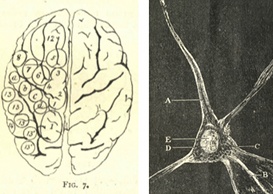
PhrenologicalMagazineNeuroanatomyThe images on the right are from the June 1890 edition (the brain) and October 1895 edition (the neuron) and both show some of the then cutting-edge neuroscience that the magazine regularly featured.

The brain is from the work of legendary neurologist David Ferrier showing his map of cortical functions transposed from his work on open-brain stimulation on animals.

The second image shows the structure of the neuron. The text describes how “molecular movements generated within any individual cell can probably be transmitted to other cells in the same striatum in the cortex” and the feature article goes on to highlight the latest discoveries in neuronal function.

It’s worth saying that this detailed discussion of neuroscience with accurate neuroanatomical images is far more common in the magazine than phrenological brain maps. It seems serious medical men wrote some of the articles and neuroscience debates are common in the pages.

The magazine is not without a bit of kookiness, however, although it’s hard to judge how much of this was considered kooky at the time.

My favourite part is where every issue has a portrait of a famous person with an interpretation of their character underneath. This is the interpretation from the portrait of Lord Wolseley, new head of the British Army, from October 1985.

The head of the new Commander-in-Chief indicates a fair balance of all the powers of his mind. He has no superabundance in any particular to give bias, no special deficiency to cause eccentricity. His head is well formed and appears to be well-developed in all parts.

Inside one issue I found an insert that just said “WANTED TO PURCHASE: a Tatoo’ed New Zealander’s Head. – Apply to Major-General H. ROBLEY, 7 St Alban’s Place, Haymarket”. It turns out that Robley was a renowned collector of such things and it seems phrenologists were one of his sources.

In fact, the magazines are full of wonderful adverts. This list of ‘penny lectures’ isn’t that different from pop psychology and neuroscience today.
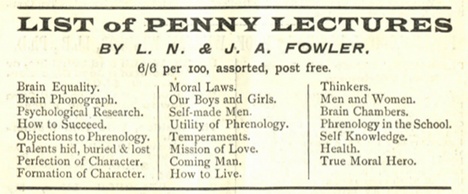
There’s some good names for a band lurking in there.


Fragments of identity

Photo by Flickr user  аrtofdreaming. Click for source.The Atlantic has a sublime article on identity, memory and amnesia – written as a reflection on meeting a friend who has lost much of his memory due to an advancing brain tumour.

The author is neuropsychologist Daniel Levitin who is better known for his work on the cognitive science of music, but here he writes beautifully about how theories of memory can blend uncomfortably with individual experience.

Once Tom and I were sitting next to each other when Pribram told the class about a colleague of his who had just died a few days earlier. Pribram paused to look out over the classroom and told us that his colleague had been one of the greatest neuropsychologists of all time. Pribram then lowered his head and stared at the floor for such a long time I thought he might have discovered something there. Without lifting his head, he told us that his colleague had been a close friend, and had telephoned a month earlier to say he had just been diagnosed with a brain tumor growing in his temporal lobe. The doctors said that he would gradually lose his memory — not his ability to form new memories, but his ability to retrieve old ones … in short, to understand who he was.

It’s a wonderfully written piece that is subtly recursive, like memory itself.
 

Link to Atlantic piece on memory and identity (via @edyong209)

Rita Levi-Montalcini has left the building

Nobel-prize winning neuroscientist Rita Levi-Montalcini has passed away at the age of 103, just a few months after publishing her last scientific study.

She won the Nobel Prize for the discovery of nerve growth factor along with her colleague Stanley Cohen and continued worked well past the time when most people would have retired.

Her most recent scientific study was published earlier this year, at the age of 102, and extended the work for which she won the Nobel.

If you want more background on a fantastic neuroscientist and her ground-breaking work, Nature published a profile in 2009, on her 100th birthday.
 

Link to obituary in the New York Times.
Link to Nature profile.

In other news: behind the video game scare

The research on the psychological impact of video games tells quite a different story from the stories we get from interest groups and the media. I look at what we know in an article for The Observer.

Perhaps the two biggest concerns are that video games are ‘damaging the brain’ and that violent video games are causing, well, violence.

It’s first worth noting that talking about the impact of ‘video games’ as a whole is about a pointless as talking about the health effects of ‘sports’ as a whole.

However, we do know that certain sorts of video games have specific effects. For example, we have increasing evidence that ‘action video games’ lead to significant improvements in certain mental skills.

The number of aliens you kill may directly contribute to an improvement in your brain. This may not sound like a typical scientific discovery, but it has come from some of the world’s finest neuroscience laboratories. In fact, it is the genuine outcome of studies on how action video games can improve your attention, mental control and visual skills. We’re talking here about fast-moving titles such as Halo, Call of Duty and Grand Theft Auto, which demand quick reflexes and instant decision-making. They’re often portrayed as the most trashy, vapid and empty-headed forms of digital entertainment, but it looks as if they may be particularly good at sharpening your mental skills.

As the article makes clear, this has been tested quite rigorously, including with randomised controlled trials.

With regard to violence, violent video games have been found to cause small, reliable but temporary increases in aggressive thoughts and behaviour in the lab – as have other forms of violent media, including films and the news.

But in terms of real-world violence “delinquent peers, depression and an abusive family environment account for actual violent incidents, while exposure to media violence seems to have only a minor and usually insignificant effect.”

Nevertheless, the video game utopians also have reason to think again. There are some negative effects of spending too much time in front of the console, which are also tackled in the article.
 

Link to Observer article on the science of how gaming affects us.

The stem cell scammers

Image from Wikipedia. Click fo source.Ukraine has become a world centre for untested stem cell treatments where patients can fly in and have embryonic stem cells implanted in their brain to supposedly treat everything from Alzheimer’s disease to autism.

These treatments are entirely unproven and are illegal in most of the world but are available for anyone wanting to pay the price.

Embryonic stem cells are a type of cell that can turn into any type of tissue in the body and can keep on dividing, in principle, endlessly.

They are named ’embryonic’ because these cells are particularly important, as you can imagine, in the development of the human embryo which needs to grow and differentiate into a rapidly developing complex organism.

A lot of the cutting-edge science is now focussing on ‘reprogrammed stem cells’ – which are adult cells genetically altered to revert to stem cells.

But stem cells used in experimental treatments are often taken from genuine human embryos, usually sourced from IVF fertility treatments.

Here, the egg is fertilised with the sperm in the lab (hence ‘test tube baby’) and the nascent embryo is implanted into the woman’s body after a few days – typically, when it has between 10 and 100 cells and is invisible to the human eye.

However, only the most viable embryos are implanted so there are often some left over. Most mainstream stem cell treatment research uses these as a source of stem cells (although science is increasingly turning to ‘reprogrammed stem cells’ as they’re potentially easier to produce and less controversial).

It’s worth saying that stem cell treatments in themselves are not necessarily bad thing but they are currently at the research stage and so are only usually given as part of scientific programmes to test their safety and usefulness.

The commercial treatments available in the Ukraine are notable for two reasons.

The first is that they typically use stem cells from aborted fetuses “of 5–8 weeks of gestation”.

The second is that they are either entirely untested or have never been confirmed as either safe not effective.

After a brief search it seems there are many commercial companies who offer stem cell therapies that would be illegal in most other countries.

This is quite shocking in itself, but perhaps the most disturbing practice is implanting fetal stem cells into the brains of children with autism.

Brain surgery is dangerous, implanting biological material from other sources even more so, and bear in mind we are talking about treatments that have never been scientifically tested.

This is from the website of one of the biggest Ukrainian stem cell clinics that advertises this ‘service’ and justifies it with lot of scientific bunk:

Fetal stem cells (FSC) that we use in autism treatment positively affect all body organs and systems, and, first of all, this treatment targets the brain. In autism, areas of brain regulating memory, concentration, attention, speech etc. are damaged. Stem cell treatment improves blood and oxygen flow to the brain (improved perfusion), replaces damaged neurons and stimulates formation of the new arteries. After some time, FSC acquire properties of cells surrounding them and multiply into these cells, which results in white and gray matter restoration and, consequently, in subsidence of neurologic symptoms and improved intellectual capacity.

The shady ‘stem cell therapy’ industry is expanding across the world and is increasingly targeting behavioural and psychological disorders.

Companies are advertising ‘treatments’ for, among other things, schizophrenia, depression, addiction and suicidal thinking.

In one particularly worrying testimony video and advert a father apparently describes how ‘stem cell therapy’ treated his son’s “childhood depressive disorder” although the symptoms and outcomes seem to be more about him being a well behaved kid.

Stem cells for neurological conditions are still an experimental treatment. They may yet be one of the greatest medical advances of the 21st century but they don’t work by being added to the brain like some sort of neurological band aid.

Unfortunately, these unproven treatments are already a massive industry and their promise is being hijacked by quacks to exploit the desperate.

Fashions fade, style is eternal

A fascinating study has just mapped which brain areas are most popular among scientists and which are most likely to get you published in the highest impact journals.

The image below looks like the result of an fMRI scan but instead of showing brain activity from a single experiment, it shows the average brain activity from almost every brain imaging study from 1985 to 2008.

In other words, it shows the popularity of different brain areas as reported in cognitive neuroscience publications.

Behrens_et_al_Figure

Actually, if you think about it, this map shows a mix of how often the brain area is active (some areas – like the insula – are active in about a third of imaging experiments so will be more likely to be ‘popular’), how likely the results are to be published, and how motivated scientists are in targeting the area – all of which contribute to their ‘popularity’.

However, the researchers went one stage further and looked at how brain areas are linked to publication in a top tier journal:

…researchers who find activity in a prescribed part of the fusiform gyrus should be confident of having their article selected for publication in a high-impact journal, perhaps due to the role of the region in face processing. Other regions with proposed roles in emotional processing returned similarly stellar performances, including both the ventral and dorsal portions of the rostral medial prefrontal cortex, the anterior insular cortex, the anterior cingulate gyrus, and the amygdala.

The recent interest in reward prediction errors might explain impactful peaks in the mid-brain and ventral striatum, areas that exhibited independent significant effects of impact factor, publication date, and their interaction: studies reporting activation in these regions are published in high-impact journals, and are increasing in number (as a proportion of all studies) over time.

Activity in a contrasting set of regions was negatively predicted by impact factor. Leading the way in ignominy was the secondary somatosensory area, but the supplementary motor area was almost equally disgraced.

The researchers also mapped this onto the brain and although the article is locked, the diagrams are free, and if you look at the second diagram on this page you can see what amounts to a career progression map of the brain.

Studying the red areas are what’ll get you published in the best journals.

So when someone tells you that science is the ‘march of progress’ just remember that it’s actually more like that time when flairs were cool again.
 

Link to locked study with open diagrams (via @hugospiers)

The relative consuming disease

The Global Mail has an amazing story about how the last treks to find cases of kuru – a cannabalism-related brain disease – have been completed.

Kuru was passed on by eating the brains of dead relatives – a long finished tradition of the Fore people in Papua New Guinea – and it infected new people through contact with prions.

Prions are misfolded proteins that cause other proteins to take on the infectious misfolding. In the case of kuru it lead to shaking, paralysis, outbursts of laughing and a host of other neurological symptoms as the brain slowly degenerated.

No-one knew prions existed or could exist before kuru. But as the article makes clear, this ‘obscure disease’ of a remote tribe revolutionised our understanding of proteins and how infections could take place.

But the story is how it was discovered is more than just lab tests and the article is a brilliant retelling of the research.

Michael Alpers has been working on the research project since the 60s and recalls some of the episodes:

After each death, he says, “I would go and talk to the family again, and say, ‘Okay?’. They had participated in cutting up bodies in the past — so that was not an unusual activity for them. We had to clear a few people — particularly the women who were wailing. But some of the women stayed. The ones involved put on masks to protect the tissue and I had gloves.

“The father, or a close relative, would hold the head, and I would take the top of the skull off with a bone handsaw. It would take maybe 20 minutes… like cutting an avocado. I would go to particular parts of the brain… take out small cubes. My assistant would hold out the bottle that was relevant, take the lid off, and I’d pop it in.

“Then I’d take the whole brain out and put it in a bucket full of formalin and cotton wool so it wouldn’t be deformed, and put the lid on. All our samples would go into an insulated box. Then I put the skull cap back on, and sewed up. Then we said goodbye… gave everyone a hug, and took off. I did this five times. It was enough.”

It’s a wonderfully written, informative piece. A long and compelling read.
 

Link to article ‘The Last Laughing Death’ (via @mslopatto)

A brief reheating of the refrigerator mother

The Telegraph has a well-intentioned but confused article about how child neglect affects the brain and what can be done about it.

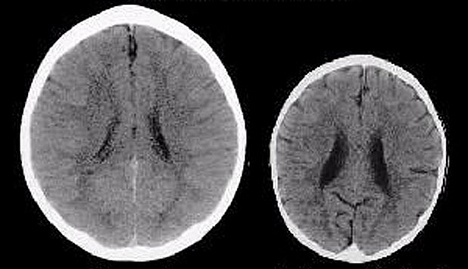
What’s the difference between these two brains? asks The Telegraph. “The primary cause of the extraordinary difference between the brains of these two three-year-old children,” says the journalist, “is the way they were treated by their mothers.”

According to the paper “The child with the much more fully developed brain was cherished by its mother, who was constantly and fully responsive to her baby. The child with the shrivelled brain was neglected and abused.”

Firstly, it’s worth saying that reduced brain size is clearly related to neglect and abuse but the images are not a typical representation of this.

These scans were originally published in an article on child abuse by neuroscientist Bruce Perry who drew them from an unpublished abstract [pdf] of a study on neglect in children, which didn’t control for malnutrition or drug exposure during pregnancy.

They’re described as showing CT scans of three-year-olds, one normal and the other neglected who has a head size smaller 97% of children his or her age. This would make him or her almost diagnosable with microcephaly, a neurological disorder of small head size usually caused by a genetic defect.

This difference in brain size has actually been found in those without the genetic defect. In fact, this difference was found in a study of severely neglected Romanian orphans but severe malnutrition was also a significant factor.

In other words, unless you include ‘starvation’ under the concept or ‘poor interaction with the mother’ the scans really don’t represent what typically happens to children who are emotionally neglected.

Oddly, the Telegraph article spins brain development as specifically depending on the mother, giving an undercurrent of traditional mother-blaming.

Neurologists are beginning to understand exactly how a baby’s interaction with their mother determines how, and indeed whether, the brain grows in the way that it should.

The ghost of the refrigerator mother rises again.

The piece is full of other neurological howlers: “Eighty per cent of brain cells that a person will ever have are manufactured during the first two years after birth” is just baffling, considering we are born with almost all the neurons we will ever have.

The number of synapses – connections between brain cells – does increase after birth but at most by about two thirds. The number peaks between about one and four years, depending on the brain area, and then it rapidly decreases as the brain removes unused connections in a process called synaptic pruning.

The words of neuroscientist Allan Schore seem to have be carefully selected to bolster this scientific misunderstanding, despite the fact his actual quotes do not suggest that he thinks brain cells ‘grow’ after birth.

Furthermore, the idea that “if a baby is not treated properly in the first two years of life, the genes for various aspects of brain function, including intelligence, cannot operate” is seemingly a fuzzily remembered misunderstanding of the role of stress on the epigenetics of neural development.

In fact, it looks like the piece has been written to support a government commissioned report by MP Graham Allen developed from an earlier report by think tank The Centre for Social Justice.

Both present the brain scans, somewhat misleadingly, as a reasonable illustration of emotional neglect, and the first report, scientifically, is a bit ropey. The second though, is surprisingly good.

It actually talks little about the brain, doesn’t feel the need to get into mother-blaming, argues that more support is needed for young children below the age of three from early intervention programmes.

This is a valuable approach and a valid point of view, which The Telegraph article is right behind, but neither brain-shrivelling mothers nor scare tactics are needed.
 

Link to somewhat confused Telegraph article.
Link to scientific review on brain effects of child abuse.

The neuroscience of sexual attractions

A recent edition of radio programme KERA Think has a fantastic discussion on development and the neuroscience of sexual attraction in its many forms.

The programme is a discussion with Simon LeVay, a neuroscientist who raised a lot of eyebrows by finding differences in the brain structure of gay and straight men in a 1991 study.

The science has massively advanced since then and LeVay gives a fascinating and lucid account of what know about the biology of the rainbow of sexual attraction – and where the mysteries still lie.
 

Link to programme page with streamed audio.
mp3 of podcast.

A history of ideas about the brain

Being Human has an excellent article on how ideas about the function of the brain have evolved over the centuries.

The piece is by respected science writer Carl Zimmer who wrote a fantastic book on the dawn of modern neuroscience called Soul Made Flesh.

This new article is a whistle stop tour of how our ideas about the brain have changed over the last three millennia:

For all the cognitive power that the human brain contains, it’s also exquisitely delicate. It has the consistency of custard. When an ancient anatomist decided to investigate the organs of a cadaver, he would have had no trouble pulling out the heart and manipulating its rugged chambers and valves. But after death, the brain’s enzymes make quick work of it. By the time the anatomist had sawed open the skull, he might well be looking at nothing but blush-colored goo. Who could ever think that in that goo could be found anything having to do with our very selves?

The site it’s written for, Being Human, seems to be a think tank funded social network and blogging platform for human nature geeks.

I’m not sure we need another topic specific social networking platform, most of which suffer from the fact people can’t be bothered to reconstruct the cliques they have from existing general purpose platforms (i.e. life), but it does seem to be filling up with interesting content (i.e. ideas).
 

Link to ‘From Cooling System to Thinking Machine’.

Hallucinations on the radio

BBC Radio 4 has just broadcast a documentary entitled ‘Hallucination – Through the Doors of Perception’ that charts the various ways in which we can experience freewheeling and autonomous perceptions.

You can hear it streamed online here or you can download it as a podcast but only for 7 more days, as like French cheese, mp3s can make you ill if they’re left out for too long.

Despite the fascinating topic, it’s actually a bit dry. It sounds like the Hitchhiker’s Guide to the Gallery without the witty commentary.

Definitely worth listening to, but probably improved by a stiff drink, or perhaps something a little hallucinatory.
 

Link to streamed version of hallucinations radio documentary.
Link to shortly to expire podcast page.

The great rock n’ roll brain scramble

It’s not often you see someone licking a brain in a rock n’ roll video and get to think to yourself “well, there’s a funny story behind that”, but this is one of those occasions.

The video for singer Candice Gordon’s new single Cannibal Love starts out as a TV cooking programme and ends in a cannibal cook-out with the brain as the pièce de résistance.

Oddly, I met Candice when I was living in Dublin when she came to a neuroscience talk I did in a pub. She was both interested in neuroscience and just starting out on her music career.

All these years later, she’s still interested in neuroscience but is now touring the world with her startling blend of big band voodoo blues.

In contrast, I’m still doing talks in pubs.

So kids, er… stay in school.
 

Link to Candice Gordon’s Cannibal Love video.

The Lancet, [temporarily] seized by irony

The Lancet has just a launched a special collection on how epilepsy is a global health problem particularly in lower-income countries.

According to several of the articles, one of the key problems that drives the medical neglect of people with epilepsy is a lack of accurate information about the condition for health professionals and the public.

How ironic then that The Lancet have put the five key scientific review articles from the series behind a paywall – costing $31.50 each. That’s 157.50 dollars for all five.

According to the figures cited in special collection, in a low income country $157.50 dollars would pay for a year’s epilepsy treatment for up to 31 people (using the cheapest anti-epileptic drug phenobarbital).

In some countries in sub-Saharan Africa, $157.50 would pay the monthly salary of a dedicated epilepsy nurse.

Or you can pay for five Lancet review articles that provide not only accurate, evidence-based treatment recommendations for epilepsy but also lament the lack of freely available, accurate, evidence-based treatment recommendations for epilepsy.

UPDATE: The Lancet has announced that all articles are now freely available to anyone who completes the free registration on their site. Credit where credit’s due – an excellent move. Many thanks to them.


Link to Lancet special collection on epilepsy.

Schizophrenia beyond the brain

The Wilson Quarterly has an excellent article about the rebirth of interest in how social experiences affect the development of schizophrenia.

It’s written by the brilliant anthropologist Tanya Marie Luhrmann, who tracks how the enthusiasm for a completely neurobiological explanation for the disorder has now begun to wane.

It’s worth saying that this extreme neurobiological focus has really been an American phenomenon.

While it’s true to say that psychiatry has taken a distinct neurobiological turn across the world, the mantra that ‘schizophrenia is a brain disease’ and only needs to be understood in terms of brain function has been most strongly championed in the United States.

For somewhat mysterious reasons, and not without a touch of irony, American psychiatry has been subject to quite striking mood swings over the past century.

The ‘Freudian takeover’ only really occurred in the US, and was overturned by the diagnostic manual championing ‘mid-Atlantics’ who created the DSM-III.

Subsequently, a dominant current of thought emerged that mental illnesses could be understood as ‘brain disorders’ – a concept massively promoted and funded by drug companies. Searches for the ‘gene for schizophrenia’ and the ‘brain circuit for depression’ were all the rage, even if they seem a little naive in hindsight.

In Europe, however, social psychiatry – where mental disorders are seen within a social context – remained widely taught. In the UK, it had more an an epidemiological flavour, where on the continent it was more focussed on analysing the cultural meaning of mental illness.

Nevertheless, Luhrmann’s article is an excellent overview of how psychiatry has started to look ‘beyond the brain’, although we’d hope it doesn’t lose sight of it while gazing at the horizon

My only significant problem was that the article repeats the ‘people with schizophrenia do better in the developing world’ claim, which is so over-general as to be useless.

Other than that though, an excellent incisive article and one of the best pieces you’re likely to read in a while.
 

Link to ‘Beyond the Brain’ in The Wilson Quarterly (thanks Peter!)