Could you endure such pain, at any hand but hers?

I finally got round to having a look at the New York Times migraine blog and found it full of fantastic writing and some wonderful artwork that aims to capture the perceptual distortions associated with the mother of all headaches.

There’s a particularly good article by Oliver Sacks (his first book was on migraine) who discusses the common geometrical patterns that can occur in the hallucinatory images, known as a form constants.

Interesting, the mathematician Paul Bressloff has suggested [pdf] that these necessarily arise when the firing of neurons in the primary visual cortex is destabilised.

Although Bressloff was particularly addressing certain hallucinations caused by psychedelic drugs, the form constants are, well, constant across conditions, so are likely to arise from a similar process in migraines too.

There are many more articles describing the science, personal stories and art of the head pounding, vision distorting and stomach churning headache. The gallery is particularly good if you’re not familiar with the range of visual effects.

However, no one seems to have touched on a poem by Robert Graves where he uses migraine as a metaphor for love (or is it the other way round?) capturing the beauty and pain of both.

Symptoms of Love

Love is universal migraine,
A bright stain on the vision
Blotting out reason.

Symptoms of true love
Are leanness, jealousy,
Laggard dawns;

Are omens and nightmares –
Listening for a knock,
Waiting for a sign:

For a touch of her fingers
In a darkened room,
For a searching look.

Take courage, lover!
Could you endure such pain
At any hand but hers?

Link to NYT’s Migraine Blog (via Neurophilosophy).

Maths and the numbers game in the brain

Frontal Cortex has alerted me to a wonderful article in The New Yorker about Stanislas Dehaene’s work on understanding the neuropsychology of number sense.

Like written and spoken language, human numerical abilities are quite astonishing for how they are organised in the brain.

After brain injury, various maths or numerical abilities can be shown to ‘doubly dissociate‘, meaning that parts of the ability can be independently damaged and so it can be inferred that they rely on independent (but, of course, interacting) brain systems.

The surprise comes from the fact that as a species, abilities like complex language, writing and maths are relatively recent cultural innovations.

While some of the core abilities may be inherited, there must be some aspects of the more complex skills which become tied up with the development of brain structure as we grow to account for the way in which they break down in very selective ways after brain damage.

Dehaene is one of the key researchers in understanding the neuropsychology of numerical ability and what he calls ‘number sense’ – a more general intuitive perception of quantity and number.

It has been suggested that this is also linked to other ways of perceiving the world, as can be seen from some strange interactions between number and space that can be seen in experiments:

But the brain is the product of evolution—a messy, random process—and though the number sense may be lodged in a particular bit of the cerebral cortex, its circuitry seems to be intermingled with the wiring for other mental functions. A few years ago, while analyzing an experiment on number comparisons, Dehaene noticed that subjects performed better with large numbers if they held the response key in their right hand but did better with small numbers if they held the response key in their left hand.

Strangely, if the subjects were made to cross their hands, the effect was reversed. The actual hand used to make the response was, it seemed, irrelevant; it was space itself that the subjects unconsciously associated with larger or smaller numbers. Dehaene hypothesizes that the neural circuitry for number and the circuitry for location overlap. He even suspects that this may be why travellers get disoriented entering Terminal 2 of Paris’s Charles de Gaulle Airport, where small-numbered gates are on the right and large-numbered gates are on the left. “It’s become a whole industry now to see how we associate number to space and space to number,” Dehaene said. “And we’re finding the association goes very, very deep in the brain.”

The article is a great read and a useful introduction to some of the key findings in the field, as well as containing a whole load of eye-opening findings about number and the brain.

Link to New Yorker article ‘Numbers Guy’.

The metaphysics of a Jazz Thing

A fantastic study has just been released by open-access science journal PLoS One that investigated the neuroscience of jazz improvisation.

Jazz musicians were put inside an fMRI brain scanner and were asked to do complete a number of different musical exercises using a specially adapted magnet-friendly keyboard.

The musicians were asked to demonstrate musical scales, a pre-practised fixed piece, and an improvisation exercise while their brains were scanned.

A summary of the study by the John Hopkins medical school team gives the main results:

The scientists found that a region of the brain known as the dorsolateral prefrontal cortex, a broad portion of the front of the brain that extends to the sides, showed a slowdown in activity during improvisation. This area has been linked to planned actions and self-censoring, such as carefully deciding what words you might say at a job interview. Shutting down this area could lead to lowered inhibitions, Limb suggests.

The researchers also saw increased activity in the medial prefrontal cortex, which sits in the center of the brain’s frontal lobe. This area has been linked with self-expression and activities that convey individuality, such as telling a story about yourself.

Some years ago, psychiatrist Sean Spence suggested that Jazz music may have been born owing to the ‘the father of Jazz’, Buddy Bolden, having schizophrenia and suffering from associated frontal lobe impairments.

Spence argued that reduced frontal lobe function meant that Bolden could only improvise, as he didn’t have the cognitive control to stick to pre-learnt pieces.

At the time improvisation was considered a sign that you couldn’t play ‘proper music’ well enough, but Bolden took improvisation to a new level with wondrous flights of fancy and, as the legend goes, jazz was born. That’s not the whole story of course, but it’s possibly an ingredient.

While these new findings don’t give us much of a lead on whether this might have been the genuine beginning of jazz music, it’s interesting that the idea that reduced frontal lobe function ‘frees up’ the over-inhibited playing of set pieces, is consistent.

Link to PLoS One article on the cognitive neuroscience of Jazz.
Link to study summary.
Link to BBC News on Spence’s theory.

Psychosis and the coming glutamate revolution

Dopamine has been the big player in understanding schizophrenia since antipsychotic drugs were discovered. All current antipsychotics have their main effect by blocking dopamine function in the mesolimbic pathway and there’s now significant evidence that this is the location of one of the major dysfunctions.

It’s been clear for a while that this isn’t the whole story though. Ketamine and PCP, two glutamate-focused drugs that barely touch the dopamine system directly, are heavily linked to schizophrenia and can intensify psychotic symptoms.

Findings such as these have sparked a flurry of interest in understanding the role of glutamate in psychosis, and there’s now an intense interest in developing drugs that might target this system.

One of the key hopes is that these newer drugs will have fewer side-effects, as, in some, antipsychotics are have unpleasant and unhealthy adverse consequences.

The New York Times has just published a great article on the development of these new drugs, just in mid-testing stage, and on the neuroscience that motivates them.

People who use PCP often have the hallucinations, delusions, cognitive problems and emotional flatness that are characteristic of schizophrenia. Psychiatrists noted PCP’s side effects as early as the late 1950s. But they lacked the tools to determine how PCP affected the brain until 1979, when they found that it blocked a glutamate receptor, called the NMDA receptor, that is at the center of the transmission of nerve impulses in the brain.

The PCP finding led a few scientists to begin researching glutamate’s role in psychosis and other brain disorders. By the early 1990s, they discovered that besides triggering the primary glutamate receptors — NMDA and AMPA — glutamate also triggered several other receptors.

They called these newly found receptors “metabotropic,” because the receptors modified the amount of glutamate that cells released rather than simply turning circuits on or off. Because glutamate is so central to the brain’s activity, directly blocking or triggering the NMDA and AMPA receptors can be very dangerous. The metabotropic receptors appeared to be better targets for drug treatment.

The article talks about some of the new drugs in development, and the fact that this is where drug companies are placing their (quite substantial) bets at the moment.

Link to NYT article ‘Daring to Think Differently About Schizophrenia’.

Neurology podcasts – the shocking truth

The American Academy of Neurology are now doing fortnightly super-geeky podcasts that feature discussions about studies published in their journal.

If you’re not familiar with the arcane language of neurology – tough luck, as they make no effort to explain anything to the uninitiated.

They’re not quite as bad as the American Journal of Psychiatry podcasts (which I previously described as an ‘excessively thorough lecture given by a voice synthesiser’ although I’m actually finding the fembot voice rather sexy – is that wrong?) and include some discussion rather than just spoken summaries.

Occasionally, they throw a curve ball and include poetry, or a quick hint or tip for the clinician, but mainly they’re neurologists doing what neurologists do best – talking about brain disorders in lots and lots of detail.

Also, I challenge you not to shout out “Space. The Final Frontier!” when you hear the opening fanfare.

I keep mentioning them, but the Royal College of Psychiatrist’s podcasts are excellent – dealing with the nitty gritty of the science but also explaining the concepts and debating the controversial points. They really should be a model for others to follow.

And as an aside, Nature’s NeuroPod seems to be missing in action again.

Mind Hacks. The Perez Hilton of academic neuroscience podcast gossip.

The operation of the skulls: a trepanation video

Neurophilosophy has found a gory but completely astonishing film of a Kisi medicine man in Tanzania performing a trepanation operation. A young lady endures the seven hour procedure that puts a hole in her skull without any anaesthetic.

Mo has been doing some fantastic work on the history of trepanation and his illustrated article on the topic is a must read if you want an overview of this ancient procedure.

This film emphasises the importance of the operation in some cultures and highlights quite what a remarkable, if not, somewhat hazardous procedure trepanation really is.

And by the way, if you saw our recent rather whimsical post on ‘brain hats’, the end of the video gives a whole new meaning to the phrase.

Link to video of Kisi trepanation.
Link to illustrated history of trepanation.

Better living through caffeine

Developing Intelligence has a fantastic post on what pharmacology and neuropsychology has told us about getting optimally wired on caffeine.

In small amounts, caffeine boosts mental function, and the article looks at scientific studies that have told us which are the optimal doses, which psychological abilities are most affected and what you can take with caffeine to modulate its effect.

Obviously, caffeine has its health risks. Psychologically speaking, even everyday doses run the risk of withdrawal symptoms and have the tendency to increase anxiety, so as with any drug, it’s important to educate yourself so you can judge the risks for yourself.

The Wikipedia page on caffeine is wonderful, so it’s a great complement to the fantastic round-up of stimulation-related tips from Developing Intelligence.

Link to article ‘A User’s Guide to Getting Optimally Wired’ (via BadScience).
Link to Wikipedia page on caffeine.

Haunted by Dracula’s Teeth Syndrome

This case report from a 2001 study describes a patient with persistent headaches who experienced ‘phantom teeth’ – the sensation of non-existent vampire-like teeth in her mouth.

Phantoms‘ are often the result of having a limb or other appendage removed and can affect almost any part of the body (indeed, phantom penises have been reported in the medical literature).

In this case phantom teeth seem to have occurred after surgical removal of the gums, although this case is particularly interesting because the phantoms are for teeth that were never there in the first place.

Phantoms are thought to arise when the brain’s map of the sensory areas becomes distorted during re-organisation, after the actual sensations from the removed appendage stop.

A 52-year-old woman was referred to a neurologist because of right facial pain radiating from the malar region diagonally to the right upper lip area. She had pain for several months following upper and lower surgical resection of hypertrophic gums. The pain was severe, constant, and interfered with her sleep. She had no gustatory sweating or flushing of her face or neck. She developed symptoms of depression because of the chronic pain…

She reported a constant sensation of having two long extra upper canine teeth growing in front of her normal canines that felt like they were pressing on her tongue. The sensation was experienced as someone with vampire-like long upper canines (“Dracula’s teeth”)…

There was no family history of gum hyperplasia or supernumerary teeth. She complained of poor taste, forgetfulness, sleep fragmentation, and high-pitched ringing noises in her ears of long-standing. She had no burning of her tongue.

Link to abstract of scientific study.

The highs and lows of brain doping

Today’s edition of Nature has some commentary from scientists responding to their recent feature on ‘optimising’ the healthy brain with pharmaceutical drugs.

I suspect the letters have been edited a little though, as the first, from developmental psychologist James M. Swanson and neurobiologist Nora Volkow (who is also director of the National Institute on Drug Abuse) seems to suggest that enhancement drugs risk being addictive because:

…cognitive enhancers such as the stimulants methylphenidate (Ritalin) and amphetamine amplify the activity of dopamine, a neurotransmitter that increases saliency, making cognitive tasks and everyday activities seem more interesting and rewarding. This learned experience can lead to abuse of the drug and to compulsive use and addiction in vulnerable people.

These drugs are widely used for cognitive enhancement, but the issue is hardly new as these are relatively old drugs that almost solely target the dopamine system, whereas the newer ‘cognitive enhancement’ drugs (most notably modafinil) work in a quite different way (modafinil alters dopamine, among other effects, but it’s hardly comparable).

Hence, they do not have the same pharmacological potential for abuse and simply aren’t found to be as addictive as the amphetamines in the ‘real world’.

In fact, when the Nature article asked the hypothetical question whether you would take an enhancing drug if it had no side effects, it was almost certainly inspired by modafinil.

While the drug isn’t side-effect free (several are common) it tends to be significantly less risky than your typical high-charge dopamine agonist such as amphetamine, which can cause cardiovascular problems and psychosis to name but a few of its dangerous effects.

That issue aside, one of the most interesting points is made in a letter from philosopher Nick Bostrom who argues that drug companies should be allowed to develop enhancement drugs without having to specify an illness to treat.

He argues this is because the current system demands that drugs are licensed for a specific disorder, which means new disorders get invented (‘disease mongering‘) as a way of legitimising the sale of drugs which are helpful but for less serious problems of living, such as low-level anxiety, persistent tiredness or normal memory decline, but are not significant medical treatments.

So maybe the solution to the drug companies warping medicine is to allow them to sell drugs as ‘tonics’, rather than medications. Certainly food for thought.

There’s several other responses on the ethics and experiences of cognitive enhancement from some of the leaders in the field, so well worth a look through.

Link to ‘brain doping’ correspondence in Nature

My first book of hallucinogenic drugs

It’s not often a children’s book on hallucinogenic drugs gets written, but this seems to be one of those occasions. Matt Hutson has scanned in some remarkable pages from exactly such a book, published in 1991.

Apparently it’s quite comprehensive, covering everything from neurons to shamans, and is also full of funky illustrations.

The prose is lucid, but the pictures crack me up. Take the cover. Look kids, in a drug free zone, you can do all kinds of things, like play tic-tac-toe. Or even watch people play tic-tac-toe! And remember, friends don’t let friends wear non-footie pants.

In some cases the book might be counterproductive: “Have you ever looked at yourself in an amusement park mirror? Look what happened to you! Now, try to imagine that the whole world looked that way to you.” Awesome! Where can I get some?

Link to Silver Jacket on ‘Focus on Hallucinogens’.

New super low-power brain scans

Memoirs of a Postgrad has got a great write-up of a new low-power MRI machine, the technology that does most of the structural and functional brain scans. Even the smaller MRI machines need huge electromagnets, but this new technology uses magnets thirty thousand times weaker to image the brain.

In a standard MRI machine, a strong magnetic field is used to align the proton in each of the hydrogen atoms before using an RF pulse to knock them out of alignment. As they snap back into alignment with the magnetic field, they emit a signal which can be detected and used to create a 3D image. In the new version, the very small magnetic field isn’t enough to align the protons, so a short duration (1 second) magnetic pulse of slightly higher magnitude (30 millitesla).

The resulting signals are very small, so an array of highly sensitive magnetometers are used (so-called superconducting quantum interference devices, or SQUIDS). A hugely important additional advantage of using these SQUIDS is that they are also used in the MEG (magnetoencephalography) imaging technique. This potential for MRI and MEG using the same machine raises the intriguing possibility of producing simultaneous structural images (using the MRI) and brain activation maps (using the MEG).

Unfortunately, the use of SQUIDs dashes any hopes of making the machines much smaller.

The SQUID sensors need to be extremely cold (working at approximately -170 degrees C) and so are usually bathed in liquid nitrogen, meaning a huge insulated tank sits atop the scan area.

IEEE Spectrum magazine has an article with some images from the new type of scanner, which look pretty fuzzy at the moment, but apparently can better distinguish tumours in the brain and will undoubtedly become clearer as new software is developed.

Link to Memoirs of a Postgrad post.
Link to IEEE Spectrum article.

Depression, antidepressants and the ‘low serotonin’ myth

Bad Science has a fantastic article on antidepressants and the widely-promoted but scientifically unsupported ‘low serotonin theory’ of depression.

Owing to a huge advertising push by drug companies, not only the ‘man on the street’, but also a surprisingly large numbers of mental health professionals (clinical psychologists, I’m look at you) believe that depression is linked to ‘low serotonin’ in the brain.

The only drawback to this neat sounding theory is that it is almost completely unsupported by empirical evidence or scientific studies.

Experiments that have deliberately lowered serotonin levels in the brain have found that it is possible to induce ‘negative mood states’ (usually milder and as short-lasting as a slight hangover), but these do not even begin to compare to the depths of clinical depression.

In terms of patients with the clinical mood disorder itself, not a single study has found a link to reduced serotonin.

Bad Science neatly reviews the science, and also discusses a new research study which chased up journalists that propagated the myth to ask for their sources.

Needless to say, none of them had any sound scientific basis for their claims.

This is not to say that antidepressants don’t help treat depression, (evidence suggests they do – although the effect is more modest than drug companies would have us believe), or that neurobiology isn’t important (by definition, if it’s a change in thought and mood, it’s a change in brain function).

If you’re interested in the history of how the ‘low serotonin hypothesis’ came to be thought up and then subsequently promoted, despite the lack of evidence, Professional Psychology: Research and Practice recently published a great article on the topic [pdf].

Link to Bad Science on the serotonin myth.
pdf of article on the history and popularity of the myth.
Link to excellent PLoS Medicine article on evidence and adverts.

So long, and thanks for all the fish, suckers

SciAm’s Mind Matters blog has a completely fascinating post on the common assumption that humans have the the most complex brain of all the animals. Compared to a whale, however, our brain is smaller and has even less cortical folds. Does that mean they’re smarter?

The article is by neuroscientist R. Douglas Fields and takes a comparative look at brain size, relation to body size, and function across the species.

It turns out, we’re perhaps not quite so special as we like to believe. Even on the ratio of brain to body size, humans are beaten by the humble tree shrew.

We humans pride ourselves on our big brains. We never seem to tire of bragging about how our supreme intelligence empowers us to lord over all other animals on the planet. Yet the biological facts don’t quite square with Homo sapiens’ arrogance. The fact is, people do not have the largest brains on the planet, either in absolute size or in proportion to body size. Whales, not people, have the biggest brains of any animal on earth.

Just how smart are whales? Why do they have such big brains? Bigger is not always better; maybe the inflated whale brain is not very sophisticated on a cellular level. We’re closer to answering such questions now, for a couple of recent papers address them squarely. What they find is helping separate fact from fiction.

It turns out that while whales have bigger brains, humans have more neurons. Nevertheless, whales have more glial cells.

Glial cells were traditionally thought to do nothing more than support and insulate the neurons, but it’s becoming increasingly clear that they’re actually part of the brain’s processing system (although they’re exact role is far from clear).

So maybe there’s a lot more to the whale brain that it first appears.

Link to ‘Are Whales Smarter Than We Are?’.

Test your corpus callosum

I’ve just discovered a wonderfully simple finger touch procedure that can test the function of your corpus callosum, a key brain structure that connects the two cortical hemispheres.

It is called the ‘cross lateralization of fingertips test’ and was used in a 1991 study by Kazuo Satomi and colleagues.

It relies on the fact that different hemispheres are responsible for the movements and sensations from each hand.

In other words, each hand is connected to a different side of the brain, and, to allow you to co-ordinate both hands, the brain passes information between the two sides by using the corpus callosum.

The corpus callosum is the largest structure in the brain and works like a huge bundle of white matter ‘cables’, connecting different areas.

If this structure gets damaged, a patient might have trouble with coordinating their hands, preventing them from matching sensations on one hand with movement on the other, because the information doesn’t get to where it’s needed.

The test works like this: you need to ask someone to close their eyes and put their hands face up.

You then touch one of their fingertips with a pencil, and with the opposite hand the participant needs to touch the corresponding finger with thumb of the same hand.

For example, if you touched their right ring finger, they would need to touch their left ring finger with their left thumb, as shown in the diagram above.

You need to do this on both hands, with them always touching the corresponding finger on the opposite hand.

It’s important that the person keeps their eyes closed, because as soon as they look, they get information from the eyes, which goes to both hemispheres.

Patients who have damage to the corpus callosum (either because of acquired damage or because it just hasn’t developed) usually can’t do this test, because of the disruption in communication between the two hemispheres of the brain.

Of course, just to be sure its not a problem with movement or sensation in one hand only, the patient is also asked to do another quick test where they’re asked touch the exact finger you just touched.

For this part, the sensation and movement happen in the same hand, so information doesn’t need to cross the corpus callosum.

The test was shown to me by Dr Emma Barkus, who researches what neurological tests can tell us about psychosis and unusual experiences.

Link to Wikipedia page on the corpus callosum.
Link to abstract of Satomi and colleagues study (thanks Emma!).

Artistic assault

This is a completely amazing case report published in Acta Neurochirurgica about a man who managed to get a paintbrush stuck in his brain during a fight.

The most astounding thing is that from the outside it only looked like he had a tiny cut on the eye.

Artistic assault: an unusual penetrating head injury reported as a trivial facial trauma.

Mandat TS, Honey CR, Peters DA, Sharma BR.

The authors report a case of penetrating head injury that presented with a deceptively mild complaint. To our knowledge, it is the first report of a paint brush penetrating the brain. The patient reported being punched in the left eye and presented with a minor headache, swelling around the left orbit, a small cut on the cheek and slightly reduced left eye abduction. After radiological evaluation, a penetrating head injury was diagnosed.

Under general anesthesia, through a lateral eyelid incision a 10.5 cm long paint brush, which had penetrated from the left orbit to the right thalamus, was removed. No post-operative infection was seen at six months follow-up. This brief report serves to highlight that penetrating brain injury can occur without neurological deficit and that a minimally invasive surgical approach was successful in avoiding any complications.

Link to Pubmed abstract.

Buy your own brain surgery tools, online

I’ve just found a page with some beautiful pictures of antique neurosurgery tools, including these trephining or trepanning tools for cutting holes in the skull. Can you imagine the elbow work needed to get the job done?

After a bit of a search I discovered that there’s a healthy market in neurosurgical tools on the net, old and new.

Advances in the History of Psychology discovered an antique trepanning brace that’s currently for sale for a cool $1900.

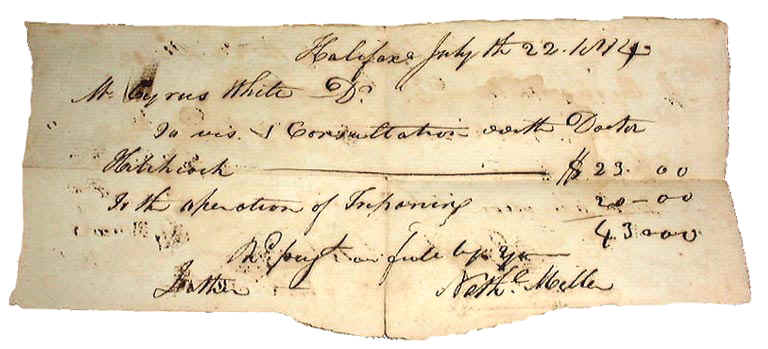
One antique dealer even has a receipt for a trepanning operation from 1814. It turns out you could get your head drilled for $20 in early 19th century Massachusetts.

If you’re after some more modern kit, it turns out you can pick up quite a few contemporary surgical tools on eBay.

Including this VectorVision2 BrainLab system, a snip (excuse the pun) at $15,000.

The VectorVision2 is an ‘augmented reality’ image guidance system (sometimes called frameless stereotaxy) that allows the surgeon to see where his tools are in relation to both the patient and a matched brain scan image – while the operation is in progress.

While the tools can be bought and sold online, most of the anaesthetics are, of course, controlled drugs.

So while you may be able to get the latest high-tech kit on eBay, you’re still going to have to resort to those traditional 19th century surgical painkillers: brandy, and a stiff upper lip.

Link to pictures of antique neurosurgery tools.
Link to VectorVision2 for sale on eBay.