Viral brain cancer theory comes of age

The San Francisco Chronicle has a great article about Dr Charles Cobbs, a neurosurgeon who had the seemingly wacky idea that malignant brain tumours called gliomas might be caused by a viral infection. Initially dismissed, there is now growing evidence for his idea and how it might lead to better prevention and treatment for these usually fatal forms of brain cancer.

Gliomas are tumour that form from glial cells – non-neuronal brain cells that provide support, nutrition protection and some just-recognised roles in signalling.

As you might expect, they are an essential part of almost every part the brain and a malignant tumour which grows from glial cells can be fatal (without treatment, within about 3 months) as they are very difficult to remove and treat.

Cobbs had observed that his patients diagnosed with malignant glioma – an aggressive brain cancer that leaves victims with a two-year life expectancy – were mostly older, well-educated and from higher socioeconomic backgrounds. Their “hyper-hygienic” lifestyles had possibly left their immune systems susceptible to more common viruses, such as the human cytomegalovirus, or CMV, a herpes virus so ubiquitous that it infects 4 of 5 Americans.

During off-hours, and without formal research funding, Cobbs and a lab partner analyzed dozens of brain tumor samples: All of them were riddled with CMV. In 2002, the doctor published his novel finding in a leading medical journal Cancer Research where it was quickly dismissed by many of his peers. “I was left with a lot of self doubt,” said Cobbs, now 45. “My fear was that we’d done something incorrect. But now, my confidence is growing.”

In February, brain cancer researchers at Duke University Medical Center published the first peer-reviewed report that confirmed Cobbs’ discovery, followed by two reports from independent labs at the M.D. Anderson Cancer Center at University of Texas in Houston and the Karolinska Institute in Stockholm, Sweden. And this month, the National Brain Tumor Society is sponsoring a first-of-its-kind gathering in Boston of the world’s top virologists and glioma experts to examine the possible link between CMV and the deadly brain tumors that are diagnosed in 10,000 Americans every year.

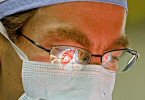
The photos accompanying the piece are excellent by the way. The image I’ve used to illustrate this post is particularly impressive – click on it to see the full-size version which you need to get the full effect.

Nature also ran a piece about Cobbs last month owing to the publication of one of his studies in the same issue where he discovered one of key receptors on which the CMV virus has its action.

Unfortunately, I can’t read either as Nature’s Athens login system is currently broken [insert your own rant about open-access publishing here].

Link to SFChronicle article ‘Surgeon changes study of brain tumors’.

Deep brain optimism

A list of things that deep brain stimulation has been used to treat. DBS involves surgically implanting an electrode into the brain which is stimulated with a ‘pacemaker’ like device.

I’ve just been looking over the DBS literature and I was quite surprised to see that it has been used to try and treat just about anything you can think of.

Maybe someone should try it for over-optimistic repetitive surgery syndrome? Anyway, here’s the one’s I’ve found, if you know of any others, do send them in or add them to the comments.

Obesity

Writer’s cramp

Tremor

Depression

Parkinson’s disease

Epilepsy

Huntingdon’s disease

Addiction

Self-mutilation

Cluster headache

Tourette’s syndrome.

OCD

Early onset pantothenate kinase-associated neurodegeneration

Dystonia

Meige syndrome

Facial pain

Hemispheric fantasies

This is quite a remarkable study from a 1985 edition of the International Journal of Neuroscience that investigated whether the apparent greater use of mental imagery during masturbation by men than women was due to differences in hemispheric specialisation.

To test whether this might be to do with brain organisation, rather than gender itself, the researchers tested the idea by asking about imagery during masturbation in right-handed males, who typically show strong hemispheric specialisation, and left-handed men, who typically show less specialisation.

Unfortunately, I don’t have access to the full paper and have no idea whether the claim that women typically report less imagery and fantasy is still thought reliable, as these sorts of findings are notoriously influenced by how the question is asked.

However, the study seemed to find partial support for it’s own hypothesis at least.

Sex and handedness differences in the use of autoerotic fantasy and imagery: a proposed explanation.

Int J Neurosci. 1985 May;26(3-4):259-68.

Gottlieb JF.

Previous research has described a greater use of fantasy and imagery during masturbation by men, than women. This study suggests that this gender disparity results from the increased frequency of bilateral speech representation found in the female brain. Support for this theory was obtained by comparing the use of autoerotic fantasy and imagery in another group distinguished by their degree of cerebral lateralization: dextral vs. sinistral males. The prediction that masturbatory fantasy and imagery would be more common in the more lateralized dextral males was partially confirmed in this study.

I gave up looking for a suggestive yet tasteful image than combined the concepts of sex and hemispheric specialisation, so I’ve illustrated this post with picture of a flower instead.

As an aside, brain anatomy has a few rude jokes thrown in. For example, the mammillary bodies are two small round areas that are part of the limbic system. Their name comes from the fact that the look like breasts.

I was told by a neuroanatomy lecturer that one of the reasons given for why women shouldn’t study medicine in the 1900s was because they’d be offended by the blue humour.

However, the tradition has continued and there are many bawdy mnemonics that help modern students of the nervous system learn the names and functions of the cranial nerves.

Link to PubMed entry for hemispheric fantasy study.

When dementia releases artistic talents

KQED Quest has another excellent online feature where they discuss the curious effect where some patients with fronto-temporal dementia, a form of degenerative brain disease, suddenly have burst of creative talent creating some stunning and original works.

The videos were taken at UCSF over the course of many hours doctors spent studying Keith and his symptoms. In them, we glimpse of two of Keith’s FTD-caused obsessions: joke telling and music. (We also see one of the first symptoms to have emerged: his Jerry Garcia hairdo.)

At first glance, Keith‚Äôs behavior might strike you as more eccentric than brain-damaged, which is precisely why FTD can take so long to diagnose. If you‚Äôre a doctor with a 15-minute appointment slot, frontotemporal dementia might just look like a midlife crisis…

FTD can turn Democrats into Republicans, and vice versa. People with no interest in art begin to paint obsessively. As the neurons in Keith’s right frontotemporal lobe (just behind the right eyebrow) died, his taste in music, his sense of humor, his relationships with his family members and friends changed completely. Our self, in other words, may owe much more to the way our brains are built than we’d care to acknowledge.

It’s probably worth making clear that this is quite a rare effect. Most people with FTD will not become artistically inspired.

More common effects are problems with inhibiting behaviour sometimes leading to problems with appropriate social interaction (largely owing to frontal lobe damage) and difficulties with language and meaning (largely owing to the problems with the temporal lobes).

But because dementia trends to affect the brain in a progressive but patchy way, it can sometimes result quite unusual or surprising symptoms.

The Quest programme is a radio show, a video of Keith Jordan – a patient affected by FTD, and a narrated photo essay.

Another great production from Quest, who we featured recently because of their similarly high-quality programme on the curious pseudobulbar affect.

If you’re interested in more information on the release of artistic talents after FTD, we featured a fantastic New York Times article on the same topic which makes a great complement to the Quest programme.

Link to Quest radio programme.
Link to Quest video section.
Link to Quest narrated photo essay.

Erotic self-stimulation and brain implants

A 48-year-old woman with a stimulating electrode implanted in her right ventral thalamus started to compulsively self-stimulate when she discovered that it could produce erotic sensations.

This is a report from the early days of deep brain stimulation, way back in 1986, from an article for the medical journal Pain which discussed some unintended side-effects from one patient’s DBS treatment for chronic pain.

Soon after insertion of the nVPL electrode, the patient noted that stimulation also produced erotic sensations. This pleasurable response was heightened by continuous stimulation at 75% maximal amplitude, frequently augmented by short bursts at maximal amplitude. Though sexual arousal was prominent, no orgasm occurred with these brief increases in stimulation intensity. Despite several episodes of paroxysmal atrial tachycardia [heart disturbance] and development of adverse behavioural and neurological symptoms during maximal stimulation, compulsive use of the stimulator developed.

At its most frequent, the patient self-stimulated throughout the day, neglecting personal hygiene and family commitments. A chronic ulceration developed at the tip of the finger used to adjust the amplitude dial and she frequently tampered with the device in an effort to increase the stimulation amplitude. At times, she implored her to limit her access to the stimulator, each time demanding its return after a short hiatus. During the past two years, compulsive use has become associated with frequent attacks of anxiety, depersonalization, periods of psychogenic polydipsia and virtually complete inactivity.

Similar cases are still being reported today. A 2005 case report described a gentleman who had a DBS electrode inserted into the right subthalamic nucleus to treat the symptoms of Parkinson’s disease. He found that switching the device on and off produced a ‘morphine like’ sensation that he became quite fond of.

This effect was first discovered in humans in the early 1960s, when controversial psychiatrist Robert Heath reported on two cases of people with a number of electrodes implanted in the brain, including some in similar areas to the patients mentioned above.

In 1972, he undertook a notorious study where he implanted electrodes into the brain of a consenting 24-year-old gay male who had been repeatedly hospitalized for chronic suicidal depression and found to have temporal lobe epilepsy.

The brain implant was specifically introduced for non-sexual reasons but Heath decided to test whether pleasurable brain stimulation would encourage the man, known only as B-19, to engage in heterosexual sexual activity with a prostitute.

The study was a ‘success’ but has become infamous as one of the more distasteful episodes in the history of ‘gay conversion therapy’, which is quite hard going in a field that is well-known for its distasteful episodes.

Heath was apparently funded by the CIA as part of their abortive research programme into ‘mind control’ techniques, but I can’t find any reliable reference for that, so it might need to be taken with a pinch of salt.

Link to paper ‘Chronic Thalamic Self-Stimulation’.
Link to PubMed entry for paper.
Link to Heath ‘gay brain stimulation’ study.
Link to doi link for same.

Navigating the darkness of coma-like states

ABC Radio National’s All in the Mind recently broadcast a gripping programme on patients in the coma-like persistent vegetative state (PVS) and how new brain imaging techniques might be able to identify people who are conscious but unable to communicate with the outside world.

The programme talks to neuropsychologist Adrian Owen, whose work we’ve featured previously on Mind Hacks, who conducted a brain imaging study on a 23-year-old woman in PVS suggested that she could understand what was being said to her.

The neuroimaging team asked her to practice mental tasks when and could pick up and distinguish the related brain activity using an fMRI scanner.

The programme discusses Owen and colleagues research, including a peak at some ongoing studies to try and turn this into a method of communication, and debates the ethics of dealing with patients who are effectively unresponsive to the world.

It’s also got some striking excerpts from a Kate Cole-Adams’ novel Walking to the Moon about a woman who emerges from coma. If you want to hear more, another ABC show interviewed Cole-Adams and discussed the book.

Link to AITM on ‘Beyond coma’.
Link to Life Matters on ‘Walking to the Moon’.

Lawrence of Arabia is dead, long live the crash helmet

I just found this fascinating article from a 2002 edition of Neurosurgery that tells how a brain surgeon who unsuccesfully operated on Lawrence of Arabia after his fatal motorcyle crash was inspired to research and design crash helmets that now save thousands of lives.

T.E. Lawrence, better known as Lawrence of Arabia, was a hero of the First World War who worked as a covert agent leading a revolt against the Ottoman Empire in the Middle East and was immortalised in the 1962 film.

Lawrence was also a fan of motorbikes. In fact, he’s pictured on one in the image on the left. Sadly, his interest eventually led to his death after a motorcycle crash in Dorset.

The Neurosurgery article tells the story of Hugh Cairns, a young neurosurgeon who attempted unsuccessfully to save Lawrence’s life as part of the surgical team who treated him.

His experience led him to research the benefits of early crash helmets on Army motorcycle riders during the Second World War, finding that they were one of the major life-saving factors.

He later went on to use his knowledge of how the brain becomes damaged during impact to design and test various types of crash helmet that could best protect against these forms of injury.

Cairns’ work was a major influence on both the legal system, that has mandated helmets in many countries, and the design of the headgear itself – preventing thousands of fatal brain injuries in the process.

Link to article on Lawrence, Cairns and the origin of crash helmets.
Link to PubMed entry for article.

A vision of a daydream, or a fragment of reality

The Boston Globe has an interesting piece on daydreaming, touching on the link between daydreaming and creativity and discussing the possibly brain networks that might support our pleasant mental wanderings.

The article discusses some of the recent work on the default brain network and how this might be related to daydreaming:

Every time we slip effortlessly into a daydream, a distinct pattern of brain areas is activated, which is known as the default network. Studies show that this network is most engaged when people are performing tasks that require little conscious attention, such as routine driving on the highway or reading a tedious text. Although such mental trances are often seen as a sign of lethargy – we are staring haplessly into space – the cortex is actually very active during this default state, as numerous brain regions interact. Instead of responding to the outside world, the brain starts to contemplate its internal landscape. This is when new and creative connections are made between seemingly unrelated ideas.

“When you don’t use a muscle, that muscle really isn’t doing much of anything,” says Dr. Marcus Raichle, a neurologist and radiologist at Washington University who was one of the first scientists to locate the default network in the brain. “But when your brain is supposedly doing nothing and daydreaming, it’s really doing a tremendous amount. We call it the ‘resting state,’ but the brain isn’t resting at all.”

It’s worth bearing in mind that the connection between this network and daydreaming is only one theory, and other researchers think of it quite differently.

The ‘default network’ was suggested owing to measurements of how the brain uses energy at rest, and when brain imaging researchers noted that certain parts of the brain (mainly midline areas) were more active when participants didn’t seem to be doing very much but showed reduced activity when we participants were most engaged in attention-demanding tasks.

Neurologist Marcus Raichle has been most vocal in proposing that the network is linked to what we might broadly call daydreaming, mostly notably on the basis of a study that found that default network activity was related to what they called ‘stimulus independent thought’.

They determined this by training people on a memory task until they could do it so easily their minds wandered. They then put people in a scanner, compared brain activation in this condition to brain activation with a similar memory task but where the material was new, so they had to concentrate and weren’t able to think about other stuff.

They found that the practised condition was associated with activity in a default network, and, therefore, they linked it to daydreaming.

The trouble is, is that they only confirmed that participants were doing more off topic thinking, not what they were thinking about.

We might think of daydreaming as having thoughts about being the lead singer of an all-girl skiffle band, fighting a dragon if it happened to burst through the lab door, or screwing the research assistant who took us through the consent form, but it could be that the participants were just focused on the other stuff that was happening around them at the time.

Like the horrendous noise of the fMRI scanner, as some commentators suggested. Or perhaps, they were just being more aware of their wider environment.

And in fact, one theory suggests that the default network is not concerned with daydreaming, but maintains a background level of watchful attention to detect potentially dangerous external events (real dragons, for example), or perhaps processes memories – essentially doing our mental filekeeping.

One big problem with this area, is that it attempts to study a network which is supposedly most active when when not doing deliberate mental tasks, by extrapolating from data that involves the participants doing deliberate mental tasks.

This makes it difficult to tie it specifically to daydreaming, which is a subjective mental state that has a tendency of dancing away whenever we try and catch it.

Link to Globe article ‘Daydream achiever’ (via Frontal Cortex).

Count ’em

Wikipedia has a short but fascinating page listing animals by the number of neurons they have. There’s only about a dozen entries on there, but most interesting is that there is an animal with no nerve cells at all.

It’s called Trichoplax and apparently is a “a simple balloon-like marine animal with a body cavity filled with pressurized fluid”.

Apparently humans don’t come top of the pile, as both elephants and whales have more neurons.

However, it’s not the best referenced article in the world, to say the least, so I’m taking this last claim with a pinch of salt for the time being.

If you know better, do update the article with some more reliable sources.

Link to ‘List of animals by number of neurons’.

Great history of brain surgery programme online

The BBC has just begun broadcasting a fantastic series called Blood and Guts on the history of surgery with the first episode on neurosurgery. If you live in the UK you can watch it again on the BBC iPlayer for a few days more, or otherwise, it has appeared online as a torrent.

It’s not the most coherent trip through the history of neurosurgery, more a collection of highlights (or, in some cases, lowlights), but it’s very well made and has some fantastic historical footage and interviews with modern neurosurgeons.

It covers Harvey Cushing, Phineas Gage, Jos√© Delgado, Walter Freeman and the frontal lobotomy, transcranial magnetic stimulation, deep brain stimulation and the cutting edge of brain surgery today. There’s a particularly interesting bit where lobotomy survivor Howard Dully has a brain scan and you can see the effect of his operation.

If you’re still hungry for more, BBC News website has an article and video clip of neurosurgery while the patient is conscious, and you can even buy the book of the series.

Link to BBC iPlayer archive (for 7 days).
Link to torrent of Blood and Guts brain surgery episode.

Neurowar of words

Wired Science covers a recent US military report on military threats from the latest developments in neuroscience as well as how brain research could be ‘weaponised’ to enhance soldiers’ capabilities or disable enemy fighters.

It’s a bit difficult to judge the quality of the report, as unlike the recent in-depth report from the JASON Pentagon advisory panel, they’re charging people to download it.

From the Wired summary, it seems to cover similar ground although is perhaps a little more wide-ranging and focuses on policy and foresight rather than the nuts and bolts of brain science.

It apparently covers four main areas: mind reading; cognitive enhancement; mind control and brain-machine interfaces. As you can probably tell from the list, there’s likely to be a fair amount of speculation going on there.

It’s also interesting that the US military are really promoting their ‘military neuroscience’ angle, which is not to say that it is not a research priority. Whole wings of military research are now devoted to ‘human research’, as illustrated by the extensive science portfolio of the US Army’s Research Lab.

Nevertheless, the discussions about drug-based enhancements have so far been largely reiterating what soldiers have already done for millennia – using drugs to reduce fatigue, increase confidence and cope with trauma.

Drugs have been used for soldiering as long as there have been wars and the low-tech still prevails – from the use of coca leaves by Inca warriors to the use of the khat by modern-day Sudanese militias.

If anyone does happen to stumble across an unrestricted copy of the report online, do let me know as it’d be great to be able to link to the original.

Link to Wired Science article ‘Uncle Sam Wants Your Brain’.
Link to online shop for report.

Mainlining the active ingredients of cannabis

I’ve uploaded a fascinating video clip where a TV presenter is intravenously injected with the active ingredients of cannabis as part of the BBC documentary Should I Smoke Dope?

It’s part of an experiment to compare the effects of intravenous THC and cannabidiol combined, with intravenous THC on its own. The mix of both gives the presenter a pleasant giggly high while THC on its own causes her to become desolate and paranoid.

Both are these are known to be key psychoactive ingredients in cannabis but the video is interesting as it is a reflection of the fact that THC has been most linked to an increased risk of developing psychosis while cannabidiol seems to have an antipsychotic effect.

As we discussed earlier this year, one study found that cannabis smokers who had higher levels of cannabidiol in hair samples had the lowest levels of psychosis-like experiences.

Another study we covered reported that, at least in the UK, ‘skunk’ has virtually no cannabidiol, while hash, although variable, was more likely to contain high cannabidiol levels.

And if you’re after a more balanced view on the link between cannabis and psychosis than you normally get in the media, I’ve also uploaded a clip from the same programme where psychiatrist and leading cannabis researcher Robin Murray discusses the findings from the latest research.

If you want to check out the whole documentary, where BBC reporter Nicky Taylor gets stoned for 30 days in a row while investigating the science, culture and legal status of cannabis, it’s available as a torrent or in six parts on YouTube (1, 2, 3, 4, 5, 6).

Link to video of IV cannabidiol and THC experiment.
Link to video of psychiatrist Robin Murray on cannabis and psychosis.

Cannibalism, prions and encephalopathy (oh my!)

Cannabalism gave Western medicine its first understanding of prion diseases as an epidemic of the neurological disorder swept the South Fore tribe in Papua New Guinea. Neurophilosophy has written a remarkably lucid article on the history and neuroscience of how prion diseases, of which ‘mad cow disease’ is one, affect the brain.

The piece starts with some archive footage of a tribe member with the devastating disorder and continues to describe how this class of diseases are probably caused by misfolded proteins that can trigger the same misfolding in other proteins leading to a chain reaction of neural damage.

The Fore tribe had a tradition of ritually consuming the brain and body of deceased relatives, which likely lead to the outbreak.

The word kuru means “shaking death” in the Fore language, and describes the characteristic symptoms of the disease. Because it affects mainly the cerebellum, a part of the brain involved in the co-ordination of movement, the first symptoms to manifest themselves in those infected with the disease would typically be an unsteady gait and tremors. As the disease progresses, victims become unable to stand or eat, and eventually die between 6-12 months after the symptoms first appear.

Kuru belongs to a class of progressive neurodegenerative diseases called the transmissible spongiform encephalopathies (TSEs), which also includes variant Creutzfeldt-Jakob Disease (vCJD) and bovine spongiform encephalopathy (BSE, more popularly known as “Mad Cow Disease”). TSEs are fatal and infectious; in humans, they are relatively rare, and can arise sporadically, by infection, or because of genetic mutations. They are unusual in that the infectious agent which transmits the diseases is believed to a misfolded protein. (Hence, the TSEs are also referred to as the prion diseases, “prion” being a shortened form of the term “proteinaceous infectious particle”).

Prion diseases are a complicated area and you probably won’t find a better written introduction that captures both the science and the intrigue of these relatively new disorders.

Link to article ‘Cannibalism and the shaking death’.

The best is yet to come: reward prediction in the brain

Jonah Lehrer has written an excellent piece for the latest issue of Seed Magazine on the work of neuroscientist Read Montague who’s been discovering the essential function of dopamine in predicting rewards.

Reward prediction is the process where dopamine neurons fire when a reward is expected and also seem to code the amount of error between the prediction and what actually happens. Importantly, the process seems to be accurately described by an algorithm that was already used in computer science.

This has been an area of intense interest over the last decade as it ties together neurobiology, learning, motivation, mathematics and can be demonstrated in a variety of simple lab-based tasks. The fact that dopamine has been linked to numerous disorders in the past makes it a popular paradigm in which to understand psychiatric symptoms.

The Seed article looks at the work of Read Montague who has been studying the process and has been using ingenious methods to look at the role of this system in social reasoning.

In recent years Montague has shown how this basic computational mechanism is a fundamental feature of the human mind. Consider a paper on the neural foundations of trust, recently published in Science. The experiment was born out of Montague’s frustration with the limitations of conventional fMRI. “The most unrealistic element [of fMRI experiments] is that we could only study the brain by itself,” Montague says. “But when are brains ever by themselves?” And so Montague pioneered a technique known as hyper-scanning, allowing subjects in different fMRI machines to interact in real time. His experiment revolved around a simple economic game in which getting the maximum reward required the strangers to trust one another. However, if one of the players grew especially selfish, he or she could always steal from the pot and erase the tenuous bond of trust. By monitoring the players’ brains, Montague was able to predict whether or not someone would steal money several seconds before the theft actually occurred. The secret was a cortical area known as the caudate nucleus, which closely tracked the payouts from the other player. Montague noticed that whenever the caudate exhibited reduced activity, trust tended to break down.

One thing I notice a little of in the quotes from Montague, which is incredibly common in discussion of dopamine and reward, is a kind of ‘reward system dogma’.

Reward is usually linked to the function of the striatum and nucleus accumbens and the dogma goes something like this: “no matter what is happening when the nucleus accumbens or striatum is activated, something about the activity is rewarding”.

I was interesting to read a recent study comparing brain activation in people with ‘normal’ and ‘complicated’ (i.e. extreme) grief in response to viewing pictures of their deceased relative.

The study found additional nucleus accumbens activation in people with complicated grief and suggested that this reflects the fact they find the thoughts of them more rewarding. This is despite the fact that the nucleus accumbens has also been found to also represent salience – i.e. how likely something is to grab our attention.

It’s probably also worth mentioning that there may be some serious problems with the elegant reward prediction theory of dopamine which are were outline in a 2006 paper in Nature Reviews Neuroscience and summarised by the excellent Developing Intelligence.

The Seed is generally an excellent read though and covers an important finding and some innovative new ideas. I especially like the fMRI machines linked in parallel, like multi-player arcade machines.

Link to Seed article ‘A New State of Mind’.

Imagining missing limbs helps pain, reorganises brain

Neurology journal Brain has just published an elegant open-access study on how just six weeks of mental imagery training can help reduce phantom limb pain as well as reorganising the sensory and motor maps in the brain.

Phantom limbs are when amputees feel sensations that seem to be coming from the missing limb. Sometimes this can include pain which can either be constant or transitory.

Sensations from the nonexistent limb are thought to be due to the brain reorganising the areas which represent the body.

In the case of a phantom arm, for example, the area is no longer receiving sensations from the limb and so stops being so carefully defined. Areas serving other body areas (like the face) start to creep in and facial stimulation can be felt in the missing arm due to the fuzzy neurological boundaries.

This new study, led by neuroscientist Kate McIver, decided to test whether mental imagery can help keep these areas active and prevent the fuzziness creeping in, potentially reducing the phantom pain.

This is based on extensive research to show that imagining something activates similar brain areas to actually perceiving the sensation or executing the action. For example, imagining the sensation of a cool breeze across your arm actually increases activity in the brain areas responsible for arm sensations, while imaging picking something up activates arm-related motor areas.

The research team asked participants to rate their phantom limb pain and used fMRI to look at which brain areas were most active during some movement-related tasks. While in the scanner, the participants were asked to imagine actions with either the existing or phantom hand, to move the existing hand or were asked to purse (push together) their lips.

This last action tends to activate what was previously the hand area in the brain in people with phantom limbs, but doesn’t in people with intact limbs. Indeed, this is exactly what the initial brain scans reported, indicating that their brains had reorganised sensory boundaries.

The researchers then invited each participant for six weekly sessions that involved a mental ‘body scan’ technique that involved imagining free and comfortable movement in their phantom limb such as they could “stretch away the pain” and “allow the fingers, hand and arm to rest in a comfortable position”. Participants also practised in their own time.

After six weeks, pain ratings were taken again and the brain scanning was re-run. The painful sensations had significantly reduced and lip pursing no longer activated the hand area.

The mental imagery seemed to have ‘simulated’ arm actions and sensations well enough so that the neurological boundaries remained sharp and cross-area fuzziness didn’t encourage phantom pain.

Link to full text article in Brain.
Link to PubMed entry.

Juggling can change brain structure within 7 days

A new study just published in PLoS One reports that learning to juggle alters the structure of motion detection areas in the brain within as little as 7 days.

Led by neuroscientist Joenna Driemeyer, the study builds on a previous research that also found juggling could alter brain structure, although this previous study waited three months before the brain was checked for alterations using high resolution structural MRI scans.

This new study also took 20 non-jugglers and asked them to learn to juggle, but scanned them after 7, 14 and 35 days.

After only 7 days, a motion specialised part of the occipital lobe known as V5 had increased in density. In both studies, the changes were maintained over the subsequent weeks of practice, but these areas returned to their pre-learning state after several weeks without juggling.

This is an interesting example of rapid ‘neuroplasticity‘, the ability of the brain to adapt structurally to new situations.

However, the authors are careful to note that they can’t tell whether the brains of the participants had generated more neurons, or whether existing cells grew in size, or additional glial cells were developed, or maybe there were just changes in how much blood or other brain fluids packed the area.

Also, the fact that changes seemed to occur at the beginning of the learning cycle but that further practice maintained but didn’t cause additional changes led the researchers to speculate that learning a variety of new things, rather than simply practising old skills, may be most effective in terms of brain structure alterations.

Link to ‘Changes in Gray Matter Induced by Learning ‚Äî Revisited’.
Link to PubMed entry for paper.

Full disclosure: I’m an unpaid member of the PLoS One editorial board.