Spike activity 09-10-2015

Quick links from the past week in mind and brain news:

How much can you really learn while you’re asleep? Interesting piece that looks at what the research genuinely tells us in The Guardian.

Comedian John Oliver takes on mental health in America with a segment which is both funny and sharp.

Neuroecology has an excellent post looking at the latest mega-paper from the Blue Brain Project.

There’s a good piece on how cognitive biases affect the practice of doing scientific research in Nature. Thankfully, my training has made me immune to these effects, unlike my colleagues.

Braindecoder has some striking artistic renditions of neuroanatomy from artist Greg Dunn.

Is a Liberal Bias Hurting Social Psychology? Excellent piece in Pacific Standard.

BBC News has a good piece on the evidence behind the school shooting ‘contagion’ effect.

“A tumor stole every memory I had. This is what happened when it all came back.” Great piece in Quartz. Don’t get distracted by the inaccurate use of the term dementia. Recommended.

Spike activity 02-10-2015

Quick links from the past week in mind and brain news:

The madness of Charlie Brown. The Lancet has a wonderful article on Lucy, Charlie Brown’s local psychiatrist.

The Atlantic has an excellent piece on new research showing neurons have different genomes.

Mexico’s 13-year-old psychologist is amazing, reports USA Today. Sí, es.

PLOS Neuro has an excellent in-depth piece about the neuroscience of sleep deprivation.

Boring cityscapes increase sadness, addiction and disease-related stress. Is urban design a matter of public health? asks Aeon.

The Wall Street Journal on why a new paper may show that the ‘hot hand’ effect in basketball may be real after all.

Pioneering dubstep DJ and producer Benga was diagnosed with bipolar disorder and schizophrenia last year. He speaks to The Guardian on mental health and his comeback.

The Psychologist has an excellent piece on whether the media be restricted in their reporting of mass shootings to prevent copycat killings.

There’s a good piece in Nature about the state of connectome research in neuroscience.

The Quiet Room

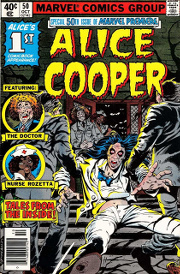
This month’s British Journal of Psychiatry has a brief but fascinating article about a 1979 Marvel comic featuring and written by rock legend Alice Cooper which depicts his real-life admission to a psychiatric ward.

The comic was timed to coincide with the release of his concept album From The Inside which describes his experiences as a psychiatric patient being treated for severe alcoholism and depression.

He was there for 3 months and in the comic he depicts the patients, doctors and nurses he met during his admission. Alice has often commented in interviews that treatment in hospital and recovering from his substance misuse saved his life, when many similar artists at that time, such as Jim Morrison and Janis Joplin, were not as fortunate, succumbing to their addictions. The lead single from the album was ‘How You Gonna See Me Now’, a song describing the anxiety the singer felt coming back home to his wife after his stay in hospital and facing the stigma of being treated for his mental illness. It went on to become a well-known successful ballad. The comic can still be found in comic shops or through online auction sites.


Link to brief British Journal of Psychiatry article.

Spike activity 25-09-2015

Quick links from the past week in mind and brain news:

Science has a fascinating piece on how cultures developed words for numbers – many languages don’t have words for numbers above five.

The majority illusion. The social illusion covered by Tech Review where something can seem socially common despite being rare in the overall group.

Wired has a thought-provoking piece on the potential role of the internet in hastening the demise of dying languages.

Researchers who reported a study on how oxytocin increases trust try and fail to replicate their own results. Good coverage from Neuroskeptic.

The LA Times has a good piece in light of the Hajj disaster that dispels some crowd behaviour myths.

There’s a brilliant piece from boxer Jerome Wilson on what it’s like to recover from a serious brain trauma in The Telegraph. Really, it’s great, go and read it.

The Guardian covers the news that a man completes a 3.5-metre course thanks to computer system that reroutes signals from his brain to electrodes on his knees.

DeepMind’s AI can now beat humans at 31 Atari 2600 arcade games, reports TechRepublic. Still thinks ET was rubbish.

Pacific Standard has a fascinating piece on how our understanding of Neanderthals has dramatically and rapidly shifted.

Guy puts cameras in his home to record every second of his new baby’s life to record his exposure to language and work out how new words emerge. Great study and findings covered in Science News.

AlterNet has a good piece critiquing the concept of ‘sex addiction‘.

A museum of many minds

I spent a very long time in the old Bethlem museum, owing to the fact that there’s little else to do when you live at one of the world’s oldest psychiatric hospitals.

The Bethlem Royal Hospital, or Bedlam as it’s been known in centuries past, has moved many times over its lifetime, but it’s now located in one of London’s comfortable, sleepy suburbs. Unfortunately, there is very, and I mean, very little to do there on weekends.

The museum was occasionally open on Saturdays, and during the six months I lived at the hospital, I visited. Repeatedly, as it turned out.

But for an institution that was founded in 1247, that has been a central character in London’s history and formative in our understanding and misunderstanding of madness, the museum was surprisingly crap.

It lived in a small, bleak portakabin in the corner of the grounds. You would walk in, stare at a few tiny walls of exhibits and then chat to the curator, who would be so bereft of visitors that it would be like a turning on a ‘history of the Bethlem’ fire hose for a few minutes before you left them to solemnly contemplate the archives once more.

But after years of neglect, the portamusem has been replaced by the Museum of the Mind in the Bethlem Royal Hospital’s central building. To get an idea of how much the new museum is being valued, they kicked the hospital bosses out to make space for it.

Apart from the museum space, it also has two galleries. One dedicated to work from current patients and another that has guest exhibitions. It also does talks from historians and art workshops – on everything from art techniques to building websites. You can even buy Bedlam mugs and pencils in the museum shop – for reasons I’m not entirely sure of.

The museum itself is beautifully put together and is entirely focused on tackling the most contentious issues in mental health. Here’s a quote, painted in large letters on one of the walls:

“The words of psychiatry are often unjust stewards, sorry guardians of meaning, workers of deception.”

The quote, quite profound in itself, doesn’t have the same impact until you understand that it’s from Aubrey Lewis the ‘father of British psychiatry’ and one of the most important people in the history of the profession.

And it is this rather confrontational approach to psychiatry’s assumptions, now and in the past, which permeates the museum.

Many of these challenges come from the voices of patients themselves, either contemporary or historical, and the testimonies to medically-induced suffering sit alongside the testimonies to its value as a remedy to mental distress.

For those looking for something of the London gothic, there are strait-jackets, manacles, and panels from a genuine padded cell from an old asylum, but it’s hardly the gaudy tourism of the London Dungeon – not least because the framing is quite different – the question of what it means to be humane in treating people with mental health difficulties is a central theme.

This approach also means artwork from patients, some of whom have been the country’s most distinguished artists in their own right, is integral to the design of the museum.

While you’re visiting, by the way, have a walk through the hospital grounds. They’re open to the public, extensive and beautiful. Locals walk their dogs there and come in the use the swimming pool. It’s quite different from how many people imagine a psychiatric hospital to be (and it has to be said, quite different from how many other psychiatric hospitals are).

And before you leave the museum, don’t miss the guest book. I’ve visited twice but the comments and art in the guestbook have been one of the highlights.
 

Link to the Museum of the Mind website.
 

Disclaimer: I still work for the NHS Trust which is responsible for the museum and occasionally still work at the Bethlem. However, I have since moved out to less salubrious accommodation in South London’s out-of-control rental market. Do note, however, that the Bethlem is genuinely out of the way in suburban London. It takes a while to get there and there is still nothing else to do there on weekends.

Spike activity 18-09-2015

Quick links from the past week in mind and brain news:

GlaxoSmithKline straight-up lied about teen suicide attempts in a trial that was used to convince regulators that Paxil was safe for kids. In-depth from the BMJ. Good summary from The Atlantic.

The New York Times on basically the same shit from Johnson & Johnson over Risperdal. Jaw-dropping punchline: the profits were worth more than any financial blow-back in fines and law suits.

Fascinating article on how the ability to deceive is being built into AI and robot interactions from Fusion. To the bunkers!

The Whitehouse, yes, President Obama, issues an executive order requiring all government services to use behavioural science nudges ‘to Better Serve the American People’. “Your neighbours believe that we have always been at war with Eastasia…”

The neuroscience of Donald Trump. I SHIT YOU NOT. A Salon piece that should be a warning to everyone not to write neuroscience articles while high on butane.

The head of the world’s biggest mental health science organisation, the NIMH, is leaving to join Google. Will be deleting YouTube videos that mention the DSM.

Wired reports on a new campaign to ban sex robots. It’s the date-that-drags-on robots I want to see the back of.

The big review paper on the lack of political diversity in social psychology is finally out. Heterodox Academy has links to the full text.

MyCentralJersey reports on Jason Lunden, an autistic neuroscientist who researches the neuroscience of autism.

There’s a brilliant piece in The Psychologist about Geel in Belgium, where for 700 years boarders with learning disabilities and mental health problems have lived with residents.

Your ears emit sounds

There’s a fascinating article on the evolution of hearing in The Scientist that also contains an interesting gem – your ears produce sounds as well as perceiving them.

In addition to amplifying hair-cell activity, these active mechanisms manifest as spontaneous movements of the hearing organ, oscillating even in the absence of sound stimuli. Such spontaneous movements actually produce sound that is emitted through the middle ear to the outside world and can be measured in the ear canal.

I wondered whether this only applied to non-human animals – it’s not clear from the text – but a brief search brings up various studies on spontaneous otoacoustic emissions in humans. For example:

Spontaneous otoacoustic emissions were evaluated in 36 female and 40 male subjects. In agreement with the results of previous surveys, emissions were found to be more prevalent in female subjects and there was a tendency for the male subjects to have fewer emissions in their left ears.

It also turns out that spontaneous otoacoustic emissions are used to test hearing in newborn babies.

It’s an interesting problem, because normally hearing is tested by giving people tests where they are played various sounds or silence at certain time points and they have to signal whether they think they heard the sound, and correct decisions are counted.

This clearly doesn’t work with babies but one way of testing hearing is by measuring the response of nerve signals that connect to the auditory brain stem.

This training video shows how it’s done but in the last section there’s a test which relies directly on detecting the ‘echoes’ created by otoacoustic emission when a tone is played directly into the ear.


Link to The Scientist article on the evolution of hearing.

Spike activity 11-09-2015

Quick links from the past week in mind and brain news:

Mental illness throughout the animal kingdom. Interesting piece from BBC Earth.

The Guardian has an excellent in-depth article on scorpion venom as a way of identifying brain tumours during neurosurgery.

There’s an excellent piece on the history of using deception in psychology studies over at Aeon.

The Covnersation has an excellent piece on how so much talk about ‘the brain’ in education is meaningless.

Psychology Should Aim For 100% Reproducibility. Some Grade A trolling from Neuroskeptic.

Robohub has an interesting piece on ‘morphological computation’ and the hidden superpower of soft-bodied robots.

Yet another ancient human / hominin species is discovered. Great coverage from The Atlantic. So where’d all our cousins go?

Twelve minutes of consciousness

The Economist has an excellent video on consciousness, what it is, why and how it evolved.

The science section of The Economist has long had some of the best science reporting in the mainstream press and this video is a fantastic introduction to the science of consciousness.

It’s 12 minutes long and it’s worth every second of your time.

Spike activity 04-09-2015

Quick links from the past week in mind and brain news:

Go get your gramophonic digital podcast player and listen to this amazing BBC Radio 4 programme on how the social discussion of dreams has changed through history.

The Atlantic on what Google’s trippy neural network-generated images tell us about the human mind.

Ignore the fact that this is yet another article on mental health that says this particular condition is much more common than you think, and you’ll find an interesting piece on depersonalisation in The Guardian.

Nature has a tribute and article collection in memory of Oliver Sacks.

Architecture’s brief love affair with psychology is overdue a revival. Good piece in The Conversation.

The New York Review of Books has Oliver Sacks’s last piece on Klüver-Bucy syndrome, the temporal lobes and unruly urges.

One of the great debates in neuroscience: are all neurodegenerative diseases caused by prions? Interesting post from Brainblogger.

Oliver Sacks has left the building

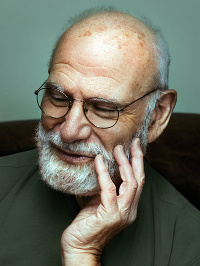
CC Licensed Photo from Wikipedia. Click for source.Neurologist and author Oliver Sacks has died at the age of 82.

It’s hard to fully comprehend the enormous impact of Oliver Sacks on the public’s understanding of the brain, its disorders and our diversity as humans.

Sacks wrote what he called ‘romantic science’. Not romantic in the sense of romantic love, but romantic in the sense of the romantic poets, who used narrative to describe the subtleties of human nature, often in contrast to the enlightenment values of quantification and rationalism.

In this light, romantic science would seem to be a contradiction, but Sacks used narrative and science not as opponents, but as complementary partners to illustrate new forms of human nature that many found hard to see: in people with brain injury, in alterations or differences in experience and behaviour, or in seemingly minor changes in perception that had striking implications.

Sacks was not the originator of this form of writing, nor did he claim to be. He drew his inspiration from the great neuropsychologist Alexander Luria but while Luria’s cases were known to a select group of specialists, Sacks wrote for the general public, and opened up neurology to the everyday world.

Despite Sacks’s popularity now, he had a slow start, with his first book Migraine not raising much interest either with his medical colleagues or the reading public. Not least, perhaps, because compared to his later works, it struggled to throw off some of the technical writing habits of academic medicine.

It wasn’t until his 1973 book Awakenings that he became recognised both as a remarkable writer and a remarkable neurologist, as the book recounted his experience with seemingly paralysed patients from the 1920s encephalitis lethargica epidemic and their remarkable awakening and gradual decline during a period of treatment with L-DOPA.

The book was scientifically important, humanely written, but most importantly, beautiful, as he captured his relationship with the many patients who experienced both a physical and a psychological awakening after being neurologically trapped for decades.

It was made into a now rarely seen documentary for Yorkshire Television which was eventually picked up by Hollywood and made into the movie starring Robin Williams and Robert De Niro.

But it was The Man Who Mistook His Wife for a Hat that became his signature book. It was a series of case studies, that wouldn’t seem particularly unusual to most neurologists, but which astounded the general public.

A sailor whose amnesia leads him to think he is constantly living in 1945, a woman who loses her ability to know where her limbs are, and a man with agnosia who despite normal vision can’t recognise objects and so mistook his wife’s head for a hat.

His follow-up book An Anthropologist on Mars continued in a similar vein and made for equally gripping reading.

Not all his books were great writing, however. The Island of the Colorblind was slow and technical while Sacks’s account of how his damaged leg, A Leg to Stand On, included conclusions about the nature of illness that were more abstract than most could relate to.

But his later books saw a remarkable flowering of diverse interest and mature writing. Music, imagery, hallucinations and their astounding relationship with the brain and experience were the basis of three books that showed Sacks at his best.

And slowly during these later books, we got glimpses of the man himself. He revealed in Hallucinations that he had taken hallucinogens in his younger years and that the case of medical student Stephen D in The Man Who Mistook His Wife for a Hat – who developed a remarkable sense of smell after a night on speed, cocaine, and PCP – was, in fact, an autobiographical account.

His final book, On the Move, was the most honest, as he revealed he was gay, shy, and in his younger years, devastatingly handsome but somewhat troubled. A long way from the typical portrayal of the grey-bearded, kind but eccentric neurologist.

On a personal note, I have a particular debt of thanks to Dr Sacks. When I was an uninspired psychology undergraduate, I was handed a copy of The Man Who Mistook His Wife for a Hat which immediately convinced me to become a neuropsychologist.

Years later, I went to see him talk in London following the publication of Musicophilia. I took along my original copy of The Man Who Mistook His Wife for a Hat, hoping to surprise him with the news that he was responsible for my career in brain science.

As the talk started, the host mentioned that ‘it was likely that many of us became neuroscientists because we read Oliver Sacks when we started out’. To my secret disappointment, about half the lecture hall vigorously nodded in response.

The reality is that Sacks’s role in my career was neither surprising nor particularly special. He inspired a generation of neuroscientists to see brain science as a gateway to our common humanity and humanity as central to the scientific study of the brain.
 

Link to The New York Times obituary for Oliver Sacks.
Spike activity 28-08-2015

Quick links from the past week in mind and brain news:

Vice has an excellent documentary about how skater Paul Alexander was affected by mental illness as he was turning pro.

The US Navy is working on AI that can predict a pirate attacks reports Science News. Apparently it uses Arrrrgh-tificial intelligence. I’m here all week folks.

The New York Times has a good piece on the case for teaching ignorance to help frame our understanding of science.

Yes, Men’s and Women’s Brains Do Function Differently — But The Difference is Small. Interesting piece on The Science of US.

Lots of junk reporting on the Reproducibility Project but these are some of the best we’ve not mentioned so far:
* Neuropsychologist Dorothy Bishop gives her take in The Guardian.
* The BPS Research Digest gives a good run-down of the results

Good video interview with philosopher Patricia Churchland on neuroscience for SeriousScience.

Don’t call it a comeback

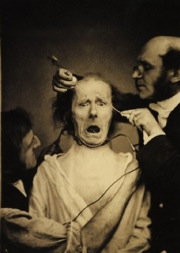
Duchenne_de_BoulogneThe Reproducibility Project, the giant study to re-run experiments reported in three top psychology journals, has just published its results and it’s either a disaster, a triumph or both for psychology.

You can’t do better than the coverage in The Atlantic, not least as it’s written by Ed Yong, the science journalist who has been key in reporting on, and occasionally appearing in, psychology’s great replication debates.

Two important things have come out of the Reproducibility Project. The first is that psychologist, project leader and now experienced cat-herder Brian Nosek deserves some sort of medal, and his 270-odd collaborators should be given shoulder massages by grateful colleagues.

It’s been psychology’s equivalent of the large hadron collider but without the need to dig up half of Switzerland.

The second is that no-one quite knows what it means for psychology. 36% of the replications had statistically significant results and 47% had effect sizes in a comparable range although the effect sizes were typically 50% smaller than the originals.

When looking at replication by subject area, studies on cognitive psychology were more likely to reproduce than studies from social psychology.

Is this good? Is this bad? What would be a reasonable number to expect? No one’s really sure, because there are perfectly acceptable reasons why more positive results would be published in top journals but not replicate as well, alongside lots of not so acceptable reasons.

The not-so-acceptable reasons have been well-publicised: p-hacking, publication bias and at the darker end of the spectrum, fraud.

But on the flip side, effects like regression to the mean and ‘surprisingness’ are just part of the normal routine of science.

‘Regression to the mean’ is an effect where, if the first measurement of an effect is large, it is likely to be closer to the average on subsequent measurements or replications, simply because things tend to even out over time. This is not a psychological effect, it happens everywhere.

Imagine you record a high level of cosmic rays from an area of space during an experiment and you publish the results. These results are more likely to merit your attention and the attention of journals because they are surprising.

But subsequent experiments, even if they back up the general effect of high readings, are less likely to find such extreme recordings, because by definition, it was their statistically surprising nature that got them published in the first place.

The same may well be happening here. Top psychology journals currently specialise in surprising findings. The editors have shaped these journal by making a trade-off between surprisingness and stability of the findings, and currently they are tipped far more towards surprisingness. Probably unhealthily so.

This is exactly what the Reproducibility Project found. More initially surprising results were less likely to replicate.

But it’s an open question as to what’s the “right balance” of surprisingness to reliability for any particular journal or, indeed, field.

There’s also a question about reliability versus boundedness. Just because you don’t replicate the results of a particular experiment it doesn’t necessarily mean the originally reported effect was a false positive. It may mean the effect is sensitive to a particular context that isn’t clear yet. Working this out is basically the grunt work of science.

Some news outlets have wrongly reported that this study shows that ‘about two thirds of studies in psychology are not reliable’ but the Reproducibility Project didn’t sample widely enough across publications to be able to say this.

Similarly, it only looked at initially positive findings. You could easily imagine a ‘Reverse Reproducibility Project’ where a whole load of original studies that found no effect are replicated to see which subsequently do show an effect.

We know study bias tends to favour positive results but that doesn’t mean that all negative findings should be automatically accepted as the final answer either.

The main take home messages are that findings published in leading journals are not a good guide to invariant aspects of human nature. And stop with the journal worship. And let’s get more pre-registration on the go. Plus science is hard.

What is also clear, however, is that the folks from the Reproducibility Project deserve our thanks. And if you find one who still needs that shoulder massage, limber up your hands and make a start.
 

Link to full text of scientific paper in Science.
Link to coverage in The Atlantic.

A Million Core Silicon Brain

For those of you who like to get your geek on (and rumour has it, they can be found reading this blog) the Computerphile channel just had a video interview with Steve Furber of the Human Brain Project who talks about the custom hardware that’s going to run their neural net simulations.

Furber is better known as one of the designers of the BBC Micro and the ARM microprocessor but has more recently been involved in the SpiNNaker project which is the basis of the Neuromorphic Computing Platform for the Human Brain Project.

Fascinating interview with a man who clearly likes the word toroid.

Spike activity 21-08-2015

Quick links from the past week in mind and brain news:

Be wary of studies that link mental illness with creativity or high IQ. Good piece in The Guardian.

Nautilus has a piece on the lost dream journal of neuroscientist Santiago Ramon y Cajal.

Video games are tackling mental health with mixed results. Great piece in Engadget.

The Globe and Mail asks how we spot the next ‘lone wolf’ terrorist and looks at some of the latest research which has changed what people look for.

A third of young Americans say they aren’t 100% heterosexual according to a YouGov survey. 4% class themselves as ‘completely homosexual’, a further 3% as ‘predominantly homosexual’.

National Geographic reports on a study suggesting that three-quarters of handprints in ancient cave art were left by women.

Psychiatry is reinventing itself thanks to advances in biology says NIMH Chief Thomas Insel in New Scientist. Presumably a very slow reinvention that doesn’t seem to change treatment very much.

Wired report that IBM have a close-to-production neuromorphic chip. Big news.

Most people are resilient after trauma. Good piece in BBC Future.

Psychological science in intelligence service operations

CC Licensed Photo by Flickr user nolifebeforecoffee. Click for source.I’ve got an article in today’s Observer about how British intelligence services are applying psychological science in their deception and infiltration operations.

Unfortunately, the online version has been given a headline which is both frivolous and wrong (“Britain’s ‘Twitter troops’ have ways of making you think…”). The ‘Twitter troops’ name was given to the UK Army’s ‘influence operations specialists’ the 77th Brigade whom the article is not focused on and whom I only mention to note their frivolous nickname.

Actually, the piece focuses on GCHQ’s Joint Threat Research Intelligence Group or JTRIG whose job it is to “discredit, disrupt, delay, deny, degrade, and deter” opponents mainly through online deception operations.

Some of the Snowden leaks have specifically focused on the psychological theory and evidence-base behind their operations which is exactly what I discuss in the article.

Controversially, not only were terrorists and hostile states listed as opponents who could pose a national security threat, but also domestic criminals and activist groups. JTRIG’s work seems primarily to involve electronic communications, and can include practical measures such as hacking computers and flooding phones with junk messages. But it also attempts to influence people socially through deception, infiltration, mass persuasion and, occasionally, it seems, sexual “honeypot” stings. The Human Science Operations Cell appears to be a specialist section of JTRIG dedicated to providing psychological support for this work.

It’s a fascinating story and there’s more at the link below.
 

Link to article on psychological science in intelligence service ops.