Lives Scientific

The BBC Radio 4 programme The Life Scientific has just broadcast programmes on two of the most interesting cognitive scientists in the UK – developmental psychologist Annette Karmiloff-Smith and robotocist Noel Sharkey.


Karmiloff-Smith is a psychologist who has made an important contribution both to the deep theory of infant brain development and has been active in many down-to-earth debates about child development.

In the programme she makes a fascinating case for why banning TV for infants isn’t really helpful but how kids TV programmes could be made to be much more useful for their cognitive development.

The Noel Sharkey programme is also fantastic. Apparently before becoming a specialist in artificial intelligence and robotics, he was an electrician, gigging musician and psychiatric nurse.

In his interview he discusses how AI has evolved in its approach during his time as a researcher and where it falls down in terms of capturing the human mind.

Both definitely worth listening to.
 

Link to Annette Karmiloff-Smith programme page and audio stream.
Link to Noel Sharkey programme page and audio stream.
Link to podcast page for both.

In the middle of a conflict

One of the things I quickly discovered while working for Médecins Sans Frontières in Colombia, was that while there is lots of research on people who have experienced armed conflict in the past, there was very little information on the mental health of people living in active conflict zones.

With MSF colleagues, we’ve just published a study that goes a little way to correcting that.

The majority of research on how war effects civilians is done on refugees or in post-conflict situations. Practically, this makes sense, as collecting data during an armed conflict can be both difficult and dangerous.

However, MSF in Colombia runs almost all its clinics in exactly this situation. The fact there was little research on which to base our interventions made my job a little challenging at times, but as we were also collecting systematic data on each consultation this also gave us a great deal of internal information on which to base decisions.

During my time there, we set ourselves the task of analysing and publishing some of this data to make sure others could benefit from it. This study has just appeared in the journal Conflict and Health.

The study looked at how symptoms of mental illness were related to experience of direct conflict-related violence (exposure to explosives, threats from armed groups, deaths of loved ones etc), violence not directly related to the conflict (domestic violence, child abuse etc) and what we called ‘general hardships’ – such as economic problems and poor social support.

We predicted that the more someone was exposed to violence from the armed conflict, the worse mental health they would have, but what we found was a little different.

Experience of the armed conflict was more linked to anxiety while non-conflict violence was more related to aggression and substance abuse. Depression and suicide risk, however, were represented equally across all of the categories.

This is interesting because a lot of conflict-related mental health interventions are focused on trauma and PTSD, where as our study and various others have found that trauma is only one effect of being caught up in an armed conflict.

It’s worth saying that being ‘trauma obsessed’ is really just a American and European condition – as I’ve discussed before, Latin American psychology in particular has a strong tradition of looking at problems on the community level rather than always aiming to treat the individual victims.

It’s worth saying that the study used clinical data, rather than data from a specifically designed study, so there is still a need for a systematic approach to the problem. But as study of over 6,000 patients who were seen in areas of active conflict, we hope it’s a useful contribution.

By the way, MSF’s work continues in Colombia. Everyday there are medical and mental health teams spending days, weeks or months in conflict zones to work with the local population who would otherwise have no access to healthcare. In over 60 countries around the world the organisation does something similar in very difficult conditions.

They also do lots of important research particularly into medical problems that often get neglected.

The majority of the staff are from the local country and they invest a lot into training.

Do drop them a donation if you get the chance.
 

Link to MSF Colombia study on the armed conflict and mental health.

2013-01-25 Spike activity

Quick links from the past week in mind and brain news:

The interesting concept of a ‘possession trance disorder’ diagnosis is discussed by Neurocritic.

BBC News video reports on how Brazil is considering a law to forcibly remove crack addicts from the street into rehab.

Goodbye PDD-NOS, hello Social Communication Disorder. A sneaked-out DSM-5 change for the autism spectrum is covered by Cracking the Enigma.

Nature reports that Henry Markham’s Human Brain Project which is supposedly aiming to ‘simulate the human brain’ (but actually, isn’t) gets kazillion dollar funding.

The DSM-5 will cost $199 a copy, reports DSM-5 in Distress. That’s like 50c a diagnosis.

Brighton Science Festival has a fantastic day on the Science of Sex on 9th February.

China’s One Child Policy may have altered the personality of a generation according to research reviewed by the Nodes of Ranvier blog.

Time magazine on how the tactics used in ‘troubled teen’ reality TV programmes are know to make adolescents worse.

Is there a right age for first sex? an interesting study is briefly covered by Providentia.

Discover Magazine reports that data storage in DNA has become a reality. Sony to sue RNA strands for piracy.

A new Nature NeuroPod has hit the wires. Psychology and Sherlock Holmes, movement and memory.

Colossal has some wonderful abstract 3D sculptures that transform in cylindrical mirrors. Have to be seen.

Compare and contrast: high heels make women’s walk more attractive to males / historically women adopted high heels from male fashion to masculinise their outfits. Found: an evolutionary psychology infinite loop!

A retrospective editing of consciousness

A new study has found that conscious experience can be altered retrospectively, so that experience of visual information can be changed almost half a second later by manipulating where our attention is drawn.

The research, led by cognitive scientist Claire Sergent, involved asking people to stare at a centre point of a screen with two empty circles either side.

At some point, one of the two circles would fill with randomly oriented stripes for just 50ms (one twentieth of a second) and afterwards the participants were asked to say which direction the stripes were pointing in.

Crucially however, each time this happened, one of the two circles would dim either before or after the stripes appeared.

This would happen at different times – from 400ms before the stripes appeared, up to 400ms after the stripes appeared, and the dimmed circle might appear on the matching side to the stripes or on the opposite side.

Dimming one of the circles grabs your attention. It makes you instantly focus more on whichever side of space it happens.

For example, if the left-hand circle dims, it grabs your attention, and if the stripes then appear on the left, you’re more likely to make a correct judgement about which direction they’re pointing because you’re already focused on this area. But if the stripes subsequently appear on the other side, you’re distracted and you do worse.

The key discovery from this experiment was that this also happens if the dimmed circle appears after the stripes. Up to 400ms seconds after.

In other words, you perceive the original visual details that would otherwise have escaped consciousness if your attention is drawn to the area after the picture disappears. It’s like a retrospective editing of consciousness by post-event attention.

This suggests that consciousness isn’t ‘filtered’ sensory information, but an active ‘conclusion’ drawn from information distributed across senses, space and time.
 

Link to locked scientific study.
Link to open-access commentary from same journal.

Back to the old school

HighSchoolNew York Magazine has a fantastic article on the psychological impact of high school and how it affects you through your adult life.

It’s a fascinating subject because so much of developmental psychology has focused on childhood and yet our adolescent school years are probably the most formative for our view of the social world.

Not everyone feels the sustained, melancholic presence of a high-school shadow self. There are some people who simply put in their four years, graduate, and that’s that. But for most of us adults, the adolescent years occupy a privileged place in our memories…

Yet there’s one class of professionals who seem, rather oddly, to have underrated the significance of those years, and it just happens to be the group that studies how we change over the course of our lives: developmental neuroscientists and psychologists. “I cannot emphasize enough the amount of skewing there is,” says Pat Levitt, the scientific director for the National Scientific Council on the Developing Child, “in terms of the number of studies that focus on the early years as opposed to adolescence. For years, we had almost a religious belief that all systems developed in the same way, which meant that what happened from zero to 3 really mattered, but whatever happened thereafter was merely tweaking.”

The piece is focussed on the American high school experience, with its weirdly formalised social structure – like a teenage Brave New World, but you can see the universal parallels.

Either way, it’s an excellent article that explores an oddly under stage of development. Recommended.
 

Link to New York Magazine on ‘Why You Truly Never Leave High School’.

Owner of Broca’s area identified

A patient who could only say the word ‘tan’ after suffering brain damage became one of the most important cases in the history of neuroscience. But the identity of the famously monosyllabic man has only just been revealed.
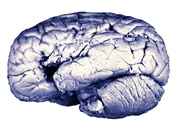
Broca’s area was one of the first brain areas identified with a specific function after 19th Century neurologist Paul Broca autopsied a man who had lost the ability to speak.

When examining the man’s brain (you can see it on the right), Broca found selective damage to the third convolution of the left frontal lobe and linked this with the fact that the person could understand speech but not produce it.

This type of speech problem after brain injury is now known as Broca’s aphasia but his innovation was not simply naming a new type of neurological problem.

Broca was one of the first people to think of the brain in terms of separate areas supporting specialised functions and studying patterns of difficulty after brain damage as a way of working this out – a science now known as cognitive neuropsychology.

The patient Broca described was nicknamed ‘Tan’ because this was the only syllable he could produce. The scientific report named his as Monsieur Leborgne but no further details existed.

Oddly, personal details were not even recorded in Broca’s unpublished medical notes for the patient.

Because of the mystery, people have speculated for years about the identity of Monsieur Leborgne with theories ranging from the idea that he was a French peasant to a philandering man struck down by syphilis.

But now, historian Cezary Domanski has tracked down the identity of Broca’s famous patient through detective work in record offices in France and published the results in the Journal of the History of the Neurosciences.

According to the Broca’s report, the health problems of Louis Victor Leborgne became apparent during his youth, when he suffered the first fits of epilepsy. Although epileptic, Louis Victor Leborgne was a working person. He lived in Paris, in the third district. His profession is given as “formier” (a common description in the nineteenth century used for craftsmen who produced forms for shoemakers).

Leborgne worked until the age of 30 when the loss of speech occurred. It is not known if the damage to the left side of Leborgne’s brain had anything to do with traumas sustained during fits of epilepsy nor, as reported in some recent publications, does it appear to have been caused by syphilis, as that was not indicated in Broca’s reports. The immediate cause for his hospitalization was his problem with communicating.

Leborgne was admitted to the Bicêtre hospital two or three months after losing his ability to speak. Perhaps at first this might have been perceived as a temporary loss, but the defect proved incurable. Because Leborgne was unmarried, he could not be released to be cared for by close relatives; he therefore spent the rest of his life (21 years total) in the hospital.

Domanski’s article finishes on a poignant note, highlighting that Leborgne became famous through his disease and death and his life history was seemingly thought irrelevant even when he was alive.

“It is time” says Domanski, “for Louis Victor Leborgne to regain his identity”.
 

Link to locked article on the identity of Broca’s patient (via @Neuro_Skeptic)

2012-01-18 Spike activity

Quick links from the past week in mind and brain news:

Yes, it’s the return of Spike Activity. As I no longer spend time in the jungle (no not that one) and 140 characters are just not enough for respectable levels of sarcasm, the weekly roundup is back.

Cross-dressing meth priest liked sex in rectory, reports The Connecticut Post. Bishop looking forward to public defrocking.

Neuroskeptic covers the disappointing DSM5 field trial results which have just been released. Thankfully the manual was finalised first. Close call.

Can people really grow out of autism? asks Forbes.

Time magazine has a truly heart-breaking obituary for US military psychologist Dr Peter Linnerooth.

Is It Time to Treat Violence Like a Contagious Disease? asked Wired Science

Ten Percent Of U.S. High School Students Graduating Without Basic Object Permanence Skills reports The Onion. The other 95% lack conservation of number. Yes folks, we’re your number one source for Piaget jokes.

The Guardian has a brilliant review of Jared Diamond’s new book The World Until Yesterday by anthropologist and explorer Wade Davis.

At the DSM5 launch conference, a missed opportunity in getting Bill Clinton as keynote speaker for the scientific programme. They could have got Beyonce for the same money.

The Neurocritic covers a fascinating study finding that the letter-colour mapping in many cases of synaesthesia is the same as Fisher-Price kid’s letters.

There an excellent review of the books ‘Coming of Age on Zoloft’ and ‘Dosed: The Medication Generation Grows Up’ at the ever-excellent Somatosphere.

The New York Times has an obituary for influential psychologist Susan Nolen-Hoeksema.

A new study analysed DNA from 34,549 people and found no genes related to vulnerability to depression. Science News covers the results.

A brain of warring neurons

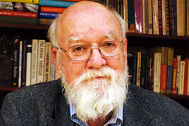
A fascinating talk from philosopher of mind Daniel Dennett where he refutes his earlier claims that neurons can be thought of like transistors in a computational machine that produces the mind.

This section is particularly striking:

The question is, what happens to your ideas about computational architecture when you think of individual neurons not as dutiful slaves or as simple machines but as agents that have to be kept in line and that have to be properly rewarded and that can form coalitions and cabals and organizations and alliances? This vision of the brain as a sort of social arena of politically warring forces seems like sort of an amusing fantasy at first, but is now becoming something that I take more and more seriously, and it’s fed by a lot of different currents.

The complete talk is over at Edge.
 

Link to Dennett talk at Edge.

The search for a genetic killer

Photo by Flickr user Null Value. Click for source.The medical examiner for the Sandy Hook shooting has requested a genetic analysis of killer Adam Lanza. Following this, a powerful editorial in the science magazine Nature has condemned the move suggesting it is “misguided and could lead to dangerous stigmatization.”

But the request to analyse the DNA of Lanza is just the latest in a long line of attempts to account for the behaviour of individual killers in terms of genetics.

Perhaps the first attempt was for a case that bears more than a surface resemblance to the Sandy Hook shooting. In 1998, a 15-year-old high school student called Kip Kinkel killed both of his parents before driving to school and shooting 24 students, one of whom died.

In his trial a child psychiatrist argued that Kinkel had “genetic loading” that made him susceptible to mental illness and violence.

His appeal also relied upon this angle. His lawyer argued that “owing to a genetic predisposition, and therefore through no conscious fault of his own, the defendant suffers a mental illness resulting in committing his crimes.”

Perhaps for the first in decades, an appeal to genetics was used in an attempt to explain the killer’s behaviour.

The genetic arguments became more sophisticated with the trial of serial killer Cary Stayner where a psychiatrist and geneticist presented a genealogy of the his family showing how mental illness and violence ‘ran through the family’.

By the time of the trial of murderer Stephen Mobley, the defence based part of their case on molecular genetics – suggesting that Mobley had a version of the MAOA gene that made him susceptible to violence.

It’s worth noting that none of these appeals to genetics have been successful in the courtroom but it’s interesting that in light of the tragic events in Sandy Hook there has been, yet again, a look towards genetics to try and make sense of the killer – this time presumably based on the yet more advanced technology of whole DNA sequencing.

On this occasion, however, the reasons seems less related to issues of legal responsibility and more for scientific motivations, supposedly to better understand the ‘DNA of a killer’.

As the Nature editorial makes clear, this is foolish:

There is no one-to-one relationship between genetics and mental health or between mental health and violence. Something as simple as a DNA sequence cannot explain anything as complex as behaviour.

However, it shows an interesting shift away from the courtroom genetics of past incidents to a ‘public health’ approach, where, as sociologist Nikolas Rose has noted, the justification is given…

…not in the language of law and rights, but in terms of the priority of protecting “normal people” against risks that threaten their security and contentment. Biological factors are merely one set of factors among others predisposing individuals to antisocial conduct, and “therapeutic interven­tions” are proposed for the good of both the individual and society.

There is a valuable science of understanding how genetics influences violent behaviour but analysis of individual killers will tell us very little about their motivations.

It does, however, reflect a desire to find something different in people who commit appalling crimes. Something that is comprehensible but distinct, alien but identifiable.

This may give us comfort, but it does little to provide answers. In the midst of tragedy, however, the two can easily be confused.
 

Link to Nature editorial.

More than just bumps

Phrenology was the practice of reading someone’s personality from the bumps on their head based on the idea that the shape of the brain affected the shape of the skull.

Contemporary neuroscience lectures often have a part where the professor puts up an image of a phrenology head and says “although this was a rediculous concept, it sparked the idea that the brain could have parts that were specialised for particular functions”.

Phrenologists are usually considered to be quacks and that serious neuroscientists ‘took over’ from where they left off, but I’ve found lots of old copies of The Phrenological Magazine in the Institute of Psychiatry library and it turns out they had a keen interest in serious neuroscience.

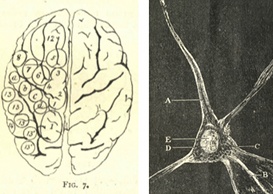
PhrenologicalMagazineNeuroanatomyThe images on the right are from the June 1890 edition (the brain) and October 1895 edition (the neuron) and both show some of the then cutting-edge neuroscience that the magazine regularly featured.
The brain is from the work of legendary neurologist David Ferrier showing his map of cortical functions transposed from his work on open-brain stimulation on animals.

The second image shows the structure of the neuron. The text describes how “molecular movements generated within any individual cell can probably be transmitted to other cells in the same striatum in the cortex” and the feature article goes on to highlight the latest discoveries in neuronal function.

It’s worth saying that this detailed discussion of neuroscience with accurate neuroanatomical images is far more common in the magazine than phrenological brain maps. It seems serious medical men wrote some of the articles and neuroscience debates are common in the pages.

The magazine is not without a bit of kookiness, however, although it’s hard to judge how much of this was considered kooky at the time.

My favourite part is where every issue has a portrait of a famous person with an interpretation of their character underneath. This is the interpretation from the portrait of Lord Wolseley, new head of the British Army, from October 1985.

The head of the new Commander-in-Chief indicates a fair balance of all the powers of his mind. He has no superabundance in any particular to give bias, no special deficiency to cause eccentricity. His head is well formed and appears to be well-developed in all parts.

Inside one issue I found an insert that just said “WANTED TO PURCHASE: a Tatoo’ed New Zealander’s Head. – Apply to Major-General H. ROBLEY, 7 St Alban’s Place, Haymarket”. It turns out that Robley was a renowned collector of such things and it seems phrenologists were one of his sources.

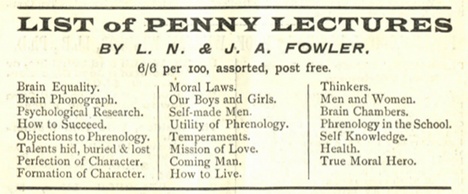
In fact, the magazines are full of wonderful adverts. This list of ‘penny lectures’ isn’t that different from pop psychology and neuroscience today.

There’s some good names for a band lurking in there.

Moving through the waters of human attention

apollorobbinsThe New Yorker has an amazing article on pickpocket and illusionist Apollo Robbins that is packed with gems about attention, misdirection and sleight-of-hand.

Robbins is a self-taught but dedicated aficionado of human consciousness and has learnt the many ways in which our attention can be manipulated.

The article discusses how Robbins does many of his pickpocketing techniques but also discusses how he got into the business and how he has begun collaborating with cognitive scientists to help us understand scientifically what he has learnt artistically.

Robbins uses various metaphors to describe how he works with attention, talking about “surfing attention,” “carving up the attentional pie,” and “framing.” “I use framing the way a movie director or a cinematographer would,” he said. “If I lean my face close in to someone’s, like this”—he demonstrated—“it’s like a closeup. All their attention is on my face, and their pockets, especially the ones on their lower body, are out of the frame. Or if I want to move their attention off their jacket pocket, I can say, ‘You had a wallet in your back pocket—is it still there?’ Now their focus is on their back pocket, or their brain just short-circuits for a second, and I’m free to steal from their jacket.”

In fact, he jointly published a scientific study in 2011 based on his discovery that when something starts moving in a straight line people tend to look back to the origin of the movements, but if something moves in a curve they stay fixed on the object.

If you want to see Robbins in action, and it really is astounding, you can catch him in various videos on YouTube.

There’s even one where he explains how he does it in terms of the neuroscience of attention which is particularly good.

But don’t miss this New Yorker article, it’s both an entertaining and informative guide to a master of human attentional blindspots.
 

Link to New Yorker article ‘A Pickpocket’s Tale’.

Intoxicating tendencies

Photo by Flickr user Caesar Sebastian. Click for source.The latest edition of BBC Radio 4’s Thinking Allowed is a special on ‘intoxication’ looking at the uses, abuses and social function of drugs through the ages.

It’s a fascinating programme in itself but it is peppered with vivid excerpts from how drugs, altered states and drug users have been described historically and are discussed currently.

One example is this wonderfully, painfully descriptive piece from writer Kingsley Amis who brilliantly captured the hangover:

Dixon was alive again. Consciousness was upon him before he could get out of the way; not for him the slow, gracious wandering from the halls of sleep, but a summary, forcible ejection. He lay sprawled, too wicked to move, spewed up like a broken spider-crab on the tarry shingle of the morning. The light did him harm, but not as much as looking at things did; he resolved, having done it once, never to move his eye-balls again. A dusty thudding in his head made the scene before him beat like a pulse. His mouth had been used as a latrine by some small creature of the night, and then as its mausoleum. During the night, too, he’d somehow been on a cross-country run and then been expertly beaten up by secret police. He felt bad.

Oh, and Happy 2013.
 

Link to Thinking Allowed intoxication edition.
mp3 of podcast for same.

Fragments of identity

Photo by Flickr user  аrtofdreaming. Click for source.The Atlantic has a sublime article on identity, memory and amnesia – written as a reflection on meeting a friend who has lost much of his memory due to an advancing brain tumour.

The author is neuropsychologist Daniel Levitin who is better known for his work on the cognitive science of music, but here he writes beautifully about how theories of memory can blend uncomfortably with individual experience.

Once Tom and I were sitting next to each other when Pribram told the class about a colleague of his who had just died a few days earlier. Pribram paused to look out over the classroom and told us that his colleague had been one of the greatest neuropsychologists of all time. Pribram then lowered his head and stared at the floor for such a long time I thought he might have discovered something there. Without lifting his head, he told us that his colleague had been a close friend, and had telephoned a month earlier to say he had just been diagnosed with a brain tumor growing in his temporal lobe. The doctors said that he would gradually lose his memory — not his ability to form new memories, but his ability to retrieve old ones … in short, to understand who he was.

It’s a wonderfully written piece that is subtly recursive, like memory itself.
 

Link to Atlantic piece on memory and identity (via @edyong209)

Rita Levi-Montalcini has left the building

Nobel-prize winning neuroscientist Rita Levi-Montalcini has passed away at the age of 103, just a few months after publishing her last scientific study.

She won the Nobel Prize for the discovery of nerve growth factor along with her colleague Stanley Cohen and continued worked well past the time when most people would have retired.

Her most recent scientific study was published earlier this year, at the age of 102, and extended the work for which she won the Nobel.

If you want more background on a fantastic neuroscientist and her ground-breaking work, Nature published a profile in 2009, on her 100th birthday.
 

Link to obituary in the New York Times.
Link to Nature profile.

In other news: behind the video game scare

The research on the psychological impact of video games tells quite a different story from the stories we get from interest groups and the media. I look at what we know in an article for The Observer.

Perhaps the two biggest concerns are that video games are ‘damaging the brain’ and that violent video games are causing, well, violence.

It’s first worth noting that talking about the impact of ‘video games’ as a whole is about a pointless as talking about the health effects of ‘sports’ as a whole.

However, we do know that certain sorts of video games have specific effects. For example, we have increasing evidence that ‘action video games’ lead to significant improvements in certain mental skills.

The number of aliens you kill may directly contribute to an improvement in your brain. This may not sound like a typical scientific discovery, but it has come from some of the world’s finest neuroscience laboratories. In fact, it is the genuine outcome of studies on how action video games can improve your attention, mental control and visual skills. We’re talking here about fast-moving titles such as Halo, Call of Duty and Grand Theft Auto, which demand quick reflexes and instant decision-making. They’re often portrayed as the most trashy, vapid and empty-headed forms of digital entertainment, but it looks as if they may be particularly good at sharpening your mental skills.

As the article makes clear, this has been tested quite rigorously, including with randomised controlled trials.

With regard to violence, violent video games have been found to cause small, reliable but temporary increases in aggressive thoughts and behaviour in the lab – as have other forms of violent media, including films and the news.

But in terms of real-world violence “delinquent peers, depression and an abusive family environment account for actual violent incidents, while exposure to media violence seems to have only a minor and usually insignificant effect.”

Nevertheless, the video game utopians also have reason to think again. There are some negative effects of spending too much time in front of the console, which are also tackled in the article.
 

Link to Observer article on the science of how gaming affects us.

A depressing financial justification

Image from Wikipedia user LuciusCommons. Click for source.One of the most controversial changes to the recently finalised DSM-5 diagnostic manual was the removal of the ‘bereavement exclusion’ from the diagnosis of depression – meaning that someone could be diagnosed as depressed even if they’ve just lost a loved on

The Washington Post has been investigating the financial ties of those on the committee and, yes, you guessed it:

Eight of 11 members of the APA committee that spearheaded the change reported financial connections to pharmaceutical companies — either receiving speaking fees, consultant pay, research grants or holding stock, according to the disclosures filed with the association. Six of the 11 panelists reported financial ties during the time that the committee met, and two more reported financial ties in the five years leading up to the committee assignment, according to APA records.

A key adviser to the committee — he wrote the scientific justification for the change — was the lead author of the 2001 study on Wellbutrin, sponsored by GlaxoWellcome, showing that its antidepressant Wellbutrin could be used to treat bereavement…

The association also appointed an oversight panel that declared that the recommendations had been free of bias, but most of the members of the “independent review panel” had previous financial ties to the industry.

Actually, it’s kind of sad that this isn’t a surprise, but perhaps more worrying is the fact that the chairman of the mood disorders panel that made the change, Jan Fawcett, doesn’t seem to understand bias.

“I don’t think these connections create any bias at all,” Fawcett said. “People can say we were biased. But it assumes we have no intelligence of our own.

Fawcett is assuming that bias means ‘dishonesty’ where people deliberately make choices for their own advantage against what they know to be a better course of action, or ‘sloppiness’ where people don’t fully think through the issue.

But bias, as you can find out from picking up any social psychology paper from the past century, is where incentives change our behaviour usually without us having insight into the presence or effect of the influencer.

This is exemplified in the work of Dan Ariely or the work that won Daniel Kahneman the Nobel Prize.

So when someone says, “I don’t think these connections create any bias” it means – ‘I’m not willing to think about the bias that these connections create’ which is a red flag that they won’t be recognised or addressed.

We’re all susceptible to them. The trick is to recognise they exist and put measures in place to account for them.

Sadly, it doesn’t look like this has happened with the DSM-5.
 

Link to WashPost article on the new depression diagnosis and industry ties.