Spike activity 27-06-2014

Quick links from the past week in mind and brain news:

Slate has a piece on developmental psychology’s WEIRD problem. Most kids in child psychology studies are from very restricted social groups – rich, educated families.

Facebook manipulated stories in users’ newsfeeds to conduct experiments on emotional contagion. Don’t remember signing the consent form for the study that appeared in PNAS?

Time covers the massive prevalence of PTSD among US veterans. The Pentagon’s PTSD treatments “appear to be local, ad hoc, incremental, and crisis-driven” with no effective evaluation.

Excellent analysis of a new study: FDA’s antidepressant warning didn’t actually backfired and cause more suicides. Neuroskeptic on the case.

Time magazine has an interesting piece on the under-reported problem of violence in women.

Interesting National Geographic piece about how new finds of human skull bones show even more complexity in the evolution of human and hominid species.

Slate has a piece on how that a lot of zoo animals are on antipsychotics because they become mentally ill when enclosed.

A spook’s guide to the psychology of deception

Last February, a file from the Edward Snowden leaks was released from a 2012 GCHQ presentation called ‘The Art of Deception: Training for Online Covert Operations’. It describes the ‘Online Covert Action Accreditation’ course which draws heavily on the psychology of influence and persuasion. This post will look at how they’re piecing together the science that forms the basis for these online operations.

The work seems to have been put together by GCHQ’s Human Science Operations Cell which presumably exists as an internal consultancy to allow the relevant cognitive and social sciences to be applied to practical covert operations.

One of the early slides lists the subjects the HSOC draws on which stretch from psychology to political science to neuroscience. At the current time, neuroscience has nothing practical to contribute, so they’re clearly blowing their neurological trumpets to sound a bit more high-tech but it’s worth noting the breadth of disciplines they draw on meaning they’ve got a wide and comprehensive vision of human behaviour from the micro to the macro.

However, one of the key slides has a road map of how everything fits together. It’s shown below and it’s quite dense so you can click the image below if you want a larger version.

One of the first thing that stands out is the ad-hoc-ness of their approach. They’ve appropriated a patchwork of relevant theories as a guide to practice with nothing being drawn from their own data.

You can see the main areas they’re drawing from – which includes profiling cultures and personality, research on persuasion, cognitive biases and scams, research on the psychology of stage magic, and organisational psychology or management science more generally.
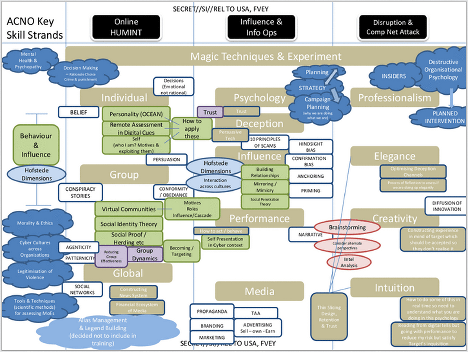
 

Perhaps the weakest elements here are the cultural and personality profiling using Hofstede’s cultural dimensions and a Big Five personality traits. The trouble is that while these are statistically reliable on the group level they predict very little on the individual level because the effects are swamped by individual variation.

This means it may be more useful in the domain of PSYOPS, which attempts to influence groups, rather than targeting individuals.

The slide below details the general psychological framework for deception. As far as I can tell, this is the only original piece of psychological theory in the presentation.
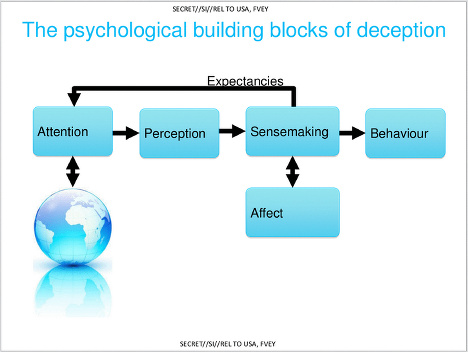
 

It’s more a useful way of organising different approaches to deception rather than a theory in itself. It’s what clinical psychologists would call a ‘formulation’. It’s a way of organising evidence-based effects that may not be thoroughly tested itself but works well enough to aid understanding.

Perhaps the key thing to note is the sensemaking component. Sensemaking is a key concept in management science that just describes the different ways in which people come to conclusions about the meaning and significance of things.

It should be a well-known concept in intelligence circles because it is used both in military people management and military intelligence analysis. Interestingly, they treat individuals as like naive intelligence analysts who are trying to piece together their own understanding of the world and aim to exploit some of the weaknesses in this process. The big messy ‘concept map’ slides mentions ‘destructive organisational psychology’ which presumably refers to using the understanding of what keeps organisation together to break them apart.

However, in terms of the psychological science which underlies their approach, the next slide is key.
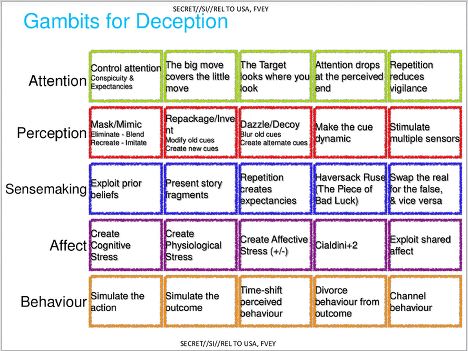
 

You can see several influences here. The techniques listed under ‘attention’ are all taken from research on the psychology of magic tricks, particularly from Susana Martinez-Conde’s work on how sleight-of-hand artists manipulate attention. Most of it is reviewed in a paper she wrote with a series of co-authors including pickpocket Apollo Robbins.

The HSOC spooks clearly love the idea of the psychology of magic and they refer to it a lot in their presentation. One slide just says ‘We want to build Cyber Magicians’, but it’s really not clear how it applies online. The whole point of sleight-of-hand is that it is dynamic and takes advantage of how you pay attention. When online, however, users’ attention doesn’t necessary flow in a predictable pattern because you can wander off from the screen, pause, grab screenshots and so on. In other words, individuals have better control over the flow of information because online interaction is designed for information control and therefore partial staggered attention.

The ‘perception’ techniques listed on the slide are largely taken from Stefano Grazioli and Sirkka Jarvenpaa’s classic paper [pdf] on online deception entitled ‘Deceived: Under Target Online’. The paper looks at how internet scammers rip people off and assuming that successful online con artists have found useful techniques by natural selection, HSOC just borrow them.

The techniques to exploit sensemaking are largely based on theories of sensemaking itself although the story fragments components seems to be drawn from research on relational agents that are designed ‘to form long-term, social-emotional relationships with their users’. Rather than actually deploying autonomous relational agents, I suspect it’s simply a case of using research insights from the area that suggests, for example, that presenting fragments of the agent’s backstory and letting the other person piece them together makes the person seem more believable.

The techniques in the ‘affect’ section are some general points taken from a vast experimental literature on the psychology of marketing and persuasion that describes how emotion modulates the heuristics (judgement processes) involved in persuasion.

The ‘behaviour’ section is the only part I don’t recognise as coming from the psychological literature. This makes me suspect it comes from PSYOPS or IO practice, but if you recognise it, leave a comment below.
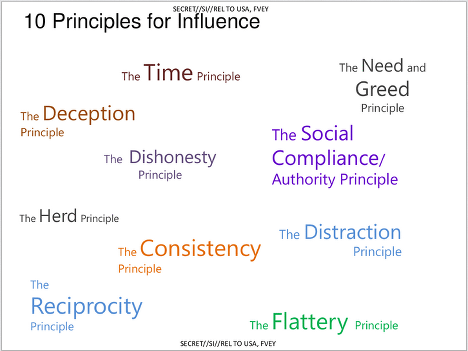
 

The ’10 Principles of Influence’ is perhaps one of the most interesting slides in terms of illustrating the empirical basis for their approach as they use research both on the strategies of honest persuasion and dishonest scammers.

‘Principles are influence’ are largely associated with the work of consumer psychologist Robert Cialdini but the list actually consists of three of his six principles (Reciprocity, Social Compliance / Authority, Consistency).

Another six are taken from Stajano and Wilson’s classic study ‘Understanding scam victims: seven principles for systems security’ which describes six methods used by con artists. One item overlaps with the Cialdini principles and additionally they’ve included flattery (known to be an effective persuasive tool) and time – although it’s not clear whether they’re referring to giving people time and putting people under time pressure.
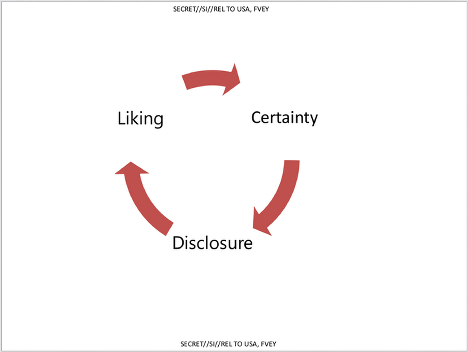
 

This section seems to be about gaining people’s trust to encourage disclosure and the slide you see above refers to social penetration theory which describes how relationships progress to increased levels of intimate connection through self-disclosure. The slide that follows this gives some basic advice about encouraging this: mirroring communication cues, adjust speech patters and so on – the sort of things you get taught in the first week of a psychotherapy course.

So here’s what the Online Covert Action Accreditation’ course looks like: like a PhD psychologist was given the task to come up with a plausible psychological framework for practical deception and influence online. It draws on a mix of persuasion psychology from marketing, studies on scammers and con-men, the social psychology of trust and disclosure, studies of how stage magic works psychologically, and work on what makes organisations work effectively and what degrades their performance.

This is a comprehensive approach to the problem, but the trouble is, this probably only translates approximately and probably rather poorly into practical effects.

In place of this, HSOC would be better of doing research and lots of it. They could do lots of informal RCTs online and gather a large amount of data quite quickly to test out which techniques actually increase influence or lead to successful deception. What behaviours on the part of the actor lead to increased self-disclosure the quickest? Does a laggy internet connection mean people’s increased frustration affects their evaluation of honest? and so on.

I suspect, however, that the Human Science Operations Cell were, and maybe still are, quite a small outfit and so they’re restricted to a consultancy role which will ultimately limit their effectiveness.

We tend to think that the secret services are super efficient experts with an infinite budget, but they probably just work like any other organisation. HSOC were probably told to deliver an Online Covert Action Accreditation course with few resources and not enough time and came up with the most sensible thing in the time allowed.

Oh, and by the way, hello spooks, and welcome to Mind Hacks.
 

Link to copy of slides.
Link to coverage from The Intercept.
The normality trap

I remember taking a bus to London Bridge when, after a few stops, a woman got on who seemed to move with a subtle but twitchy disregard for her surroundings. She found herself a seat among the Saturday shoppers and divided her time between looking out the window and responding to invisible companions, occasionally shouting at her unseen persecutors.

By East Street, the bus was empty.

You’ve probably encountered fellow travellers who are strikingly out of the ordinary, sometimes quite distressed, scattered among the urban landscape where they seem to have a social forcefield around them that makes crowds part in their presence.

If you’ve ever worked in a hospital or support service for people with psychological or neurological difficulties, you’ve probably met lots of people who are markedly out of step with the mundane rules of social engagement.

They seem to talk too loud, or too fast, or too much. They can be full of fantastical things or fantasies. They may be afraid or angry, difficult or disengaged or intent on rewind-replay behaviours. Their dress can be notable for its eccentricity or decay.

So why don’t we see people like these in anti-stigma campaigns?

Don’t get me wrong, I’m a massive fan of the great work anti-stigma campaigns do. Everybody is susceptible to mental health problems and the reason these campaigns are necessary is that they often go unrecognised by other people and instead of help, too often people receive misunderstanding and ignorance.

But there’s more to mental health than normality.

That woman on the bus shouting at her voices, she deserves respect too. That guy who posts those leaflets about Masons and thought-stealing all over town, deserves your time. The guy that speaks in a clumsy monotone voice and doesn’t look you in the eye, is also worthy of compassion.

Disability charities don’t base their campaigns solely on ‘nice people in wheelchairs’. They’re happy to show people who represent the full range of appearance and presentation. So why not mental health?

Step up mental health organisations, you’ve got nothing to lose except your conformity.

Spike activity 20-06-2014

Quick links from the past week in mind and brain news:

OK Go’s new music video is like standing naked under a waterfall of optical illusions while wearing hipster spectacles.

The mighty Neurocritic looks at advances in physical brain tweaking and the possible rebirth of paradise engineering.

The Dana Foundation has an excellent piece on how to make sense of those ‘gene for’ behavioural genetics stories in the media.

Slow news day: The New York Times reports my killer robot opinions. Sadly the key quote (“To the bunkers if you want any chance of saving yourselves from the coming robotocalypse. RUN, RUN FOR YOUR LIVES!”) was omitted.

PsyPost reports on a new study finding that the ‘trophy wife’ stereotype is largely a myth, because not even good looks can break the class barrier.

Watching porn won’t shrink your brain. Just makes you a bit sore. Brain Watch comments on a widely misreported recent study.

The Atlantic has a great piece on five neurology patients who changed the way we think about the brain.

There’s an excellent article about maternal mental health in The New York Times.

Simon says Psychosis! is an excellent new mini-documentary on the first experience of psychosis and early intervention services.

The ever-interesting neuroscientist Molly Crockett is featured in this Wellcome Trust focus on scientists’ working days.

A peek inside The Skeleton Cupboard

You’ll get more out of The Skeleton Cupboard, Tanyan Byron’s account of her training as a clinical psychologist, if you read the epilogue first.

It tells you that the patients described in the book are fictional, to preserve confidentiality, but indicates that the stories were representative of real situations.

This is a common device in clinical memoires, from Irvin Yalom’s existential tales of psychotherapy to Philippa Perry’s couch fiction, but I’m never quite sure what to make of these clinical quasi-biographies.

They are usually realistic, insightful and wonderful to read, Byron’s book is no exception, but the smudged line between truth and necessary fiction is sometimes hard to navigate.

In Byron’s case, her book is perhaps the most deliberately autobiographical in the genre, where she intends to reflect the role of the psychologist’s own psychology in working with distressed, impaired, and sometimes difficult individuals.

This is part of what clinical psychologists aim to do – understand how your own reactions are colouring your approach to the patient – but when the patients are literary collages of real people, it is perhaps the process rather than the content of those reflections that are the most informative.

From this perspective, The Skeleton Cupboard is best understood as an illustrated history of ‘how my thinking evolved as a clinician’ rather than a journal of patients past, although we assume the non-clinical parts are factual: the hard-boiled supervisor, the misjudged snogging of a psychiatrist, the friends through good times and bad.

Byron is Britain’s best ambassador for clinical psychology and a very good writer to boot and I’m sure The Skeleton Cupboard will prompt many to take up the profession or inspire them during their training. It’s also a good account of how thinking and practice evolves through first contact with patients.

It has some artistic license, maybe even melodrama in places, but it has some points of emotional truth that are hard to deny.
 

Link to more details of The Skeleton Cupboard.

Spike activity 06-06-2014

Quick links from the past week in mind and brain news:

Psychedelic chemist, godfather of Ecstasy, and lover of phenethylamines, Alexander Shulgin, has left the building. PhysOrg has an obituary.

New Republic looks back at 50 years of the landmark account of psychosis ‘I Never Promised You a Rose Garden’.

The US Secret Service wants a sarcasm detection tool for Twitter reports The Telegraph. Their irony detection tool is apparently still switched off.

Aeon Magazine has a piece on how artificial intelligence is being used to develop the first generation of sex robots. Voight-Kampff plugin for Tinder coming soon.

British folk: Now that BBC Future is available to people in the country it is based in, do check out its large cache of excellent psychology and neuroscience articles.

Mosaic has an extensive article on the US Military’s interest in boosting the brain by passing small electrical currents through it.

Go check out this excellent piece on ‘mirror neurons’ and what they’re likely to be actually doing from Nautilus magazine.

Advances in the History of Psychology blog has an interesting piece on how Little Albert may not have been correctly identified after all.

How to Criticize with Kindness: Philosopher of Mind Daniel Dennett brings some wisdom and describes the four steps to arguing intelligently over at Brain Pickings.

The Economist has a great interview with risk psychologist Gerd Gigerenzer.

A festival of anxious art

If you’re in London during June, the Anxiety Arts Festival is surprisingly diverse and interesting series of events that looks at anxiety through film, theatre and visual arts.

The festival is being curated by the Mental Health Foundation who have put together a genuinely exciting programme that avoids the curse of constant niceness and goes into some quite challenging areas.

Highlights include the darkly comic play Non-stop Exotic Anxiety, Ian Curtis and Joy Division biopic Control, South London Gallery exhibition The Military Industrial Complex on consensual reality, the irrepressible CoolTan Arts event Mad Hatters Tea Party, and Hearing Things – a theatre production of improvised scenes with mental health service users, professionals, and professional actors.

There’s masses more events and its one not to miss.
 

Link to Anxiety Festival.

Spike activity 30-05-2014

Quick links from the past week in mind and brain news:

If you’ve not been keeping up with the internet, there’s been a replication crisis hoedown and everyone’s had a go on the violin.

Political Science Replication had a good summary. Schnall’s reply, the rise of ‘negative psychology’ and a pointed response.

Military Plans To Test Brain Implants To Fight Mental Disorders reports NPR. If only there was some way to avoid traumatising people…

The BPS Research Digest has been hosting some amazing guest mind and brain writers and here’s an index to all their articles.

The Myth of Einstein’s Brain. Neuroskeptic has an excellent piece about how studies of his kidnapped brain don’t actually tell us much.

The Best Illusion of the Year contest has just announced it’s 2014 winners.

Spacetimemind is a new podcast with some good philosophy of mind material.

Neuroscientists win 2014 Kavli Prize in neuroscience: Brenda Milner, John O’Keefe, and Marcus Raichle

The Blind Woman Who Sees Rain, But Not Her Daughter’s Smile. Another fascinating piece from NPR.

Brain Watch asks ‘what happens if you apply electricity to the brain of a corpse?’ Don’t try this at home.

Philosopher fight in the New York Review of Books: Patricia Churchland and Colin McGinn on brains and minds and retorts like only philosophers can manage.

The day video games ate my school child

The BBC is reporting that a UK teachers union “is calling for urgent action over the impact of modern technology on children’s ability to learn” and that “some pupils were unable to concentrate or socialise properly” due to what they perceive as ‘over-use’ of digital technology.

Due to evidence reviewed by neuroscientist Kathryn Mills in a recent paper (pdf) we know that we’ve really got no reason to worry about technology having an adverse effects on kids’ brains.

It may not be that the teachers’ union is completely mistaken, however. They may be on to something but maybe just not what they think they’re onto.

To make sense of the confusion, you need to check out an elegant study completed by psychologists Robert Weis and Brittany Cerankosky who decided to test the psychological effects of giving young boys video game consoles.

They asked for families to take part who did not have a video-game system already in their home, had a parent interested in purchasing a system for their use, and where the kid had no history of developmental, behavioural, medical, or learning problems.

They ran a randomised controlled trial or RCT where 6 to 9-year-old boys were first given neuropsychological tests to measure their cognitive abilities (memory, concentration and problem-solving) and then randomly assigned to get a video games console.

The families in the control group were promised a console at the end of the study, by the way, so they didn’t think ‘oh sod it’ and go and buy one anyway.

So, we have half the kids with spanking brand new console, and, as part of the trial, the amount of time kids spent gaming and doing their school work was measured throughout, as was reporting of any behavioural problems. At the end of the study their academic progress was measured and their cognitive abilities were tested again.

The results were clear: kids who got video game consoles were worse off academically compared to their non-console-owning peers – their progress in reading and writing had suffered.

But this wasn’t due to an impact on their concentration, memory, problem-solving or behaviour – their neuropsychological and social performance was completely unaffected.

By looking at how much time the kids spent on the consoles, they found that reduced academic performance was due to the fact that kids in the console-owning families started spending less time doing their homework.

In other words, if your kids play a lot of computer games instead of doing homework they may well appear worse off, and from the teachers’ point-of-view, might seem a little slowed-down compared to their peers, but this is not due to cognitive changes.

Interestingly, teachers may not be in the best position to see this distinction very well because they tend, like the rest of us, to measure ability by performance in the tasks they set and not in comparison to neuropsychological test performance.

The solution is not to panic about technology as this same conclusion probably applies to anything that displaces homework (too many piano lessons will have the same effect) but good parental management of out-of-school time is clearly important.
 

Link to locked study on the effects of video games.

Important peculiarities of memory

A slide from what looks like a fascinating talk by memory researcher Robert Bjork is doing the rounds on Twitter.

The talk has just happened at the Association for Psychological Science 2014 conference and it describes some ‘Important peculiarities of memory’.

You can click the link above if you want to see if the image, but as it’s a little fuzzy, I’ve reproduced Robert Bjork’s text below:
 

Important peculiarities of the human memory system

  • A remarkable capacity for storing information is coupled with a highly fallible retrieval process.
  • What is accessible in memory is highly dependent on the current environmental, interpersonal, emotional and body-state cues.
  • Retrieving information from memory is a dynamic process that alters the subsequent state of the system.
  • Access to competing memory representations regresses towards the earlier representation over time


A lovely summary of memory’s quirks.
 

Link to Robert Bjork’s staff page.
Link to APS 2014 page with videos of the keynote talks.

Spike activity 16-05-2014

Quick links from the past week in mind and brain news:

Motherboard on a legal rights framework for biohacking the brain. Caveat hax0r no?

There Is a Doppelganger Inside All Our Heads. Interesting piece in Nautilus.

Discover Magazine covers the latest study on using electrical stimulation to increase the chance of lucid dreaming.

The seductive allure of a brain scanner made out of an old hair dryer. The mighty Neurocritic covers a curious study.

BPS Research Digest covers an interesting study on sex lives following lower limb amputation.

Turns out there are interesting financial interests behind the ‘neuroscience in the classroom’ movement. Coverage by the Headquarters blog.

Mosaic has an excellent piece on one person’s quest to understand an existence dominated by the bleakest, darkest moods.

Study linking brain cancer and mobiles inconclusive. NHS Choices covers study widely reported as “We’re doomed. Doomed, I tell you!”

Why We Took Cocaine Out of Soda. Mainly racism as it turns out. Article in The Atlantic.

Elder statesfolk of cognitive neuroscience Uta and Chris Frith have started an excellent blog called Social Minds.

Daily News on American politicians throwing neuropsychological insults around. I’ll vote for the first one who gets a basal ganglia dig in.

There’s an interesting piece on ‘supertaskers‘ – the 2% of people who can multitask without dropping their performance level over at The New Yorker.

Unsure memories of murder

The BBC News site has a special multimedia feature on a case of false confession to murder that has been been troubling Iceland from the 1970s and has recently erupted again.

The Beeb have clearly gone a bit ‘Scandinavian detective drama’ on the whole thing but it is a gripping story, not least because it involves forensic psychology legend Gisli Gudjonsson who worked on the case when he was a young police officer and later when he became a leading expert in false confessions.

In many ways, it’s a classic case of memory distrust syndrome where accused people begin to distrust what they remember and begin to believe what’s been suggested to them. In this case, through pressure of interrogation, use of memory affecting drugs and already being motivated to comply.

It’s a fascinating case and not fully resolved – a final investigation into the miscarriage of justice is about to be published by the Icelandic government.
 

Link to ‘The Reykjavik Confessions’

The genetics of intelligent radio

BBC Radio 4 has just concluded an excellent three-part series on the controversies over the genetics of intelligence and it’s one of the best and most nuanced discussions you’ll hear about the topic for many years.

The series is called Intelligence: Born Smart, Born Equal, Born Different and it’s carefully put together, wide in scope and doesn’t shy away from either tough science or difficult issues.

The only point I’d make about is one of context: most of the discussions apply to Western populations. This is not a point about race but one about environment.

Calculating heritability for a particular trait, in this case for cognitive function, involves working out how much of the difference between people is accounted for by genetics and the environment. But the result only holds for similar populations in similar environments.

For example, malnutrition, disease and high levels of environmental neurotoxins (e.g mercury from illegal gold mining) have a massive impact on cognitive function in kids and are clearly all environmental, rather than genetic, contributors to cognitive function.

But when most of these studies are done, these serious environmental effects have been screened out either explicitly (for example, by not including people who have pre-existing damage through neurotoxins in the study) or implicitly (because, for example, malnutrition barely exists where most heritability of intelligence studies are done).

The qualified conclusion is that general cognitive function is largely heritable when the most significant environmental effects on cognitive function have already been removed. This would be true for many European kids, for example, but much less so for kids from, let’s say, South Sudan.

The programme doesn’t claim otherwise, and lucidly describes how heritability is population specific, but it’s worth bearing in mind how much of the subsequent discussion addresses issues more relevant to the developed world than the one fifth of the world’s population who live in extreme poverty.

Either way, if you want to get up to speed on the debate about intelligence, cognitive function and genetics, the BBC Radio series is an excellent place to start and you’ll come away much smarter as a result.
 

Link to ‘Intelligence: Born Smart, Born Equal, Born Different’
Link to podcast page for the series.

A forest of porous dreaming

A fascinating section of the book How Forests Think by anthropologist Eduardo Kohn where he describes how dreaming is much more porous among the Runa people of Ecuador.

This is both because of how they understand dreams, but also because of the way sleep happens in their culture – it being a more social and frequently interrupted activity, meaning that dreams and the outside world interact much more intensely.

From page 13:

Sleeping in Ávila is not the consolidated, solitary, sensorially deprived endeavour it has often become for us. Sleep – surrounded by lots of people in open thatch houses with no electricity and largely exposed to the outdoors – is continuously interspersed with wakefulness. One awakens in the middle of the night to sit by the fire and ward off the chill, or to receive a gourd full of steaming huayusa tea, or on hearing the common potoo call during a full moon, or sometimes the distant hum of a jaguar. And one awakens also to the extemporaneous comments people make throughout the night about those voices they hear.

Thanks to these continuous disruptions, dreams spill into wakefulness and wakefulness into dreams in a way that entangles both. Dreams – my own and those of my housemates, the strange ones we shared, and even those of their dogs – came to occupy a great deal of my ethnographic attention, especially because they so often involved the creatures and spirits that people the forest. Dreams too are part of the empirical, and they are kind of real. They grow out of and work on the world, and learning to be attuned to their special logics and their fragile forms of efficacy helps reveal something about the world beyond the human.

Interestingly, if your sleep is interrupted by people giving you huayasa tea you are also likely to sleep rather differently as it contains caffeine, meaning you may sleep more lightly and be more sensitive to your environment as a result.

I’m still getting to grips with the book which sounds lovely but is actually about how the theory of anthropology as a study of humans is challenged by societies where whole ecosystems form part of cognitive systems.

As with any book about deep theory, it is both difficult and intriguing, and sometimes I feel like I am lost in a forest myself.
 

Link to more details of How Forests Think.

Spike activity 09-05-2014

Quick links from the past week in mind and brain news:

Slate has an in-depth piece on the ‘real story’ of Phineas Gage. Perhaps not such a revelation to some but beautifully told nonetheless.

There’s an extensive piece on the latest developments with neuromorphic chips in MIT Tech Review.

Foreign Policy magazine has ‘The Case Against Killer Robots‘. Wasn’t this made way back in the early 80s?

Things You Cannot Unsee (and What That Says About Your Brain). Nice piece on visual perception and scence interpretation in the brain from The Atlantic.

Wired takes us Inside the Strange New World of DIY Brain Stimulation.

Fascinating piece on BPS Research Digest: The enigma of dyslexic musicians.

New Scientist has a piece on RDoC ‘psychiatry’s scientific reboot’ but don’t miss BishopBlog with a more critical take.

A short history of game panics. Reason magazine takes us on a trip through history.

Neuroskeptic discusses a new study on how fMRI studies could be confounded by the pattern of the participants’ breathing.

The poly themes of psychosis

The latest London Review of Books has an amazing first-person account of psychosis that illustrates the complex interlocking webs of ideas and perceptions that can occur in the more intense versions of the experience.

As a description of the lived-experience of psychosis, it is actually quite rare, because most are written about relatively (and I mean relatively) circumscribed or contained experiences which clearly do not reflect reality but have their own internal logic.

These are perhaps the most common forms that psychosis takes but some are bizarre, intense and complex, involving delusions that seem to encompass a huge number of themes (known as polythematic delusions).

I met a woman called Margaret in Fairmile hospital. I assumed she was my link to the politician with the same first name. She explained periods to me. I wondered if the PM was angry with me for writing a story saying she deserved to hang for sinking the Belgrano. I tried to manoeuvre Margaret around to the front of the hospital so that a Rolls could pull in off the main road and take me to Mrs Thatcher. She didn’t seem very willing to comply. The shrink had been watching me and asked why I looked up at the sky when helicopters flew over. They were sent by Francis Pym to rescue me. Despite the massive grounds around the Victorian building the choppers never seemed to land. I soon realised I would do six months unless I staged a recovery. I stopped looking at helicopters and after only three months I was free.

One of the difficulties with a lot of discussion about mental health and mental health treatment is that ‘psychosis’ is assumed to be a single thing or variations of a single thing, when in fact it can vary massively both in terms of how the person experiences it and how it impacts them.

I have met people who have delusions and hallucinations but continue high powered jobs (probably, so have you, without realising it) whereas other people are massively disabled and / or distressed by their experiences.

As with most difficulties in life, those who are most affected are the least able to advocate for themselves, so this article stands out as a sharply written piece that captures some of the ever-woven web of intense psychosis.
 

Link to first-person account of psychosis in The LRB.