Encephalon 68, 69 and my memory is like a sieve

The 69th edition of the Encephalon psychology and neuroscience carnival has just appeared on Brain Stimulant and… dear God, I just realise I missed the 68th edition on the excellent Ouroboros as well, so here are both for your reading pleasure.

A couple of my favourites include a fantastic post on Neuroanthropology post entitled “Who you callin‚Äô a ‚Äòneuroconstructivist‚Äô punk?!” (actually, I added the punk, but you get the idea), and a Neurocritic article on a curious neurological condition where people lose the ability to correctly point at a named body part.

I always say there’s plenty more, but this time there’s a whole load more where that came from, thanks to my slightly faulty memory.

Link to Encephalon 68.
Link to Encephalon 69.

A Trance of Pleasure

Photo by Flickr user ubiquity_zh. Click for sourceA 2003 study in Epilepsy and Behavior has some descriptions of the ecstatic seizures experienced by some patients with epilepsy.

They include intense erotic and spiritual experiences, feelings of become close to and blending with other people, and some sensations that couldn’t be fully captured in words.

I’ve put some of the descriptions below because they sound absolutely wonderful:

Patient 1
The first seizure occurred during a concert when he was a teenager. He remembers perceiving short moments of an indefinable feeling. Such episodes recurred and a few months later evolved into a GTC [generalized tonic–clonic seizure]. He characterizes these sensations as “a trance of pleasure.” “It is like an emotional wave striking me again and again. I feel compelled to obey a sort of phenomenon. These sensations are outside the spectrum of what I ever have experienced outside a seizure.” He also describes cold shivering, increased muscle tension, and a delicious taste, and he swallows repeatedly. He enjoys the sensations and is absorbed in them in a way that he can barely hear when spoken to. When in a particular, relaxed mood, he can sometimes induce seizures by “opening up mentally” and contracting muscles. He denies any religious aspects of the symptoms. “It’s the phenomenon, the feeling, the fit taking control.” It lasts a few minutes and afterward he is tired with difficulties expressing himself for about 1 hour.

Patient 6
This man has a multifaceted symptomatology and a tendency to interpret bodily sensations as supernatural phenomena. Nevertheless, from the beginning of his forties, he experienced distinct, stereotypical attacks with a “change of concept of the surrounding world.” He reports an “oscillating erotic sensation, like twinkling polar light” in his pelvic region and down the inside of his thighs. This is described as different from sexual excitement, more like “an erogenous charge of the skin.” He may also have a clairvoyant feeling of a “telepathic contact with a divine power.” These sensations are of short duration and may be accompanied by faintness and followed by drowsiness. With carbamazepine treatment, the frequency of these attacks has been considerably reduced.

Patient 11
The attacks started in his first school year. The experiences are beyond what can be described in words. “I can sense the colours red and orange without seeing them. The feeling has an erotic aspect. It starts in the stomach and spreads upwards. It is pleasant, but not similar to ordinary joy. It is like an explosion.” In the close presence of another person, he can feel a sort of peculiar unification. An intense déjà vu sensation, a queer taste, and “gooseflesh” are also components of the seizures. As a child he was surprised that his friends denied having similar feelings, and he learned to keep them to himself. Sometimes these attacks evolved into CPSs with reduced consciousness and complex automatisms and afterward he had transient difficulties speaking. Before the diagnosis of epilepsy was made in his late teens, he was referred to a psychiatrist. A right-sided temporal lobe calcification was diagnosed by computed tomography at about 30 years, but he refused surgery. At 42, an expansion in the same region was found by MRI, and he was operated for an anaplastic oligodendroglioma. He was seizure-free for 6 years until recurrence of the tumor.

One of the striking things about epilepsy is how different each person’s experience of having a seizure can be.

While it is stereotypically assumed to be a negative experience, some aspects can be remarkably beautiful.

The Russian author Dostoyevsky famously said of his epilepsy “I would experience such joy as would be inconceivable in ordinary life – such joy that no one else could have any notion of. I would feel the most complete harmony in myself and in the whole world and this feeling was so strong and sweet that for a few seconds of such bliss I would give ten or more years of my life, even my whole life perhaps.”

There are several more case descriptions in the article, all of which have some aspect which touch at least the edge of ecstasy, if not the very heart of the experience.

Link to article.
Link to PubMed entry for same.

Beautiful butterfly brain

This is a beautiful butterfly brain greetings card, created by graphic designer TweeK. I’d never would have imagined that an MRI scan and butterflies would go together so effortlessly, and the effect is quite stunning.

You can buy copies of the card online, so you can impress the hardest-to-impress of your brain-inclined friends, or you can just visit the page to see it in more detail.

I can’t stop looking at it.

Fantastic.

Link to TweeK’s butterfly brain greetings card.

Dodging the border agency of the brain

Photo from Wikipedia. Click for sourceI just noticed that neurotechnology analyst Zack Lynch has a forthcoming article in Epilepsy and Behavior on the latest developments in the commercial brain science field. Avid neuroscience fans may be familiar with most of it but the section on new technologies to cross the blood-brain barrier was eye-opening.

The blood-brain barrier (BBB) is a sieve-like border crossing that allows only certain molecules to pass from the blood into the brain.

It’s remarkably restrictive and many molecules are just too big to get past, meaning that many drugs that could affect the brain are virtually useless, simply because they can’t cross the border.

This has led neuroscientists to think of ways of smuggling, tunnelling and sneaking this these molecules past the barrier, and Lynch’s article lists some of the latest technologies which aim to jump the fence.

• Implantable devices: Implantable pumps bypass the blood–brain barrier (BBB) and deliver highly accurate amounts of drugs to specific sites in the brain or spinal cord.

• Expression systems: A French company is circumventing the BBB using encapsulated cell technology (ECT), a polymer implant containing cells that provide continuous, long-term release of the therapeutic protein to the brain or eye.

• Receptor-mediated transport: Receptors that transport nutrients to the brain from the blood can be tricked into transporting therapeutic chemicals, peptides, and proteins across the BBB. Insulin, transferrin, and lipoproteins, for example, cross the BBB by facilitated transport, and can be combined with therapeutic proteins or other molecules to promote access to the brain.

• Cell-penetrating peptides: During the past decade, several arginine-rich peptides have been described, such as SynB vectors, which allow for intracellular delivery and BBB transport. The mechanism for this transport is unknown. A Swiss company is using cell-penetrating peptides to develop treatments for stroke and myocardial infarction.

• Focused ultrasound: Some research shows that focused ultrasound can temporarily open the BBB in a targeted area for a window of time. A seed stage company is working to commercialize this technology and improve it for use in humans.

• Nanoparticle formulations: Nanoparticle formulations refer to therapeutics encapsulated in nanoscale particles that can pass the BBB. Although there is great interest in using nanotechnology to improve neuropharmaceutical delivery to the brain, it will take some time to overcome challenges of this platform, including the need for intravenous delivery, manufacturing, and clearance by the liver.

Link to summary of article.

Turn left at the surge of excitement

We covered Christian Nold’s brilliant project to create emotion maps of cities before, and I had the pleasure of going to the launch of his new book on Emotional Cartography on Friday. It’s awesome for lots of reasons, but one of the best ones is that you can download it free from the project website.

Nold came up with the idea of fusing a GSR machine, a skin conductance monitor that measures arousal, and a GPS machine, to allow stress to be mapped to particular places. He then gets people to walk round and creates maps detailing high arousal areas of cities.

The biomapping website has some of the fantastic maps from the project.

His book, called Emotional Cartography: Technologies of the Self contains some of the wonderful maps images, but also chapters by artists, psychogeographers, designers, cultural researchers, futurologists and neuroscientists who examine the relationship between space and the self.

One of the chapters is written by our very own Tom Stafford who explores the neuroscience of the self through a case study of an amnesic patient from the scientific literature called SS, who seemed to be unaware of his own depression because of his profound memory problems. Tom also gave a great talk at the launch, which you can also read online.

If you want to read the books, and I highly recommend it, you can download the book as a screen quality or print quality PDF, and its released under a Creative Commons license so you can take it to your nearest copy shop if you want a hard copy.

Link to Emotional Cartography website.
Link to Biomapping website.

The beautiful baby brain

Jonah Lehrer has an excellent piece in today’s Boston Globe about how babies’ brains develop and what psychologists are starting to understand about the infant mind.

It’s largely riffing on the work of Alison Gopnik, one of the world’s leading developmental psychologists, who has long argued that babies might be more conscious than adults and that we learn to filter the world and mentally manage its initial chaos.

While this less focused form of attention makes it more difficult to stay on task – preschoolers are easily distracted – it also comes with certain advantages. In many circumstances, the lantern mode of attention can actually lead to improvements in memory, especially when it comes to recalling information that seemed incidental at the time.

Consider this memory task designed by John Hagen, a developmental psychologist at the University of Michigan. A child is given a deck of cards and shown two cards at a time. The child is told to remember the card on the right and to ignore the card on the left. Not surprisingly, older children and adults are much better at remembering the cards they were told to focus on, since they’re able to direct their attention. However, young children are often better at remembering the cards on the left, which they were supposed to ignore. The lantern casts its light everywhere.

I’m a bit sceptical of one bit of the article though, where it claims that babies have more neurons than adults, as researchers have only very recently attempted to make this estimate and, in fact, found that babies and adults have about the same in the cortex, which makes up the vast majority of the brain.

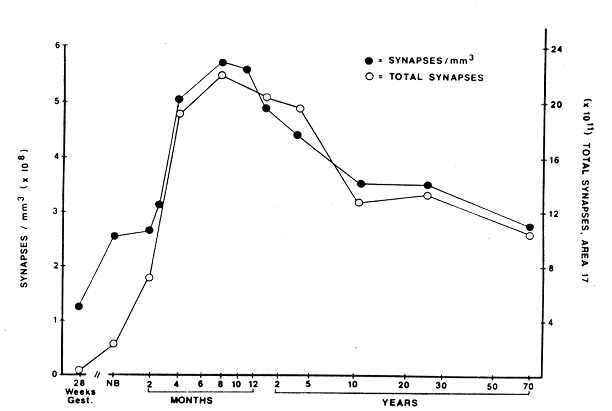
In terms of synapses, connections between neurons, this varies on the age of the infant. For example, have a look at this graph of synapse density as we grow, taken from a study of the human cortex.

Newborns start with fewer synapses than adults but this number rockets, so by six months of age we have approximately twice as many connections. This tails off as the brain prunes connections on a ‘use it or lose it’ basis.

I’m always slightly awestruck whenever I view that graph as it is a vivid illustration of the incredibly rapid changes changes that take place as we grow and learn to make sense of the world.

It’s this same sense of awe that the Boston Globe manages to capture as it explains how understanding the baby’s brain can help us make sense of the adult mind.

Link to Boston Globe article ‘Inside the baby mind’.

Should we be trying to stop dream violence?

The Onion has a video of a funny spoof news report on “Should We Be Doing More To Reduce The Graphic Violence In Our Dreams?”

It gets a little bit gory towards the end, so if that’s not your thing, you may prefer another one of their recent reports on the news that “70 percent of all praise is sarcastic”.

Link to ‘Should We Be Doing More To Reduce The Violence In Our Dreams?’
Link to ’70 Percent of All Praise is Sarcastic’.

CIA psychology through the declassified memos

I’ve been reading the recently released CIA memos on the interrogation of ‘war on terror’ detainees. The memos make clear that the psychological impact of the process is the most important aim of interrogation, from the moment the detainee is captured through the various phases of interrogation.

Although disturbing, they’re interesting for what they reveal about the CIA’s psychologists and their approach to interrogation.

General framework
It is clear that empirical psychological science is core to interrogation-based intelligence gathering on both the individual and general approach levels. In clinical psychology, this is known as the scientist-practitioner model, where scientific research is used to understand types of problems and design interventions, but also where an iterative hypothesis-testing information-gathering process is applied to each individual.

The memos state that psychologists are involved in both directing interrogations and mental health assessments, making it likely that the majority of military psychologists are originally trained as clinical psychologists.

Indeed, after a visit to Guantanamo Bay, American Psychological Association president Ronald Levant wrote about his trip in an article for Military Psychology noting “I turned to see a former doctoral student in clinical psychology from Nova Southeastern University (NSU), who is now a military psychologist”. NSU strongly emphasises the scientist-practitioner model and it this style of clinical psychologist which probably makes up the bulk of the CIA’s ‘Behavioral Science Consultation Teams’ (BSCTs).

It is also clear that the CIA are interested in finding out two types of information: one, intelligence from the detainees, and two, which methods are most effective in doing so. It is interesting that all references to the impact and effectiveness of the interrogation methods are based on single cases (x has started giving intelligence after the use of y) or data from the US Military’s own SERE interrogation resistance programme, run on its own personnel.

There is no significant blacked out text in these sections, indicating that there are unlikely to be other key sources of evidence (such as secret research on the effectiveness of torture). In other words, Guantanamo and other interrogation facilities are as much interrogation labs as they are interrogation centres.

Integrated physiological monitoring
The memo [pdf] that discusses the interrogation of ‘al-Quaeda operative’ Abu Zubaydah has an interesting part where it states that “in an initial confrontational incident, Zubaydah showed signs of sympathetic nervous system arousal”. This would suggest that the detainees are wired-up to a system that detects physiological arousal – probably GSR, blood pressure, heart rate or a similar combination.

This would allow the interrogators to look for patterns in stress responses and focus on areas where stress was present despite an outward appearance of calm. The memo also notes that Zubaydah “appears to have a fear of insects”. Assuming that detainees would not voluntarily disclose their phobias, we can assume that likely phobias are detected by exposing the detainee to photos or situations related to common fears and then monitoring the detainee for abnormal stress responses.

Profiling
The summary of the psychological profile of Zubaydah is notable for the fact it doesn’t use the psychoanalytic or psychodynamic language more favoured by FBI profilers, instead using the relatively plain language of cognitive and psychometric approaches. For example, it describes his “coping resources”, rather than his ‘defences’, “problems” rather than ‘conflicts’ and makes no reference to any unconscious desires or motivations.

The profile is apparently “based on interviews with Zubaydah, observations of him, and information collected from other sources such as intelligence and press reports”. As with the FBI, there is likely to be formal psychometric methods for analysing self-written text to help inform the personality profile, although the complete profile is probably put together by a psychologist who integrates the various sources of information with only a conservative level of interpretation.

Confused understanding of ‘learned helplessness’
A couple of the memos note that the whole interrogation procedure and environment is designed “to create a state of learned helplessness“. This is a concept originally developed by psychologist Martin Seligman who found that dogs given inescapable electric shocks would eventually just give up trying to avoid them and remain passive while electrocuted. The theory was related to depression where people with no control over their unpleasant lives supposedly just learnt to be withdrawn and passive.

The concept is not particularly well validated, but even if it was and you were an interrogator, you’d want to avoid learned helplessness at all costs, because the detainee would see no point in co-operating. Furthermore, the acceptance of the theory is in direct contrast to the claims that the interrogations should not cause “severe physical or mental pain or suffering.” Learned helplessness is, by definition, the effect of chronic uncontrollable suffering.

What the interrogators want, and indeed, what the memos describe, is not learned helplessness, but where the detainees know and can demonstrate that co-operation is the only method that allows them control over their environment. This is more akin to sociologist Ervin Goffman’s concept of a total institution.

Clues and curiosities
One memo [pdf] mentions the concept of ‘resistance posture’, meaning the act of resisting the interrogators demands. The fact that this a specific term is used, and that it is additionally referred to as something that could be measured (‘This sequence “may continue for several more iterations as the interrogators continue to measure the [detainee’s] resistance posture”‘) suggests that this might be a specific psychological concept that is being empirically measured, perhaps through a combination of behavioural and physiological responses, presumably to help distinguish between resistance and genuinely not knowing the answer to a question.

It’s interesting that there is no reference to any neuroscience-based research or monitoring to justify conclusions, despite the widespread reports of the US secret services funding billions of pounds of research in this area. This may be because it’s too secret to release to the public, but it is just as likely that, as with other brain-based ‘prediction’ methods (neuromarketing, brain-scan ‘lie detection’) the data is less useful than more straightforward and better validated psychological and physiological methods.

As has been picked up by Wired the claims that 180 hours of sleep deprivation is not harmful in the long-term is based on a selective and limited reading of the scientific literature and is disputed by the people who carried out the research.

Link to PDFs of released memos.

The suicidal attraction of the Golden Gate Bridge

I’ve just found this morbidly fascinating article from a 2003 edition of The New Yorker that discusses the attraction of San Francisco’s Golden Gate Bridge to people who are suicidal.

It’s full of interesting snippets, like the fact that suicidal people tend to ignore the nearby and equally fatal Bay Bridge in favour of its more famous and more attractive cousin.

It also has quotes from some of the very few people who have ever jumped off the bridge and survived, and describes exactly what impact such a jump has on the body.

The article also touches on the debates over the erection of a suicide barrier on the landmark (it was finally decided in 2008 to put one in place) and the people-based suicide prevention methods.

It also has this lovely snippet about one of the police patrolmen, who has a wonderfully gentle way of talking to suicidal people:

Kevin Briggs, a friendly, sandy-haired motorcycle patrolman, has a knack for spotting jumpers and talking them back from the edge; he has coaxed in more than two hundred potential jumpers without losing one over the side. He won the Highway Patrol’s Marin County Uniformed Employee of the Year Award last year.

Briggs told me that he starts talking to a potential jumper by asking, “How are you feeling today?‚” Then, “What’s your plan for tomorrow?‚” If the person doesn’t have a plan, Briggs says, “Well, let’s make one. If it doesn’t work out, you can always come back here later.”

Apparently the article was the inspiration for the 2006 documentary film The Bridge which covered similar territory.

Link to New Yorker article ‘Jumpers’.

2009-04-24 Spike activity

Quick links from the past week in mind and brain news:

The first Neuroanthropology Conference kicks off in October and looks awesome.

Twitter causes immorality nonsense deftly dispatched by bloggers. Most mainstream press lost the plot although Time did a good job and Wired Science were keeping it real.

The Guardian review neurophysiologist Kathleen Taylor’s new book on cruelty.

AI system examines mysterious and ancient symbols from the long-lost Indus Valley civilization and suggests that they may represent a spoken language, reports Wired.

The Financial Times has a look at the Wellcome Collection’s latest exhibition on ‘madness and modernity’.

The links between autism and genius are explored by The Economist.

Not Exactly Rocket Science has a brilliant article on how touch-related brain activity reduces after only a couple of weeks of having your hand in a cast.

There are a couple of wonderful girl-with-exposed-brain paintings here.

The New York Times reports on mental illness, the musical! (thanks Daniel!)

BBC Radio 4’s Health Check has a programme on meningitis and supernumeray phantom limbs.

Newsweek has an interesting Q&A on the psychology of memory.

An extended and interesting article on the psychology of how we related to the environment is published by The New York Times.

NeuroImage has an article arguing for community neuroimaging databases. Hallelujah and amen!

Is there a link between autistic traits and anorexia? asks New Scientist.

Frontal Cortex has an excellent piece on the commuters paradox – where we consistently underestimate the pain of a long commute.

Rapid emotional swings could predict violence in psychiatric patients suggests new research covered by Science News.

BBC News on the impressive ‘Blue Brain‘ project but who seem to like talking themselves up rather a lot. Apparently just a “matter of money” to simulate a whole brain (oh, and a good conceptual understanding of how the brain actually works beyond simplified models of the neocortical column).

18 ways attention goes wrong. PsyBlog continues riffing on attention by listing several related problems.

Psychiatric Times has an excellent article on the philosophy of psychiatry and how we define what counts as a mental illness. Bonus ‘internet addiction’ slapdown included.

Neuronarrative on a study suggesting that TV may be a surrogate for social interaction.

New ‘mind reading’ consumer EEG headsets about to hit the shelves with dull-looking games, according to New Scientist. They look fantastic, but don’t believe the hype – the fun will be in equipment hacks and data aggregation projects.

The Economist has a couple more good articles: one on the cognitive benefits of bilingual babies and the other on preconscious action selection and free will.

Makes of antidepressant Lexapro (escitalopram) may be gearing up for the latest in a long line a heavy weight US government fines for illegal promotion, reports Furious Seasons.

From the four humours to fMRI

The excellent Cognition and Culture blog found a fascinating lecture by the energetic medical historian Noga Arikha about the four humours theory of medicine and how its legacy influences our modern day ideas about the mind and brain.

The four humours theory suggested that the function of the mind and body was determined by the balance of four fluids in the body: black bile, yellow bile, phlegm, and blood.

While specific diseases were explained in this way, so were character traits and, in their excess, mental illness.

Indeed, some of the old names for these fluids still survive as descriptions of character traits (for example, we can still describe someone as phlegmatic or sanguine) even if we’re unaware of their origins.

However, Arikha outlines that its possible to trace the thinking behind humoural theories right through history into our current ideas about mind and brain in the age of brain scans and cognitive neuroscience.

The talk is based on her book, called Passions and Tempers: A History of the Humours, and the video is a bit shaky at times but worth sticking with as it’s an engrossing lecture.

Link to video of talk by Noga Arikha.

Phantom portraits

I’ve just found a gallery of one of my favourite art science projects of all time which used digital photo manipulation to illustrate the phantom limbs of post-amputation patients.

The images are incredibly striking, because they vividly illustrate that phantom limbs are often only phantom part-limbs. Sections can be missing, even in the middle, so a phantom hand can be felt even if a phantom elbow cannot.

Or perhaps a phantom hand can feel as if it protrudes directly from the point of amputation at the shoulder, or perhaps it feels distorted, or perhaps has no intervening phantom arm, or perhaps it is stuck in one position, and so on.

The project was the brainchild of neuropsychologist Peter Halligan, neurologist John Kew and photographer Alexa Wright. Actually, Peter is an ex-boss and I spent several years of my PhD with a huge picture of RD (above) in my office and it never failed to amaze me.

Unfortunately, the pictures in the online gallery are a viewable but a little small, although there are some larger versions if you scroll down in this essay.

Link to After Images online gallery.

Reverse psychology in a pill: anti-placebo

Photo by Flick user ArneCoomans. Click for sourceYou may be aware of the placebo effect, where an inert pill has an effect because of what the patient thinks it does. You may even be aware of the nocebo effect, where an inert pill causes ‘side-effects’. But a fascinating 1970 study reported evidence for the anti-placebo effect, where an inert pill has the opposite effect of what it is expected to do.

Storms and Nisbett were two psychologists interested in attribution, the process of how we explain the causes of events and the impact this has on how we feel.

We know that attributions have a big impact on our level of physical and emotional health. For example, your heart is racing when you’re about to give a talk. If you attribute it to a weak heart, you may start worrying whether you might pass out and become incredibly stressed, but if you attribute it to the situation, you might just think its a natural reaction for the event and feel primed and ready.

In anxiety disorders, we know that people often attribute natural bodily reactions to frightening causes, which makes people feel more on edge, and hence, their body kicks into an even higher gear, and so on. The cycle continues, to fever pitch. In essence, it’s anxiety-fuelled anxiety.

Insomnia has an element of this. People can be worried that they’re not sleeping, and so get anxious thoughts when they go to bed, and so feel on edge, ad nocturnum, until the early hours.

So rather than getting people to fill in questionnaires about causes of insomnia, a typical method in attribution research, Storms and Nisbett wanted to test these ideas in the real world.

They recruited a group of patients with insomnia and told them they were doing a four-night study on dreaming and asked them to rate their difficulty in falling asleep each night.

The first two nights were exactly that, a sleeping and rating exercise, but on the third night the participants were given pills. One group was told that the pill would make them feel more aroused, like a shot of caffeine, while the others were told that the pill would make them feel more relaxed, like a sleeping pill.

On the fourth night, the group were given the ‘opposite’ pill, but in reality, all the pills were identical and completely inert, containing nothing more than sugar.

Now here’s the thing. The insomnia patients taking the ‘relaxation’ pills slept really badly, and the patients taking the ‘arousal’ pills slept much better.

What seemed to be happening was that patients taking ‘uppers’, normally trapped in a cycle of anxious self-monitoring, could attribute any arousal they had to the pill. Any sign of feeling wired wasn’t them, it was the pill, so they could relax and fell asleep easily.

In contrast, those who had taken the ‘downers’ thought that any arousal must be their insomnia causing them problems, and it must be really bad, because it was getting to them despite the supposed sleeping pill they’d taken. In other words, they were freaking out because they couldn’t sleep despite the ‘medication’.

It turns out that this simple experiment wasn’t easily replicated but the problem was solved in 1983 when it was realised that this effect only held for people with insomnia who obsessively self-monitored.

But what these experiments tell us is that the effects of medication, the symptoms of illness and even the process of ‘being sick’ is partly dependent on our own ideas about what’s happening.

Link to PubMed entry for original Storms and Nisbet study.
Link to 1983 replication.

Taking pride in your posture

A simple but elegant study just published in the European Journal of Social Psychology found that getting people to generate words about pride caused them to unknowingly raise their posture, while asking them to generate words about disappointment led to an involuntary slouch.

The research team, led by psychologist Suzanne Oosterwijk, asked people to list words related to ‘pride’ and ‘disappointment’, and some emotionally neutral control categories of ‘kitchen’ and ‘bathroom’, while being secretly filmed.

‘Pride’ caused a slight increase in posture height, while ‘disappointment’ caused the participants to markedly slouch.

The researchers suggest that the activation of the concept of disappointment led to a spontaneous bodily simulation of the feeling. They link this to the idea of embodied cognition that suggests that our mental life is fundamentally connected to acting on the world.

As we discussed last year, research has suggested that bodily expressions of pride and shame are the same across cultures, indicating that this connection between action and emotion may be a core part of our emotional make-up.

Link to abstract of study (via the BPSRD).

The medieval senses and the evil eye

The latest edition of neurology journal Brain has an extended review of three books about the history of the senses which gives a fascinating insight into how the meaning of our sensory experiences has changed over the centuries.

This paragraph is particularly interesting as it relates medieval theories of perception to the superstition of the ‘evil eye‘ where you could curse someone by looking at them.

While we now think of vision as a system for interpreting passively received light, the ‘evil eye’ makes much more sense when you realize that medieval people thought that light rays could fundamentally influence what they touched and even that the eyes actively sent out rays that could influence the objects within sight.

In 1492, learned debates also influenced how the world was perceived. As medical historians Nancy Siraisi and James T. McIlwain, also a neuroscientist, point out, medieval scholars would have located sensory perception in the brain (Siraisi, 1990; McIlwain, 2006). However, they would have perceived the five senses as active entities conveying information about the outside world to the internal senses of common sense, imagination, judgement, memory and fantasy (the ability to visualize).

Scholars differed considerably over how this worked in practice: for example, were rays emitted from the eyes towards the viewed object or was it the other way round? Either theory allowed for these rays to influence both viewer and object, thus explaining the widespread concept of the evil eye, or a belief still current in the 18th century that what a mother saw affected her foetus. The brain, however, was not the only sensitive organ of the body.

The heart was believed to be the centre of the animal soul, and thus closely associated with more carnal senses such as touch. The brain, the centre of the rational soul, was more closely associated with sight; the eyes often viewed as the ‘windows of the soul’. Sight, therefore, was given pre-eminence in the pre-modern world as it is today, but often for spiritual reasons due to the inter-dependence of religion and rational knowledge (scientia).

Thus even if the brain functioned in the past very much as it does today, the emotional and moral meaning of sensory experience differed dramatically.

The whole review is worth reading in full, not just because of the insights into medieval psychology, but also because these new books introduce ‘sensory history’ – a history of ideas about how we experienced the world through our bodies.

Link to review.
Link to DOI entry for same.

Predicting the determined self-castrator

The Journal of Sexual Medicine has a surprising study looking at psychological attributes that predict which castration enthusiasts who will actually go on to remove their own testicles, in contrast to those who just fantasise about it.

This is the abstract from the scientific paper:

A passion for castration: characterizing men who are fascinated with castration, but have not been castrated

Roberts LF, Brett MA, Johnson TW, Wassersug RJ.

J Sex Med. 2008 Jul;5(7):1669-80.

Introduction. A number of men have extreme castration ideations. Many only fantasize about castration; others actualize their fantasies.

Aims. We wish to identify factors that distinguish those who merely fantasize about being castrated from those who are at the greatest risk of genital mutilation.

Methods. Seven hundred thirty-one individuals, who were not castrated, responded to a survey posted on http://www.eunuch.org. We compared the responses of these “wannabes” to those of 92 men who were voluntarily castrated and responded to a companion survey.

Main Outcome Measures. Respondents answered the questionnaire items relating to demographics, origin of interest in castration, and ambition toward eunuchdom.

Results. Two categories of wannabes emerged. A large proportion (‚àº40%) of wannabes’ interest in castration was singularly of a fetishistic nature, and these men appeared to be at a relatively low risk of irreversible genital mutilation. Approximately 20% of the men, however, appeared to be at great risk of genital mutilation. They showed a greater desire to reduce libido, change their genital appearance, transition out of male, and prevent sexually offensive behavior. Nineteen percent of all wannabes have attempted self-castration, yet only 10% have sought medical assistance.

Conclusions. We identify several motivating factors for extreme castration ideations and provide a classification for reasons why some males desire orchiectomies. Castration ideations fall under several categories of the Diagnostic and Statistical Manual of Mental Disorders, 4th Ed. (DSM-IV), most notably a Gender Identity Disorder other than male-to-female (MtF) transsexual (i.e., male-to-eunuch) and a Body Identity Integrity Disorder. Physicians need to be aware of males who have strong desires for emasculation without a traditional MtF transsexual identity.

We reported on an earlier study by the same research group last year, which discovered that ‘voluntary eunuchs’ report that they are pleased that they have had their testicles removed and seem mentally healthy.

Link to PubMed entry for study.