A Rush of Blood to the Brain

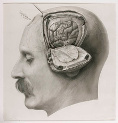
An article from Culture, Medicine, and Psychiatry that discusses the concept of ‘moral disability’ and brain trauma in Victorian times includes a fascinating section on what was presumably thought to be the science of ‘knocking some sense into the brain’.

The piece is by medical historian Brandy Shillace who researches Victorian scientific ideas and how they affected society.

Sadly, the article is locked (quite rightly, humanities can kill if not used correctly) but this is the key section:

While eighteenth-century French philosopher François Bichat had suggested that a blow suffered to one side of the head might restore the good senses of the disordered side, Wigan’s work suggested that “where such mental derangement depends on inflammation, fever, impoverished or diseased blood, or other manifestly bodily disease,” it could be cured by actively seeking and rooting out the source, by trephining the brain or otherwise subduing the offending hemisphere… The Lancet was replete with unusual cases of brain trauma and its curious results, many that seemed to support Wigan in his assumptions about physical trauma, variously applied.

I performed a survey from 1839 to 1858 and discovered a case of brain trauma in numerous issues, eight of which were particularly revelatory of the unusual nature of the brain and its hemispheres. The 1843 account of Dr. Peter S. Evans, “Derangement of the Brain by a Sudden Shock and Its Recovery,” claims that a boy was beaten into idiocy, and then beaten out of it again (regaining his full senses after being whipped by a cart driver). One of Wigan’s cases describes a young gentleman in a “paroxysm of maniacal delirium” who shot himself sane.

Not recommended.
 

Link to locked article in Culture, Medicine, and Psychiatry

Hallucinating astronauts

I’ve got a piece in The Observer about the stresses, strains and mind-bending effects of space flight.

NASA considers behavioural and psychiatric conditions to be one of the most significant risks to the integrity of astronaut functioning and there is a surprisingly long history of these difficulties adversely affecting missions.

Perhaps more seriously, hallucinations have been associated with the breakdown of crew coherence and space mission stress. In 1976, crew from the Russian Soyuz-21 mission were brought back to Earth early after they reported an acrid smell aboard the Salyut-5 space station. Concerns about a possible fluid leak meant the replacement crew boarded with breathing equipment, but no odour or technical problems were found. Subsequent reports of “interpersonal issues” and “psychological problems” in the crew led Nasa to conclude the odour was probably a hallucination. Other Russian missions were thought to be have been halted by psychological problems, but the US space programme has not been without difficulties. During the Skylab 4 mission, long hours, exhaustion and disagreements with mission control resulted in the crew switching off their radio and spending a day ignoring Nasa while watching the Earth’s surface pass by.

The piece also tackles a curious form of hallucination caused by cosmic rays and the detrimental effects of zero-gravity of brain function, as well as some curious Freudian theories from pre-space flight 1950s about the potential psychological consequences of leaving ‘Mother Earth’.

Enjoy!
 

Link to Observer article on psychological challenges of astronauts.

Spike activity 05-10-2014

Quick links from the past week in mind and brain news:

Dropping science: neuroscientists throw down epic / excruciating rap battle on Twitter. Bring the line noise.

The New Yorker has an interesting piece on the neuroscientific legacy of the Vietnam War. In neuroscience terms, it was America’s World War One.

The latest edition of Nature NeuroPod is particularly good: psychosis, detecting animacy, network theory for brains.

Livescience covers an interesting study finding that the uncanny valley effect is affected by loneliness.

The US Government spend $300 million on BRAIN initiative projects and the news coverage is remarkably poor. Here’s the best of a bad bunch: reporting from MIT Tech Review.

Nautilus has some postcards from the edge of consciousness. On the science of sensory deprivation.

Guy breaks captcha on Silk Road 2.0 and scrapes the site for trends in the dark net drug trade.

Slate covers ‘Sluggish cognitive tempo’ – another in a long-line of vague and unhelpful psychiatric disorder-hopefuls to sell medication for.

A peculiar prevalence of p-values below p=.05 in Psych Science? Not so fast. Great piece from Daniel Lakens blog.

Most People With Addiction Simply Grow Out of It: Why Is This Widely Denied? Excellent piece in Substance.

This week in bad neuroscience reporting: beer and curry ‘heal the brain’. Next week: wanking and funfairs cure Parkinson’s disease.

A review of Susan Greenfield’s “Mind Change”

I was asked to write a review of Susan Greenfield’s new book “Mind Change” for the October edition of Literary Review magazine which has just been published.

You can read the review in the print edition and I did have the full text posted here but the good folks at the magazine have also put it online to read in full, so do check it out at the link below.

Mind Change marshals many published sources to address these claims. However, this provides little scientific insight owing to Greenfield’s difficulty with synthesising the evidence in any meaningful sense, while she also makes some glaring mistakes in her interpretation of it. Although she makes much of her use of peer-reviewed evidence, surveys done by companies for marketing campaigns are often given the same weight as scientific studies and opinions from self-appointed pundits as those of specialists.

As an end-note, what’s most interesting is that Greenfield is essentially making an argument about public health but doesn’t really have the conceptual tools to do so and consequently doesn’t seem to understand how, and how strongly, to draw real world inferences from different types of evidence.

However, in terms of Greenfield’s evolution, she is at least tackling some of the relevant evidence, but this really isn’t up to a standard that merits any of the media attention it gets.
 

Link to review of “Mind Change”.

Buggin’ Out

Sociology journal Transition has a fascinating article giving a history of the surprisingly frequent appearance of schizophrenia in rap music.

In psychiatric circles, schizophrenia is considered a serious mental illness that causes delusions, hallucinations, and social withdrawal. But in rap, schizophrenia means something else: a mode of defiance, a boast, or a threat. The term appears frequently when describing competition between rappers. In “Speak Ya Clout,” the duo Gang Starr rhymes that they are “schizophrenic with rhyme plus we’re well organized” as a way of warning that they are “stepping rugged and tough.”

Schizophrenia also enhances claims of competitive violence—in “16 on Death Row,” 2Pac famously warned that, “I’m kind of schizophrenic, I’m in this shit to win it.” Schizophrenia also helps rappers describe collective responses to racism or injustice. In the multi-artist hit “Everything,” Busta Rhymes calls for action by rapping, “Panic and schizophrenic, sylvy-Atlantic / Wrap up your face in ceramic, goddamit we controllin the planet.”…

Yet something much larger than mere sampling is at play in rap’s use of the terms schizophrenia and schizophrenic. Rap lyrics are the latest installments in a political debate that has evolved over the past century (at least) regarding the contested relationships between race, madness, violence, and civil rights… At stake is a series of existential and material questions about the causes, actions, and implications of sanity itself.

The article is locked but a pdf has made its way online.

It’s a fantastic piece that traces how schizophrenia and psychosis have become deeply politicised, racially charged concepts.

They were used to pathologise black civil rights protesters, whose demand for equal rights were considered part of a ‘protest psychosis’, and have been used in civil rights discourse to symbolise the effects of a racist society.

And this is how it seems to have ended up as a borrowed badge of pride for generations of MCs.

The piece is by psychiatrist Jonathan Metzl who also wrote the definitive history of the so-called ‘protest psychosis’ and it serves as a great introduction to an important chapter in the bitter history of race, psychiatry and psychosis.
 

Link to locked Transition article in JSTOR.
pdf of full-text.

Spike activity 26-09-2014

Quick links from the past week in mind and brain news:

Why most scientists don’t take Susan Greenfield seriously. A serious rebuttal for some poor scientific claims over at BishopBlog.

The Guardian has a good profile of food and flavour scientist Charles Spence who specialises in sensory integration.

Couvade syndrome: some men develop signs of pregnancy when their partners are pregnant. The Conversation has a piece on a genuinely intriguing condition.

The Chronicle of Higher Education has an interesting piece on Why Freud Still Haunts Us.

‘GCHQ employs more than 100 dyslexic and dyspraxic spies’ according to some covert recruiting PR slipped out as news in The Telegraph.

The New York Times has a retrospective on the life and times of Prozac.

There’s an excellent concise introduction to RDoC in Acta Psychiatrica Scandinavia that is essential reading if you’re interesting in the future of psychiatric neuroscience.

Rewriting the Rules has an interesting reflection from relationship psychologist Meg Barker on 10 years of researching open relationships and non-monogamy.

Pipe-wielding philosopher of mind Pete Mandik occasionally puts out great educational videos. This on Daniel Dennett’s ‘multiple drafts’ theory of consciousness is excellent.

An earlier death

Journalism site The Toast has what I believe is the only first-person account of Cotard’s delusion – the belief that you’re dead – which can occur in psychosis.

The article is by writer Esmé Weijun Wang who describes her own episode of psychosis and how she came to believe, and later unbelieve, that she was dead.

It’s an incredibly evocative piece and historically, worth remembering.

Somatic details figure heavily in these recollections: what I wore, what I looked like. I told myself, through mirrors and dressing-up and Polaroids and weighing myself, You have a body. The body is alive.

But the more that I tried to remind myself of the various ways in which I did, in fact, seem to have a body that was moving, with a heart that pumped blood, the more agitated I became. Being dead butted up against the so-called evidence of being alive, and so I grew to avoid that evidence because proof was not a comfort; instead, it pointed to my insanity.


Link to ‘Perdition Days: On Experiencing Psychosis’

Spike activity 12-09-2014

Quick links from the past week in mind and brain news:

New Scientist reports that sleeping brains can process and respond to words. Forward directly to boss.

“Cyranoids” – Stanley Milgram’s Creepiest Experiment. Neuroskeptic covers the science behind a little known Milgram experiment and a curiously common TV trope.

The Neurocritic reports on a case of mistakenly garnishing your dish with hallucinogenic flowers.

America’s New Bedlam. Genuinely disturbing BBC Radio Assignment documentary on mental illness in US prisons. Podcast at this mp3 link.

Science News reports on the lack of research on the science of potty training.

Well, what do you know. The Fix reports that anti-marijuana academics are being paid by makers of prescription opiates.

io9 reports on a woman with no cerebellum – one of the few known cases on congenital cerebellar agenesis.

Brain surgeon Henry Marsh, who has had a long relationship with Ukraine, writes in The Guardian of his experience of being there during the recent upheaval.

Mental health debates without the stress

If you work in mental health, you could do much worse than reading the editorial in today’s Lancet Psychiatry about unpleasant debates and how to avoid them.

Unfortunately, debates in mental health tend to get nasty quite quickly – but I’ve seen no part of the debate spectrum which has a monopoly on bigotry or a blessed surplus of consideration.

But instead of throwing up their hands in despair, the editorial team wrote some sensible guidance on bringing some respect to moving mental health forward.

The first is to assume the best of one’s opponent: that their argument proceeds not from self-interest, financial interest, or wilful ignorance, but from genuine curiosity and a desire to improve the lives of people with mental health problems. There is a view that so-called punching up to perceived figures of authority is justifiable and necessary, but punching up is still punching someone. There is always potential in the discussion of mental health issues to trigger distress, as everyone, patient or professional, has an unseen personal history and sensitivity.

Second, it is worth questioning whether one line of investigation or treatment necessarily diminishes the other. Although a holistic medical perspective on mental distress is useful, alternative types of assistance might also be of value. Such services need to be taken seriously, evaluated thoroughly, and, when appropriate, considered for public funding. Perhaps some arguments about which model of research or practice should be prioritised would be better resolved by a united campaign for better funding across the board.

Third, as Sun Tzu advised, know your enemy. Do not dismiss biological data as an irrelevant folly, nor philosophical and sociological analysis as a form of obscurantism. Take some time to consider your opponent’s intellectual discipline, and how his or her work might be criticized on its own terms. This might be a long, difficult, and tedious process, but it is what patients, and the public, deserve.

The final point is to ensure that those whose voices are not listened to enough are given the space and opportunity to be heard. Their numbers include individuals such as mental health nurses and social workers, who provide a large amount of care but who are given little time compared with psychologists and psychiatrists. Most important, the voices of patients must be “airtime” respected in all their diversity. If a new form of mental health care is to be built, all involved would do well to remember the three principles of James Madison, President of the USA and father of its constitution: compromise, compromise, compromise.

A tip of the hat to you.
 

Link to Lancet Editorial ‘Duel diagnosis’ (via @PsychiatrySHO)

Agents, social encounters and hallucinated voices

I’ve written a piece for the new PLOS Neuro Community about how the social aspects of hallucinated voices tend to be ignored and how we might go about making it more central in psychology and neuroscience.

It came about because the PLOS Neuro Community have asked authors of popular papers to write a more gentle introduction to the topic, so the piece is based on a PLOS Biology paper I wrote last year.

I’ve met a lot of people who hear hallucinated voices and I have always been struck by the number of people who feel accompanied by them, as if they were distinct and distinguishable personalities. Some experience their hallucinated entourage as hecklers or domineering bullies, some as curious and opaque narrators, others as helpful guardians, but most of the time, the voice hearer feels they share a relationship with a series of internal vocal individuals.

The piece discusses psychology and neuroscience but in the post, I also mention some work I’ve been doing with philosopher of mind Sam Wilkinson. As luck would have it, Sam just published a post about what we’re working on, on the excellent Imperfect Cognitions blog.

It looks at hallucinated voices and the representation of agency and agents. If you’re not used to these terms they can be slightly opaque but they refer to how the mind and brain represents autonomous individuals – be they human, animal, presumed or imaginary – and how that might relate to the experience of having hallucinated voices.
 

Link to A Social Visit with Hallucinated Voices.
Link to The Representation of Agents in Auditory Verbal Hallucinations.

Psychoactive plants in season at Kew Gardens

The Royal Botanical Gardens at Kew, or London’s Kew Gardens if you’re not from the 1800s, has a fantastic season of events on the science of psychoactive plants that starts on 20th September.

It covers everything from coffee to opium to magic mushrooms and discuss the pharmacology, public policy and ethnobotany of intoxicating plants.

There are a number of installations, exhibitions and events that you can access by paying to get into the gardens as normal, as well as some dedicated talks that require specific tickets.

The full details of the daily talks and films haven’t been announced yet but a few highlights from the published programme seem to be a talk on plant intoxicants in history and culture with the ever-interesting Mike Jay, a living display of mind-altering plants, and a talk on the neuroscience on intoxicating plants.

If you’re going to visit the gardens it’s worth taking a day for it as the tickets are a bit pricey (£15) but as the place is so huge you get good value if you’re there long enough to see plenty of it.
 

Link to details of Kew’s Intoxication season.

Freaky brain tongue graffiti

You wait all year for neuroscience themed graffiti and then two come along in a week. This was found on Carrera 31 in Medellín yesterday morning.

It turns out that over the years I’ve managed to collect a fair amount of brain-themed graffiti for Mind Hacks, which you can browse at your pleasure here.

And with that, I leave the booming, buzzing confusion of Medellín and head back to the sustained attention of London.

Taste illusions

I’ve just found a 2008 review article on the multisensory perception of flavour that is full of fascinating examples of taste illusions and demonstrates the surprisingly complexity of the gustatory system.

The following is one of my favourites. The article first makes the interesting observation that the majority of odour names refer to objects and most non-object odour names like ‘acrid’ and ‘pungent’ actually refer not to smell but to felt sensation.

Another manifestation of the object-based nature of olfactory perception is the constant error made, when eating, of attributing to taste what really belongs to the sense of smell. The error of localizing the odors coming from food as originating in the mouth has been termed the olfactory illusion. It has been compared to the ventriloquism effect, that is, the influence of visual cues on the identification of the location of a sound source. Green (2001) has provided a similar explanation for the fact that although flavor is perceived by receptors on the tongue, in the nose, and even in the eyes, the brain interprets the overall sensation as originating from within the mouth. According to Green, all of the sensory information is localized in the mouth in order that we associate this information with the food being consumed, in the same way that we typically use both touch and vision to localize a point on our bodies.

The paper is by psychologists by Malika Auvray and Charles Spence and it’s sadly locked – but someone has handily a put a pdf online.
 

Link to journal hosted locked article (via @velascop)
pdf of full text.

Brain digger in Medellín

A digger scooping the brain of a blue man, found earlier this week in Medellín, on Calle 67, just by the metro station Hospital.

The text translates as ‘changing forests for cement’ but has been scratched on after the original artwork, presumably by someone who isn’t familiar with the industrial brain digger industry and its interest to Colombian graffiti artists.

A torrent of accidental poems

CC Licensed photo by Flickr user Jonathan Reyes. Click for source.Neurology journal Neurocase has an interesting study of a women who started compulsively writing poetry after having brief epileptic amnesia treated with the anti-seizure drug lamotrigine.

A 76-year-old woman reported having a poor memory and short periods of disorientation and was eventually diagnosed with transient epileptic amnesia – brief recurrent seizures that lead to short periods where affected people can’t lay down new memories.

Several months after starting lamotrigine [a common and widely used anti-seizure drug], the patient suddenly began to write original verse. Whereas poetry had never previously been among her pastimes, she now produced copious short poems (around 10–15 each day) on quotidian topics such as housework or about the act of versifying itself and sometimes expressing her opinions or regret about past events. These poems often had a wistful or pessimistic nature but did not have a moral or religious focus. Her husband characterized them as “doggerel” because they were generally rhyming and often featured puns and other wordplay.

My poems roams,
They has no homes
Yours’, also, tours,
And never moors.

Why tie them up to pier or quay?
Better far, share them with me.

Prose – now, that’s a different matter.
Rather more than just a natter.
Prose is earnest, prose is serious
Prose is lordly and imperious
Prose tells you, loud, clear, that
Life – life is dear.

This versifying had a compulsive quality: she spent several hours per day writing poetry and became irritated if attempts were made to disengage her. However, she appeared to derive pleasure from the activity and there was no evidence of associated distress. She did not produce prose passages, diaries, or other examples of hypergraphia, nor did she develop new interests in other “creative media,” such as visual arts or music.

When reassessed 6 months after the onset of versifying this apparent compulsion had diminished, but she continued to produce occasional poems. She had also developed a more general fondness for wordplay, frequently using puns in speech, making humorous word associations, and identifying word patterns in everyday objects such as car license plates. Throughout this period there were no associated mood symptoms, features of a thought disorder, or other changes in her behavior or cognition to suggest hypomania or another generalized neuropsychiatric disturbance.

The article mentions the exclusion of hypomania and thought disorder because these are two other phenomena that appear as compulsive rhyming or punning in speech.

The article also mentions some similarities between the compulsive poem writing and hypergraphia – compulsive and copious writing that is a well-known although not particularly common symptom of epilepsy.

The difference in this case, however, is that hypergraphia often appears as meaningless, rambling or disorganised, and this particular patient produced competent, if not particularly high quality poems.

One of the most interesting implications of these cases is that rhyming, punning and poetic speech, which we normally think of as something that needs specific conscious effort and attention, can appear spontaneously to the point of overwhelming our normal forms of communication.
 

Link to open-access scientific article.
Link to DOI of same.

Round trip ticket to the science of psychedelics

The latest edition of The Psychologist is a special open-access issue on the science and social impact of hallucinogenic drugs.

There’s an article by me on culture and hallucinogens that discusses the role of hallucinogenic drugs in diverse cultures and which also covers how cultural expectations shape the hallucinogenic experience – from traditional Kitanemuk society to YouTube trip videos.

The other articles cover some fascinating topics.

Neuroscientists Robin Carhart-Harris, Mendel Kaelen and David Nutt have a great article on the neuroscience of hallucinogens, Henry David Abraham discusses hallucinogen persisting perception disorder or post-trip flashbacks, and there’s also piece that talks to a researcher, participant and clinician on the use of psilocybin to alleviate cancer anxiety, while Keith Laws discusses an intense painting and its psychedelic aspects.

There’s also an excellent piece on the influence of psychedelic drugs on literature from Dirk Hanson – long-time writer of the essential drug blog Addiction Inbox, and Mo Costandi (who you may know from the Neurophilosophy blog) has written a fantastic retrospective of the use of psychedelics in psychiatry.

Overall, a fascinating read and well worth checking out.
 

Link to special issue of The Psychologist on hallucinogens.