The economics of crack hustling

I just found this fascinating TED lecture by economist Steven Levitt on the social structure and economics of ghetto crack dealing. What’s surprising is that hustling rocks is a below-minimum-wage occupation with a 7% per annum employee death rate – despite the hype, a very shitty job.

Levitt is famous for being one of the co-authors of the book Freakanomics but is mostly known in the academic world for his research on the economics of crime and the underworld.

His lecture recounts some of the findings of a 10-year research project into the economics of a crack-dealing gang from an inner city US housing project.

Unsurprisingly, being a hustler is incredibly dangerous, but perhaps more of an eye-opener is that the business is run very much like a franchise and that most street dealers had second jobs, moonlighting in the mainstream economy, because dealing crack pays below the minimum wage.

The career prospects are slightly better higher up the ladder, but are still surprisingly modest in the grand scheme of things.

In other crack news, The New York Times recently published an article discussing research on ‘crack babies’, now many children whose mothers were addicted to crack while they were pregnant have grown up to be adolescents.

During the 1990s, a huge fear was that the children of ‘crack moms’ would be neurologically impaired, as when born they tend to be smaller in body and head size.

Although there are detectable differences in the teenage years, these aren’t as bad as expected, and it seems that being a ‘crack baby’ isn’t a life sentence as it was once thought.

Link to Steven Levitt on sociology and economics of crack dealing.
Link to NYT on ‘The Epidemic That Wasn’t’.

War trauma and brain impact

Although much of The Telegraph’s science coverage seems to have gone down the pan recently, they’ve just published a remarkably well balanced and informative article on war trauma and how it is associated with measurable changes in brain structure.

Brain imaging studies have found that people with post-traumatic stress disorder tend to have smaller hippocampi, an area known to be key for emotional memory.

But it’s not clear whether this is a direct consequence of PTSD, or simply that people with smaller hippocampi are more likely to develop the disorder after trauma.

The article does a fantastic job of presenting a balanced look at the causality hypnotheses, and quotes psychiatrist Simon Wessely, known for his research on the psychology, neuroscience and history of combat trauma.

But Prof Wessely has found that the very thing that exposes soldiers to PTSD might also help them deal with it: their job. According to his research at King’s, group cohesion and firm leadership are critical in reducing the impact of psychological distress.

“You have to remember we are talking about professional soldiers who have been highly trained,” he says. “Their training is designed to harden them against the unpleasant nature of war. The military is actually very effective at reducing the risk of PTSD with their training, their professionalism, esprit de corps and morale. War is a stressful business and this all prepares soldiers for that.”

The flip side is that the memories that provoke trauma are not necessarily those of gruesome battles or injuries. “The kind of events that affect them are not simply seeing bad things and coming under fire ‚Äì it is when the rules they have come to expect are somehow broken. It is when errors of omission or commission lead to the feeling they have been let down, or that they have let their comrades down, that mental health problems occur. This is why ‘friendly fire’ incidents are so psychologically damaging ‚Äì it violates the soldiers’ rules of who is supposed to be shooting at them. They will feel anger at those responsible.”

The only bizarre bit is the second to last paragraph where it mentions “new treatment is being developed, drawing on neurolinguistic programming, relaxation techniques and even Eye Movement Desensitisation Therapy”.

It mentions EMDR as if it is something unusual, when it is an increasing well researched evidence-based treatment, and NLP as if it is nothing out-of-the-ordinary, when it is largely pseudoscience that lacks even the most basic empirical support.

Link to ‘How brain scans show the trauma of war’.

The Straight Dope on Learning Styles

beans.jpg

The glorious truth is that people think and learn differently. Some people like words, but not pictures, some like movements rather than sounds. Why are people different? Who knows, perhaps because Allah loves wondrous variety.

A funny thing is that we have the tendency to ignore this fact. Perhaps because empathy is difficult, perhaps because learning makes itself invisible. I have a dear friend, Cat, who doesn’t have visual imagery. When she thinks of a dog, for example, she doesn’t see one in her mind’s eye. She doesn’t see anything. When she dreams she rarely has pictures — she just knows what is happening in the dream. People often don’t believe this. They think that everyone must experience their inner world in pictures, the way they do. Sorry. People are just different. Some always see things when they imagine them, some don’t. Some people have a sense of pitch, some don’t. So it goes.

So the idea of learning styles makes a lot of intuitive sense. Surely if we know that people think and learn differently, we should be able to design our teaching to take advantage of different learning styles. Right?

This is where we hit problems. Are learners either primarily visual, auditory, kinesthetic (as claimed in NLP)? Or are they primarily analytic, creative or pragmatic (as proposed by Robert Sternberg). Is the world made of Convergers, Divergers, Assimilators and Accomodators? Maybe instead we should use the Myers-Briggs categories of Sensers, Intuitors, Thinkers and Feelers?

Faced with these possibilities an academic psychologist has a standard set of questions they would like answered: can you really divide people up into a particular set of categories? Are the tests for these categories reliable; if you take the test twice will you come out the same both times? Are the categories you are trying to use related to how people learn? If you use a theory of learning styles, do people learn better? Can you use learning styles to predict who will benefit most from particular styles of instruction? Does using a learning styles system – any system – for teaching have other effects on learners or teachings, such as making them more confident or making them expend more effort?

These questions stem from the way academic psychologists systematically approach topics: we like to establish the truth of psychological claims. If someone comes to us with a theory about learning styles we want to know (a) if learning styles really exist, (b) if they really are associated with better learning and also (c) if, when learning styles are taken into account, learning is better because of something about the specific learing style theory rather than just being a side effect of an increase in teacher confidence, effort or somesuch.

So, what have academic psychologists found out about learning styles? We know that some of the supposed categories of learning styles are actually dimensions that vary continuously across the population. For example visual imagery: it is not that some people are visual thinkers, it is that most people have some visual imagery and a few have very strong imagery and a few, like my friend Cat, have less than average. We also know that people can change their learning styles over time, for different tasks and in different contexts. We also know that it is very difficult to prove that teaching that uses learning styles is better because of the particular theory of learning styles used, rather than merely because a learning style theory, any learning style theory, is being used and this makes people pay more attention to what they are doing.

Learning styles seem intuitively sensible. Having thought about learning styles helps teachers improve their teaching and also helps increase their confidence and motivation. But there is no strong evidence that any one theory of learning styles is the best, or most true, compared to the others. Learning style theories can be useful without being true, and it isn’t clear that knowing the truth about the differences in how people learn will be immediately useful or produce a more useful theory of learning styles. This difference between truth and utility is a typical dilemma of psychology.

Sadly, the headlines for this conclusion aren’t snappy. It is easier to say that “Some people are visual thinkers and others are auditory thinkers” than it is to say that “Thinking about presenting information in different sensory modalities will make your teaching more varied and help those you are teaching who have different preferences to yourself”. Using a learning style theory is great, but you lose a lot of flexibility and potential for change if you start to believe that the theory is based on proven facts about the way the world is, rather than just being a useful set of habits and suggestions which might, sometimes, help guide us through the maze of teaching and learning.

Cross-posted at schoolofeverything.com

Part of a series:

Image: jelly belly by House of Sims

Giant killing

The Wall Street Journal is reporting that pharmaceutical giant Pfizer are about to settle a legal case brought by the US Government over illegal promotion of their now withdrawn painkiller Bextra (valdecoxib) for a staggering $2.3 billion.

This follows the news that Eli Lilly have just settled a similar case against them for a previous record of $1.42 billion related to illegal promotion of their antipsychotic drug Zyprexa (olanzapine) with several cases against them still ongoing.

The cases relate to ‘off-label marketing’, an illegal practice where companies explicitly encourage doctors to prescribe drugs for conditions that the compound isn’t licensed for. In the case of olanzapine, this included dementia, and we now know the combination of antipsychotics and dementia greatly increases short and longer-term mortality.

The practice of off-label promotion is widespread and has been for years but this is the first time that such massive cases have been settled against the companies concerned.

As an aside, one of the most useful sources for news on the pharma industry and psychiatry is a blog we often link to called Furious Seasons.

It’s written by Phil Dawdy, an ex-newspaper journalist and ex-antipsychotic user who does some remarkable investigative journalism that is almost entirely supported by donations from readers of the website.

I mention this as he’s just had another experience of a journalist pumping him for information and then neglecting to mention him, despite the fact that he’s not only been on the pulse of developments for the last few years, he’s actually been part of the story as he publicly hosted some incriminating documents for the Zyprexa case.

He was recently flagged up as a great example of independent web journalism by respected science writer David Dobbs, but only seems to get credit from writers who already get self-publishing.

I don’t always agree with his take but find Furious Seasons essential reading nonetheless, which must be a sign of a good writer.

I credit him with having a sort of underground sensibility for sorting through the spin of corporate psychiatry but it won’t be long before he goes mainstream, so catch him while he’s still live and direct.

Link to WSJ on Pfizer settlement.
Link to Furious Seasons.

Neuroimaging, before the invention of television

Neuroscience textbooks often suggest that the ability to image the structure of the brain in living patients started in the 1970s with the introduction of the CT scanner. What they tend to forget is that brain surgeon Walter Dandy was already neuroimaging patients as early as 1918.

We think of x-rays as only being useful for getting pictures of bones but soft tissue does show up on an x-ray.

The images rely on certain bits of the body having a higher density and therefore blocking more of the rays falling on the photographic plate.

Bones are obviously very dense so show up well but look at this image of a hand x-ray. You can clearly see the difference between bone, flesh and air. What you can’t see is any difference in the soft tissue.

The crucial difference that struck Walter Dandy was the possibility of distinguishing flesh and air on an x-ray.

Knowing that the brain is surrounded by cerebrospinal fluid (CSF), which also fills internal spaces called the ventricles, he decided to simply replace the fluid with air and x-ray the patient.

He published his first results in 1918. He described how he drilled a hole in the skull of a patient and carefully removed the CSF from the ventricles and replaced it with air.

Now known as ventriculography, one of the images he took is illustrated on the top left. For the first time, you could clearly see the ventricles in a living patient.

During the procedure, he noted that some of the air has escaped the ventricles and was occupying the space between the skull and the brain.

The following year he published another study where he deliberately filled this space with air as well, so the surface of the brain was surrounded by the gas and so could show up on an x-ray.

The bottom left image shows the result of this, and you can see it clearly shows some of the ‘trenches’, the cerebral sulci, on the surface of the brain.

Now called pneumoencephalography, the procedure was immensely useful, but, extremely unpleasant. In his 1918 article he noted that the patient’s reaction “was characterized by a rise of temperature, nausea, vomiting, and increased headache”.

Furthermore, it takes weeks, if not months, for the CSF to be replaced by the body, leaving the patient in a debilitated and fragile state.

However, it was used throughout the 20th century and the research literature is peppered with the results of this early neuroimaging research.

Link to 1918 paper on imaging of the ventricles.
Link to 1919 paper on imaging the brain surface.

Complex beginnings

The term ‘complex’, used to refer to a mental illness or psychological hang-up, has become so common as to have entered everyday language (e.g. ‘he has an inferiority complex’) but I only just recently found out about the origin of the concept.

The following is from the epic and endlessly fascinating book The Discovery of the Unconscious by Henri Ellenberger, where he discusses the use of the ‘word association test’ in early 1900s psychiatry.

The story takes us through some of the most important figures in the history of 19th and 20th century mind science. From p691:

The test consisted of enunciating to a subject a succession of carefully chosen words; to each of them the subject had to respond with the first word that occurred to him; the reaction time was exactly measured…

It was invented by Galton, who showed how it could be used to explore the hidden recesses of the mind. It was taken over and perfected by Wundt, who attempted to experimentally establish the laws of the association of ideas.

Then Aschaffenberg and Kraepelin introduced the distinction of inner and outer associations; the former are associations according to meaning, the latter according to forms of speech and sound; they could also be called semantic and verbal associations.

Kraepelin showed that fatigue caused a gradual shift toward a greater proportion of verbal associations. Similar effects were observed in fever and alcoholic intoxication. The same authors compared the results of the word association test in various mental conditions.

Then a new path was opened by Ziehen who found that the reaction time was was longer when the stimulus word was to something unpleasant to the subject. Sometimes, by picking out several delayed responses, one could relate them to a common underlying representation that Ziehen called gefühlsbetonter Vorstellungskomplex (emotionally charged complex of representations), or simply a complex.

Carl Jung later used the test extensively as a more rigorous alternative to Freudian free association and found some interesting results.

In women, erotic complexes were in the foreground with complexes related to the family and dwelling, pregnancy, children and marital situation; in older women he detected complexes showing regrets about former lovers. In men, complexes of ambition, money and striving to succeed came before erotic complexes.

The description comes from a chapter about Carl Jung, who was originally a psychoanalyst but broke away from Freud’s system and developed his own.

Freud’s theories, with only a few exceptions, just seem to get loopier the more you read them. Jung is interesting because on the surface his ideas seem quite barmy but are often remarkably sensible when you understand them in more detail.

Despite his interest in everything from ghosts to UFOs, he always maintained these were essentially psychological phenomena that reflected important aspects of our collective culture and subconcious mind.

For example, I always thought his concept of the ‘collective unconscious’ was supposed to be some sort of semi-mystical psychic connection, but in fact, he was just describing much of what is now a premise of evolutionary psychology.

Namely, that by nature of being human, we may share some inherited psychological structures, common symbols or ideas – such as what ‘motherhood’ entails – that can be seen in both common behaviours and in myths and stories throughout history.

Irrational reading

Science writer Jonah Lehrer has a short but useful piece in the Wall Street Journal where he recommends five must-read books on irrational decision-making.

Lehrer is well placed to be making recommendations as he’s recently been completely immersed in the science of decision-making to write his newly released book How We Decide.

The five books he recommends are:

Extraordinary Popular Delusions and the Madness of Crowds by Charles Mackay.

Judgment Under Uncertainty by Daniel Kahneman, Paul Slovic and Amos Tversky

How We Know What Isn’t So by Thomas Gilovich

The Winner’s Curse by Richard H. Thaler

Predictably Irrational by Dan Ariely

All of which I can also heartily recommend, except The Winner’s Curse, but simply because I’m not familiar with it.

By the way, the first book that Lehrer recommends was published in 1841 and is freely available online.

Link to ‘Books on Irrational Decision-Making’ from the WSJ (via FC).

Electricity, let it wash all over me

I’ve just found a fantastic article that discusses the representation of epilepsy in contemporary rock and hip hop. It was published last year in the neurology journal Epilepsy and Behaviour and is both fascinating and funny owing to the contrast between the stuffy academic journal style and the lyrics drawn from the street.

For example, where else are you likely to read anything like the following:

In “Ballad of Worms,” Cage, a New York rap artist with a troubled psychiatric past, rails against God for giving his girlfriend (previously “the hottest bitch”) meningitis.

It’s a fascinating review, not least because most of the songs that mention epilepsy are from death metal bands, lyrical singer-song writers or hip hop artists.

I was a bit confused at first because it misses out some obvious tracks, but I quickly realised it’s just sampling from lyrics about epilepsy, rather than trying to give a complete overview.

For example, we mentioned a Beastie Boys track where Adrock gives props to his own epilepsy back in 2007. Beck also gives a nod to his epilepsy in his 2006 track Elevator Music:

I shake a leg on the ground
Like an epileptic battery man
I’m making my move

Joy Division frontman Ian Curtis famously developed epilepsy and had several seizures on stage. Their pulsing 1979 track She’s Lost Control, although not explicitly about his own experiences, vividly describes a girl having a seizure in the street.

There are many more examples, and after doing a search I was surprised at quite how often epilepsy and seizures are referenced in rock n’ roll.

The review notes that epilepsy is often linked to the historical themes of madness and cognitive impairment, but interestingly contemporary music also uses it as a metaphor for all consuming love and sexual desire, as well as wild abandon in dancing – which are not traditional themes.

The paper is by clinical neuropsychologist Sallie Baxendale, who does some compelling and diverse research into epilepsy, including a recent article on the representation of epilepsy in movies.

Link to ‘The representation of epilepsy in popular music’.
Link to PubMed entry for same.

Corseting female sexuality

The New York Times has an interesting and in-depth article on research into female sexuality that looks at the work of some of the most prominent female researchers in the field.

It does a great job of discussing the often surprising results of recent scientific studies but a commentary on Neuroanthropology really nails why it misses the mark.

The whole article is pitched to support that old tired clich√© of sexuality that ‘women are complicated, men are simple’ and it uses the differences in research findings to suggest women are enigmatic, complex, they don’t know what they want, or are torn by competing sexual desires.

But this is largely because the scientific studies have looked at specific research questions that don’t relate to ‘what do women want?’ line, as if this is a question that could actually be answered.

Neuroanthropology uses a great analogy that demonstrates why this is just bad spin:

One can imagine an article with the title, ‘What do diners want?’, which bemoaned the fickleness and impenetrable complexity of culinary preferences: Sometimes they want steak, and sometimes just a salad. Sometimes they put extra salt on the meal, and sometimes they ask for ketchup. One orders fish, another chicken, another ham and eggs.

One day a guy ordered tuna fish salad on rye, and the next, the same guy ordered a tandoori chicken wrap, hold the onions! My God, man, they’re insane! Who can ever come up with a unified theory of food preferences?! Food preferences are a giant forest, too complex for comprehension. What do diners want?!

You get my drift. The line of questioning is rhetorically time-tested (can we say clichéd even?) but objectively and empirically nonsensical. So many of these experiments seem to be testing a series of different, related, but ultimately distinct questions.

Can they all be glossed as, ‘What do women want?’ Yeah, sort of, but you’re going to get a hopeless answer.

Rather ironically, the NYT article celebrates the complexity of female sexuality but ultimately suggests that it’s the one-dimensional question that’s important when this is nothing but a caricature of human nature.

It’s worth reading for the coverage of the research, but the whole premise of the article is slightly askew. The Neuroanthropology piece is an excellent way of getting a broader vista.

Link to NYT article ‘What Do Women Want?’.
Link to excellent Neuroanthropology commentary.

I don’t like Mondays

Photo by stock.xchng user Simeon. Click for sourceThe defenders of Bullshit Blue Monday tend to suggest that even if the formula is nonsense, it promotes awareness of mental health at a time of the year when people are feeling particularly low. In light of this, today’s Bad Science column discusses the research on mood and time of year and finds there’s no reliable link between season and depression.

The piece looks at studies of suicides, depression, prescriptions of antidepressants, mood changes and hospital admissions – and none show a reliable connection.

Goldacre concludes:

And worst of all, we know that lots of things really are associated with depression, like social isolation, stressful life events, neighbourhood social disorder, poverty, child abuse, and the rest. Get those in the news, I dare you. Suicide is the third biggest cause of life years lost. Anything real you could do to study the causes, and possible preventive measures, or effective interventions, would be cracking. Making stupid stuff up about the most depressing day of the year, on the other hand, doesn’t help anyone, because bullshit presented as fact is simply disempowering.

By the way, during previous Bullshit Blue Monday posts, I alluded to a researcher who was threatened with legal action by Cliff Arnall for criticising the formula.

As it happens, it was psychologist Petra Boyton and you can now read her account of being subject to below-the-belt nastiness.

To lighten the tone a little, I must point out my highlight of the whole media debacle: an article in The Scotsman who gave the date of Blue Monday as the 23rd 21st of January – a Wednesday.

Link to Bad Science on season, mood and Bullshit Blue Monday.
Link to Petra Boyton on formulas, science reporting and legal threats.

2009-01-23 Spike activity

Quick links from the past week in mind and brain news:

New Scientist has an interesting piece on progress in human-like interaction by machines. Check the impressive video.

UK psychologist Oliver James discusses his polemic book on the psychological effects of materialism on BBC Radio 4’s Bookclub. See programme page and sidebar for listen again.

Discover Magazine has a Carl Zimmer article on the extended mind hypothesis and technology entitled ‘How Google Is Making Us Smarter’.

Do you believe in free will? asks PsyBlog.

BPS Research Digest reports on research suggesting it’s the quality, not just the length, of sleep that is important for learning.

Articles related to topics and themes in the book Understanding Psychology are collected by Time magazine. Not sure why, but a good collection nonetheless.

The Boston Globe has an article on CBT pioneer Aaron Beck and how the therapy for depression is being updated to include the role of genetics and neurobiology.

The neuroscience of the emotional instability of <a href="
http://sciencenews.org/view/generic/id/40028/title/Neural_paths_for_borderline_personality_disorder”>borderline personality disorder is discussed by Science News.

BBC News has an excellent article on mental health in Afghanistan.

On-the-ball science writer Jonah Lehrer’s new book on decision-making, called How We Decide is out now!

PhysOrg has an article on recent research looking at differences in default network activity in schizophrenia.

Research showing differences between men and women in the ability to control hunger is covered by Time magazine.

The Wall Street Journal discusses the emerging role of neuroscience and brain imaging evidence in the legal system.

Psychopaths ‘manipulate’ their way out of jail, reports New Scientist although the study shows no evidence of ‘manipulation’, just the fact they get parole more often. Careful with the labelling.

Neurophilosophy has an excellent write-up of a somewhat pedestrian review paper on the neuroscience of delusions after brain injury that concludes with a ‘new’ theory that already exists.

Dog On Anti-Depressants Mauls Former French President. That, is why Furious Seasons is so good. See David Dobbs’ excellent piece for several other good reasons.

Simulating hysteria for fun and profit

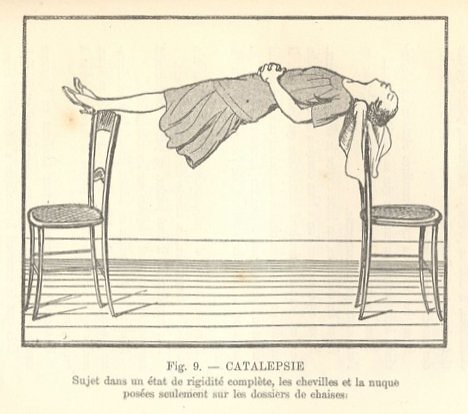
I’ve just found pages from a 1941 French hypnotism manual on the (tastefully NSFW) Au carrefour √©trange blog that has some wonderful illustrations of hypnotism ‘in action’.

A few are particularly curious because they seem to be directly mimicking famous images of hysteria from the 1800s.

Hysteria is the presence of neurological symptoms without any detectable neurological damage that could account for it (see previous) and the top image on the right is taken from a late 1800s book ‘Lectures on the Diseases of the Nervous System’ by Jean-Martin Charcot who argued that patients with hysterical epilepsy can show this type of body posture he called the ‘Grande Hysterie Full Arch’.

It’s an iconic image and can be seen to the left of the famous painting entitled ‘A Clinical Lesson with Doctor Charcot at the Salp√™tri√®re’ by Andr√© Brouillet that Freud had hung above his couch. You can still see it there in fact, in Freud’s old house, now the Freud Museum in London.

The image below is taken from the 1941 French hypnotism manual. In fact, all the images of the woman mimic Charcot’s famous photos or drawings of hysterical patients.

For example, here’s the Charcot original of a woman between two chairs, and here’s the image from the manuel d’hypnotisme.

Unfortunately, the Au carrefour √©trange website doesn’t have text from the book, but the images suggest that it is encouraging practitioners to simulate these famous poses.

Interestingly, Charcot was the first to suggest that hypnotism and hysteria may rely on similar neurological and psychological processes owing to the fact that it is possible to temporarily simulate hysteria with hypnosis.

Over 100 years later, there is growing evidence that this is the case, as neuroimaging studies have shown that hysterial paralysis and hypnotically-induced paralysis activate remarkably similar brain areas.

However, his classifications of the different body postures of hysteria are now thought to useless, and likely caused by Charcot’s own suggestions to his patients.

The pages from the hypnotism book are on a site with tasteful but NSFW images, so be cautious at work, or be ready with your excuse about a historical interest in Charcot.

UPDATE: The same blog has images from another French hypnotism book called Nouveau cours pratique d’hypnotisme et de suggestion from 1929. Dig that cover!

Link to pages of ‘Manuel pratique d’hypnotisme’ (via MorbidAnatomy).

The cutting edge of robotics

Singularity Hub has reviewed the best commercial and research lab robots from 2008 and has videos of each and every one.

It’s a fantastic collection that has everything from exoskeletons, to violin playing humanoids, to ultra-lightweight robots that fly by flapping gossamer-thin wings.

The most curious is probably the robot self-reassembling chair or maybe the robo-shapes from the ISI Polymorphic Robotics Laboratory.

Anyway, a fascinating collection and great to see how AI and mechanical engineering are being applied to create the latest in cutting-edge robotics.

Link to ‘A Review of the Best Robots of 2008’ videos.

The shock of the few

Monsters existed in the 1800s. They were not mythical creatures, but children born with birth defects who were widely discussed in the medical literature and sometimes cruelly paraded in the travelling freak shows of the time. Curiously, one of the most popular explanations for these congenital deformities concerned the psychology of the expectant mother.

If you had asked a 19th century doctor why some children were born with unusual bodies, or even fairly common birthmarks, you might have been told that they were caused by a frightening incident experienced by the mother during pregnancy.

The theory, known as ‘maternal impression‘, suggested the trauma could symbolically imprint itself on the foetus. The 1896 book Anomalies and Curiosities of Medicine described many such cases in their chapter on obstetric anomalies, and this is a fairly typical example:

Parvin mentions an instance of the influence of maternal impression in the causation of a large, vivid, red mark or splotch on the face: “When the mother was in Ireland she was badly frightened by a fire in which some cattle were burned. Again, during the early months of her pregnancy she was frightened by seeing another woman suddenly light the fire with kerosene, and at that time became firmly impressed with the idea that her child would be marked.’

In another case history, a child with hydrocephalus with a “small and rabbit-shaped” face and deformed eyes is explained by the fact that a rabbit jumped at its mother during pregnancy where she was frightened by its ‘glare’.

Perhaps one of the most curious cases was published in 1817 and concerned a recalcitrant father who denied being responsible for an unwanted pregnancy, causing the mother a great deal of distress. The child was later born, reportedly with the name of date of birth of his father clearly visible in his eyes.

This is a curious mirror of the first, probably mythical, case of maternal impression, where Hippocrates reportedly saved the honour of an adulterous princess by explaining her dark skinned child as due to her having a portrait of a ‘negro’ in her room.

Although the theory enjoyed a long and colourful life, it peacefully passed away in the late 19th century when it became clear that the mind of the mother had no influence on birthmarks or congenital deformities.

For many years the psychological state of the expectant mother was thought to have virtually no effect on the developing child.

But then the Soviet Union invaded Finland in 1939, and that all began to change.

The quickly assembled Finnish force was vastly outnumbered and ominously outgunned but, unlike their Soviet counterparts, they were quick and comfortable in the Artic conditions and made swift and deadly attacks.

In one of history’s great military victories, they defeated the Russians but suffered heavy losses. Many of the dead were young men, and many of the grieving were young pregnant women.

Nearly 40 years later, two Finnish psychiatrists decided to look at the mental health of the children who grew up without fathers. They compared children born to women who grieved during pregnancy, to those born to women who lost their husbands after the child had been born.

Their study, published in 1978, found that mothers who had lost their husbands during pregnancy were much more likely to have children who later developed schizophrenia.

Many similar studies have found that severe maternal stress during pregnancy affects the developing brain of the child, increasing the risk of cognitive or psychiatric problems later in life, possibly due to the effect of the hormonal response of the hypothalamo-pituitary-adrenal (HPA) system.

Thankfully, we no longer think of people as monsters, whatever their size, shape or mental state, and we have long banished the monstrous myths of ‘maternal impression’.

But we do know that the mind of the mother is connected to the development of the unborn baby, and that maternal experiences can still echo through the life of the child.

Cocaine nights, moral relativism, orgasms and gangs

BBC Radio 4’s wonderfully eclectic and vastly under-rated social science programme Thinking Allowed has had some fascinating programmes lately, covering the concern of ‘cocaine girls’ in 1915 London, the history of the orgasm, moral relativism, gang culture, the social meaning of scents and the culture of detectives, to mention just a few of the topics.

The programme is a mixture of social history and the latest in sociology research on contemporary issues that looks at the most amazingly diverse range of issues.

Although there are no mp3 downloads, you can listen to all of the programmes online as streamed audio.

Some of my recent favourites have included an exploration of the social panic about the cocaine scene in 1915 London, evidence for the existence of ‘gang culture’ in the UK and the psychology of the police interviews but you’ll find discussions on pretty much anything you can think of (and probably plenty you’d never have thought about before) in the archive.

Some of the most interesting points relate to how our concerns of ‘new threats’ to society, for example the influence of popular culture or new technology, are old acquaintances but are presented as new by every generation.

Other interesting programmes often reveal a new angle to something I’d never considered. The programme on the sociology of smell discusses the ‘language’ of scents and perfumes. It asks why we think some scents are ‘feminine’ or ‘masculine’ and how have we come to associate certain smells with specific social meanings.

Link to Thinking Allowed website and archive.

Encephalon 62 – the straight dope

The 62nd edition of the Encephalon psychology and neuroscience writing carnival has just appeared on The Mouse Trap as a remarkably well-written guide to the latest in the last fortnight’s online mind and brain discussions.

A couple of my favourites include a nuanced look at the neurobiology and culture of addiction from Neurophilosophy and a look at a recent study on the psychological effects of the first human face transplant from Brain Blogger.

There are plenty of other great articles in this latest edition, all enthusiastically presented by Sandy’s engaging write-up.

Link to Encephalon 62.