When the ship goes down

The New York Times covers a new study on the co-operative behaviour of passengers when two famous sea-faring passenger liners sunk: the Lusitania sank fast, leading to every-man-for-themself type escape behaviour, whereas the Titanic took almost three hours to sink, meaning women and children were given priority and rank and social class were respected.

It reminds me of a famous, if not somewhat disheartening, study [pdf] on the predictors of survival after air crashes that was covered by Mary Roach’s brilliant book on dead bodies, Stiff. From p87:

Here is the secret to surviving one of these crashes: Be male. In a 1970 Civil Aeromedical institute study of three crashes involving emergency evacuations, the most prominent factor influencing survival was gender (followed closely by proximity to exit). Adult males were by far the most likely to get out alive. Why? Presumably because they pushed everyone else out of the way.

Link to NYT piece on sinking study.
Link to summary of scientific study.
pdf of air crash report.

Touch me

Photo by Flickr user lintmachine. Click for sourceThe New York Times has an interesting short article on psychology studies that have looked at the emotional influence of brief touches.

The evidence that such messages can lead to clear, almost immediate changes in how people think and behave is accumulating fast. Students who received a supportive touch on the back or arm from a teacher were nearly twice as likely to volunteer in class as those who did not, studies have found. A sympathetic touch from a doctor leaves people with the impression that the visit lasted twice as long, compared with estimates from people who were untouched. Research by Tiffany Field of the Touch Research Institute in Miami has found that a massage from a loved one can not only ease pain but also soothe depression and strengthen a relationship.

In a series of experiments led by Matthew Hertenstein, a psychologist at DePauw University in Indiana, volunteers tried to communicate a list of emotions by touching a blindfolded stranger. The participants were able to communicate eight distinct emotions, from gratitude to disgust to love, some with about 70 percent accuracy.

“We used to think that touch only served to intensify communicated emotions,” Dr. Hertenstein said. Now it turns out to be “a much more differentiated signaling system than we had imagined.”

The piece goes to to discuss research on sports team success and touch but it misses out one of my favourites studies in the area, that we covered back in 2007.

It found that a light touch on the arm increased the chances that a male research assistant would persuade a woman in a nightclub to dance with him, or to swap phone numbers.

UPDATE: Christian just sent me this study finding that a light touch from a doctor encourages patients to take medication properly:

Although the positive effect of touch on compliance has been widely found in the literature, a new evaluation has been carried out in a health setting. Four general practitioners were instructed to slightly touch (or not) their adult patients who suffered from a pharyngitis when they asked them for a verbal promise to take the prescribed antibiotic medication. One week later, patients were solicited at home to evaluate the number of tablets that were taken. Greater medication compliance was found in the touch condition.

Link to NYT piece on the psychology of touch.

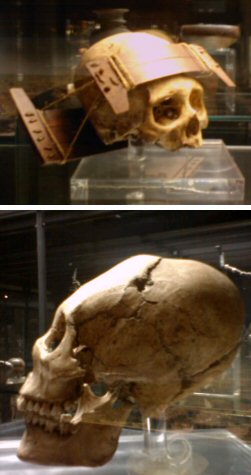
Decorative skull reshaping

Intentional reshaping of the skull during childhood has been reported from all over the ancient world but it seemed to be most popular among the peoples who lived in the Andes before the Spanish conquistadores arrived. On the left you can see two examples I found this morning in the national museum of the Banco Central del Ecuador, one of Quito’s largest archaeological museums.

The pictures aren’t the best as they were taken with my second-rate mobile phone camera, but click if you want a larger version.

These are skulls from the Machililla culture that dates from around 1,600 – 800 BC, although the practice was widespread.

Unfortunately, it seems not much has been written on the practice, but there is one excellent article 2005 that was published in the journal Child’s Nervous System.

As the article notes, the practice was typically used to denote group membership or to indicate social class:

In large and complex societies, a uniform head shape reflected that the individuals belonged to the same or similar group. In smaller, less complex societies head shape demarcated group differences. The Indians in Oruro—in what is now Bolivia—serve as an example of what happened in small societies, where cranial shaping was used for cast differentiation: high-class Indians had tabular erect heads, the middle class had tabular oblique heads, and the rest of the people had ring-shaped heads.

In the Muisca culture, in Colombia, intentional cranial deformation was a sign of hierarchy, performed only in the high classes: it was a sign of social status like clothes, accessories, funeral ceremonies, and tombs. In certain pre-Columbine cultures like the Caribe Indians in Colombia, the Aymaras in Bolivia, and the Patagones in Argentina, cranial deformation was performed only on men and it was an important factor for becoming a member of the ldquowarrior classrdquo. In Borneo and on the European continent, head-shaping was performed only on women with an aesthetic purpose. Among the Calchaquí Indians in the north of Argentina, in the Philippines, and in the Celebes islands, head-shaping was performed on both sexes.

Some ancient writings linked the purpose of this practice to the intention by certain populations to dominate other people. According to Santa Cruz Pachacuti, the Inca leaders Manco Capac and Lrsquooke Yupanki ordered the heads of the newborn Aymara Indians to be tightly squeezed to make them foolish, unintelligent, and obedient. However, studies of indigenous groups who practiced cranial deformation in newborns, such as the British Columbian Indians or the Amazonian natives, did not find evidence of any neurological or psychological impairment.

The article also notes that the method used above, compression of the head using boards, was not the only method.

Two other methods were widely used that are illustrated on the right.

One involved tightly wrapping the head with a binding that was progressively adjusted, and the other required the child to be restrained against a portable cradle-board that had an additional plank that would push down on the skull.

Link to locked article on skull deformation in Andean people.

Shimmering madness

There is an amazing blog, called either ru_medart or something I don’t understand in Russian, that collects artistic depictions of the mad from the history of art.

It’s a wonderful collection of images, and, as you might expect, many of the pictures depict the sort of ‘raving madness’ that was the stereotype of centuries past.

However, it also has portraits of famous people throughout history who have been mad or have been claimed as mad, as well as some more contemporary paintings and some wonderful illustrations of ‘hysterics’ from Charcot’s clinic at the Salp√™tri√®re in Paris.

The only obvious omissions are the paintings of Théodore Géricault who painted a series of 10 portraits of asylum patients in an attempt to capture the essence of madness, partly based on the belief that it was reflected in the physical features of the body.

The image on the right is of an absolutely stunning piece called ‘Shimmering Madness’ by the American artist Sandy Skoglund, made with jelly beans, wood, plastic, metal and motors. It looks stunning as an image but to see it in all it’s glory you really need to watch the short movie, and believe me, it is amazing.

Link to madness in art blog (via BoingBoing).

Seeing red, feeling hot, realising nothing

Photo by Flickr user Thomas Hawk. Click for sourceSeeing red leads men to view women as more attractive and more desirable despite them not being aware of any change in their perceptions. A delightful study from last year that, as the authors note, has ‘clear practical implications’!

Romantic red: red enhances men’s attraction to women.

J Pers Soc Psychol. 2008 Nov;95(5):1150-64.

Elliot AJ, Niesta D.

In many nonhuman primates, the color red enhances males’ attraction to females. In 5 experiments, the authors demonstrate a parallel effect in humans: Red, relative to other achromatic and chromatic colors, leads men to view women as more attractive and more sexually desirable. Men seem unaware of this red effect, and red does not influence women’s perceptions of the attractiveness of other women, nor men’s perceptions of women’s overall likeability, kindness, or intelligence. The findings have clear practical implications for men and women in the mating game and, perhaps, for fashion consultants, product designers, and marketers. Furthermore, the findings document the value of extending research on signal coloration to humans and of considering color as something of a common language, both within and across species.

pdf of full text of study.
Link to PubMed entry for study.

The evolution of death and dying

The New Yorker has a wonderful article on the psychology of death and dying which is carefully woven into the curious life story of psychiatrist Elisabeth Kübler-Ross, the originator of the ‘stage’ model of grief.

If you only read one popular article on grief, you’d do a lot worse than reading this carefully researched and sensitively written piece which journeys through both the social and cultural rituals of dying and how psychological theories have changed over the years.

It also tackles the fascinating life of Elisabeth Kübler-Ross who was responsible for the influential but now discredited ‘stage’ model that suggested that both dying and grieving people experience denial, anger, bargaining, depression and acceptance.

Subsequent studies have not supported these stages but Kübler-Ross was a pioneer in encouraging clinicians to address death with their gravely ill patients and her first book, On Death and Dying, opened up the practice of bereavement counselling for people who feel they need help coming to terms with their own death or the loss of loved-ones.

Kübler-Ross later became interested in a range of, it must be said, fairly flaky practices, such as mediumship and ‘channelling’ the dead, and she fell out of favour with the medical mainstream.

Late in life, she was disabled by a stroke and had a great deal of trouble coming to terms with her own mortality although the experience helped her write her final and widely regarded book, On Grief and Grieving, where she reflects on her own death and her life’s work.

The New Yorker article looks at Kübler-Ross’ legacy, but much more than that, examines a great deal of what we know about the process and how it is being integrated into modern medicine. Highly recommended.

 
Link to New Yorker article ‘Good Grief’ (via @mocost).

Lost in frustration

Photo by Flickr user honikum. Click for sourceNew Scientist has a piece on culture and psychological distress by Ethan Watters, the same chap who wrote the recent and widely discussed New York Times article on the ‘globalisation of mental illness’. This new article looks at similar territory but also pulls out some examples of where concepts and symptoms don’t translate well between different societies.

The meaning matters as much as the event,” says Ken Miller, a psychologist at Pomona College, Claremont, California, who studied in Afghanistan and elsewhere the reactions to war trauma.

He found many psychological reactions that were not on any western PTSD symptom list, and a few with no ready translation into English. In Afghanistan, for example, there was asabi, a type of nervous anger, and fishar-e-bala, the sensation of agitation or pressure.

Giathra Fernando, a psychologist at California State University, Los Angeles, also found culturally distinct psychological reactions to trauma in post-tsunami Sri Lanka. By and large, Sri Lankans didn’t report pathological reactions in line with the internal states making up most of the west’s PTSD checklist (hyperarousal, emotional numbing and the like). Rather, they tended to see the negative consequences of tragic events in terms of damage to social relationships. Fernando’s research showed the people who continued to suffer were those who had become isolated from their social network or who were not fulfilling their role in kinship groups. Thus Sri Lankans conceived the tsunami damage as occurring not inside their minds but outside, in the social environment.

It’s probably worth mentioning that this goes both ways and there are many everyday psychological concepts in English and Western society that don’t translate well into other languages.

Some of these become obvious when you read studies that have attempted to translate questionnaires originally in English into other languages.

For example, here’s an excerpt from a study that translated a mental health questionnaire from the World Health Organisation into Urdu:

This item [“Do you have trouble thinking clearly?”] presented considerable problems in translation. It measures the disturbance in concentration and cognition associated with depressive disorders. We could not find an exact substitute for the term, “clear thinking” in colloquial Urdu, and the nearest semantic and technically equivalent term that was acceptable in back translation was “wazay soch bichar”

Unfortunately, it doesn’t say what ‘wazay soch bichar’ is in English, so if you’re an Urdu speaker do get in touch as I’d love to find out.

It’s also often the case that words such as ‘anxiety’ may have a related word in another language but the sensations associated with it are not the same.

The New Scientist piece, taken from a forthcoming book by Watters, argues that Western concepts are now being exported around the world and local people are increasingly describing mental and social distress in terms of Western, and particularly, American, diagnoses.

UPDATE: Many thanks to Mind Hacks reader Matt for getting in touch with the translation:

i have a translation of ‘wazay soch bichar’ for you. my colleague nasir says the literal translation of it is ‘obvious thinking’ and agrees there is no direct translation of ‘thinking clearly’ in urdu and that ‘wasay….’ is the best available.

Link to ‘How the US exports its mental illnesses’.

You’ve got mail…

A curious case of a woman who believed she was receiving email directly into her body near to where a diamond teddy bear was residing, published in the International Journal of Geriatric Psychiatry:

We report the case of an elderly lady with no experience of using a personal computer or internet technology, whose delusional experiences included the direct personal receipt of email. Ms T, an 84-year old female with a 40-year history of schizoaffective disorder, presented with a delusional belief that something precious and of value ‘for all people’ had been inserted into her body by a doctor in Germany in the 1950s.

She had sought medical help because she believed that an abdominal operative procedure would be necessary to remove a ‘‘rat and a teddy bear made of diamonds’’ that she believed had grown within her. Following admission, she remained highly guarded, distressed and preoccupied with the need of urgent surgery, which she demanded every time she met her medical team.

When asked about the origins of this belief and her desire for surgery, she said that she had gained knowledge about this from a friend, whom she had seen last in 1945. She explained that she received emails from this friend. These arrived in her mind, exactly like electronic mail, but were managed without a computer. Rather than receiving messages in text form, she received what she described as ‘an impression in my mind’, which conveyed an unequivocal meaning to her.

She also believed that her friend had some valuable information for the medical team and that he would be able to contact the senior physician by a similar mechanism. Following 4 weeks of treatment with risperidone 1.0 mg bd her mental state improved to the point where she stopped receiving the emails, gained insight into her primary belief and told us that she was satisfied that surgery was no longer needed.

Link to PubMed entry for case study.

Bragging for beginners

The BPS Research Digest covers an interesting study on the perception of boasting, looking at whether there are specific contexts in which bragging actually leads people to think more highly of you and whether there are those where people end up thinking you’re a bit of an arse.

It turns out, there are. Participants were asked to rate the character and personality of a chap called ‘Avi’ who boasted about his A grade exam performance in a number of scenarios. The results showed that bragging only had the desired effect when someone else brought up the subject that Avi wanted to boast about:

The crux of it: context is everything when it comes to boasting. If Avi’s friend raised the topic of the exams, Avi received favourable ratings in terms of his boastfulness and likeability, regardless of whether he was actually asked what grade he got. By contrast, if Avi raised the topic of the exams, but failed to provoke a question, then his likeability suffered and he was seen as more of a boaster.

In other words, to pull off a successful boast, you need it to be appropriate to the conversation. If your friend, colleague, or date raises the topic, you can go ahead and pull a relevant boast in safety. Alternatively, if you’re forced to turn the conversation onto the required topic then you must succeed in provoking a question from your conversation partner. If there’s no question and you raised the topic then any boast you make will leave you looking like a big-head.

I was interested that the study was from Israel and wondered how well the results apply to other countries.

I’ve informally noticed that the social acceptability of ‘talking oneself up’ varies greatly between countries – from the USA, where moderate self-praise is standard social currency, to the UK, where it is only acceptable when followed by a self-deprecating comment or joke, to Sweden where it is only acceptable when one is threatened by armed men or the future of the world hangs in the balance.

However, I’ve not been able to track down any studies on the topic, so I’m not sure how well my observations reflect the wider world.

Link to BPSRD on bragging study.
Link to DOI entry and abstract of study.

Fighting fatigue

Photo by Flickr user ashley rose. Click for sourceChronic fatigue syndrome (CFS) makes people angry. Not so much the condition itself, which is associated with diffuse body pain, persistent tiredness and loss of concentration, but the science around it. After an American team announced last year that they had found a novel virus in 68 of 101 CFS patients, a UK team just reported that they failed to find the virus in any of the 186 patients they studied. Knives have already been drawn in the latest round of a long-running battle.

To understand why this is such an emotive issue, you need to get a handle on some key issues.

The first is that there is a heated debate as to the causes of the condition. On one pole of the debate is a group, largely of people affected by the condition, who believe that the condition is entirely caused by a biological disruption to the body, most likely an unidentified viral infection. On the other, is a group, largely consisting of researchers, who believe that there is a significant psychological component to the illness.

This is, of course, a bit of a simplification, but it broadly captures the two main sides of the debate and if you’re not familiar with how high feelings run, let me give you an example. I was contacted by one CFS researcher wanting a copy of a paper I wrote on extreme communities because their family was under police protection following death threats, subsequent to a public suggestion that psychology might play a part in the condition.

The emotion is fuelled by the common, insidious but wrong-headed notion that any condition that is influenced by mental states is not a ‘real illness’ and the widespread prejudice that individuals are more to blame for psychological problems because psychology is perceived as being just a matter of ‘changing your mind’.

There is a mountain of research to show that both of these claims are plainly ridiculous and psychology is likely important in all illness, but perhaps the clearest example is the placebo effect. You can’t just ‘decide’ to better but the placebo effect has been shown to improve the symptoms of almost any illness your care to think of, albeit to differing degrees.

But people affected by CFS are often on the sharp end of these prejudices and it is not uncommon that they have had the experience of someone telling them they are ‘putting it on’ or ‘aren’t trying hard enough’. When you are disabled to the point of immobilisation, this is pretty hard to take.

So it is not surprising that many are drawn to the exclusive ‘viral infection’ explanation, because it proves the idiots wrong, even if it does so using the opposite side of the same coin – prejudice about what constitute a ‘real illness’.

Proponents of the idea that the condition is influenced by psychology, including beliefs about its effects, behaviour patterns and perceptions of how the body is reacting, note that numerous controlled studies have found that a psychological approach, in the form of a cognitive behavioural therapy (CBT), is one of the most effective, if not the most effective treatment. Despite this, it is often rated as one of the least preferred among patients groups.

Into this hot button debate steps an American team who found evidence for the little understood retrovirus XMRV in about two thirds of patients with CFS. Proponents of the ‘viral theory’ rejoiced and the study made headline news around the world.

Considering the potential importance of the findings, a UK team then attempted to see if they could detect XMRV in British CFS patients. It has widely been described as a ‘replication’ of the original study in the media, but it really isn’t, as the team used a different, although still reliable ways of looking for the virus, while attempting to make improvements in lab management to reduce the chances of cross contamination and detecting false positives.

They found nothing in any of the 186 patients they studied. No sign of the virus at all. The research was published in PLoS One and if you want a flavor of the feeling the research has generated, take a look at the ratings and comments on the article since it was published earlier today. You can almost feel the anger simmering through.

From an outsider’s perspective, it’s interesting to see how CFS is considered by many to be a single condition that must have a single cause. But in reality, the diagnosis is just made on a collection of symptoms – tiredness, pain, impaired mental abilities and so on.

These symptoms are interesting because they occur in a whole range of conditions: in diabetes, after concussion, after a viral infection, after any of stroke, brain injury or Parkinson’s disease, alongside a range of mental illnesses, and so on.

In other words, there is unlikely to be a single cause for CFS, because the same symptoms can be caused by any number of underlying problems. The reason that CFS isn’t diagnosed in all these other cases is because it is a diagnosis of exclusion – in other words, by definition, if you can’t find a clear cause, the symptoms are labelled as CFS. However, it doesn’t follow that all current cases of CFS will therefore by accounted by a single, currently unknown, problem.

I wouldn’t be surprised if some cases of CFS are triggered by an unknown viral infection, but to think that this is the sole explanation is likely to be missing the bigger picture.

Similarly, to deny a psychological component to any medical condition risks denying a useful tool to help those who need it most. As an illustration, surgeons now widely recognise that psychological factors are essential to the long-term success of a transplant.

You would be hard pressed to find a more ‘physical’ condition and yet psychology plays a key role. But to promote the importance of thinking about the role of our own minds in how disability affects us, be with transplants or CFS, we need to fight the prejudice associated with mental explanations.

Link to PubMed entry for US study on the XMRV virus and CFS.
Link to UK CFS study in PLoS One.

Full disclosure: I’m an unpaid member of the PLoS One editorial board.

Personals from psychologists

Photo by Flickr user _Dano. Click for sourceAdverts from psychologists in the Personals section of the New York Magazine.

Marriage-Minded Jewish Doctor – Successful. 43-year-old behavioral psychologist and entrepreneur. I’m 5’11”, slim, considered handsome, and have many diversified social and cultural interests. More importantly, others judge me to be warm, sensitive, romantic, altruistic and capable of great love and devotion. I’d love to hear from you if you are a highly educated, emotionally mature woman, interested in a relationship leading to marriage. 9896

Slender, Dark-Haired, Very Pretty – Bright, funny psychologist, young 37, blues and jazz fan, seeks witty, sane, attractive man, 30-45. NYM M182

Your Mother’s Dream: 28, handsome, caring Jewish psychologist. Into Jazz, arts, sports. Seeks and interesting attractive woman. Photo/phone. NYM H108

Dynamic, Attractive Psychologist – Seeks secure Jewish man: 30’s. Be sincere, successful and witty. Enjoy NYC and nature. Bio/photo/phone. NYM S910

Tall, Slender, Attractive – Intelligent Black woman, 36, PhD psychologist, seeks warm, emotionally mature, active, successful, professional man, 30-46. Nationality unimportant. Please send letter, photo, phone. NYM B395

Affectionate, Attractive, Caring – Older NJ psychologist seeks attractive woman for a loving, enduring relationship. Please include photo and phone. NYM B341

Beautiful, Slim Jewish Divorcee – 45, successful female media psychologist with private practice, seeks male with usual demographics – but believes in chemistry above all. 9778

Handsome Psychologist – Sincere, down-to-earth, looking for bright attractive woman, 30-45. Photo. 4338

Very Attractive Single Woman – Psychologist / writer, seeks leftist man who is fit, funny and fortyish. NYM P036

Tanglewood anyone? – Lovely picnic, Boston Symphony… Engaging, cheeky LI psychologist, pretty, trim, 60s, understated, seeks like male. 5209

Woman Psychologist – 37, blond, sexy, great sense of humor, optimistic, love to cook and loves the outdoors, down-to-earth, voracious reader, whimsical. I am looking for a sensitive, sexy, successful, witty, generous, smart, kind man who wants an intimate relationship. If this is you, please send a note. 8477

True Romance – Desired by psychologist 44, 5’7″, brown hair, serious artist – with pretty woman, intelligent, passionate, self-reliant, beautiful eyes, sexy smile, any race or age. Please write. 6806

Sensual-Spirited Psychologist – 40something, 5’5″ brunette seeks handsome, humorous, honest professional with strong Jewish consciousness, family values and love of the arts – for joyful, marriage-minded relationship. 4148

Slim Pretty, Jewish Widow – Psychologist, 48; strong cultural interests, liberal politics. Enjoys country, beach. Intelligent, sensitive, emotionally stable woman seeks make counterpart to share life. Photo?/bio/phone. NYM G404

Attractive Psychologist, Male – 38, warm, funny, smart and successful would like to meet a truly beautiful woman (both inside and outside) under 34. Photo much appreciated. NYM G423

Successful Male, PhD, Psychologist – 41, 5’10”, slim, warm, caring, sensitive, health conscious, non-smoker, Jewish (not religious). Seeks vivacious, tender, professionally accomplished woman with depth and emotional resources open to becoming best friend/lover/wife. NYM V320

Pretty School Psychologist – Caring, slim, Jewish woman, 36, with zest for the outdoors, seeks thoughtful, active, attractive, professional man, 35-45, for long-term. Note/photo please. 8624

“How But In Custom – And in ceremony are innocence and beauty born?” Jewish psychologist, 36, bright, verbal, attractive, a lover of Yeats, seeks man with romantic heart and high values. NYM K142

Send No Photo – Warm, loving, attractive, sexy psychologist, mother, 47, seeks professional man, 45-58, who values honesty, closeness, simple pleasures. Appreciate meaningful reply. NYM R372

Going gently

The New York Times has an sensitive and in-depth article about the difficult decision to administer strong sedative drugs to terminally ill patients to ease their suffering at the expensive of potentially quickening their death.

It is, in all but one respect, a very good article, however it does contain a monumentally stupid paragraph:

For pain, the guidelines list opioid drugs, including morphine, methadone and fentanyl.

Doctors say that other drugs used for sedation are ketamine, an anesthetic and sedative popular at rave parties, and propofol, an anesthetic, which was ruled, with lorazepam, to have caused Michael Jackson’s death. In very high doses, sodium thiopental is used as a sedative in the three-drug combination used for lethal injections.

You could link almost any drug (or indeed, any substance – table salt – for example) to some nefarious use or lethal outcome. In fact, some of the most demonised street drugs – heroin and cocaine – have common and legitimate medical uses.

Medicine is always a case of balancing the positive and negatives of any treatment for the benefit of the patient. Context-less examples tell us nothing about this balance.

Other than that, the article is very good and really gets to the core of why end-of-life sedation is such as difficult topic, both emotionally and medically.

Link to NYT article ‘Hard Choice for a Comfortable Death: Sedation’.

The isolation contagion

The Boston Globe covers an interesting new study finding, seemingly paradoxically, that loneliness can be spread from person-to-person and can work its way through social networks.

The paradox is resolved by the important point, outlined by one of the study’s authors, John Cacioppo, that ‚ÄúLoneliness isn‚Äôt being alone, it‚Äôs feeling alone”. In other words, it’s not about having social contact but about feeling like you have meaningful relationships.

This feeling, it turns out, was increased or was more likely to occur when one person had contact with a person who already reported themselves to be feeling lonely.

The paper Cacioppo co-wrote with Christakis and Fowler, published in the current issue of the Journal of Personality and Social Psychology, found that having a friend who reports feeling lonely makes a person 52 percent more likely to feel lonely. In another measure, they found that, for each additional day per week a person reported feeling lonely, his friends reported an additional lonely day per month. Not only that, having a friend who has a friend who feels lonely makes a person 25 percent more likely to feel lonely, and at three degrees of separation (a friend of a friend of a friend) the odds are still increased by 15 percent…

The spread of loneliness seems to have its own particular characteristics. Women, for example, seem to be more susceptible than men. Also, the more lonely people a person knows, the more likely she herself is to become lonely. That trait distinguishes loneliness from something like alcoholism: Having an alcoholic friend increases your odds of becoming an alcoholic, but having three alcoholic friends makes you no more likely than having just one…

Distance also seems to matter to the spread of loneliness. The authors found that living close to a lonely friend was more likely to make their loneliness contagious – if the friends lived more than a mile apart there was no significant effect. This was in contrast to obesity, which, Christakis and Fowler have found, doesn‚Äôt require physical proximity to spread. In other work, the two have found that an obese friend who lives in the next state can still make you more likely to gain weight.

Not mentioned by the Globe article was the interesting finding that loneliness spreads most strongly through mutual friends but only weakly through family members.

The study, which you can read the study in full as a pdf, was drawn from data from the famous Framington Heart Study which tracked the health of a small community over many years and, rather fortuitously, asked who was related to and friends with who, initially for the purposes of tracking people down if the researchers lost contact.

Link to Boston Globe article ‘The loneliness network’.
Link to PubMed entry for loneliness study.
pdf of full text of study.

Trend setters may only be visible in rear view mirror

Photo by Flickr user victoriapeckham. Click for sourceI’ve just found this excellent Fast Company article from last year challenging the idea that there is a ‘tipping point’ in fashions or trends driven by small numbers of highly connected people who have a disproportionate influence over which new products or ideas become popular.

The piece is based on work by Duncan Watts, a physicist and sociologist, who created numerous computer simulations of how trends move through society in a similar way to how medical scientists model how diseases spread.

One study has suggested that the role of key highly influential people in starting fashions or trends is likely to have been vastly overstated. This conclusion has rattled the cages of many in the marketing world who have been focussed on identifying and targeting ‘trend setters’ for many years.

Watts set the test in motion by randomly picking one person as a trendsetter, then sat back to see if the trend would spread. He did so thousands of times in a row.

The results were deeply counterintuitive. The experiment did produce several hundred societywide infections. But in the large majority of cases, the cascade began with an average Joe (although in cases where an Influential touched off the trend, it spread much further). To stack the deck in favor of Influentials, Watts changed the simulation, making them 10 times more connected. Now they could infect 40 times more people than the average citizen (and again, when they kicked off a cascade, it was substantially larger). But the rank-and-file citizen was still far more likely to start a contagion…

Mind you, Watts does agree that some people are more instrumental than others. He simply doesn’t think it’s possible to will a trend into existence by recruiting highly social people. The network effects in society, he argues, are too complex–too weird and unpredictable–to work that way. If it were just a matter of tipping the crucial first adopters, why can’t most companies do it reliably?

As Watts points out, viral thinkers analyze trends after they’ve broken out. “They start with an existing trend, like Hush Puppies, and they go backward until they’ve identified the people who did it first, and then they go, ‘Okay, these are the Influentials!'” But who’s to say those aren’t just Watts’s accidental Influentials, random smokers who walked, unwittingly, into a dry forest? East Village hipsters were wearing lots of cool things in the fall of 1994. But, as Watts wondered, why did only Hush Puppies take off? Why didn’t their other clothing choices reach a tipping point too?

However, Watts’ work is largely based on computer simulations. These have the advantage of having to be based on very explicit well-defined descriptions of the phenomenon, which many of the more popular accounts are not, but have the disadvantage or having to include various assumptions and simplifications about what actually happens when people pass on ideas.

The Fast Company article is interesting as it looks at how some core marketing ideas are being tested by Watts, and how the public relations world is reacting to having some of their assumptions questioned.

Link to Fast Company article ‘Is the Tipping Point Toast?’

The ancient mind was planning earlier than thought

Science News covers a fascinating new archaeological study that mapped the the remains of an 750,000 year-old settlement lived in by the ancestors of the human race and found evidence for tasks being organised in different areas, suggesting a degree of intelligence and problem solving that was not thought to have arisen until much later in evolution.

The study, just published in Science, analysed the pattern of artefacts in the Gesher Benot Ya’aqov site, located in what is now Northern Israel.

Previously, only modern humans, Homo sapiens, were thought to have developed the mental capacity to organise and separate their daily tasks. However, this site was settled by hominin ancestors of the human race and shows distinct signs of planned organisation:

Daily behaviors occurred in two main parts of a rectangular living area excavated at GBY, the researchers conclude. One area hosted primarily flint-tool making and preparation of fish for eating. In another area, situated around a large hearth, residents resharpened used stone tools, fashioned new tools out of basalt and limestone, ate fish and crabs, and cracked nuts after roasting them.

Roasting allowed the inedible shells of various nuts to be easily peeled off. It also reduced levels of bitter substances, called tannins, found in acorns.

‚ÄúHominids who were responsible for the organization of space at GBY had very advanced cognitive abilities that have generally been considered an important marker of human intelligence,” Goren-Inbar says.

Many researchers have thought that the mental capacity to plan and organize living spaces around different activity areas first arose among Homo sapiens roughly 100,000 years ago, well after the species originated around 200,000 years ago.

Until now, hominid sites from before 100,000 years ago had yielded stone tools and bones of various animals but no signs of separate activity spots in common living spaces.

Link to write-up from Science News.
Link to summary of scientific study in Science.

On the soul of robots

Image by Flickr user FlySi. Click for sourceNew Scientist has an interesting article discussing research on how we attribute personality traits to robots. This is not just the human-like android from research labs, it’s the robots that are already in widespread use in the workplace and home like the floor-cleaning Roomba.

This is a fantastic snippet about a study on the commercially available Aethon TUG robot, used to deliver supplies on hospital wards, and what staff made of the machine:

TUG, which is made by Aethon, can navigate a building’s corridors and elevators on its own and tell humans it has arrived with a delivery…

The lack of any social awareness led interviewees to complain that they felt “disrespected” by the robot. “It doesn’t have the manners we teach our children,” said one, “I find it insulting that I stand out of the way for patients… but it just barrels right on.”

Luckily for TUG, its unvarying, one-size-fits-all social skills happened to be a natural fit in the relaxed atmosphere of the post-natal ward, says Mutlu. But the same default settings were interpreted as demanding and attention-seeking on the oncology ward, which is a more stressful and busy place to work. “If you are going to design robots with human-like capabilities you have to design the appropriate social behaviour that goes along with it,” Mutlu says.

This reminds me of perhaps the only study that has evaluated what personality traits people attribute to the synthetic speech on a voice mail system, rating it as practical, intelligent, courteous, efficient, straight-forward, sophisticated, methodical, progressive and alert.

Link to NewSci article ‘Learning to love to hate robots’.