Blue Monday bullshit competition

Two weeks today will be the annual ‘Blue Monday‘ bullshit festival, where Cliff Arnall and his “formula” are wheeled out in an attempt to make us believe that it tells us about the most depressing day of the year. However, Mind Hacks is running a competition that may prove a useful antedote and you can enter.

To be fair, the day is usually quite depressing, but only because we have to put up with the usual rubbish masquerading as science in the media.

The whole idea is still being pushed by a PR agency, but rather disappointingly, the respected UK charity the Mental Health Foundation have seemingly shelled out hard cash for [see update below] the dubious pleasure of using the opportunity to try and promote mental well-being.

Promoting mental health is, of course, a fantastic idea, but using utter gibberish and pseudoscience to do so is like trying to promote a healthy diet by telling people that apples are particularly bad for us on certain days.

So, to help cheer us all up we want you to come up with a formula that describes what total bullshit these formulas are.

Be creative. As with the original formula, don’t feel you have to be chained by the laws of maths, or even logic.

The most creative entry will win a prize. Sent to you where ever you are in the world.

Be careful not to say nasty things about Mr Arnall himself, rumour has it has he a tendency to threaten legal action against people who say things that could be interpreted as casting aspersions on him directly, although it would be perfectly acceptable to point out that his formula is utter nonsense.

You can either include your entry as a comment to this post, post them to your own blog and send us a link, or email me directly via this web form.

Not only will you be helping the public understanding of science through sarcasm, you could win a prize and get featured on Mind Hacks.

We will print the best entries a few days before the date itself.

The game is afoot!

UPDATE Green Communications commented on a later entry to say that the Mental Health Foundation has not paid for this publicity campaign and that it is being completed on a non-commercial basis.

Acquiring a natural edge

Photo by stock.xchng user tucci. Click for sourceThe Boston Globe has an interesting article on how we interact with urban environments and discusses research suggesting that contact with nature has significant cognitive benefits.

It’s a fascinating article that touches on studies that have found a range of benefits for having contact with a natural environment:

Studies have demonstrated, for instance, that hospital patients recover more quickly when they can see trees from their windows, and that women living in public housing are better able to focus when their apartment overlooks a grassy courtyard…

City life can also lead to loss of emotional control. Kuo and her colleagues found less domestic violence in the apartments with views of greenery. These data build on earlier work that demonstrated how aspects of the urban environment, such as crowding and unpredictable noise, can also lead to increased levels of aggression.

It does, however, contain one misreading that suggests that urban environments blunt our mental sharpness, based on a recent study led by psychologist Marc Berman.

The study actually found that a walk in an urban environment had no significant effect on our mental abilities, although a walk in a natural environment improved them.

Each of these changes was measured relative to an initial assessment conducted indoors and the same pattern emerged when participants just viewed pictures or natural or urban environments.

As far as I know, there is no evidence that urban environments have a negative impact on our cognitive abilities. Comment or get in touch if you know otherwise.

However, we do know that living in an urban environment is one of the most reliable and important environmental risk factors for the development of schizophrenia.

It’s not clear exactly what it is about urban living that raises the risk, although there’s a good commentary by psychiatrist Jim van Os that discusses some of the current explanations.

Link to Boston Globe article on urban impact.
Link to study on the cognitive benefits of interacting with nature.
Link to DOI entry for same.

Mind Bites

Mind Bites is a beautiful photography project by artist Will Lion which combines striking images with quotes from cognitive science research.

You can either view it as a Flickr photo set or as an interactive Flash gallery.

The image on the left is one of the more abstract pictures, but the full range contains everything from portraits, to landscapes, to still life photos – with the research quotes taken from studies on memory to hormonal influence on the earnings of lap dancers.

I can’t help thinking these would make great pictures to have in a psychology department which are usually adorned with faded conference posters and dull oil paintings.

The full set of Will Lion’s ‘Mind Bites’ project is both visually engaging and thought-provoking which is the essence of much great art.

Link to images as Flickr photo set.
Link to Mind Bites as interactive Flash gallery.

A very rough guide to highlights of 2008

A not very thorough list of my personal 2008 highlights in mind and brain news, dredged from my memory and reproduced for your reading pleasure:

Funniest (unintentional)
USA Today publishing an alarmist story about ‘digital drugs’ that can, according to the article, mimic the effects of alcohol, marijuana, LSD, crack, heroin, sex, heaven and hell. Sadly not true, although hilarious to read.

Funniest (intentional)
The Web Therapy web series staring Lisa Kudrow as an incompetent psychologist. Wonderfully produced, cleverly satirical and very funny to boot.

Best film
The English Surgeon. A profoundly beautiful documentary about the work of London-based neurosurgeon Henry Marsh and his colleague Igor Kurilets in the Ukraine. Do not miss it. See the comments!

Best podcast / radio episode
RadioLab’s delicious programme on Orson Well’s War of the Worlds broadcast and its subsequent psychological impact. Just pure audio delightfulness.

Best video lecture
A gripping lecture at the University of California by historian Prof Alfred McCoy on the ‘psychological torture: a CIA history’.

Most interesting new concept
Brain-computer interfaces to weapons systems pose problems for the definition of a ‘war crime’ if they’re triggered preconsciously, according to an interesting analysis by lawyer Stephen White.

Most interesting interview
A tie between sociologist Harry Collins discussing his work on the social interactions of physicists and what this tells us about what we have to do to be considered an expert and what types of expertise there are, and an Neurophilosophy interview with Heather Perry who trepanned herself and is remarkably reflective about the experience.

Most useful academic article
Nikos Logothetis’ article in Nature about what fMRI is really measuring and what we can and can’t infer about the mind and brain from neuroimaging experiment.

Best example of neurobabble
The cover article on neuroscience-based management in an issue of HR Magazine which has to be read to be believed. Or maybe that’s just your basal ganglia talking.

Most tangential post
I start off talking about blond girls in t-shirts and end up talking about philosophy of mind. Actually, usually happens the other way round in real life.

Best cognitive science art project
Artificially intelligence punk rock pogo robots. Enough said.

Best random clip of TV documentary
A TV presenter is intravenously injected with differing mixtures of the active ingredients of cannabis as part of the BBC documentary Should I Smoke Dope?.

Most overdue decision
The American Psychological Association banning participation in torture. Did it really need all the fuss?

To the bunkers! Most likely to hasten the coming robot war
Pentagon requests robot packs to hunt humans. Uh huh.

The Human Terrain System, 1867

I was under the impression that the US Military’s Human Terrain System, their new band of ‘militarised’ anthropologists, was a relatively new development but I just found a fascinating article on the use of social scientists by the Russian army during their invasion and occupation of Turkestan in the 1860s.

As with the modern military project, this also generated formal academic research which has surprising echoes with the modern push to get academics involved in focused foreign policy-oriented research.

The project was the brain child of Konstantin von Kaufman (pictured), a Russian army veteran who was appointed Governor-General of the newly acquired territories of Turkestan.

Learning from failure, Konstantin von Kaufman made ethnographic knowledge ‚Äúthe core‚Äù of his administrative policies in Turkestan…

But beyond religious tolerance, von Kaufman‚Äôs ethnographic inquiry was being undertaken with the utmost enthusiasm. Geographers, linguists, ethnographers, artists, natural scientists and other social scientists were employed to carry out von Kaufman‚Äôs project…

[Modern historian Daniel] Brower goes on to describe the “flood” of scholarly and popular articles and publications on Turkestan that followed. The attempt to classify the peoples of Central Asia met with confusion as people’s identities were frequently “multiple and contradictory.” But the “real needs of Kaufman’s ethnographic project were met.” Kaufman’s influence was, despite some interruptions, a lasting policy that even influenced the Soviets’ policies in Central Asia.

The article is taken from a blog written by Christian Bleuer, a doctoral student studying the social, political and military dynamics of Afghanistan.

There’s another good post on the site directly relevant to the modern Human Terrain System, which describes the fluctuating and complex social power structures of Afghani society which makes understanding it such a challenge.

Link to piece on Russia’s ‘Human Terrain System’ of the 1860s.
Link to piece on social power structures of Afghanistan.

‘War on terror’ social science funding announced

Wired has the list of funded projects from the Pentagon’s new $50 million ‘Minerva’ programme that supports social science research intended to have a strategic benefit for the ‘war on terror’.

Named after the Roman goddess of wisdom and war, the project is part of the US Government’s increasing reliance on social science to fight the ‘war on terror’ and it comes in the wake of the controversy over its Human Terrain System.

However, a key difference is that the Human Terrain System is a team of social scientists employed by the US Army to directly assist the military with its ongoing operations, while the Minerva project funds university research.

The seven funded projects cover sociology, psychology, religious studies and political science and Wired gives brief rundown:

Susan Shirk of the University of California at San Diego. Shirk will lead a project titled “The Evolving Relationship between Technology and National Security in China: Innovation, Defense Transformation and China’s Place in the Global Technology Order.”

Arizona State Religious Studies prof Mark Woodward. His team will investigate “counter radical-Muslim discourse.” (Read Woodward’s recent commentary on the Bush shoe-throwing incident here.)

Arms control expert Patricia Lewis, who is deputy director and scientist-in-residence at the James Martin Center for Nonproliferation Studies at the Monterey Institute of International Studies. Her project will look at Iraqi perspectives on the U.S. wars in the Middle East.

Jacob Shapiro of Princeton University. Shapiro studies the organizational aspects of terrorism; his proposal was titled “Terrorism Governance and Development.”

San Francisco State University psychology prof David Matsumoto, who leads a project called “Emotion and Intergroup Relations.”

Foreign policy expert James Lindsay of the University of Texas. He is leading an investigation into the effects of climate change on state stability in Africa.

MIT’s Nazli Choucri. Her project will focus on “cyber international relations.”

Unfortunately, the announcement is a little short on details and we only have the titles so far, but the projects seem interesting at first glance as they are much more general than the typical Pentagon funded research in this area which is often highly applied and bears upon an immediate and pressing problems.

Wired notes that the Minerva project was announced, in part, to ‘heal the rift’ between the government and social scientists, some of whom have expressed their anger at the ‘militarization’ of their discipline.

Thanks to the excellent Advances in the History of Psychology for the heads-up on this.

Link to Wired’s closer look at Minerva’s funding.

Drug corruption: a rough guide

The January edition of the New York Review of Books has an excellent article on the pharmaceutical industry and the corruption of medical ethics that summarises the recent revelations of fraud, undisclosed payments, data burying and off-label promotion that pervade the industry.

The piece is by Marcia Angell, who spent 20 years as editor of the New England Journal of Medicine and is now a senior lecturer in Harvard Medical School.

Rather disappointingly, although not particularly surprisingly, is the fact that psychiatry holds pride of place in the drug company corruption and unethical dealings stakes, with the large part of the article focusing on the marketing of major psychiatric drugs.

Marketing in the pharmaceutical industry not only relates to advertising and payments to doctors – in the form of money or gifts – but also to the published research which is often specifically designed to show the drug in the best possible light, or is deliberately buried if it doesn’t.

One person who has been instrumental in uncovering some of the most recent revelations is US Senator Charles Grassley who has spent the last year digging into payments to doctors and has uncovered large undisclosed sums paid to the biggest names in psychiatry.

The New York Review of Books article is a fantastic potted guide to the whole sordid business and is well worth a read if you want an update on the latest techniques used to market psychiatric drugs.

Link to NYRB piece ‘Drug Companies & Doctors: A Story of Corruption’.

The psychosis podcast

The University of Manchester have developed a pilot of an educational podcast on psychosis and they’d like your help in evaluating it.

Their page has all the details and I won’t give you too much additional information on it here, except to say you just need to answer a brief questionnaire, listen to the podcast and give your feedback online.

It’s part of a project to provide accurate and useful information on delusions, hallucinations and their effects, as well as tips of dealing with unusual experiences if they occur.

You just need to check their page and all will be explained.

Link to Manchester Uni podcast evaluation page.

The original sex machine

New Scientist has a completely charming article on ‘Elektro‘ – the world’s first celebrity robot who wowed the crowds at the 1939 New York World’s Fair with his mechanics that produced a remarkable interactive experience for the time.

The article is by Noel Sharkey, an AI and robotics researcher, who recounts the robot’s amazing story as he moved from mechanical marvel, to forgotten relic, to museum centrepiece.

One curious part of the story is that Elektro tried the classic B-list celebrity tactic of using sex to revive a flagging career – appearing in a proto soft porn film in the 1960s.

The movie was entitled Sex Kittens Go to College, and you can see Elektro featured in the trailer. The movie is remarkable largely for the fact that it is so soft as to be completely safe for work – presumably relying on the strategy rediscovered by millions of bloggers that simply mentioning sex in the title gets attention regardless of the content (see above).

However, there’s also some great colour newsreel footage of Elektro in action at the World’s Fair and you can see how impressive he was.

The NewSci article describes some of the technology that drove Elektro. The mechanics of the ‘voice recognition’ system are a particularly inventive hack.

The incredible ingenuity of Elektro’s design was topped off by his sleek exterior. There was no remote control. Instead, the robot relied on a combination of motors, photoelectric cells, telephone relays and record players to perform 26 preprogrammed routines, each one initiated by voice commands from a human co-star. These were spoken into a telephone connected to the robot’s chest, where circuitry converted each syllable into a pulse of light and transmitted it to a photoelectric cell. A second circuit added up the syllables and triggered relays to operate the corresponding electromechanical functions: a command with three syllables, for example, would start the robot’s routine, and four syllables would stop it. As part of these routines, Elektro would raise and lower his arms, turn his head, move his mouth, count on his fingers and even smoke a cigarette and puff out smoke.

The robot could also respond to questions by using relays to switch between a bank of phonographs playing 78 rpm voice recordings that were hidden behind a curtain. This gave Elektro a vocabulary of 700 words and an extensive repertoire of banter: “I am a smart fellow as I have a very fine brain of 48 electrical relays,” he would tell the crowd. “It works just like a telephone switchboard. If I get a wrong number I can always blame the operator. And by the way, I see a lot of good numbers out in our audience today.”

Link to NewSci article on Elektro.
Link to trailer for Sex Kittens Go to College.
Link to footage of Elektro at the 1939 World’s Fair.

Neuropod on HM, brain banking and 2008 highlights

The latest Nature Neuropod podcast has just hit the wires and as is fitting for the December edition it contains a great roundup of the year’s neuroscience highlights.

There’s also a tribute to recently departed HM from neuropsychologist Susan Corkin, a visit to the UCL brain bank (check the wonderfully appropriate Hammer Horror German accent) and some interesting updates from the world of molecular neuroscience.

In the final section, Nature Neuroscience editor Charvy Narain discusses her highlights of the year in new discoveries and what better way to end the year.

Link to Neurpod page and streaming.
mp3 of December podcast.

The brand new book of human troubles

With three years still left until publication, the fights over the new version of the psychiatric diagnostic manual, the DSM-V, are hotting up and The New York Times has a concise article that covers most of the main point of contention.

“What you have in the end,” Mr. Shorter said, “is this process of sorting the deck of symptoms into syndromes, and the outcome all depends on how the cards fall.”

Psychiatrists involved in preparing the new manual contend that it is too early to say for sure which cards will be added and which dropped.

Although I doubt the DSM committee are using that exact metaphor, it certainly illustrates the point that the process requires a certain degree of value-judgement.

It’s interesting, however, that the public debate is currently focused on whether certain diagnoses should be included or not, rather than whether diagnosis itself is useful for psychiatry.

We’ve had psychometrics for a good 100 years that allow us to measure dimensions of human experience and performance with a much greater degree of accuracy than clinical diagnosis allows.

The slightly obsessive need to classify everything is both an inheritance from the infection model of disease, where one either has the pathogen or does not, and is encouraged by the US health care system, where insurance companies will only pay for treatment if it is diagnosed with an ‘official’ diagnosis.

Nevertheless, it is perfectly possible to treat someone based on continuous measures of distress, impairment and functioning using evidence-based cut-off points to judge whether a particular treatment should be applied.

In fact, many physical diseases are treated in exactly this way. The definitions of obesity, hypertension, diabetes and many others rely on an evidence-based cut-off point on a continuous scale of weight, blood pressure and blood glucose level.

There is no qualitatively different cut-and-dry distinction between just below the cut-off and just above it – it’s just the point at which outcome studies predict that other things get much worse.

So rather than questioning the process, we need also to question the system, because diagnoses are tools and we need to know when and where they are most useful.

Link to NYT ‘Psychiatrists Revise the Book of Human Troubles’.

Excessive and highly structured daydreaming

An article in press for Consciousness and Cognition reports the case of a 36 year-old woman with a long history of excessive daydreaming where she’d spent long periods of time wrapped up in a fantasy world.

Importantly, the patient has no significant signs of mental illness and can easily distinguish fantasy from reality but just gets caught up in her internal reveries.

The subject of this case report is a professionally accomplished 36-year-old female presenting with a long history of excessive and highly structured daydreaming which she states has contributed to considerable distress during periods of her life. The patient is single, does not smoke, drink or use illegal drugs, and comes from a supportive and healthy family, reporting no abuse or trauma in her history.

Her distress, though subjectively reported as significant enough to seek and continue psychiatric treatment, remains difficult for us to diagnose. The imaginative episodes and their content are experienced as neither dysphoric nor intrusive, and the patient has been rigorously assessed for contributing or comorbid symptoms of mood, anxiety, personality, schizotypal, dissociative, and attentional disorders; indeed we have monitored her for over ten years, and have employed all clinical psychiatric measures available to consistently rule out comorbidity or mental status change in her case.

We have tenuously viewed her symptoms as indicating possible features of obsessive-compulsive behavior, reflected in the prescription of 50 mg/day of fluvoxamine, an antidepressant believed to influence obsessiveness and/or compulsivity. The medication has been continued for 10 years, as the patient affirms this treatment has made her daydreaming much easier to control. She reports that occasionally the amount of time spent daydreaming will rise and she will increase her dosage of fluvoxamine briefly until it subsides…

Recently, the patient discovered a website containing a surprising number of anonymous postings on the topic of excessive or uncontrolled daydreaming. Numerous posters described patterns and tendencies that appeared remarkably consistent with the patient’s experience (including the original pacing behavior) and emphasized the stress of concealing their imaginary lives and the attendant shame, confusion, and difficulty in controlling their divided realities.

Link to case study.
Link to DOI entry for same.

Neuroscience Boot Camp

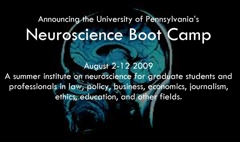
bootcampheader.jpgThe University of Pennsylvania have announced a Neuroscience Boot Camp. Over 10 days in August 2009, through “a combination of lectures, break-out groups, panel discussions and laboratory visits”, the Boot Camp promises to cover all the neuroscience you need to know to be an informed consumer of neuroscience research.

The Boot Camp is aimed at grad students and professionals from law, policy, education, business, ethics and other fields for which recent neuroscience research could be relevant. The Boot Camp is based out of Penn’s Neuroethics centre, so it is sure to be run by people who are used to thinking through the possible implications of findings from cognitive and affective neuroscience research.

Link Neuroscience Boot Camp
Link Neuroscience Boot Camp goals

The fire within

The Beautiful Mind is an online gallery of stunning neuroscience photographs, aiming to demonstrate the beauty within.

Although it’s currently an online exhibition, it will be touring Europe in 2009 and aims to promote art-science integration.

If you can suffer the shrink wrapped Flash interface, it has some wonderful images. The one featured in this post is a photo of mitochondria from astrocytes in cell culture.

Link to The Beautiful Mind exhibition (thanks Sandra!).

Human brain tissue found after two thousand years

CNN has an interesting piece on how an archaeological dig in the North of England has dug up intact human brain tissue, preserved for 2,000 years.

Rachel Cubitt, who was taking part in the dig, described how she felt something move inside the cranium as she cleaned the soil-covered skull’s outer surface. Peering through the base of the skull, she spotted an unusual yellow substance.

“It jogged my memory of a university lecture on the rare survival of ancient brain tissue. We gave the skull special conservation treatment as a result, and sought expert medical opinion,” she said in a statement on York University’s Web site.

A sophisticated CT scanner at York Hospital was then used to produce startlingly clear images of the skull’s contents.

Philip Duffey, Consultant Neurologist at the Hospital said: “I’m amazed and excited that scanning has shown structures which appear to be unequivocally of brain origin. I think that it will be very important to establish how these structures have survived, whether there are traces of biological material within them and, if not, what is their composition.”

Link to ‘Britain’s oldest human brain unearthed’ (via BoingBoing).

New Scientist neuroscience top 10 available online

New Scientist have recently made a years’ worth of articles freely available online and have compiled a list of 2008’s top 10 neuroscience articles.

There are some fantastic articles in there, my favourite being a piece on Karl Friston’s ‘unified theory of the brain’ which argues that it’s essentially a hierarchy of Bayesian probability functions. We discussed it back in May if you want a brief overview.

If you’re not sure what Bayesian probability functions are or even if you do and it sounds like a long-shot theory, have a read as it’s a thought-provoking idea.

Some of the other pieces are also well worth checking out, and includes topics such as whether autism is an exaggeration of certain otherwise normal brain function, whether the brain has built in randomness and what happens to the sleeping brain, to name but a few.

A great collection and wonderful to see NewSci opening up their archive. Good stuff.

Link to NewSci 2008 brain science top 10.